
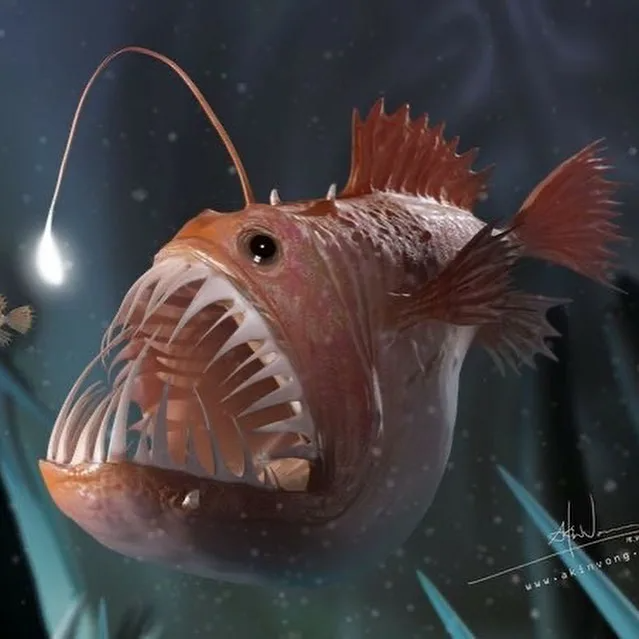
The deep-sea anglerfish is not a single species but a diverse suborder of bathypelagic fishes, Ceratioidei, containing roughly 170 described species across 11 families.
Two of those families - Ceratiidae, the warty seadevils, and Melanocetidae, the black seadevils - supply most of the familiar imagery: a massive dark-skinned predator with a cavernous mouth, transparent needle teeth, and a glowing bulb on a stalk dangling over its head. Almost everything else about these animals is stranger than the cartoon version. Males in several families are tiny parasitic appendages.
The lure is lit by borrowed bacteria, except when it is not. Entire species have been described from bodies that exploded on the way to the surface.
This guide covers every aspect of deep-sea anglerfish biology and ecology: classification, habitat, anatomy, bioluminescence, the parasitic mating system, hunting, reproduction, conservation, and how humans have slowly learned to see them alive. It is a reference entry, not a summary - expect specific depths, dimensions, taxonomic figures, and the names of the researchers who pulled these animals out of the dark.
Etymology and Classification
The name "anglerfish" comes from the fish's use of a rod-and-lure structure - the illicium tipped by an esca - to attract prey, the same basic strategy an angler with a fishing pole uses. The suborder name Ceratioidei derives from the Greek keras, meaning "horn", a reference to the projecting illicium that gives the animals their characteristic silhouette.
Ceratioidei sits inside the order Lophiiformes, which also contains shallower relatives such as goosefishes (Lophiidae), frogfishes (Antennariidae), and batfishes (Ogcocephalidae). The shallow-water lophiiforms share the core fishing-rod adaptation but lack the deep-sea specialisations that make ceratioids so famous.
Within Ceratioidei biologists recognise 11 families. The two headline families for most people are:
- Ceratiidae - the warty seadevils, including Ceratias and Cryptopsaras. Large females, globally distributed, extreme parasitic dwarfism in males.
- Melanocetidae - the black seadevils, including Melanocetus. Compact, very dark-skinned, large head relative to body, famous in natural history documentaries.
Other ceratioid families include Linophrynidae (leftvents, with some of the most extreme sexual parasitism), Himantolophidae (footballfishes), Diceratiidae (double anglers), Oneirodidae (dreamers), Gigantactinidae (whipnose anglers), Thaumatichthyidae, Centrophrynidae, Caulophrynidae, and Neoceratiidae. Each family has its own mix of body plan, lure shape, and reproductive strategy.
For this entry the representative species is Cryptopsaras couesii, the triplewart seadevil. It is widespread in all oceans between about 500 and 2,000 metres, is sexually parasitic, and was first described by Theodore Gill in 1883 from specimens trawled off the eastern United States. When biologists generalise about the family, C. couesii is often what they have in mind.
Habitat and Range
Ceratioid anglerfishes live in the midwater column - not on the seafloor - of every ocean except the Arctic Ocean and the high-latitude Southern Ocean. Their preferred habitat is the bathypelagic zone, roughly 1,000 to 4,000 metres below the surface, with many species also occupying the lower mesopelagic zone from 200 to 1,000 metres.
A few species are recorded as deep as about 4,000 metres; the deepest reliable ceratioid records sit just past this boundary. They are never true abyssal fish in the sense of sitting on the abyssal plain, though their range overlaps with that depth.
The bathypelagic world is unlike any other habitat. Key conditions include:
- No sunlight. Below roughly 1,000 metres sunlight is essentially absent. The only light is biological.
- Low temperature. Water temperature between 2 and 5 degrees Celsius across most of the ceratioid range.
- High pressure. Pressure at 2,000 metres is about 200 atmospheres. At 4,000 metres, about 400 atmospheres.
- Low food density. Midwater biomass is sparse and widely scattered; organisms can go long periods between meals.
- Uniform water mass. Temperature, salinity, and oxygen vary little over vast horizontal distances, so many species are nearly globally distributed.
The combination of darkness and low food density is the selective pressure behind most anglerfish weirdness. You cannot chase prey you cannot see. You cannot waste energy hunting in an environment where meals are rare. You cannot assume you will meet a mate during your lifetime. Everything about ceratioid biology - the lure, the distensible stomach, the parasitic male, the reduced skeleton - traces back to these three facts.
Size and Physical Description
Ceratioid anglerfishes show the most extreme sexual size dimorphism known in vertebrates. Females are large-bodied ambush predators. Males are dwarfed, in some cases to the point where they stop being recognisable as the same species.
Female size ranges (selected species):
| Species | Typical female length |
|---|---|
| Melanocetus johnsonii | 10-18 cm |
| Cryptopsaras couesii | 30-45 cm |
| Himantolophus groenlandicus | 50-60 cm |
| Ceratias holboelli | 80-120 cm |
Male size ranges:
- Free-living adult males in non-parasitic species: 1-5 cm.
- Parasitic males at attachment: 1-10 cm depending on family.
- In Ceratias holboelli the sexual size ratio can exceed 60 to 1 by length.
Beyond size, ceratioid females share a recognisable body plan. The body is short, stout, and laterally compressed in many species, rounded and almost spherical in others. The head is enormous relative to body length, dominated by a wide, upward-facing mouth hinged to swing open and take prey almost as tall as the fish itself.
Skin is usually dark brown, grey, or black - an anti-reflective coating that prevents any stray light from betraying the fish's outline to prey or predators. Many species have tiny papillae or warts across the skin, which is where the "warty seadevil" common name originates.
The defining feature is the illicium, a modified first dorsal-fin spine that projects from the snout or forehead. The illicium is mobile, muscled at its base, and tipped with the bulbous esca, the lure. Esca shape varies dramatically across families and is a primary tool for species identification: some are simple bulbs, others are branched, feathered, or hung with filaments. In Cryptopsaras couesii the name "triplewart" refers to three small caruncles behind the esca.
Teeth are long, thin, transparent, and hinged inward so that any object pushed against them slides toward the throat but cannot slide back out. The stomach wall is enormously elastic. Skeletal ossification is reduced, saving weight and energy in an environment where the fish mostly drifts rather than swims strongly.
The Glowing Lure
The esca is the most recognisable feature of the group and also one of the most sophisticated biological light sources known. In the vast majority of ceratioid species it works as a bacterial lantern.
Inside the esca is a chamber lined with host tissue and filled with a specific type of luminescent bacteria, usually from the genera Enterovibrio or Photobacterium. These are close relatives of the bacteria found in the light organs of certain shallow-water fishes and squid. They produce a steady blue-green glow through the same luciferin-luciferase biochemistry that powers most bioluminescence in the ocean.
Key facts about how the bacterial lure is set up and operated:
- The larva hatches without bacteria. It must acquire them from seawater through a tiny pore in the developing esca.
- The relationship is obligate for the fish but optional for the bacteria. The bacteria can live free; the fish cannot light the lure any other way (in most families).
- Muscles at the base of the illicium control lure motion (wave, jiggle, point).
- A shutter of pigmented tissue controls lure brightness by covering or exposing the bacterial chamber.
- The esca can be extended or retracted close to the body depending on species and situation.
In 2019 a study on members of Linophrynidae found that some ceratioid lures also contain photocytes - intrinsic light-producing cells - that generate light through the fish's own biochemistry, not via bacteria. This confirmed something deep-sea biologists had long suspected: the group uses multiple independent solutions to the same problem, and bacterial symbiosis is not the whole story.
The function of the light is straightforward. In a habitat where any movement or glow is unusual, a small steady source attracts curious animals. Small fish, shrimp, and squid swim closer to investigate. When they reach striking distance the female flexes and engulfs them in a single gulp. Some researchers suspect the lure also plays a role in mate attraction, but evidence for that is weaker than evidence for predatory use.
Sexual Parasitism - the Strangest Mating System in Vertebrates
Ceratioid anglerfishes include some of the only vertebrates that practise obligate sexual parasitism. Not every family does it. Those that do, do it completely.
In a sexually parasitic species the reproductive cycle works like this:
- Free-living male stage. A tiny male - a few centimetres long, often with oversized eyes and enormous nostrils - hatches and develops. He has no functional digestive system as an adult. His entire physiological budget is spent on finding a female before he starves, usually within weeks or a few months.
- Mate search. Males find females by scent (species-specific pheromones) and probably by sight of the lure. They swim through kilometres of empty water following chemical gradients.
- Attachment. When a male locates a female he bites onto her body - typically her belly, flank, or head. Enzymes start to break down the skin at the bite site.
- Tissue fusion. Over days the male's mouth tissue fuses with the female's skin and musculature. His circulatory system joins hers. He now receives nutrients from her bloodstream.
- Degeneration. The male's eyes, fins, teeth, and most internal organs shrink or disappear. He is reduced to a small bump on the female's body, consisting mostly of testes and a rudimentary support tissue.
- Pairing for life. The fused male remains part of the female's body for the rest of her life. When she spawns, he releases sperm in synchrony.
A single female can carry multiple attached males simultaneously. Specimens with three, four, and even eight attached males have been recorded.
The immunological puzzle is significant. Normally a vertebrate body rejects foreign tissue, which is why organ transplants need immunosuppressive drugs. Ceratioid females tolerate a living male graft permanently. A 2020 study in Science found that parasitic anglerfish have lost key genes of the adaptive immune system, including genes encoding MHC class I and II molecules.
They rely almost entirely on innate immunity. This genetic sacrifice allows the male-female fusion to persist without rejection.
Why did this system evolve at all? The best-supported explanation is encounter scarcity. In a habitat as empty as the bathypelagic zone, a male may only ever encounter one reproductively mature female in his lifetime. Giving up independent existence in exchange for permanent reproductive access is, in evolutionary accounting, a favourable trade.
Hunting and Diet
Ceratioid anglerfishes are ambush predators. They do not pursue prey. They hang in the water column, lure extended, and wait. When something comes close enough, the massive mouth swings open and water - plus whatever was in front of it - is sucked inside in a fraction of a second. The transparent hinged teeth close behind the prey. The distensible stomach accommodates the rest.
Recorded prey items (from stomach contents across species):
- Bristlemouths (Gonostomatidae) - among the most abundant vertebrates on Earth, a reliable food source
- Lanternfishes (Myctophidae) - vertical migrators that enter the bathypelagic at night
- Hatchetfishes (Sternoptychidae)
- Deep-sea shrimp and other decapod crustaceans
- Small cephalopods, including juvenile squid
- Other anglerfish (occasional)
- Unidentified gelatinous zooplankton
Anglerfish can swallow prey up to roughly twice their own body length. Individual records push even further. Such a meal may represent weeks or months of food and is metabolised slowly in the cold.
Hunting efficiency depends on the lure and on patience. The fish probably spends most of its life nearly motionless. Low metabolic rates mean low oxygen demand, which matches the relatively oxygen-poor bathypelagic waters. Swimming ability is modest. The skeleton is lightly built and the musculature is weak compared with pelagic predators in shallower water. Everything about the body plan is optimised for "wait, then snap", not "chase".
Reproduction and Life Cycle
Reproductive details vary by family but follow a common outline. Spawning produces buoyant egg masses - in some species long gelatinous ribbons several metres long - that rise toward the surface. The eggs hatch into small pelagic larvae that develop in the upper hundreds of metres, where food is more plentiful.
Generalised life cycle:
- Egg. Buoyant, laid in large numbers inside gelatinous matrices. Rise from the spawning depth toward the surface layers.
- Larva. Develops in mesopelagic or epipelagic waters. Transparent, rounded body. No lure yet; no parasitic male fusion yet.
- Juvenile. Begins to descend as it matures. Sex differentiation becomes visible. Females start developing the illicium; males develop enlarged olfactory organs and a search-and-attach morphology.
- Adult. Reaches bathypelagic depth. Female settles into ambush lifestyle. Male begins his search phase.
- Pair formation. In parasitic species the male attaches and fuses. In non-parasitic species he pairs temporarily.
- Spawning. Female releases eggs in coordination with attached or nearby male(s). Cycle restarts.
Lifespan estimates are rough. Otolith growth analyses on larger ceratioids suggest females can live 20 to 25 years, which fits the general pattern of slow growth and long life in cold deep-water fishes. Male lifespans, as discussed, are either very short (free-living) or tied to the female (parasitic).
How Humans Have Studied Them
For most of scientific history, the entirety of what biologists knew about ceratioid anglerfishes came from dead specimens. Deep trawls dragged nets through the midwater and brought up anglerfish along with everything else. Many specimens were partially crushed, torn, or - because bathypelagic fish contain gases and body fluids adapted to high pressure - ruptured on the way up. Several species were first described from recognisable fragments of burst individuals.
Some milestones in the slow process of seeing these animals properly:
- 1833. Lophius piscatorius (shallow-water angler) anatomy documented in detail, providing baseline for the lophiiform body plan.
- 1922. Norwegian biologist Bjarne Saemundsson first proposes that tiny "males" attached to ceratioid females are the same species, not parasites from a different group.
- 1925. Charles Tate Regan formalises the idea of sexual parasitism and catalogues many of the known cases.
- 1930s-1970s. Submarines and early submersibles (Trieste, Alvin) visit deep water but rarely encounter ceratioids; most data still comes from trawls.
- 2014. MBARI releases the first clear natural-habitat video of a living deep-sea anglerfish, a black seadevil, filmed by a remotely operated vehicle off central California.
- 2018. Kirsten and Joachim Jakobsen of the Rebikoff-Niggeler Foundation film the first live video of a female anglerfish with an attached parasitic male, off the Azores near 800 metres.
- 2019. Intrinsic bioluminescence (photocyte-based, not bacterial) confirmed in some linophrynid ceratioids, revising a long-held assumption.
- 2020. Genetic work on immune function shows loss of adaptive immune genes in parasitic species, explaining how tissue fusion avoids rejection.
Edith Widder, whose decades of deep-sea observation with low-light cameras have shaped modern understanding of bioluminescence, is one of the key figures in bringing these animals out of specimen jars and into living video.
Conservation and Human Interaction
Deep-sea anglerfishes are not currently considered at high extinction risk. The IUCN has assessed only a handful of ceratioid species, and most fall under "Data Deficient" or "Least Concern" where assessed. Their habitat is vast, their populations are widely distributed, and they are rarely targeted by commercial fisheries. They are sometimes caught as bycatch in deep trawls for species such as orange roughy or grenadiers, but they are not retained for food or trade.
Broader threats to the bathypelagic habitat are real and growing:
- Deep-sea mining. Proposed mining of polymetallic nodules and hydrothermal-vent deposits would introduce sediment plumes, noise, and light into deep-water ecosystems that have never experienced any of those pressures.
- Climate change. Warming surface waters and changes in ocean circulation alter food flux from the surface to the midwater, which ultimately supports every midwater predator.
- Pollution. Persistent organic pollutants and microplastics accumulate in deep-water food webs.
- Scientific capture. Deep trawling for research damages midwater communities; modern ROV-based observation avoids most of this impact.
Anglerfish are not dangerous to humans in any practical sense. Their habitat is thousands of metres away from any swimmer, and even the largest females would fit in a bathtub. Their cultural impact, however, is outsized. The image of a glowing lure in a black void has become a shorthand for the alien strangeness of deep water and has appeared in films, novels, and scientific outreach for decades. That cultural reach, in turn, helps fund and justify ongoing deep-ocean exploration.
Related Reading
- Deep-Sea Creatures: Life in the Abyss
- Bioluminescence in the Ocean
- Giant Squid: The Deep Ocean's Legend
- Vampire Squid: The Living Fossil of the Deep
References
Relevant peer-reviewed and institutional sources consulted for this entry include the Pietsch monograph Oceanic Anglerfishes: Extraordinary Diversity in the Deep Sea (University of California Press, 2009), published work by Theodore Pietsch and collaborators in Copeia and Ichthyological Research, the 2020 Science paper on immune-gene loss in parasitic ceratioids by Swann and colleagues, Monterey Bay Aquarium Research Institute observational reports, and the Rebikoff-Niggeler Foundation's field documentation of in situ parasitic pairing in the Azores. Species counts reflect the consolidated ceratioid checklist current to 2020.
Frequently Asked Questions
What is a deep-sea anglerfish?
Deep-sea anglerfishes are fishes in the suborder Ceratioidei, part of the order Lophiiformes. Roughly 170 species are grouped into 11 families, of which Ceratiidae (warty seadevils) and Melanocetidae (black seadevils) are the best known. They live in the bathypelagic and mesopelagic zones of the world ocean, typically between 200 and 2,000 metres, in permanent darkness.
Females carry a modified dorsal spine called the illicium tipped with a bioluminescent lure called the esca, which they wave to attract prey. They are ambush predators with enormous mouths, long translucent teeth, and distensible stomachs that allow them to swallow animals larger than themselves.
How big do deep-sea anglerfish get?
Size varies enormously across the roughly 170 species. The smallest species mature at only a few centimetres. The largest, Ceratias holboelli, reaches 1.2 metres in females and occasionally more. A typical black seadevil (Melanocetus) female is 15-20 centimetres long. Males are dramatically smaller across the suborder - usually between 1 and 5 centimetres.
In Ceratias holboelli the sexual size difference is about sixty to one by length and several hundred thousand to one by mass, the most extreme sexual dimorphism known in vertebrates. Females invest almost all growth energy in body mass; males invest almost none because their only biological job is to find a female and fertilise her eggs.
How does the glowing lure work?
The lure, technically called the esca, sits at the tip of a modified first dorsal fin spine called the illicium. Inside the bulb of the esca is a chamber filled with symbiotic bioluminescent bacteria - usually from the genera Enterovibrio or Photobacterium - that produce a steady blue-green glow. The fish cannot make the chemicals itself for most species.
Juvenile anglerfish hatch without bacteria and must acquire them from seawater through a small pore in the esca. Muscles at the base of the illicium let the female wave, jiggle, or dim the lure to imitate drifting prey and attract curious fish and crustaceans within striking distance.
In 2019 work on linophrynid anglerfish confirmed that at least some species also produce light intrinsically, through their own photocytes, making the group more biochemically varied than once thought.
Why do male anglerfish fuse to females?
Not every ceratioid species does this, but in several families - including Ceratiidae and Linophrynidae - it is the norm. A free-swimming adult male is tiny and has no functional gut. He exists only to find a female and attach. When he locates one by scent or sight of her lure, he bites onto her body, usually near the belly or flank. Enzymes dissolve the skin at the bite site.
The male’s tissue fuses with the female’s, his circulatory system connects to hers, and his eyes, fins, teeth, and most internal organs degenerate. He becomes a permanent sperm-producing appendage nourished by her bloodstream. A single female can host multiple attached males. This system evolved because the bathypelagic zone is vast, dark, and sparsely populated - finding a mate is so rare that when you finally do, biologists think it pays to never let go.
What do deep-sea anglerfish eat?
Deep-sea anglerfish are generalist ambush predators. Stomach-content studies have recovered small fishes (bristlemouths, lanternfishes, hatchetfishes), shrimp and other crustaceans, cephalopods including small squid, and occasionally other anglerfish. A distensible stomach and hinged transparent teeth let them swallow prey much larger than their own head. There are verified records of anglerfish consuming animals close to twice their own body length.
Feeding is rare and unpredictable at bathypelagic depths, so when a meal does come, the fish takes as much as it can fit. Digestion is slow - a single large prey item can sustain a female for weeks.
Where do deep-sea anglerfish live?
Ceratioid anglerfishes are found in every ocean except the Arctic and the high-latitude Southern Ocean, with distinct species dominating different basins. Most live in the bathypelagic zone between roughly 1,000 and 2,500 metres, although some species range into the mesopelagic above that and others descend to around 4,000 metres.
They inhabit open midwater rather than the seafloor, drifting in the aphotic zone where sunlight never penetrates and where temperatures hover between 2 and 5 degrees Celsius. Pressure at typical depths is 100 to 200 atmospheres. Because the environment is nearly uniform across ocean basins, many ceratioid species have broad - sometimes nearly global - distributions.
How long do deep-sea anglerfish live?
Lifespan is poorly known because these fish are almost impossible to keep alive in captivity and are rarely recaptured in the wild. Otolith (ear bone) analysis of some ceratioid specimens suggests that larger females may live 20 to 25 years, matching the slow growth, low metabolism, and cold temperatures of the bathypelagic zone. Males have much shorter lives.
Free-swimming males of parasitic species exist only until they find a female or starve - typically a matter of weeks to a few months. Once attached, a male survives as long as the female does. Whether permanently fused males age independently of their host is still an open question.
Have deep-sea anglerfish been filmed alive?
Yes, although footage is extraordinarily rare. The first clear video of a living deep-sea anglerfish at depth was captured in 2014 by the Monterey Bay Aquarium Research Institute (MBARI) using a remotely operated vehicle off central California, showing a black seadevil in its natural habitat.
In 2018 researchers with the Rebikoff-Niggeler Foundation filmed the first live footage of a female anglerfish with a parasitic male attached, at around 800 metres near the Azores. Additional ROV encounters have been recorded since, but lone sightings across decades of submersible dives remain the norm.
Most specimens in scientific collections were caught by deep trawls, and many were damaged because bathypelagic fish rupture when brought to surface pressure.