
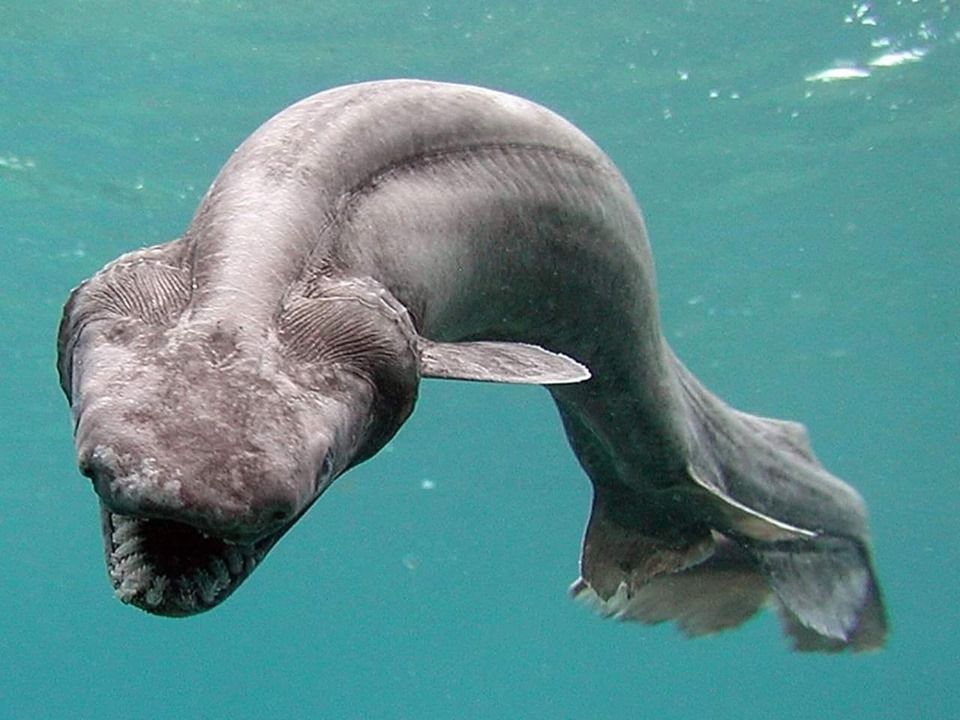
What is a frilled shark?
The frilled shark (Chlamydoselachus anguineus) is a primitive deep-sea shark that has remained essentially unchanged for 80 million years, making it a living fossil from the age of dinosaurs. They grow to 1. 5-2 meters long with eel-like slender bodies, giving them a serpentine appearance.
A Dinosaur-Age Shark Still Swimming
A snake-like shark moves slowly through the dark water 1,000 meters below the ocean surface. Its body is nearly 2 meters long. Six pairs of frilled gill slits line its throat. Its mouth contains 300 needle-sharp three-pronged teeth.
This is a frilled shark, and its ancestors looked nearly identical 80 million years ago, when dinosaurs still walked on land, when continents were in different positions, when most modern animal groups hadn't yet evolved.
The frilled shark survived the extinction that killed the dinosaurs. It survived every major climate shift since. It continues doing what frilled sharks have always done: swimming slowly through deep ocean darkness, occasionally catching squid with an arsenal of specialized teeth.
The Animal
Frilled sharks are primitive deep-sea sharks.
Physical features:
- Length: 1.5-2 meters typical
- Body shape: serpentine, eel-like
- Gills: six pairs (most sharks have five)
- Dorsal fin: single, far back on body
- Color: dark brown to dark gray
- Eyes: large, adapted to dim light
Why "frilled":
The name comes from the gill slits, which appear frilled or fringed, an ancient shark feature preserved from 80+ million years ago.
Scientific name:
Chlamydoselachus anguineus, literally "cloak-gilled snake-like shark"
80 Million Years Unchanged
Frilled sharks are genuine living fossils.
Ancient origins:
- Ancestors appeared 80+ million years ago
- Late Cretaceous period
- Lived alongside dinosaurs
- Persisted through K-Pg extinction (66 million years ago)
- Continue today in essentially unchanged form
Preserved features:
Frilled sharks retain traits that most modern sharks lost:
- Six gill pairs (most sharks have five)
- Single dorsal fin in primitive position
- Serpentine body shape
- Specific tooth structure (three-pronged)
- Primitive reproductive patterns
Fossil comparisons:
Fossils from the Cretaceous show sharks with:
- Nearly identical body plans
- Same tooth arrangements
- Similar dental structure
- Same gill structure
Modern frilled sharks closely match these fossil animals.
Evolutionary significance:
They split from the main shark evolutionary line approximately 80 million years ago. While other sharks diversified into fast-moving apex predators, frilled sharks maintained their ancient form. Their niche in deep ocean darkness didn't require the changes that drove other shark evolution.
The 300 Teeth
Frilled shark teeth are distinctive and specialized.
The arrangement:
- 300+ teeth active at any time
- 25 rows total (visible in living animals)
- Each tooth three-pronged (trident-shaped)
- Curved slightly backwards
- Sharp and needle-like
The trident design:
Each tooth has three prongs:
- Central prong slightly larger
- Two flanking prongs symmetric
- Points are all needle-sharp
- Designed for gripping slippery prey
Replacement system:
- Outer rows wear down or break
- Inner rows move forward to replace
- Continuous tooth replacement throughout life
- Faster than in most shark species
Why this design:
Frilled sharks hunt:
- Squid (primarily)
- Small fish
- Other soft, slippery prey
The trident teeth grip firmly:
- Three points distribute force
- Backward curve prevents escape
- Overall: catch and hold, not bite and chew
Hunting and Diet
Frilled sharks are specialized ambush predators.
Diet composition:
- Squid (60-80% of diet)
- Small fish (20-40%)
- Occasional shark and ray eggs
- Rarely crustaceans
Hunting strategy:
Unlike active shark predators:
- Swim slowly through water column
- Wait or drift with currents
- Detect prey through acute senses
- Strike rapidly but briefly
- Grip firmly with trident teeth
- Swallow whole
Jaw mechanics:
The frilled shark jaw opens differently from typical sharks:
- Jaw extends deep into throat
- Mouth can open exceptionally wide
- Prey swallowed whole (not bitten apart)
- Can handle prey relatively large for body size
Prey scale:
- Typical prey: squid 30-50 cm
- Large prey: occasional 80+ cm squid
- Can swallow prey equal to own body diameter
Deep Sea Life
Frilled sharks adapted specifically for deep-sea environments.
Depth preferences:
- Range: 100-1,500 meters
- Peak abundance: 500-1,200 meters
- Upper mesopelagic to bathypelagic zones
Temperature tolerance:
- 2-8°C
- Cold-adapted metabolism
- Can tolerate slight variations
- Restricted to cold oceans overall
Habitat features:
They prefer:
- Continental slopes (dramatic underwater cliffs)
- Submarine canyons (current-concentrated food)
- Seamounts (rising underwater mountains)
- Complex terrain with current variation
Global distribution:
Despite specific habitat needs:
- Found in many oceans worldwide
- Discontinuous distribution
- Each population isolated from others
- Different regional variations
Movement and Behavior
Frilled sharks move unlike typical sharks.
Swimming style:
- Eel-like undulation
- Slow, graceful movement
- Uses whole body length
- Low energy expenditure
Speed:
- Typical: 1-2 km/h
- Short bursts: faster
- Not a fast swimmer by shark standards
- Matches their ambush hunting strategy
Depth behavior:
- Can change depth moderately
- Generally remain at preferred depths
- May descend deeper during feeding
Not aggressive:
Unlike many sharks:
- Slow and deliberate
- Not known to attack large animals
- Retreats from threats
- Defensive rather than offensive behavior
Reproduction
Frilled shark reproduction takes extraordinary time.
Gestation:
- 3.5 years (42 months)
- Longest known in any vertebrate
- Far exceeds most other sharks
- Among the longest in all biology
Why so long:
- Cold water slows development
- Deep-sea life slows metabolism
- Large, well-developed young produced
- Ancient reproductive pattern
Litter size:
- 2-15 pups per litter
- Usually 5-10
- Much smaller than many fish
- Size partially compensates for long gestation
Young:
- Born 40-60 cm long
- Fully formed at birth
- Independent immediately
- Mature to adults in several years
Population implications:
This slow reproduction:
- Limits population recovery from mortality
- Makes populations vulnerable
- Requires careful conservation
- Extends generation times
Where They Live
Frilled shark populations exist worldwide in deep waters.
Known populations:
Pacific:
- Japan (best-studied population)
- Northern California
- Chile (southern waters)
- Australia (some waters)
Atlantic:
- Portugal and western Europe
- South Africa
- Argentina
Other:
- Some deep-sea basins worldwide
- Often isolated populations
- Limited travel between regions
Japanese prominence:
Japan has more frilled shark research because:
- Significant deep-sea fishing industry
- Frequent specimens in markets
- Active deep-sea research programs
- Cultural interest in unusual marine life
Research Challenges
Studying frilled sharks is difficult.
Obstacles:
Deep-sea habitat:
- Difficult to reach
- Expensive submersible time
- Limited observation opportunities
- Brief encounters
Fragility at surface:
- Rapid pressure change kills them
- Most specimens die during capture
- Live photographs rare
- Behavioral observation limited
Slow biology:
- Difficult to study breeding (3.5-year gestation)
- Long generation times
- Limited specimens available
- Population dynamics unclear
Research methods:
Scientists study frilled sharks through:
- Bycatch specimens from fisheries
- Deep-sea submersible observations
- Genetic analysis of preserved specimens
- Feeding ecology from stomach contents
- Radio tracking (limited attempts)
Conservation Status
Frilled sharks face conservation concerns.
IUCN status:
Near Threatened, reflecting concerns despite relative abundance.
Specific concerns:
Bycatch:
- Deep-sea fisheries catch them
- Not typically targeted
- Collection reduces populations
- Released specimens often die
Slow reproduction:
- 3.5-year gestation limits recovery
- Each death significantly impacts local populations
- Cannot replace losses quickly
- Extended recovery after any pressure
Habitat threats:
- Deep-sea mining proposals
- Continental slope activity
- Climate change effects
- Pollution reaching deep waters
Protection:
- Some fisheries regulations
- International protection discussions
- Specific regional conservation efforts
- Generally insufficient attention
Cultural Significance
Frilled sharks have cultural presence.
Japanese culture:
- Called "rabbit shark" or "sea snake" in various regions
- Occasionally found in fish markets
- Subject of local folklore
- Research subjects in Japanese deep-sea science
Western perception:
- Known through nature documentaries
- Viral social media content
- "Prehistoric shark" narratives
- Educational materials
Nicknames:
- Frilled shark (most common)
- Lizard shark (some regions)
- Scaffold shark (from tooth appearance)
- Primitive shark (referring to ancient features)
Why They Matter
Frilled sharks represent important biological concepts.
Living fossils:
They provide:
- Direct window to Cretaceous shark biology
- Evolutionary stability examples
- Comparison with fossil sharks
- Insights into ancient ocean ecosystems
Deep-sea biology:
- Success in darkness and pressure
- Slow-life-cycle adaptations
- Specialized hunting strategies
- Conservation of ancient lineages
Evolution:
- Stability vs change in species
- Niche specialization
- Ancient evolutionary strategies
- Why some lineages persist unchanged
Conservation:
- Indicators of deep-sea ecosystem health
- Vulnerable to deep-sea development
- Part of biodiversity heritage
- Test case for protecting ancient species
The Ancient Shark
Every frilled shark swimming today is a living link to the age of dinosaurs.
When you see a frilled shark in photographs or videos, you're seeing an animal that looked essentially the same when:
- T. rex was alive
- Continents were in different positions
- Most modern mammal orders didn't exist
- Oceans had ammonites still swimming in them
They have survived:
- Meteor impact that killed dinosaurs (66 million years ago)
- Multiple climate shifts
- Sea level changes
- Ocean chemistry changes
- The rise and fall of countless species
They continue swimming today, doing exactly what frilled sharks have always done: hunting squid in deep ocean darkness with their 300 trident-shaped teeth.
If they go extinct now, through deep-sea fishing pressure, climate change, or habitat destruction, we lose something irreplaceable. A lineage that survived what killed dinosaurs, failing to survive what modern humans did.
For now, they're still here. In deep oceans around the world, slender snake-like sharks with ancient features continue their 80-million-year run, occasionally glimpsed by scientific submersibles but otherwise invisible to us - persistent, ancient, largely unchanged.
Ancient Shark Lineages
Our research team finds that the frilled shark's ancient features fit into a broader pattern of deep-sea shark evolution. Several shark lineages with Cretaceous-age origins still persist, most of them in the deep ocean where they have found refuge from the changes that have transformed shallow-water ecosystems.
"The deep sea is a museum of shark evolution. Species like the frilled shark, the goblin shark, the megamouth shark, and the greenland shark have all been on Earth for tens of millions to hundreds of millions of years with relatively little apparent change. Their shallow-water relatives have diversified and specialized and often gone extinct, while these deep-water species have quietly persisted in the stable environment of the deep." - Dr. David Ebert, Pacific Shark Research Center [1]
Living Fossil Shark Species
| Species | Lineage age | Adult length | Distinctive feature |
|---|---|---|---|
| Frilled shark (Chlamydoselachus anguineus) | 80+ million years | 1.5-2 m | Snake-like body, 6 gill slits |
| Goblin shark (Mitsukurina owstoni) | 125+ million years | 3-4 m | Extendable jaw, elongated snout |
| Megamouth shark (Megachasma pelagios) | Discovered 1976, ancient lineage | 5 m | Enormous mouth, plankton-feeding |
| Greenland shark (Somniosus microcephalus) | ~30 million years | 4-7 m | 400+ year lifespan |
| Cow shark (Hexanchidae) | 190+ million years | 2-5 m | 6-7 gill slits |
| Megamouth shark (Pacific, 2014 rediscovery) | Deep lineage | ~4 m | Planktivorous |
The Six-Gilled Anatomy
Most modern sharks have five gill slits. Frilled sharks have six. This anatomical feature ties them to an ancient lineage: the only other sharks with six or seven gill slits belong to the family Hexanchidae (cow sharks), which share a common ancestor with frilled sharks far back in evolutionary time.
"The number of gill slits is not arbitrary. Extra gill slits require different blood vessel layouts, different skull structures, and different developmental patterns. Sharks with six or seven gills are all relicts of an earlier phase of shark evolution before the five-gilled body plan became dominant." - Dr. Gavin Naylor, Florida Museum of Natural History [2]
Gill Slit Counts in Living Sharks
| Number of gill slits | Family examples | Representative species |
|---|---|---|
| 5 | Most shark families | Great white, tiger, mako, bull sharks |
| 6 | Hexanchidae, Chlamydoselachidae | Frilled shark, sixgill shark |
| 7 | Hexanchidae (some) | Sevengill sharks (Notorynchus and Heptranchias) |
The frilled shark is the only living species in the family Chlamydoselachidae. Fossil members of the family have been identified from the Late Cretaceous (80-90 million years ago), confirming that the body plan has been essentially stable for tens of millions of years.
Notable Research Findings
- The frilled shark's pregnancy is one of the longest gestation periods in any vertebrate, at up to 3.5 years. By comparison, elephants gestate for 2 years and humans for 9 months. The long gestation reflects the slow metabolism and cool deep-sea environment.
- Frilled sharks have approximately 300 three-pronged teeth in 25 rows. The teeth are pointed backward like fish hooks, making prey nearly impossible to escape once caught.
- The frilled shark hunts using a coiled-spring lunge. Its flexible snake-like body allows it to launch forward at prey from a coiled resting position, reaching speeds sufficient to catch squid and small fish despite its slow cruising speed.
- Our research team notes that frilled shark specimens are almost always recovered in poor condition because they die rapidly if brought to surface pressure. This has limited studies of their physiology and behavior to what can be observed from the few brief encounters with ROV cameras.
- A rare live specimen captured by a Japanese fisherman in 2007 and filmed in Awashima Marine Park died within hours of its recovery. The footage from that brief encounter provided some of the best available record of a living frilled shark and was widely circulated in news coverage.
- Frilled sharks are classified as Least Concern by the IUCN Red List, but this classification is based on the species' wide geographic distribution rather than confirmed population data. Most conservation biologists consider deep-sea sharks understudied, and their true status is largely unknown.
- The species has been recorded from Japan, Australia, southern Africa, the Caribbean, and the northeastern Atlantic. Populations likely extend through much of the temperate and subtropical oceans at depths of 100 to 1,500 meters.
- The genus Chlamydoselachus includes two recognized species: C. anguineus (the more widespread) and C. africana, described in 2009 from South African waters and thought to be a previously overlooked distinct species.
References
[1] Ebert, D. A. (2015). Deep-Sea Cartilaginous Fishes of the Indian Ocean. FAO Species Catalogue.
[2] Naylor, G. J. P., Caira, J. N., Jensen, K., et al. (2012). A DNA sequence-based approach to the identification of shark and ray species. Bulletin of the American Museum of Natural History, 367, 1-262.
[3] Kubota, T., Shiobara, Y., & Kubodera, T. (1991). Food habits of the frilled shark Chlamydoselachus anguineus. Bulletin of the National Science Museum, Tokyo, 17, 25-33.
[4] Tanaka, S., & Hashimoto, M. (2016). Reproductive biology of the frilled shark. Memoirs of the National Museum of Nature and Science, 52, 169-178.
Related Articles
- Goblin Shark: The Deep Sea's Living Fossil
- Great White Shark: The Ocean's Apex Predator
- Nautilus: The 500-Million-Year-Old Living Fossil
Frequently Asked Questions
What is a frilled shark?
The frilled shark (Chlamydoselachus anguineus) is a primitive deep-sea shark that has remained essentially unchanged for 80 million years, making it a living fossil from the age of dinosaurs. They grow to 1.5-2 meters long with eel-like slender bodies, giving them a serpentine appearance. Their name comes from the six pairs of gill slits that appear frilled or fringed - a feature shared with their Cretaceous ancestors but unlike modern sharks.
They have approximately 300 needle-sharp teeth arranged in 25 rows, each tooth three-pronged for gripping slippery prey. Unlike most modern sharks, frilled sharks have a single dorsal fin far back on their bodies. They live at depths of 100-1,500 meters in continental slopes worldwide. Despite being sharks, their movement is more eel-like than typical shark-like.
They represent one of the oldest surviving shark lineages and provide valuable insights into prehistoric shark biology.
How many teeth does a frilled shark have?
Frilled sharks have approximately 300 needle-sharp teeth arranged in 25 rows in each jaw - totaling 300 teeth in active use at any time. Each tooth has a distinctive three-pronged (trident) shape designed for gripping slippery prey. The tooth structure is unique among living sharks, resembling teeth found in fossil sharks from 80+ million years ago.
The rows work in conjunction - as outer rows shed teeth, inner rows move forward to replace them, much like modern sharks but with a more primitive arrangement. Their jaws extend deep into their throat, allowing them to swallow prey whole rather than bite chunks. Their teeth are designed specifically for catching and holding fast-moving prey like squid, which forms their primary diet.
The combination of 300 teeth and flexible jaw mechanism means a frilled shark bite is nearly impossible to escape - prey is held firmly while the shark swallows it whole.
Why are frilled sharks considered living fossils?
Frilled sharks are true living fossils because they’ve retained features from shark ancestors that lived 80+ million years ago during the Cretaceous period. Their body plan preserves primitive shark characteristics that most modern sharks have lost. The frilled gill slits (hence the name) were common in ancient sharks but rare in contemporary species. Their single dorsal fin placement (far back on body) reflects ancient arrangements.
Their eel-like body shape is more primitive than the typical streamlined shark form. Their three-pronged teeth match fossilized teeth from Cretaceous sharks. Their reproductive pattern (long gestation, few offspring) resembles ancient sharks. They split from the main shark evolutionary line around 80 million years ago and have remained nearly unchanged since. Fossils of nearly-identical sharks exist from this period.
Modern frilled sharks look essentially like their Cretaceous ancestors would have looked. This extreme evolutionary stability is rare - most shark lineages have changed dramatically over similar timeframes.
Where do frilled sharks live?
Frilled sharks inhabit deep continental slopes worldwide at depths of 100-1,500 meters, with most encounters at 500-1,200 meters. They have a discontinuous distribution - found in specific regions rather than continuously. Main populations include waters off Japan (best studied population), Portugal, California, Chile, South Africa, and parts of Australia. They prefer cold waters with temperatures of 2-8 degrees Celsius.
They tend to live in and around submarine canyons, continental slopes, and other areas with dramatic underwater topography. These areas often have complex currents that concentrate prey species they hunt. Their lives are mostly spent in darkness. They don’t venture into shallow coastal waters under normal conditions - rare shallow sightings typically involve injured or dying specimens.
Japanese waters have produced the most scientific observations, likely because Japan has more deep-sea research activity in suitable frilled shark habitat. Their preferred depths make direct observation rare and most research based on bycatch specimens.
How dangerous are frilled sharks?
Frilled sharks pose virtually no danger to humans. They live at depths that humans never reach naturally, and their attacks on anything other than their specific deep-sea prey have never been documented. Their teeth, while numerous and sharp, are designed for gripping smooth squid and small fish, not larger animals. Their eel-like movement doesn’t support aggressive attack strategies used by other sharks.
Their speed is relatively slow compared to other sharks. Any human encounter with a frilled shark would be either a dead or dying specimen, or a very rare research submersible observation. Divers cannot reach their depths. Swimmers never encounter them. Commercial fishermen occasionally catch them as deep-sea bycatch, but even then they pose no real threat. No recorded injuries from frilled sharks exist.
They are truly benign deep-sea fish despite their fearsome appearance. Their primitive features and 80-million-year lineage make them fascinating rather than frightening. They represent a genuine success story of evolutionary conservation - a species unchanged from dinosaur times still swimming in our oceans.