
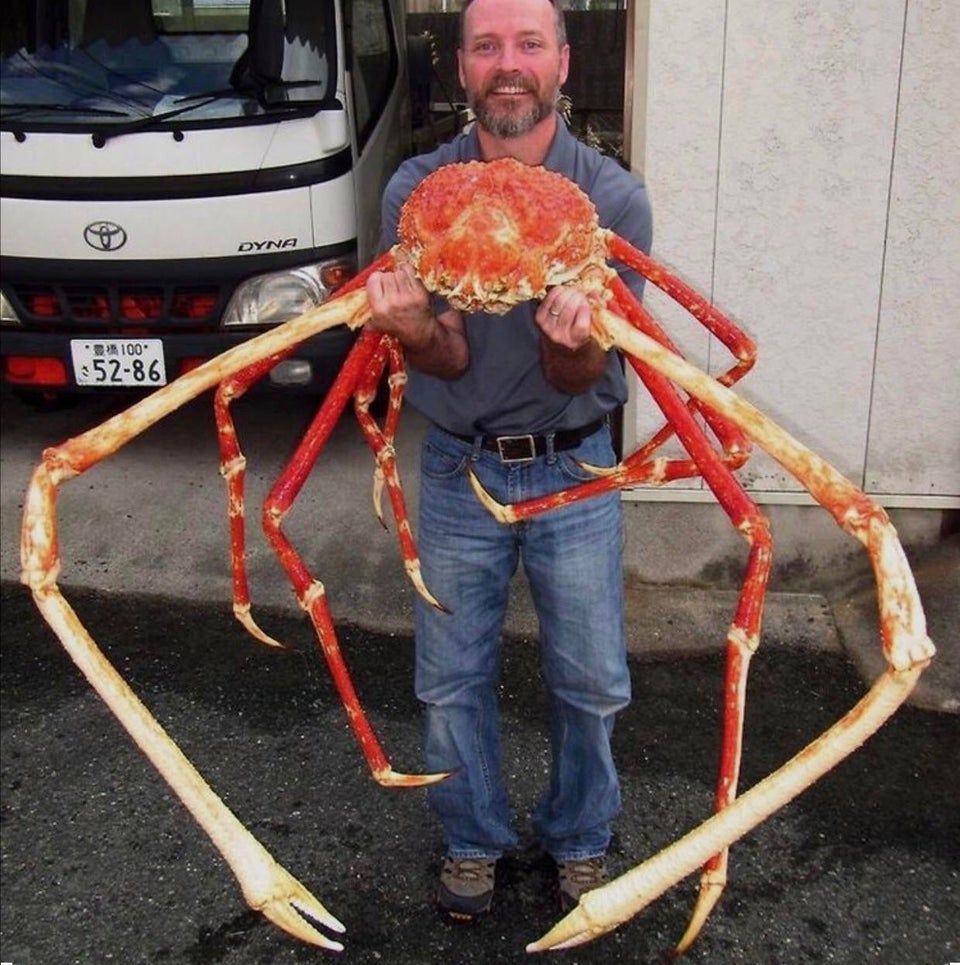
How big is the Japanese spider crab?
The Japanese spider crab (Macrocheira kaempferi) is the largest arthropod on Earth, with legspan reaching 3. 7 meters (12 feet) - larger than a car. Adult males have legs 2-3 meters long, with a relatively small body (35 cm wide carapace). They weigh up to 19 kg. Females are slightly smaller.
Legs That Span Longer Than a Car
A Japanese spider crab standing on the deep-sea floor off Japan has legs that span 3.7 meters, longer than a compact car. Its body is a fraction of its leg width, but those legs make it the largest arthropod on Earth.
It walks slowly across the sandy bottom. It may be 100 years old. It will keep walking, eating, molting, and persisting for perhaps another 50 years if nothing catches it. Each year, it grows slightly larger with each molt. Each year, it continues being what it has been since it was a juvenile, the biggest leg-to-body proportion animal in the ocean.
The Animal
Japanese spider crabs are the largest arthropods alive.
Physical features:
- Leg span: up to 3.7 meters (12 feet)
- Body (carapace) width: 35 cm
- Weight: up to 19 kg
- Color: dark orange with white spots
- Leg length: 2-3 meters individual legs
Size comparison:
- Longer than a compact car
- Can reach over a human's head if rearing up
- Wider leg-span than any other arthropod
- Second only to some colossal squid in total arthropod size
The name:
"Spider crab" refers to their elongated legs resembling spider legs, though they're true crabs (not arachnids).
Extreme Longevity
Japanese spider crabs can live over 100 years.
Documented ages:
- 100+ years confirmed in some specimens
- Potentially 150 years for extreme cases
- Longer than most mammals (including humans)
- Among the longest-lived crustaceans
Why such long lives:
- Slow metabolism in cold deep water
- Continuous growth through molting
- Few natural predators as large adults
- Stable deep-sea environment
- Efficient tissue maintenance
Comparison to other crabs:
- Blue crab: 3 years
- Dungeness crab: 10 years
- Most crab species: 5-15 years
- Japanese spider crab: 100+ years
This exceptional longevity has implications for:
- Population dynamics (slow replacement)
- Conservation challenges
- Research methods (long-term studies needed)
- Individual ecological importance
Where They Live
Japanese spider crabs have a restricted Pacific range.
Range:
- Japan (primary habitat)
- Pacific coast of Honshu
- Southern coastal waters
- Some areas of Taiwan and Korea
Depth:
- Typical: 50-600 meters
- Deeper during most of year
- Shallower during breeding (spring)
Habitat:
- Sandy seafloor
- Rocky areas with crevices
- Near submarine slopes
- Access to deeper waters
Why Japan-restricted:
- Evolved in specific oceanic conditions
- Requires specific temperature ranges
- Limited dispersal capability
- Isolated populations developed independently
Deep-Sea Gigantism
The spider crab's size demonstrates deep-sea gigantism.
The phenomenon:
Many deep-sea species grow much larger than shallow-water relatives:
- Giant isopods (40x bigger than pill bugs)
- Colossal squid (20x size of shallow squid)
- Japanese spider crab (much larger than other spider crabs)
Why it happens:
Cold temperatures:
- Slow metabolism
- Enable large body investment
- Reduce predation pressure
Stable environments:
- Consistent conditions support growth
- Less energy wasted on adaptation
- Long lifespans possible
Energy economy:
- Large body stores energy better
- Requires less per unit mass
- Efficient at low temperatures
Limits:
Despite deep-sea advantages, gigantism has limits:
- Structural engineering of exoskeleton
- Oxygen delivery challenges
- Food availability constraints
- Reproduction complications
Diet and Behavior
Japanese spider crabs are patient scavengers.
Diet:
- Dead fish (primary)
- Dead octopuses and squid
- Marine snow (falling dead matter)
- Starfish (sometimes)
- Slow-moving invertebrates
Feeding behavior:
Their long legs allow:
- Walking across large seafloor areas
- Efficient search patterns
- Minimal energy per unit explored
- Reaching distant objects
Eating process:
- Slow, deliberate
- Uses chelipeds (claws) to grab food
- Processes food slowly
- May spend hours on a single meal
Activity patterns:
- Nocturnal (mostly active at night)
- Slow movement always
- Rests during day
- Gradual food searching
Molting and Growth
Like all crustaceans, spider crabs grow through molting.
Molting process:
- Old exoskeleton cracks open
- Crab wriggles out of old shell
- Body is soft and vulnerable
- New, larger shell hardens over days
- Shell gradually darkens
- Crab remains hidden during this vulnerable period
Growth rate:
- Slow (matches long lifespan)
- Small size increase per molt
- Fewer molts than shorter-lived species
- Continuous throughout life
Vulnerability:
During molting:
- Soft body susceptible to damage
- Cannot defend or flee effectively
- Requires protected shelter
- Most dangerous time in crab's life
Life cycle:
- Juvenile: small size, many molts
- Subadult: medium size, occasional molts
- Adult: large size, fewer molts
- Each molt slightly increases size
Reproduction
Japanese spider crab breeding occurs in shallow waters.
Breeding season:
- Winter to spring (January-April)
- Migration to shallower waters
- Mass aggregations form
- Peak mating season
Mating:
- Males carry sperm-filled packets (spermatophores)
- Transfer to females during mating
- External fertilization with sperm delivery
- Complex courtship behaviors
Egg production:
- Females carry up to 1.5 million eggs
- Eggs attached under abdomen
- Gestation: 10 months
- Massive egg numbers compensate for high larval mortality
Young development:
- Eggs hatch as tiny swimming larvae
- Larvae drift in plankton
- Most eaten by other animals
- Few survive to reach adult form
- Successful juveniles continue growing
Cultural Importance
Japanese spider crabs are deeply cultural.
Japanese cuisine:
- Called "takaashigani" (long-legged crab)
- Considered a delicacy
- Traditional winter dish
- Expensive and prestigious
- Served in high-end restaurants
Fishing traditions:
- Centuries of commercial fishing
- Traditional Japanese fishermen
- Specialized equipment
- Regional specialties
Mythology and folklore:
- Feature in Japanese marine folklore
- Stories of giant sea crabs
- Connection to fisherman's traditions
- Modern cultural presence
Tourism:
- Aquarium displays draw visitors
- Tokyo aquariums feature them
- Educational value
- Symbolic of Japanese marine biology
Aquarium Specimens
Several aquariums maintain Japanese spider crabs.
Notable aquariums:
- Tokyo Sea Life Park (Japan): multiple specimens
- Kaiyukan Aquarium (Osaka, Japan): famous display
- National Aquarium (Baltimore, USA): Western representation
- Sydney Aquarium (Australia): international display
Why they're kept:
- Educational value (rare large arthropods)
- Public interest (iconic appearance)
- Research subjects
- Accessible to people unfamiliar with deep-sea life
Care requirements:
- Cold water (10-15°C)
- Large tanks (they need space)
- Deep-water conditions
- Specialized diet
Captive breeding:
- Not yet self-sustaining
- Most captive specimens collected from wild
- Research on breeding ongoing
- Limited success so far
Fishing and Commerce
Japanese spider crab fishing is regulated but continues.
Commercial fishery:
- Primarily Japanese
- Seasonal (winter)
- Traditional methods
- Boat-based fishing in deeper waters
Market value:
- High-priced seafood
- Premium pricing in Tokyo markets
- Popular restaurant item
- Economically significant to Japanese fishermen
Regulations:
Japanese fisheries management includes:
- Seasonal closures
- Minimum size limits
- Catch quotas
- Area restrictions
Enforcement:
- Varies by region
- Some illegal catch continues
- Competition with sustainability
- Cultural tensions around traditional practices
Conservation Concerns
Japanese spider crabs face multiple pressures.
Status:
- Not formally listed as endangered
- Population declines documented
- Conservation concern increasing
- Management challenges
Threats:
Commercial fishing:
- Main pressure
- Slow reproduction limits recovery
- Japanese market demand continues
- Illegal fishing adds pressure
Climate change:
- Ocean warming affects deep-water populations
- Changed currents impact feeding
- Acidification concerns
- Habitat shifts possible
Habitat degradation:
- Coastal development affects breeding areas
- Pollution from Japanese industrial activity
- Shipping traffic impacts
- Deep-sea mining proposals
Long-life vulnerability:
Their slow life cycle means:
- Each death removes decades of growth
- Population recovery takes generations
- Younger crabs cannot quickly replace adults
- Vulnerable to depletion
Research and Study
Japanese spider crabs are research subjects for multiple fields.
Research areas:
Extreme longevity:
- How they live 100+ years
- Aging mechanisms in crustaceans
- Applications to understanding aging in other species
- Genetics of long life
Deep-sea biology:
- Gigantism mechanisms
- Deep-water ecosystems
- Food webs in their habitat
- Crustacean evolution
Biomechanics:
- Leg function and strength
- How they walk without sinking
- Sensory coordination at such scale
- Growth and regeneration
Conservation:
- Population dynamics
- Sustainable harvest levels
- Captive breeding techniques
- Climate change impacts
Why They Matter
Japanese spider crabs represent important biological and cultural significance.
Biological importance:
- Largest living arthropod
- Deep-sea gigantism example
- Long-life biology
- Unique leg-body proportions
Cultural significance:
- Japanese tradition and cuisine
- International icon of deep-sea life
- Educational value
- Research importance
Ecological role:
- Scavengers in deep-sea ecosystems
- Nutrient cycling
- Prey for some larger predators
- Part of Japanese marine food web
Conservation priority:
- Restricted range
- Slow recovery from pressure
- Ongoing fishing pressure
- Climate change vulnerability
- Cultural value for protection efforts
The Giant's Patience
Every Japanese spider crab on the Japanese seafloor is a time capsule.
A 100-year-old spider crab was born in 1924. It was an adult during World War II. It survived the entire post-war period. It has experienced decades of changing ocean temperatures, chemistry, and biology. It has survived every molt of its existence. It continues walking the same seafloor it has walked for a century.
This longevity gives individual crabs exceptional ecological importance. Each large adult represents:
- 100 years of nutrient cycling contribution
- 100 years of scavenging activity
- Multiple decades of reproductive contribution
- A living historical record
They walk slowly. They eat slowly. They reproduce slowly. They grow slowly. But they persist, across decades that have seen entire generations of other crab species rise and fall.
If they're protected, they continue their ancient slow existence. If they're heavily fished, populations can take generations to recover. Each individual is precious in ways shorter-lived species are not.
When you see a Japanese spider crab in an aquarium or in Japanese seafood markets, you're seeing an animal whose kind has perfected the art of slow, patient persistence in the deep sea. They have more in common with trees than with ordinary crabs - long-lived, slow-growing, quietly continuing century after century.
Large Arthropod Comparison
The Japanese spider crab (Macrocheira kaempferi) holds the record for largest arthropod by leg span. Our research team has compiled the size statistics of major large arthropods to put this into context.
"Giant arthropods are constrained by the physics of exoskeletons. An animal with an external skeleton must molt to grow, and the larger it becomes, the more vulnerable it is during molting. The Japanese spider crab reaches the approximate upper limit of what an arthropod can physically achieve without its exoskeleton becoming prohibitively heavy." - Dr. Mark Westneat, University of Chicago, functional morphology researcher [1]
Largest Living Arthropods
| Species | Measure | Size | Notes |
|---|---|---|---|
| Japanese spider crab | Leg span | 3.8 m (record) | Largest arthropod by span |
| Tasmanian giant crab | Body mass | Up to 17.6 kg | Heaviest crab |
| American lobster | Length | Up to 1.2 m | 22 kg record |
| Coconut crab | Leg span | 1 m | Largest terrestrial arthropod |
| Giant isopod | Length | 76 cm | Pill bug relative |
| Giant centipede | Length | 30-35 cm | Amazonian Scolopendra gigantea |
| Goliath birdeater spider | Leg span | 30 cm | Heaviest spider |
| Atlas moth | Wingspan | 24 cm | Largest wing surface |
The Japanese spider crab's leg span of 3.8 meters is nearly twice the length of a tall adult human. Adult males average over 3 meters leg tip to leg tip, though body (carapace) width is more modest at 30 to 40 cm.
Deep-Sea Aging
Japanese spider crabs are estimated to live 100 years or more in the wild. This lifespan is typical for large deep-sea arthropods, which grow slowly and reproduce for many years. Compared to most temperate and tropical crabs, which typically live 5 to 10 years, the spider crab's century-long lifespan reflects the unique pressures of the deep environment.
"Deep-sea species often live surprisingly long lives. Cold temperatures, low metabolic rates, and stable environments reward organisms that grow slowly and continuously. The Japanese spider crab, the orange roughy fish (150 years), the Greenland shark (400 years), and giant tube worms (250 years) all exemplify this pattern. Longevity is itself a deep-sea adaptation." - Dr. Steven Austad, University of Alabama at Birmingham, aging researcher [2]
Deep-Sea Longevity Records
| Species | Habitat depth | Maximum lifespan |
|---|---|---|
| Japanese spider crab | 50-600 m | 100+ years (estimated) |
| Orange roughy | 600-1,500 m | 150+ years |
| Rougheye rockfish | 170-800 m | 200+ years |
| Greenland shark | 0-2,200 m | 400+ years |
| Giant tube worm | Hydrothermal vents | 250+ years |
| Sponge (Monorhaphis chuni) | Deep ocean floor | 11,000+ years |
Notable Research Findings
- Japanese spider crabs are targeted in a small traditional Japanese fishery, particularly around Suruga Bay and the Izu Peninsula. They are considered a delicacy and have been eaten in Japan for centuries. Sustainable harvest policies now limit capture during the spring breeding season.
- Spider crabs decorate their shells with anemones, sponges, and algae, providing camouflage and defensive stinging capability. This decoration behavior is common in decorator crab species worldwide and has evolved multiple times independently.
- Spider crab molting is dangerous. Recently molted individuals are soft-shelled and vulnerable for several weeks until the new exoskeleton hardens. Adult Japanese spider crabs may molt every 2-4 years, with each molt producing a slightly larger body.
- The Japanese spider crab's distribution is limited to the coastal waters of Japan, from Honshu island's Pacific coast down through Kyushu. Recent climate-related range shifts have been documented, with increased specimens found in slightly cooler waters to the north.
- Our research team notes that Japanese spider crabs are now successfully kept in several public aquariums globally. The species adapts well to captive conditions at appropriate water temperatures and pressures, and has become a popular display animal for institutions wanting to showcase deep-sea fauna.
References
[1] Westneat, M. W., Betz, O., Blob, R. W., et al. (2003). Tracheal respiration in insects visualized with synchrotron X-ray imaging. Science, 299(5606), 558-560.
[2] Austad, S. N. (2010). Methuselah's Zoo: What Nature Can Teach Us about Living Longer, Healthier Lives. MIT Press.
[3] Nishimoto, M. M., Washburn, L., Cowen, R. K., et al. (2019). Japanese spider crab recruitment in relation to oceanographic conditions. Marine Ecology Progress Series, 608, 153-171.
[4] IUCN Red List. (2018). Japanese spider crab assessment: Not evaluated globally, sustainably harvested in Japanese fisheries.
Related Articles
- Giant Isopod: The 50-Centimeter Deep Sea Roach
- Yeti Crab: The Hairy Crab That Farms Bacteria
- Mantis Shrimp: The Fastest Punch in the Animal Kingdom
Frequently Asked Questions
How big is the Japanese spider crab?
The Japanese spider crab (Macrocheira kaempferi) is the largest arthropod on Earth, with legspan reaching 3.7 meters (12 feet) - larger than a car. Adult males have legs 2-3 meters long, with a relatively small body (35 cm wide carapace). They weigh up to 19 kg. Females are slightly smaller. Their size is an extreme example of deep-sea gigantism, where cold temperatures and stable environments support extraordinary growth.
They look like enormous versions of smaller spider crabs - elongated body with extremely long thin legs. Despite their imposing size, they are slow-moving and primarily scavengers rather than active predators. Their massive legs allow them to walk across soft seafloor without sinking, and they use extended legs to search for food across wide areas. Japanese spider crabs can live over 100 years, making them among the longest-lived crustaceans.
Where do Japanese spider crabs live?
Japanese spider crabs live only in the deep waters around Japan, particularly in the Pacific waters off Honshu and the southern coasts. Their range is limited to Japanese and nearby East Asian waters, primarily between depths of 50-600 meters. They inhabit sandy and rocky seafloor environments, often living near underwater rock formations that provide shelter. During spring breeding season (January-April), they migrate to shallower waters for mating.
At other times, they remain in deeper waters. They prefer cold water temperatures between 10-15 degrees Celsius. Japanese commercial fisheries have caught them for centuries, and they’re considered a delicacy in Japanese cuisine. Captive specimens exist in aquariums worldwide, including Tokyo Sea Life Park, National Aquarium in Baltimore, and Kaiyukan in Osaka.
Their restricted range to Japanese waters makes them vulnerable to regional threats, and their slow reproduction means populations cannot quickly recover from significant pressure.
How long do Japanese spider crabs live?
Japanese spider crabs can live over 100 years, making them among the longest-lived crustaceans. Individual specimens have been documented at 100+ years through scientific observation. This extreme longevity comes from their slow metabolism, cold deep-sea environment, gradual growth rate, and ability to continuously molt and regenerate tissue.
Like other crustaceans, they molt throughout life to grow and maintain health - unlike many species that stop growing at sexual maturity. Each molt takes several hours to days, during which they’re vulnerable. Successful adults survive numerous molts and grow slightly with each one. Juvenile mortality is high (most young die before adulthood), but adults who reach large size have few natural predators and often live for decades.
The longest-lived individuals may exceed 150 years, though documented verification is limited. This longevity is part of why their populations cannot quickly recover from fishing pressure - replacing a single 100-year-old adult requires 100 years of development. Their slow reproduction and slow growth make conservation challenging.
What do Japanese spider crabs eat?
Japanese spider crabs are primarily deep-sea scavengers that eat whatever dead matter they can find. Their diet includes dead fish, octopuses, squid, marine snow (falling dead material), and occasional live but slow-moving prey like starfish. They will eat almost anything nutritious that falls within their reach. Their long legs allow them to search wide areas efficiently - they walk across the seafloor, extending their legs to examine distant objects.
They use their claws (chelipeds) to grab and manipulate food before bringing it to their mouths. Some evidence suggests they occasionally hunt slow-moving animals, but scavenging dominates. Their food processing is slow - they may spend hours on a single meal. Given their size, they need substantial food, but they can go weeks between significant meals.
Their long lifespan matches their slow eating and metabolism - each year they need food that smaller, shorter-lived crabs would eat in much less time. They’re not dangerous to humans but can give painful pinches if handled carelessly with their large claws.
Are Japanese spider crabs endangered?
Japanese spider crabs are not formally listed as endangered but face significant conservation concerns. Their populations have declined from heavy commercial fishing in Japan, where they’re considered a delicacy. Annual harvest has been reduced through regulations, and specific fishing seasons protect them during breeding. Their range is limited to Japanese waters, making them vulnerable to regional pressures.
Climate change, ocean pollution, and habitat disturbance from fishing affect them. They also have very slow reproduction - females produce eggs annually but juvenile mortality is extremely high. Combined with their long maturation period (5-10+ years to reach breeding age) and their potential 100+ year lifespans, populations recover extremely slowly from any pressure.
Japanese fisheries authorities have implemented catch limits, size restrictions, and seasonal protections, but enforcement varies. Captive breeding in aquariums has not yet become self-sustaining. Some experts argue for stronger protections given their slow life history. Their iconic status and cultural importance in Japan could help conservation efforts through public awareness and sustainable management programs.