
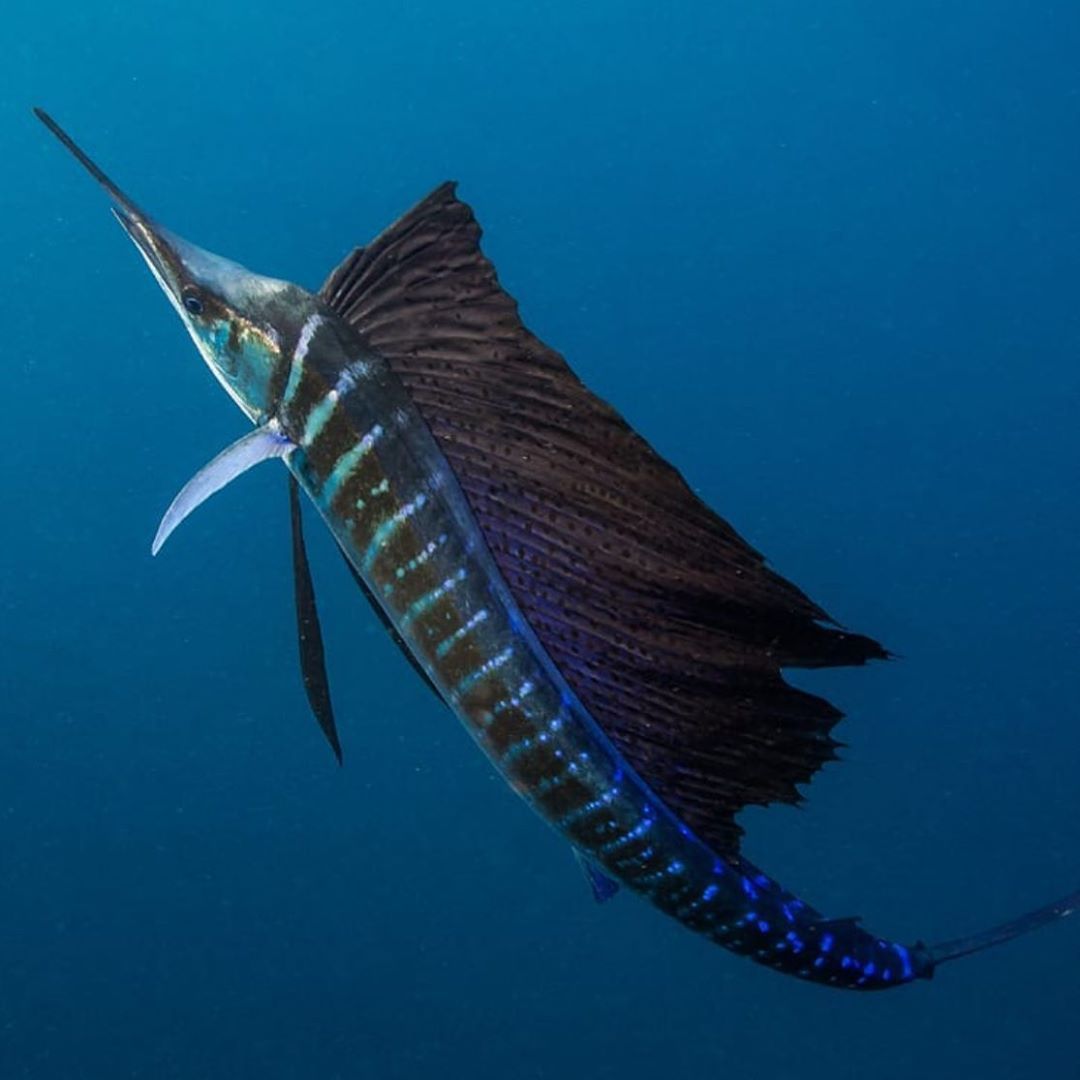
How fast is a sailfish?
Sailfish (Istiophorus platypterus) are among the fastest fish in the ocean, with recorded burst speeds of up to 110 km/h (68 mph). This speed claim has been contested - some researchers argue 109-110 km/h represents maximum speeds, while others consider typical speeds of 60-70 km/h more accurate for sustained pursuit.
110 km/h With a Retractable Sail
A group of 15 sailfish encircle a school of sardines in Caribbean waters. They extend their massive sail-like dorsal fins to herd the fish into a tight ball. Colors flash across their bodies, deep blue one moment, iridescent pink the next. They take turns charging through the bait ball, stunning fish with their bills.
Individual sailfish reach speeds of 110 km/h (68 mph). Combined with their coordinated hunting tactics, they're among the ocean's most effective predators.
This is the sailfish (Istiophorus platypterus), the fastest fish in the ocean and one of the most visually spectacular.
The Animal
Sailfish are large pelagic predators.
Physical features:
- Length: 2-3.5 meters typical, up to 4 meters
- Weight: 25-100 kg (record: 240 kg)
- Bill: elongated upper jaw
- Sail: enormous dorsal fin
- Color: blue on back, silver-white below
- Eyes: large for speed targeting
- Tail: crescent-shaped powerful tail
Distinctive features:
The sail:
- Largest dorsal fin of any fish species
- 2x height of body
- Blue-purple with spots
- Retractable
- Color-changing
Body:
- Streamlined for speed
- Flexible during swim
- Powerful swimming muscles
- Efficient aerodynamics
Bill:
- Long extended upper jaw
- Used to stun prey
- Defensive weapon
- Identifies billfish family
Extraordinary Speed
Sailfish speed is contested but impressive.
Claimed maximum:
- 110 km/h (68 mph) recorded
- Some researchers dispute
- 95-105 km/h widely accepted
- Among fastest fish
Other fast fish:
- Black marlin: 130 km/h (disputed)
- Yellowfin tuna: 75 km/h
- Swordfish: 97 km/h
- Mako shark: 74 km/h
Speed mechanism:
- Streamlined body
- Powerful tail propulsion
- Collapsible fins reduce drag
- Specialized muscles
Sustained vs burst:
- Burst speed: maximum
- Cruising: 20-30 km/h
- Different muscle fibers
- Efficient at each level
Hunting speeds:
- Use bursts during pursuit
- Maneuver quickly
- Accelerate rapidly
- Catch fast prey
The Color-Changing Sail
The sail is more than speed reduction.
Color changes:
Rapid transformations:
- Deep blue
- Iridescent pink
- Silver
- Black
- Various patterns
How they change:
- Specialized chromatophores
- Nerve-controlled
- Rapid (seconds)
- Multiple colors simultaneously
Purposes:
Visual communication:
- Signal to other sailfish
- Coordinate hunts
- Establish dominance
- Display during breeding
Prey confusion:
- Rapid color changes confuse bait fish
- Multiple moving stimuli
- Disrupts vision
- Hunting advantage
Predator evasion:
- Different colors at different angles
- Harder to target
- Visual disruption
Aerodynamic function:
- Full extension for maneuvering
- Folded during pure speed
- Flexible depending on need
- Optimized for situation
Cooperative Hunting
Sailfish hunt in coordinated groups.
Group size:
- 5-30 individuals typically
- Sometimes larger
- Family or unrelated groups
- Cooperative despite no formal structure
Hunting sequence:
Detection:
- Locate bait fish schools
- Use sight and pressure sensing
- Position around school
- Prepare for attack
Encirclement:
- Circle around fish
- Prevent escape
- Use sails to appear larger
- Create corral
Corralling:
- Drive fish into tight ball
- Compress school
- Reduce maneuverability
- Concentrate prey
Attack:
- Take turns striking
- Use bill to stun fish
- Swallow stunned prey
- Continue cooperative pattern
Communication:
During hunts:
- Color signals coordinate
- Body position language
- Vocalizations (some species)
- Coordinated movement
Research findings:
- Extraordinarily cooperative
- Complex coordination
- High intelligence
- Advanced behavior
Where They Live
Sailfish inhabit warm tropical seas globally.
Oceans:
Atlantic:
- From Cape Cod to Argentina
- Gulf of Mexico
- Caribbean Sea
- Central and South America
Indian Ocean:
- East Africa to Indonesia
- Middle East
- Australia northwest
- Various Indian Ocean coasts
Pacific:
- Alaska to Peru (Eastern)
- Philippines to Japan (Western)
- Hawaii
- Various tropical coasts
Mediterranean:
- Eastern Mediterranean
- Limited populations
- Expansion due to warming
Preferred conditions:
- Temperature: 21-28°C
- Depth: 0-50 m typically
- Habitat: pelagic (open ocean)
- Features: near currents and bait concentrations
Migration:
Seasonal movements:
- Follow prey fish
- Seek optimal temperatures
- Cross ocean distances
- Return to preferred areas
Billfish Family
Sailfish are part of the billfish family.
Billfish family:
- Sailfish: most colorful
- Blue marlin: largest
- Black marlin: fastest claimed
- Striped marlin: common
- Swordfish: solo hunter
- Spearfish: smaller
Common features:
- Elongated upper jaw (bill)
- Large body size
- Long-distance migration
- Pelagic lifestyle
- Top predators
Differences:
Each species has unique characteristics:
- Diet preferences
- Size variations
- Speed claims
- Geographic ranges
Relationships:
- Sailfish less massive than marlin
- More cooperative than swordfish
- More colorful than most
- Unique sail feature
Hunting Techniques
Sailfish use multiple attack methods.
Bill strikes:
- Swim through bait ball
- Swing bill rapidly
- Stun multiple fish
- Return to consume
The stun:
- Hit fish with side of bill
- Knock unconscious
- Easier to catch
- Efficient method
Capture:
- Grab stunned fish
- Swallow whole
- Quick digestion
- Continue hunting
Timing:
- Short attacks (seconds)
- Multiple attempts
- Rest between strikes
- Coordinated with others
Prey types:
- Sardines (major prey)
- Herring
- Mackerel
- Small tuna
- Cephalopods occasionally
Cultural Significance
Sailfish are iconic game fish.
Sport fishing:
Major tourism industry:
- Florida Keys Gold Coast
- Costa Rica tournaments
- Panama destinations
- Various global locations
Catch-and-release:
- Standard practice
- Tag-and-release programs
- Conservation focus
- Sustainable tourism
Cultural icons:
Ernest Hemingway:
- Famous sailfish catcher
- Writing about fishing
- Cuban fishing traditions
- Literary significance
Art and media:
- Nature documentaries
- Sport fishing TV
- Scientific publications
- Cultural imagery
Economic value:
- Tourism revenue
- Sport fishing industry
- Research funding
- Cultural tourism
Reproduction
Sailfish reproduce offshore.
Sexual maturity:
- 3-4 years
- Both sexes similar
- Offshore spawning
Breeding:
- Spawning in warm waters
- External fertilization
- Millions of eggs released
- Planktonic larvae
Gestation:
- External reproduction
- No parental care
- Larvae drift with currents
- High mortality
Lifespan:
- Wild: 13-15 years (some records)
- Possibly longer (limited data)
- Continuous growth
- Slow to reproduce
Population replenishment:
- Slow reproductive rate
- High juvenile mortality
- Adult loss significant
- Recovery challenges
Conservation Status
Sailfish face ongoing pressures.
IUCN status:
Vulnerable (downgraded from Near Threatened in 2011).
Population trends:
- Declining globally
- Regional variations
- Some areas stable
- Continuing concerns
Threats:
Commercial fishing:
- Bycatch in tuna fisheries
- Longline operations
- Significant mortality
- International concern
Sport fishing:
- Major pressure in some areas
- Mostly catch-and-release
- Still some mortality
- Regulated harvest
Habitat loss:
- Climate change
- Ocean warming
- Prey redistribution
- Ecosystem shifts
Pollution:
- Plastic pollution
- Chemical contamination
- Reduced water quality
- Indirect effects
Protection:
- ICCAT regulations
- Regional fishery management
- Catch-and-release standards
- Research tagging
Research
Sailfish research reveals cooperative intelligence.
Research areas:
Hunting behavior:
- Group coordination
- Color communication
- Cognitive capabilities
- Cooperative strategies
Migration:
- Satellite tracking
- Long-distance movement
- Climate correlation
- Population mixing
Physiology:
- Speed mechanics
- Body design
- Temperature regulation
- Sensory capabilities
Population:
- Density estimates
- Age structure
- Reproductive success
- Genetic diversity
The Cooperative Speed Demons
Every sailfish swimming in tropical waters represents advanced cooperative hunting evolution.
They're fast. They're visually spectacular. They're colorful. They hunt in groups. They communicate through color. They use their bills strategically. They feed using complex coordination.
Their sail is a display organ, communication tool, and maneuverability aid. Their speed is among the fastest in the ocean. Their intelligence supports complex group hunting. Their color changes rival anything in the cephalopod world.
Yet they're declining. Ocean warming affects them. Fishing pressure persists. Pollution impacts ecosystems. Their slow reproduction cannot compensate for losses.
In Caribbean, Atlantic, Indian, and Pacific tropical waters, they continue their ancient patterns. Groups coordinate. Colors flash. Sails extend. Speeds reached. Meals captured cooperatively.
Whether they persist depends on continued conservation efforts, protected fishing areas, climate change mitigation, and international cooperation. The fastest fish in the ocean, the most cooperative billfish, the color-changing hunters; they deserve protection for both their unique biology and their role in ocean ecosystems.
Speed Rankings in the Ocean
The Atlantic sailfish (Istiophorus albicans) and Indo-Pacific sailfish (Istiophorus platypterus) are widely cited as the fastest fish in the ocean, though measuring absolute maximum velocity remains scientifically contested.
Early 1960s reel-pull experiments recorded 109 kilometers per hour, though more recent high-speed video and biomechanical modeling suggest true maximum bursts fall between 70 and 90 kilometers per hour. Below are the top contenders based on the most rigorous recent measurements.
| Species | Max Recorded Speed | Sustained Cruising | Measurement Method |
|---|---|---|---|
| Sailfish (Istiophorus) | 70-90 km/h (burst) | 30 km/h | High-speed video, biomechanical |
| Black marlin (Istiompax indica) | 82 km/h (disputed) | 35 km/h | Reel-pull, now questioned |
| Shortfin mako shark | 74 km/h (burst) | 35 km/h | Boat radar tracking |
| Swordfish | 64 km/h (burst) | 30 km/h | Sonar tracking |
| Yellowfin tuna | 76 km/h (burst) | 40 km/h | Tagging data |
| Wahoo | 78 km/h (burst) | 30 km/h | Sport fishing records |
| Bluefin tuna | 70 km/h (burst) | 30 km/h | Satellite tags |
A 2016 study by Domenici and colleagues at the Institute of Coastal Marine Environment in Italy used high-speed video to directly measure the peak swimming speeds of sailfish attacking sardine baitballs. Their measurements, published in Royal Society Open Science, recorded maximum bursts of 8.1 meters per second (29 kilometers per hour) during actual hunting rather than flight [1].
"The sailfish records from the 1960s and 1970s used a swimming pool and a hooked fish pulling a fishing reel, which is not a valid measurement of burst swimming performance. Our high-speed video recordings of predatory attacks on live prey are the first accurate measurements of sailfish swimming speed under natural hunting conditions. The fish are very fast, but not 110 kilometers per hour fast." - Dr. Paolo Domenici, National Research Council of Italy [1]
The Hunting Sequence of a Baitball
Groups of 50 to 70 sailfish coordinate attacks on sardine baitballs in the shallow waters off Isla Mujeres, Mexico, and the Florida Keys. High-speed footage has revealed that individual sailfish take turns entering the baitball, making rapid slashing strikes with the bill to stun and injure fish. The bill is used as a lateral slashing weapon rather than a piercing instrument, with injured sardines becoming easy prey.
Behavioral ecologists have documented that individual sailfish have measurable capture success rates - experienced adult fish succeed on roughly one in four slashing attempts, while younger fish succeed on fewer than one in ten. Over a typical 20-minute baitball encounter, a coordinated group of 50 sailfish may extract 200 to 400 sardines, consuming a substantial fraction of the school before it disperses.
"Group hunting in sailfish is one of the most sophisticated cooperative hunting behaviors documented in any fish. The individuals do not share prey after capture, but the presence of multiple attackers dramatically increases each individual's success rate. This is cooperation by proximity rather than by altruism - each fish benefits from the chaos the others create." - Dr. Jens Krause, Leibniz Institute of Freshwater Ecology [2]
Sensory Biology and Color Communication
Sailfish possess specialized chromatophores that allow rapid color changes from pale blue to intense cobalt with vertical brown-purple stripes. These color changes serve communication functions during group hunting - intense striping correlates with attack readiness, and researchers hypothesize that the color shifts prevent sailfish from slashing their own groupmates in the chaos of a baitball attack.
Electroretinogram recordings have shown that sailfish retinas contain photoreceptors sensitive to blue and ultraviolet wavelengths, allowing effective visual hunting at depths down to 200 meters where red light has been absorbed by seawater. Their visual acuity under these low-light conditions is among the highest documented in open-ocean fish.
A 2012 study documented that sailfish possess cranial endothermy, warming their brain and retinas several degrees above ambient ocean temperature using specialized eye muscles. This adaptation is shared with other billfish and enables rapid visual processing during high-speed attacks on fast-moving prey.
Satellite Tracking and Migration Patterns
Satellite pop-off tag studies conducted by the Billfish Foundation and the NOAA Southeast Fisheries Science Center have documented individual sailfish traveling over 5,000 kilometers between tagging and tag release locations. Atlantic sailfish tagged off the Florida coast have been recovered in waters off West Africa, and Indo-Pacific individuals tagged in the Coral Sea have been tracked north to the Philippines.
Most tagged individuals remain within the upper 50 meters of the water column during daylight hours, descending briefly to depths of 250 meters at midday to thermoregulate and potentially to forage on deepwater squid. Their habitat preference centers on the 26 to 30 degree Celsius isotherm, and sailfish populations are predicted to shift poleward as oceanic warming progresses through the 21st century.
Economic Importance and the Recreational Industry
Sailfish are the cornerstone species of a multi-billion dollar recreational billfish industry spanning from Guatemala and Costa Rica through the Florida Keys, Caribbean, West Africa, and the Indo-Pacific. Central American sailfish tournaments routinely generate 30 to 50 million dollars annually per major tournament circuit, with catch-and-release practices now dominant.
Costa Rica's Flamingo, Quepos, and Los Suenos sailfish grounds host some of the highest sailfish catch rates in the world, with peak-season boats recording 20 to 40 sailfish released per day. Similar productivity is documented off Guatemala's Pacific coast, where the Iztapa region is informally known as "the sailfish capital of the world."
"A single sport-caught sailfish has an estimated lifetime economic value of over 1,800 dollars to a host country when released alive, compared to approximately 50 dollars as a commercial landed fish. The economic case for catch-and-release management is overwhelming once tourism revenue is factored into the calculation." - Dr. Ellen Peel, President, The Billfish Foundation [5]
Anatomical Adaptations for Pelagic Speed
Sailfish possess a suite of anatomical adaptations shared with other pelagic top-speed fish - a highly fusiform body, a rigid lunate tail, a deep caudal keel for lateral stability, and a powerful red-muscle layer for sustained swimming. Their skin is covered with microscopic tubercles that disrupt boundary layer turbulence, reducing drag at high speeds in a process analogous to the riblet surfaces used on competition swimwear.
The long bill serves multiple functions beyond its slashing use. Hydrodynamic modeling suggests the bill acts as a flow-directing structure that reduces drag around the sailfish's head during forward motion. The bill is also richly innervated with pressure-sensitive organs that detect the movement of prey in turbid water, functioning as a forward-facing mechanoreceptor system.
The iconic dorsal sail is normally folded into a groove along the back during high-speed swimming, preserving hydrodynamics. It is erected during hunting to increase apparent body size, during thermoregulation at the surface, and during courtship displays.
References
- Domenici, P., Wilson, A. D. M., Kurvers, R. H. J. M., et al. (2014). How sailfish use their bills to capture schooling prey. Proceedings of the Royal Society B, 281(1784), 20140444. DOI: 10.1098/rspb.2014.0444
- Herbert-Read, J. E., Romanczuk, P., Krause, S., et al. (2016). Proto-cooperation: group hunting sailfish improve hunting success by alternating attacks on grouping prey. Proceedings of the Royal Society B, 283(1842), 20161671. DOI: 10.1098/rspb.2016.1671
- Block, B. A., & Finnerty, J. R. (1994). Endothermy in fishes: a phylogenetic analysis of constraints, predispositions, and selection pressures. Environmental Biology of Fishes, 40(3), 283-302. DOI: 10.1007/BF00002518
- Sagarese, S. R., Walter, J. F., Babcock, E. A., et al. (2016). Validating long-term age and growth analysis for sailfish. Bulletin of Marine Science, 92(4), 491-508. DOI: 10.5343/bms.2016.1009
- Ehrhardt, N. M., & Fitchett, M. D. (2006). Economic and ecological benefits of releasing sailfish and billfish worldwide. The Billfish Foundation Technical Report Series, 1, 1-42.
Related Articles
- Peregrine Falcon: The Fastest Animal on Earth
- Mako Shark: The Ocean's Fastest Shark
- Whale Shark: The Largest Fish on Earth
Frequently Asked Questions
How fast is a sailfish?
Sailfish (Istiophorus platypterus) are among the fastest fish in the ocean, with recorded burst speeds of up to 110 km/h (68 mph). This speed claim has been contested - some researchers argue 109-110 km/h represents maximum speeds, while others consider typical speeds of 60-70 km/h more accurate for sustained pursuit. Their speed ranks them among the top 5 fastest fish species.
Their aerodynamic body, specialized muscles, and extensible body fins allow them to achieve and sustain high speeds. Their distinctive sail-like dorsal fin, when extended, provides maneuverability at speed while creating a displaceable feature for energy efficiency. They use their speed primarily for: hunting fast prey fish, escape from larger predators, migration across ocean regions, and cooperative hunting strategies.
Their combination of speed, maneuverability, and hunting intelligence makes them apex predators in their ecosystems. Other fish cited as potentially faster include the marlin and some tuna species, though accurate speed measurements in ocean conditions are challenging.
What is the sailfish's sail for?
The sailfish’s distinctive dorsal fin - which gives the species its name - serves multiple purposes during hunting and social behavior. The sail can: fully extend to nearly vertical position, fold down against body when swimming fast, change color dramatically (from deep blue to iridescent pink), signal to other sailfish, herd fish schools, disrupt prey fish vision, and provide aerodynamic surfaces for maneuvering.
During hunting, sailfish groups coordinate by extending their sails to corral bait fish into tight balls. They change colors rapidly - blue one moment, pink and silver the next - which confuses prey and possibly communicates with other sailfish. Their sails contain specialized chromatophores (pigment cells) that allow rapid color changes. When excited or pursuing prey, their sails flash color changes in patterns similar to octopuses.
This visual communication system is rare among fish and has been extensively documented by underwater photographers and researchers. Their combination of speed, sail use, and color changes makes them among the most visually striking predators in the ocean.
Where do sailfish live?
Sailfish inhabit warm tropical and subtropical oceans worldwide, with significant populations in all major ocean basins. Their global range includes: Atlantic Ocean (from Cape Cod to Argentina), Indian Ocean (from South Africa to Japan), Pacific Ocean (from Alaska to Peru), and Mediterranean Sea (eastern regions).
They prefer: warm water temperatures (21-28°C ideal), open ocean (pelagic), depths typically under 50 meters, areas with abundant bait fish, and regions near continental shelves. They are highly migratory - individuals tracked have traveled thousands of kilometers annually. Popular sport fishing destinations include: Florida Keys and Gulf of Mexico, Costa Rica Pacific coast, various Caribbean islands, Southeast Asian waters, and Australia’s east coast.
Some populations show specific seasonal patterns - moving to warmer waters during cool months, then returning for summer. Climate change is affecting their distributions, with ranges potentially shifting. Their wide distribution in warm oceans makes them accessible to sport fishermen worldwide, contributing to their cultural prominence as game fish.
How do sailfish hunt?
Sailfish use sophisticated cooperative hunting strategies that are among the most complex in the fish world. Their hunting techniques involve groups of 5-30 sailfish working together.
The hunt proceeds: groups locate large schools of bait fish, sailfish encircle the school, extend their sails to make themselves appear larger, use their bodies to corral fish into tight balls, rapidly change color to confuse prey, take turns striking through the bait ball, use their bills to stun prey fish, then catch and eat the stunned fish. This cooperative hunting allows them to catch prey that individual sailfish couldn’t effectively target.
Their hunting includes: communication through color changes, coordinated positioning, role rotation during attacks, and remarkable group intelligence. Individual hunters are less successful than groups. Research suggests they demonstrate: cause-and-effect understanding, anticipation of prey movement, communication with conspecifics, and coordinated timing.
Their hunting behavior is considered some of the most advanced cooperative behavior among fish species.
Are sailfish endangered?
Sailfish are listed as Vulnerable by the IUCN, with populations declining but not yet critically threatened. Their main threats include: overfishing (both commercial and sport fishing), bycatch in tuna and swordfish fisheries, habitat degradation, climate change effects on prey distributions, and slow reproductive rates making recovery difficult.
Sport fishing is managed in many regions - catch-and-release is common, regulated sizes enforced, tag-and-release programs support research, and quota systems protect populations. Commercial fishing pressure varies by region - some areas heavily fished, others relatively protected. Mexico’s Pacific coast and various Caribbean islands have implemented strict conservation measures including marine protected areas.
Research tracks populations through: satellite tagging, DNA analysis, long-term population studies, and international cooperation. Catch records help monitor health. International agreements like the International Commission for the Conservation of Atlantic Tunas (ICCAT) regulate fishing levels. Their long lifespan (potentially 15+ years) and slow maturation (6-10 years) mean populations cannot quickly recover from overfishing.
Conservation requires sustained international effort as their migratory nature crosses national boundaries.