
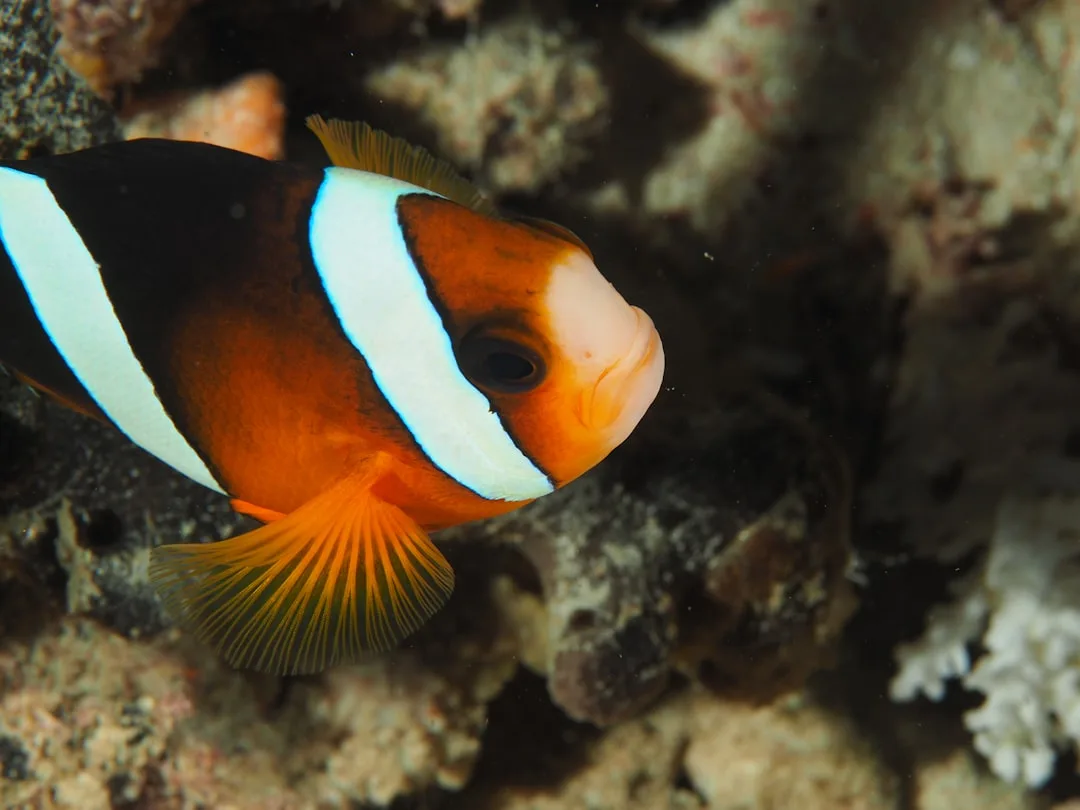
The clownfish is the most recognisable reef fish on Earth. Thanks to decades of documentary footage and one spectacularly successful animated film, the bright orange body and three white bars of Amphiprion ocellaris are globally associated with tropical coral reefs - even by people who could not identify any other reef species.
Behind that cultural familiarity sits a biology so strange that if it had been invented for fiction it would seem implausible. Every clownfish is born male. Some change sex. They live inside stinging anemones without being stung. Their social hierarchy is so rigid that subordinates deliberately stunt their own growth to avoid being evicted.
This guide covers every major aspect of clownfish biology and ecology: size and colouring, the symbiosis with sea anemones, diet, reproduction, sequential hermaphroditism, social hierarchy, species diversity, lifespan, and the conservation paradox created by the world's most famous fish cartoon. It is a reference entry, not a summary - so expect specifics: centimetres, depths, egg counts, and species names.
Etymology and Classification
The genus name Amphiprion comes from Greek, roughly translating as 'saw on both sides' - a reference to the serrated edges on the gill cover. The species epithet ocellaris means 'eye-like' and refers to the contrasting rings of colour along the body. 'Clownfish' is an informal English name referencing the bold, painted-on pattern; the alternative 'anemonefish' is more accurate biologically and is preferred in much of the scientific literature.
Clownfish sit inside the family Pomacentridae, the damselfishes, which contains more than four hundred species of small, territorial reef fish. Within that family they occupy the subfamily Amphiprioninae, comprising roughly thirty recognised species. Twenty-nine of those sit inside the genus Amphiprion, and one - the maroon clownfish - belongs to the monotypic genus Premnas, distinguished by a sharp cheek spine absent in the others.
The species Amphiprion ocellaris is sometimes called the 'false percula clownfish' because it was once confused with the genuine percula clownfish A. percula. The two look nearly identical but differ in fin ray counts, the thickness of the black outlining around the white bars, and subtle range boundaries. A. ocellaris is the species seen in 'Finding Nemo' and is by far the most common clownfish in the aquarium trade.
Size and Physical Description
Clownfish are small reef fish. Amphiprion ocellaris adults reach 7 to 10 centimetres in total length, with females consistently larger than males. The largest species in the family - the maroon clownfish Premnas biaculeatus - can exceed 17 centimetres.
Dimensions of a typical adult common clownfish:
- Length: 7-10 cm
- Weight: 15-30 g
- Body depth: 30-40% of standard length
- Lateral compression: pronounced, allowing weaving between tentacles
Coloration features:
- Body: bright orange to reddish-orange
- Bars: three vertical white bands outlined in black
- Fins: orange with black distal margins
- Eyes: ringed with black and white pigment
The three white bars are diagnostic. The first runs from the top of the head across the eye to the base of the pectoral fin. The second runs from the front of the dorsal fin across the mid-body to the belly. The third arcs across the tail base. The black outlining around each bar is thinner in A. ocellaris than in its close relative A. percula, which is the single most reliable visual distinction between the two.
Clownfish colouring is not camouflage. The bars and warm orange tones actually contrast strongly with the anemone background. Biologists believe the pattern functions as an aposematic warning - a visual advertisement to predators that this fish is nesting inside a bed of stinging tentacles and not worth pursuing.
Symbiosis with Sea Anemones
The relationship between clownfish and sea anemones is one of the most studied mutualisms in marine biology. Both species benefit, and neither thrives as well on its own in clownfish habitat.
How the clownfish survives contact with stinging cells:
The defining question of clownfish biology is how the fish lives unharmed among cnidocytes - specialised stinging cells - that routinely kill small reef fish that brush against them. The answer involves the mucus layer that covers the clownfish's body. This mucus is unusually thick and chemically distinct from the mucus of other reef fish.
It contains a protein profile that closely resembles the anemone's own surface chemistry, so the anemone's nematocysts fail to identify the fish as 'non-self' and never discharge.
This mucus protection is not innate - it is partly acquired. A juvenile clownfish that settles on a new anemone performs a ritualised acclimation dance on arrival, brushing short stretches of its body against the tentacles, then retreating, then returning with longer and longer contact.
Over several hours this rolling contact coats the fish's mucus in anemone-specific chemicals while conditioning the anemone to tolerate this individual. After acclimation the clownfish can swim freely through the tentacles without provoking a sting.
What the clownfish gains:
- Near-complete protection from predators - moray eels, groupers, and snappers cannot reach it
- Safe nesting substrate - the rock beside the anemone hosts the egg clutch
- Access to leftover prey captured by the anemone
What the anemone gains:
- Food scraps and nitrogen-rich waste that fertilises its symbiotic algae
- Aggressive defence against anemone predators - butterflyfish in particular
- Improved water circulation - the constant fin fanning of resident clownfish increases oxygen delivery to the tentacles
Anemones that host clownfish grow faster, produce more offspring, and survive bleaching episodes at higher rates than unpaired anemones of the same species.
Host anemone species:
| Anemone | Scientific name | Notes |
|---|---|---|
| Magnificent anemone | Heteractis magnifica | Most common host across Indo-Pacific |
| Giant carpet anemone | Stichodactyla gigantea | Large, dense host preferred in lagoons |
| Mertens' carpet anemone | Stichodactyla mertensii | Sprawling host on reef flats |
| Leathery sea anemone | Heteractis crispa | Shallower reefs, tolerant of lower salinity |
Amphiprion ocellaris specifically associates with Heteractis magnifica, Stichodactyla gigantea, and S. mertensii, though in captivity it will adopt almost any compatible anemone. Across the thirty clownfish species, roughly ten anemone species serve as hosts, and most clownfish specialise in only one or two.
Social Hierarchy Inside an Anemone
A single host anemone typically shelters one breeding pair plus two to four smaller non-breeding males, arranged in a rigid size-based hierarchy. The largest fish is always the breeding female. The second largest is always the breeding male. Below them sit subordinates in descending order of size.
The order is enforced by aggression and self-restraint:
The alpha female chases and nips at any subordinate that grows beyond an acceptable proportion of her own size. Subordinates respond to this aggression by deliberately suppressing their growth. Laboratory work has shown that subordinates eat less, convert food less efficiently, and release stress hormones that slow development when the female above them becomes aggressive. The result is a queue of stable-sized non-breeders waiting for a vacancy.
If the alpha female dies or is removed, the hierarchy reconfigures quickly:
- The breeding male transitions into a female over roughly two to six weeks.
- The largest non-breeder matures into a reproductively active male.
- All other subordinates move up one position.
This pattern - protandrous sequential hermaphroditism - is the single most unusual feature of clownfish biology and is covered in the next section.
Sequential Sex Change
Clownfish are protandrous sequential hermaphrodites. In plain terms: every individual is born male, and selected individuals change into females later in life. The trigger is social, not genetic. When the dominant female in an anemone dies, her breeding male partner begins a hormonal cascade that reshapes his reproductive system.
The transition process:
- Ovarian tissue that has been dormant since birth activates.
- Testicular tissue gradually regresses.
- Behaviour shifts - the new female becomes more aggressive and territorial.
- External size increases rapidly as she feeds more and suppresses subordinates less.
- Full functional female status is reached in two to six weeks.
The change is irreversible. A transitioned female cannot return to being male. This is the reason the social queue moves in only one direction: once the top slot is filled, the only way to join the breeding pair is to wait for another vacancy and then change sex.
The adaptive logic is straightforward. Clownfish live in tiny, isolated patches of habitat - a single anemone is their entire world. Travelling to find a mate means leaving the anemone and risking near-certain predation. By being born male, growing into a breeding male if a slot opens, and then becoming female if needed, every individual maximises their chance of reproducing without ever leaving home.
Reproduction and Parental Care
Clownfish are monogamous for life - or at least for as long as both members of the breeding pair survive. The pair spawns every two to three weeks during warm months, often synchronising with the lunar cycle.
The spawning sequence:
- Nest preparation. The male selects a patch of bare rock or dead coral immediately adjacent to the host anemone. He spends several days biting off algae, clearing debris, and polishing the surface with his fins.
- Courtship. The pair engage in ritualised display - fin flicks, chasing, and signal head-shakes. The female's belly swells noticeably with eggs.
- Egg deposition. The female deposits 100 to over 1,000 adhesive orange eggs in tight parallel rows while the male swims close behind fertilising each pass.
- Parental care - the male's job. From this point the male takes almost all parental duties.
Male care behaviour:
- Fans the clutch continuously with pectoral fins to oxygenate the eggs
- Removes dead, infertile, or fungus-infected eggs by mouth
- Guards the nest against nearby grazing fish and small invertebrates
- Maintains nesting site hygiene with regular mouth-cleaning of the substrate
Incubation and hatching:
- Duration: 6-10 days depending on water temperature (warmer water shortens incubation)
- Hatching: occurs at night, typically 2-3 hours after sunset
- Eggs change colour from orange to silver as embryos develop visible eyes
- Hatching synchronised to the new moon in many populations
The newly hatched larvae are tiny, transparent, and entirely planktonic. They drift on ocean currents for 8 to 12 days, feeding on rotifers and copepod nauplii. At the end of that pelagic phase they metamorphose, develop adult colouring, and return to the reef. Finding a host anemone is not random: larvae navigate using smell, sound, and the chemical signatures of hosts.
Studies have shown that clownfish larvae actively swim against currents toward the reef soundscape during their final settlement window.
Most larvae never make it. Estimates of pelagic mortality exceed 99%. The survivors settle onto an anemone - usually not the one their parents live on, since parental sites are already full - and enter the bottom of the local social hierarchy.
Diet and Feeding
Clownfish are opportunistic omnivores with a diet heavily weighted toward zooplankton drifting past the anemone.
Natural diet by approximate proportion:
- Zooplankton (copepods, larval crustaceans, tunicates): 60-70%
- Benthic algae and detritus: 15-20%
- Small invertebrates: 10-15%
- Anemone prey leftovers: 5-10%
Feeding behaviour centres on the host anemone. A clownfish rarely ventures more than a metre or two from the tentacles. It dashes out to grab a drifting particle, then retreats to the safety of the stinging cover before swallowing. This constant short-range shuttle is a major part of the species' activity budget and contributes to the nitrogen cycling that fertilises the anemone.
In captivity, clownfish accept virtually any small prepared food: flake, pellet, frozen mysis shrimp, frozen brine shrimp, and live copepods. Juveniles eat aggressively, consuming close to their own body mass per day during rapid growth phases. Adults eat far less and often pause feeding for days around spawning events.
Range and Habitat
Clownfish in general occupy the tropical Indo-Pacific. The common clownfish Amphiprion ocellaris occupies the eastern Indian Ocean, the Coral Triangle, and the western Pacific - including northern Australia, Indonesia, Malaysia, the Philippines, Papua New Guinea, the Solomon Islands, and southern Japan.
Habitat preferences:
- Sheltered lagoons, reef flats, and back-reef slopes
- Depths of 1-15 metres (occasionally to 30 metres)
- Water temperatures of 25-28 degrees Celsius
- Low-current microhabitats near anemones
- Clear tropical water with salinity near 35 ppt
Clownfish are not native to the Red Sea, the Atlantic Ocean, the Caribbean Sea, or the eastern Pacific. Different clownfish species occupy those regions - for instance, Amphiprion bicinctus in the Red Sea - but A. ocellaris is strictly Indo-Pacific. Aquarium suppliers occasionally mislabel fish, but no natural Atlantic population exists.
Individual fish rarely leave a home territory smaller than a square metre. A clownfish that is separated from its anemone by more than a few metres of open substrate is effectively stranded and usually does not survive long without another host.
Species Diversity
Roughly thirty species make up the clownfish clade. They differ in colour, pattern, size, and host anemone specificity.
Notable species:
| Species | Scientific name | Distinctive feature |
|---|---|---|
| Common clownfish | Amphiprion ocellaris | 'Finding Nemo' fish; thin black bar outlines |
| Percula clownfish | Amphiprion percula | Thicker black bar outlines |
| Maroon clownfish | Premnas biaculeatus | Largest; cheek spine present |
| Tomato clownfish | Amphiprion frenatus | Single white head bar; deep red body |
| Pink skunk clownfish | Amphiprion perideraion | Pale pink with a single dorsal white stripe |
| Clark's anemonefish | Amphiprion clarkii | Broadest host range of any clownfish |
| Saddleback clownfish | Amphiprion polymnus | Distinctive mid-body 'saddle' patch |
| Red Sea clownfish | Amphiprion bicinctus | Only clownfish in the Red Sea |
Most species are geographically restricted to a particular region of the Indo-Pacific, and several have only been formally described in the last two decades. New species are still being separated out of what was previously assumed to be single widespread taxa.
Lifespan and Longevity
Wild clownfish live 6-10 years on average, which is already unusual for a small reef fish - most damselfishes of comparable size live 3-5 years.
In captivity the numbers are dramatically higher:
- Well-kept aquarium specimens: 15-20+ years
- Verified record: 21+ years in private aquaculture collection
- Biologically possible ceiling: estimated 30 years based on senescence markers
Researchers have identified unusually low rates of cellular senescence in clownfish compared with similar fish. The leading explanation is low lifetime stress: clownfish live inside a safe anemone, never travel, breed on a predictable schedule, and have their position in the social hierarchy reinforced constantly rather than challenged. The handful of studies tracking telomere length and oxidative damage in long-lived breeders have shown markedly slower decline than in free-swimming reef fish.
Conservation Status and the 'Finding Nemo' Paradox
The IUCN Red List currently classifies Amphiprion ocellaris as Least Concern. The global population is large, the range is broad, and the species tolerates a variety of reef conditions.
That global rating masks severe localised problems. The 2003 release of Pixar's 'Finding Nemo' - a film whose moral was explicitly about not capturing wild reef fish - triggered a worldwide surge in clownfish pet demand. Reports from the aquarium trade documented a roughly 400% increase in collection requests in the year following the film's release. Much of that demand was met by collectors in Indonesia, the Philippines, and Vanuatu using destructive methods:
- Cyanide stunning, which damages reef tissue and kills non-target species
- Anemone removal with pry bars, destroying the host habitat permanently
- Over-collection of breeding pairs, leaving anemones permanently unoccupied
Subsequent reef surveys found that some local clownfish populations lost more than 70% of residents within a decade. In places where anemones themselves were removed, recovery has not occurred because the habitat is gone - not just the fish.
Other threats:
- Coral bleaching and anemone bleaching. Host anemones bleach like corals when water temperatures rise and expel their symbiotic algae. Bleached anemones contract, produce less food, and often starve to death - taking their resident clownfish with them.
- Ocean acidification. Falling pH affects larval navigation. Laboratory experiments show that acidic water disrupts clownfish larvae's ability to smell host anemones.
- Coastal development. Sediment runoff smothers shallow reefs where clownfish settle.
- Climate-driven range shifts. Host anemones are migrating poleward, but clownfish larvae may not disperse fast enough to track them.
The conservation picture has improved in one important way. Aquaculture now supplies more than 70% of the clownfish sold in the aquarium trade globally, and A. ocellaris was one of the first marine ornamentals to be fully captive-bred at commercial scale. Choosing captive-bred fish removes essentially all wild collection pressure.
Clownfish and Humans
The clownfish holds an unusual place in human culture. Before 2003 it was a well-known reef species familiar to divers and aquarium hobbyists. After 'Finding Nemo' it became - alongside the panda, the dolphin, and the great white shark - one of the handful of wild animals that virtually everyone on Earth can identify by sight.
That recognition has been a double-edged sword. Awareness has driven donations to reef conservation, eco-tourism demand in Indo-Pacific destinations, and school-age interest in marine biology.
It has also fuelled the pet trade pressure described above and created persistent misconceptions - most notoriously the idea that a clownfish separated from its father (as in the film) would be psychologically scarred, when in reality the surviving parent would simply change sex and pair up with a newcomer.
Reef tourism built around clownfish exists across Indonesia, the Philippines, Australia, and Fiji. Dive operators routinely advertise 'Nemo sites' - reef anemones with habituated clownfish that tolerate close observation. Responsible operators follow strict 'no touch' protocols, since handling damages the mucus layer that protects the fish from its host's sting.
Related Reading
- Seahorse: Male Pregnancy on the Reef
- Pufferfish: The Deadliest Delicacy
- Ocean Sunfish: The Heaviest Bony Fish Alive
- Remarkable Fish: The Most Extraordinary Species in the Sea
References
Relevant peer-reviewed and governmental sources consulted for this entry include IUCN Red List assessments for Amphiprion ocellaris, published research in Coral Reefs, Marine Biology, Proceedings of the Royal Society B, and Journal of Experimental Marine Biology and Ecology, Great Barrier Reef Marine Park Authority monitoring data, and CITES trade records for the marine ornamental aquarium industry. Taxonomic counts follow the most recent revisions published in Zootaxa.
Frequently Asked Questions
How big do clownfish get?
Adult common clownfish (Amphiprion ocellaris) reach 7-10 cm in total length, with females consistently larger than males. The largest species in the group is the maroon clownfish (Premnas biaculeatus), whose dominant females can exceed 17 cm. Weight is modest - typically 15-30 g - because clownfish bodies are laterally compressed for weaving between anemone tentacles.
Juveniles settle onto a host anemone at roughly 1 cm in length and grow rapidly in their first year before growth slows dramatically once social position stabilises.
How does the clownfish-anemone symbiosis work?
The relationship is mutualistic: both species benefit. Clownfish gain near-total protection from predators by sheltering among the anemone’s stinging tentacles. Their skin is coated in a specialised glycoprotein-rich mucus that chemically resembles the anemone’s own cells, which prevents its cnidocytes from firing.
In return, the anemone receives food scraps dropped during clownfish meals, nitrogen-rich waste that fertilises its symbiotic algae, aggressive defence against butterflyfish and other anemone predators, and improved water circulation as the fish fan oxygenated currents across the tentacles. Roughly ten anemone species host clownfish, and different clownfish species specialise in different hosts.
Do clownfish really change sex?
Yes. Clownfish are protandrous sequential hermaphrodites, meaning every individual is born male and the largest fish in a social group transitions into a female. Only one female exists per anemone, paired with one breeding male. When the alpha female dies or is removed, the breeding male’s ovarian tissue activates, his testicular tissue regresses, and within a few weeks he becomes a fully functional female.
The next-largest non-breeder then matures into the new breeding male. The sex change is irreversible - a transitioned female cannot return to being male - so the queue moves only one direction up the hierarchy.
Where do clownfish live?
Clownfish inhabit warm tropical waters across the Indo-Pacific, from the eastern Indian Ocean through the Coral Triangle to the western Pacific, including northern Australia, Indonesia, the Philippines, Papua New Guinea, the Solomon Islands, and southern Japan. They occupy coral reef flats, lagoons, and sheltered bays at depths between 1 and 15 metres, occasionally down to 30 metres.
Individual fish rarely leave the immediate vicinity of their host anemone - a territory that may span only a single square metre of reef. The common clownfish Amphiprion ocellaris does not naturally occur in the Red Sea or the Caribbean, despite persistent confusion from aquarium labelling.
How do clownfish reproduce?
Breeding pairs are monogamous and spawn every two to three weeks during warm months. The male prepares a patch of smooth substrate, usually a rock immediately adjacent to the host anemone, by biting away algae and debris. The female then deposits 100 to over 1,000 adhesive eggs in tight rows while the male fertilises them externally.
From that point the male takes over parental duties: he fans fresh water across the clutch with his pectoral fins, picks out dead or fungus-infected eggs, and defends the nest from intruders. After six to ten days of incubation the eggs hatch at night. Larvae drift in the plankton for eight to twelve days, then return to reefs to settle on a new anemone, often navigating by smell.
How long do clownfish live?
Wild clownfish typically live 6-10 years, which is already remarkable for a small reef fish of their size. In captivity, where they are shielded from predators, disease pressure, and storm damage, lifespans extend dramatically - documented aquarium specimens have passed 20 years, and longevity research suggests 30+ years is biologically possible.
Life-history studies have shown that clownfish show almost no signs of cellular senescence compared with similar-sized reef fish, which researchers attribute to their low-stress anemone-based existence and tight social hierarchy. The record for the oldest verified captive Amphiprion ocellaris exceeds two decades.
Are clownfish endangered?
The IUCN currently lists Amphiprion ocellaris as Least Concern, but this global assessment masks severe localised declines. The 2003 release of ‘Finding Nemo’ caused a worldwide spike in demand for pet clownfish - an estimated 400% increase in some markets - and much of that demand was met by collectors using cyanide and destructive methods on reefs in Indonesia, the Philippines, and Vanuatu.
Some local anemone populations lost more than 70% of their resident clownfish within a decade. Captive-breeding programs have since reduced wild collection pressure, and responsible aquarium trade now sources most clownfish from aquaculture. Climate-driven coral bleaching and anemone loss remain the more serious long-term threat.
What do clownfish eat?
Clownfish are opportunistic omnivores. Their natural diet is dominated by zooplankton - copepods, larval crustaceans, and tunicate larvae that drift past the host anemone - supplemented by benthic algae grazed from nearby rock, small invertebrates, and leftover scraps from anemone prey captures. They rarely stray more than a metre or two from the anemone to feed, darting out to grab passing particles and retreating to the tentacles between snatches.
In captivity they accept flake food, frozen mysis shrimp, brine shrimp, and pellets. Juveniles eat roughly their own body mass in food per day; adults need far less.