
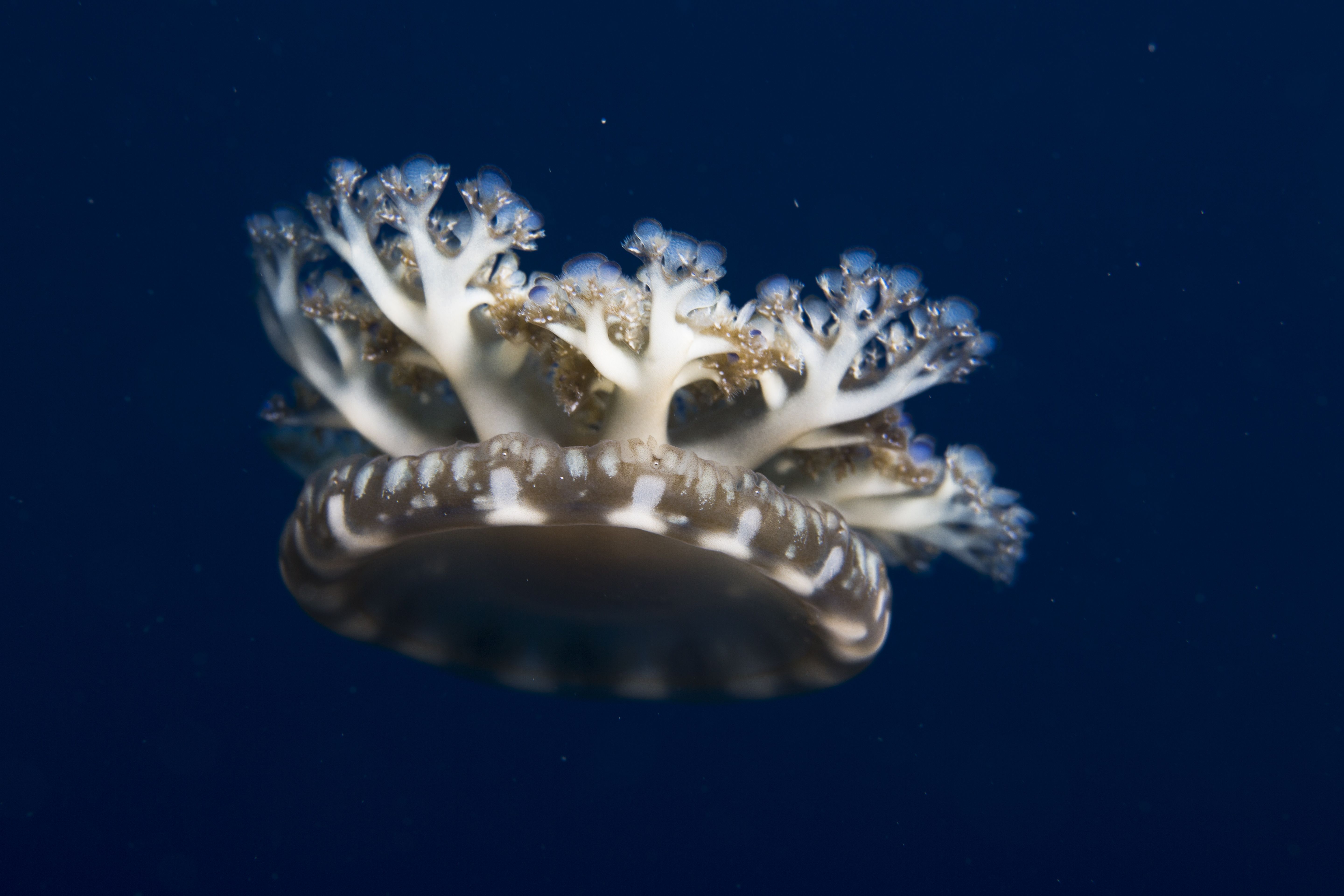
What is an upside-down jellyfish?
Upside-down jellyfish (genus Cassiopea) are a group of jellyfish species that live inverted - with their bells on the seafloor and their tentacles/oral arms facing upward toward sunlight. This unusual orientation is opposite to most jellyfish, which have tentacles below the bell.
Living Inverted to Grow Food
In a Caribbean mangrove lagoon, hundreds of jellyfish rest on the shallow seafloor. Unlike every other jellyfish you've seen, these are upside down, their bells pressed against the sand, their tentacles waving upward toward the sunlight.
They're not confused or injured. They're farming. Their tentacles contain symbiotic algae that need sunlight. By positioning themselves inverted, the jellyfish maximize light exposure for their algae, which in turn produce 60-70% of the jellyfish's food through photosynthesis.
This is the upside-down jellyfish (genus Cassiopea), an unusual species that inverts typical jellyfish biology to farm its own food.
The Animal
Upside-down jellyfish look different from typical jellyfish.
Physical features:
- Size: 15-30 cm across
- Color: yellow-brown to green (from algae)
- Position: inverted (bell on seafloor)
- Tentacles: face upward
- Oral arms: elaborate, branched
- Saucer-shape: compact body
The symbiotic algae:
Their distinctive color comes from:
- Zooxanthellae (photosynthetic algae)
- Present in tentacle tissues
- Gives yellow-brown-green color
- Same algae as in corals
The Photosynthetic Lifestyle
Their entire biology centers on algae symbiosis.
The symbiosis:
A mutualistic relationship between jellyfish and zooxanthellae:
Jellyfish provides:
- Protected habitat
- Nutrients from waste
- CO2 for photosynthesis
- Access to sunlight
- Stable conditions
Algae provides:
- Sugars from photosynthesis (60-70% of food)
- Oxygen production
- Color (yellow-brown-green)
- Carbon fixation
How it works:
- Jellyfish rests bell-down on seafloor
- Tentacles face upward to sunlight
- Algae photosynthesize in tentacles
- Algae produce sugars
- Jellyfish uses sugars for energy
- Both partners benefit
Sunlight dependency:
Without sunlight:
- Algae die
- Jellyfish gradually starves
- Relationship fails
- Individual dies
Why Upside Down?
The inverted position serves specific purposes.
Maximum light exposure:
- Tentacles face sun directly
- Perpendicular orientation optimal
- Light penetrates throughout tentacles
- Efficient photosynthesis
Alternative to typical jellyfish:
Most jellyfish:
- Bell up, tentacles below
- Drift passively
- Actively hunt prey
- Don't photosynthesize
Upside-down jellyfish:
- Bell down, tentacles up
- Stay on seafloor mostly
- Filter-feed small prey
- Rely on photosynthesis
Bottom-dwelling advantage:
- Stable substrate
- Maximum sunlight
- Avoid currents
- Protected from predators
Active during day:
- Opposite of many jellyfish
- Dependent on daylight
- Night activity reduced
- Solar-powered biology
Where They Live
Upside-down jellyfish inhabit warm shallow waters globally.
Preferred habitats:
Mangrove lagoons:
- Classic habitat
- Sheltered water
- Dense populations possible
- Key ecosystem role
Shallow bays:
- Protected water
- Sandy bottoms
- Shallow enough for light
- Common location
Tide pools:
- Warm water
- Limited movement
- Stable conditions
- Natural shelter
Seagrass beds:
- Adjacent to mangroves
- Shallow productive waters
- Complex habitat
- Abundant food
Geographic distribution:
Caribbean:
- Florida Keys
- Gulf of Mexico
- Caribbean islands
- Central American coasts
Indo-Pacific:
- Red Sea
- Indian Ocean tropics
- Southeast Asian waters
- Pacific tropical areas
Mediterranean:
- Some invasive populations
- Expanding range
- Climate-driven
- Monitoring ongoing
Diet and Feeding
Combined strategies support their energy needs.
Photosynthetic food:
60-70% of energy from algae:
- Sugars produced by photosynthesis
- Absorbed from algae
- Continuous supply
- Major food source
Active predation:
Remaining 30-40% from prey:
- Small zooplankton
- Invertebrate larvae
- Fish eggs and larvae
- Various small organisms
Feeding mechanism:
Tentacles and oral arms:
- Capture small prey
- Stinging cells (weak)
- Mucus traps particles
- Move to mouth
Protein supplement:
- Algae provide sugars
- Prey provides protein
- Essential for growth
- Complete nutrition
Metabolic flexibility:
- Can survive on algae alone for some time
- Prey supplementation improves health
- Adaptable feeding
- Efficient energy use
Reproduction
Upside-down jellyfish have complex breeding.
Reproductive cycle:
Similar to other jellyfish:
- Medusa stage (what we see)
- Release eggs and sperm
- Fertilization in water
- Larvae develop
- Settle as polyps
- Strobilation produces new medusae
Unique aspects:
Their polyps can:
- Clone asexually
- Produce many offspring
- Establish colonies
- Persist for years
Population dynamics:
- Rapid reproduction possible
- Dense aggregations form
- Local population explosions
- Climate-dependent timing
Life span:
- Medusa stage: 6-18 months
- Polyp stage: potentially long-lived
- Cycle continues: indefinitely
- Individual variation: significant
The Unusual Mucus Defense
Upside-down jellyfish release stinging mucus.
The mucus:
- Contains nematocysts (stinging cells)
- Released when disturbed
- Drifts in water
- Can sting swimmers
How it works:
When disturbed:
- Jellyfish releases mucus
- Mucus floats in surrounding water
- Swimmers pass through mucus
- Nematocysts fire on skin
- Mild sting results
Effect on swimmers:
- Mild tingling sensation
- Skin itching
- Brief discomfort
- Not medically concerning
Distinctive experience:
Sometimes called:
- "Invisible jellyfish"
- "Itchy water"
- "Phantom stings"
- "Mangrove itch"
Different from direct stings:
- Direct contact: minimal pain
- Mucus exposure: widespread itch
- Delayed onset possible
- Unique phenomenon
Sleep-like State
Upside-down jellyfish show remarkable biology.
Rest states:
Research has shown:
- Reduced activity at night
- Slower pulsing rates
- Response to sleep-related compounds
- Behavior resembling sleep
Scientific interest:
Despite having no brain:
- Exhibit sleep-like patterns
- Respond to sleep deprivation
- Show rest cycles
- Fascinating biology
Evolution of sleep:
- Suggests sleep evolved early
- Primitive rest state
- Basic biological need
- Research implications
Studies:
- Zebrafish comparison
- Sleep biology research
- Basic evolutionary studies
- Growing scientific interest
Research Applications
Upside-down jellyfish support diverse research.
Symbiosis studies:
Model for understanding:
- Coral-algae relationships
- Symbiotic partnerships
- Climate change impacts on symbiosis
- Bleaching mechanisms
Regeneration research:
- Can regrow damaged tissues
- Inform regenerative medicine
- Study growth mechanisms
- Medical applications
Climate change:
- Sensitive indicators
- Respond to temperature changes
- Show coral-like responses
- Early warning systems
Sleep biology:
- Despite lacking brain
- Show sleep-like behavior
- Evolutionary insights
- Basic biology research
Toxin research:
- Mild venom
- Chemical compounds
- Potential applications
- Therapeutic possibilities
Mangrove Ecosystem Role
Important in mangrove health.
Ecological functions:
- Filter water (feeding)
- Support other species
- Indicator species
- Nutrient cycling
Mangrove-jellyfish connection:
- Mangroves shelter them
- Jellyfish support ecosystem
- Mutual benefits
- Interdependent health
Tourism value:
- Mangrove tours feature them
- Educational opportunities
- Ecotourism draw
- Environmental awareness
Conservation indicator:
- Their health reflects mangrove health
- Monitoring focus species
- Warning system
- Environmental assessment
Invasive Populations
Some populations are spreading beyond native range.
Mediterranean invasion:
- Populations establishing
- Climate change enabled
- Expanding range
- Environmental concern
Other invasions:
- Various non-native areas
- Shipping transport
- Climate-related spread
- Management challenges
Environmental concerns:
- Affect local species
- Compete for resources
- Alter ecosystems
- Difficult to control
Response:
- Monitoring programs
- Early detection
- Public awareness
- Research ongoing
Climate Change Impact
Upside-down jellyfish may be affected by climate change.
Bleaching events:
Like corals:
- Algae can be expelled during stress
- Jellyfish loses color
- Nutritional crisis
- Can recover if stress ends
Temperature increases:
- Generally favorable (warm water)
- Extended range possible
- Longer active season
- Population increases possible
Ocean acidification:
- Affects symbiotic algae
- May disrupt relationships
- Future concerns
- Research needed
Population shifts:
- Expanding to new areas
- Climate-driven changes
- Ecosystem implications
- Monitoring essential
Comparison with Corals
Upside-down jellyfish share features with corals.
Similarities:
- Both host zooxanthellae
- Both depend on symbiosis
- Both live in warm shallow waters
- Both sensitive to bleaching
- Both contain stinging cells
Differences:
Corals:
- Sessile (attached permanently)
- Colonial organisms
- Complex colonies
- Reef-building
Upside-down jellyfish:
- Mobile (can move)
- Individual organisms
- No permanent structure
- Temporary positions
Scientific value:
- Model for studying corals
- Easier to manipulate
- Experimental animal
- Research applications
Human Encounters
Generally positive interactions.
For swimmers:
- Usually safe to observe
- Minor sting risk from mucus
- Fascinating to watch
- Cultural curiosity
For tourism:
- Mangrove tour highlight
- Photography subject
- Educational opportunity
- Environmental awareness
For research:
- Easy to study in field
- Accessible populations
- Sustainable research
- Scientific value
For aquariums:
- Popular display species
- Manageable in captivity
- Teaching opportunity
- Cultural appeal
Aquarium Care
Moon jellyfish are popular in aquariums, but upside-down jellies also get attention.
Requirements:
- Shallow tank with sunlight
- Sandy bottom
- Warm water (24-28°C)
- UV lighting (for algae)
- Stable conditions
Advantages:
- Relatively easy to maintain
- Beautiful appearance
- Educational value
- Cultural interest
Challenges:
- Need specific lighting
- Require stable conditions
- Sensitive to changes
- Specialized care
Public aquarium examples:
Many display them:
- Monterey Bay Aquarium
- Various educational facilities
- Themed exhibits
- Research institutions
Scientific Significance
Upside-down jellyfish matter to science.
Evolutionary biology:
- Alternative jellyfish strategy
- Symbiosis evolution
- Coral comparisons
- Success without typical predation
Symbiosis research:
- Model organism
- Easier than corals
- Experimental access
- Applied implications
Medical research:
- Regeneration studies
- Sleep biology
- Symbiotic relationships
- Cellular biology
Ecology:
- Mangrove ecosystem
- Indicator species
- Environmental health
- Climate change monitoring
Conservation
Upside-down jellyfish require environmental protection.
Threats:
Habitat loss:
- Mangrove destruction
- Coastal development
- Pollution effects
- Climate change
Pollution:
- Water quality degradation
- Chemical contamination
- Sediment issues
- Multiple impacts
Climate change:
- Temperature changes
- Bleaching risks
- Range shifts
- Long-term concerns
Protection:
- Mangrove conservation
- Marine protected areas
- Research and monitoring
- Public awareness
Status:
- Not formally threatened
- Populations generally stable
- Some regional concerns
- Monitoring essential
Why They Matter
Upside-down jellyfish represent unique biology.
Biological uniqueness:
- Alternative jellyfish lifestyle
- Photosynthetic symbiosis
- Inverted body orientation
- Mutualistic relationships
Ecological significance:
- Mangrove ecosystem health
- Indicator species
- Nutrient cycling
- Biodiversity maintenance
Scientific value:
- Research model
- Evolutionary study
- Symbiosis understanding
- Climate indicators
Cultural importance:
- Tourism highlights
- Educational value
- Aquarium displays
- Public fascination
The Farming Jellies
Every upside-down jellyfish resting in a mangrove lagoon is doing something no other jellyfish does, inverting its body to farm photosynthetic algae in its tentacles.
They could have evolved as typical jellyfish. Instead, they found a completely different niche. Their alternative biology works so well they've spread globally through warm shallow waters.
Their relationships with algae parallel corals. Their rest states offer insights into sleep evolution. Their regenerative abilities interest medical researchers. Their ecological roles support mangrove ecosystems.
In tropical coastal waters, they continue their unusual biology, resting upside down, tentacles skyward, photosynthetic algae producing food from sunlight, absorbing what they need while providing their algal partners with a protected home.
They demonstrate that evolution explores many paths. Not all jellyfish hunt aggressively. Not all need brains. Not all face upward. Some find better strategies by inverting everything and letting their microbial partners do the hard biological work.
Their mangrove homes remain crucial. Their photosynthetic partnerships continue. Their scientific value grows. And their unique lifestyle offers glimpses into alternative evolutionary possibilities that most marine biology textbooks barely mention but that ocean waters around the world clearly support.
The Cassiopea Genus and Species Diversity
The upside-down jellyfish comprise the genus Cassiopea, family Cassiopeidae, order Rhizostomeae, containing at least 10 recognized species distributed across warm shallow coastal seas. Our research team has summarized the known species with their ranges and distinguishing features.
| Species | Distribution | Bell Diameter | Distinguishing Trait |
|---|---|---|---|
| Cassiopea andromeda | Indo-Pacific, Red Sea | 30 cm | Original described species, 1775 |
| Cassiopea xamachana | Caribbean, Florida | 30 cm | Widely studied in research |
| Cassiopea frondosa | Caribbean | 25 cm | Bushy oral arm appendages |
| Cassiopea ornata | Indo-Pacific | 25 cm | Ornate oral arm lappets |
| Cassiopea ndrosia | Micronesia | 20 cm | Recently described |
| Cassiopea mayeri | Florida, Caribbean | 35 cm | Formerly synonym with xamachana |
| Cassiopea medusa | Fiji, Pacific islands | 18 cm | Small, island endemic |
| Cassiopea vanderhorstii | Indonesia | 15 cm | Dark pigmentation |
A 2018 molecular phylogenetic study by Morandini and colleagues, published in Marine Biodiversity, demonstrated that Cassiopea andromeda populations classified as a single species actually consist of multiple genetically distinct lineages, some of which have been invasively introduced to the Mediterranean Sea through Suez Canal transit and aquarium releases [1].
The Symbiotic Dinoflagellate Partnership
The photosynthetic productivity of upside-down jellyfish depends on endosymbiotic dinoflagellates of the family Symbiodiniaceae, the same group that partners with reef-building corals. These microscopic algae live inside the jellyfish's tissues, receive CO2 and waste nitrogen, and in return supply up to 90 percent of the host's metabolic energy through photosynthesis.
"The Cassiopea-Symbiodiniaceae partnership is a remarkable parallel to the coral-algae relationship but with distinct ecological context. Cassiopea can expel and re-acquire its symbionts more readily than hard corals can, which makes it one of our most powerful experimental models for studying the bleaching process in real time." - Dr. William Fitt, University of Georgia [2]
Fitt's laboratory has maintained continuous Cassiopea colonies for over 30 years, using them to track symbiont acquisition rates, thermal stress thresholds, and nutrient transfer dynamics. This body of work has directly informed coral reef climate-response research.
Cassiosomes and the Mucus Sting Phenomenon
A 2020 publication in Communications Biology by Cheryl Ames and colleagues at the Smithsonian National Museum of Natural History resolved a decades-old mystery about how upside-down jellyfish produce "itchy water" without direct contact. The research identified small free-swimming masses of stinging cells, called cassiosomes, which are released into the water column by the jellyfish's oral arms [3].
"Cassiosomes are essentially autonomous microscopic stinging grenades. Each one contains its own symbiotic algae, its own nematocyst battery, and enough metabolic machinery to remain active in the water for ten days. This is the first documented example of a cnidarian releasing self-propelled, biologically autonomous stinging structures." - Dr. Cheryl Ames, Smithsonian National Museum of Natural History [3]
The cassiosomes swim using cilia, locate potential prey through chemical detection, and discharge nematocysts on contact. This system allows upside-down jellyfish to hunt small organisms at a distance without leaving their resting posture, solving the functional problem of how a sessile-appearing animal maintains predatory feeding.
References
- Morandini, A. C., Stampar, S. N., Maronna, M. M., & Da Silveira, F. L. (2017). All non-indigenous species were introduced recently? The case study of Cassiopea (Cnidaria: Scyphozoa) in Brazilian waters. Journal of the Marine Biological Association of the United Kingdom, 97(2), 321-328. DOI: 10.1017/S0025315416000400
- Fitt, W. K., & Trench, R. K. (1983). The relation of diel patterns of cell division to diel patterns of motility in the symbiotic dinoflagellate Symbiodinium microadriaticum Freudenthal in culture. New Phytologist, 94(3), 421-432. DOI: 10.1111/j.1469-8137.1983.tb03456.x
- Ames, C. L., Klompen, A. M. L., Badhiwala, K., et al. (2020). Cassiosomes are stinging-cell structures in the mucus of the upside-down jellyfish Cassiopea xamachana. Communications Biology, 3, 67. DOI: 10.1038/s42003-020-0777-8
- Nath, R. D., Bedbrook, C. N., Abrams, M. J., et al. (2017). The jellyfish Cassiopea exhibits a sleep-like state. Current Biology, 27(19), 2984-2990. DOI: 10.1016/j.cub.2017.08.014
Related Articles
- Moon Jellyfish: The Most Recognizable
- Portuguese Man o' War: The Floating Colony
- Coral Reefs: The Rainforests of the Sea
Frequently Asked Questions
What is an upside-down jellyfish?
Upside-down jellyfish (genus Cassiopea) are a group of jellyfish species that live inverted - with their bells on the seafloor and their tentacles/oral arms facing upward toward sunlight. This unusual orientation is opposite to most jellyfish, which have tentacles below the bell. Their tentacles serve as light-gathering surfaces because they contain symbiotic algae (zooxanthellae) that photosynthesize - the jellyfish effectively ‘farms’ its own food.
The jellyfish positions itself to maximize sunlight exposure for the algae, which in return provide 60-70% of the jellyfish’s energy. They reach 15-30 cm across and live primarily in warm shallow waters. Their common name ‘upside-down jellyfish’ perfectly describes their lifestyle. Eight species are currently recognized in the genus Cassiopea, found globally in tropical and subtropical shallow waters.
They’re especially abundant in mangrove lagoons, shallow bays, and tide pools. Their unique lifestyle has made them subjects of ecological and symbiotic research.
How do upside-down jellyfish photosynthesize?
Upside-down jellyfish don’t photosynthesize themselves - they host symbiotic algae (zooxanthellae) that photosynthesize on their behalf, creating a mutually beneficial relationship.
The process works as follows: microscopic algae (zooxanthellae) live inside the jellyfish’s tissues, particularly concentrated in the tentacles, algae use sunlight to photosynthesize (converting CO2 and water into sugars), jellyfish tissues benefit from these photosynthetic products, algae receive protected habitat and nutrients from jellyfish waste, both partners benefit mutually.
The jellyfish positions itself upside-down specifically to maximize algae’s light exposure. Without sunlight, the algae die and the jellyfish gradually starves. This photosynthetic relationship provides approximately 60-70% of the jellyfish’s energy needs. They can also capture small prey with their stinging cells for additional protein.
This symbiosis is similar to coral relationships, and upside-down jellyfish are sometimes called ‘mobile corals.’ Their algae give them yellow-brown to green coloration, the specific pigment of their symbiotic partners. Scientists study this relationship to understand symbiotic biology and potential applications.
Where do upside-down jellyfish live?
Upside-down jellyfish inhabit warm shallow tropical and subtropical waters worldwide, particularly in mangrove lagoons, shallow bays, and tide pools. They prefer: warm waters (24-30°C), shallow depths (typically under 5 meters for maximum sunlight), clear water (for photosynthesis), low wave action (they need to rest on bottom), and stable bottom conditions.
Their global range includes: Florida Keys (significant populations), Caribbean Sea, Gulf of Mexico, Red Sea, Indian Ocean tropical regions, Southeast Asian waters, Central Pacific tropical areas, and various coastal tropical zones. They are especially abundant in: mangrove forests and lagoons, sheltered bays, tide pools, seagrass beds, shallow coral areas, and some freshwater/brackish environments.
Their shallow water preference serves their photosynthetic needs - deeper water has less light. They are often found in dense aggregations, sometimes covering entire mangrove lagoon floors. Their presence indicates healthy mangrove or lagoon ecosystems. Some populations have invaded non-native regions, particularly around Mediterranean coastlines where they’re becoming invasive species.
Do upside-down jellyfish sting humans?
Upside-down jellyfish can sting humans but cause only mild reactions compared to other jellyfish. Their stings: cause brief mild tingling or burning sensation, produce minor redness or itching, symptoms typically resolve within hours, rarely cause severe reactions, and are generally not medically concerning. Unlike dangerous jellyfish (box jellyfish, Portuguese men o’ war), upside-down jellyfish pose minimal risk to swimmers.
However, they can be uncomfortable for sensitive individuals. Their interesting feature: released mucus can continue stinging even after the jellyfish is gone. They release mucus during feeding or disturbance, which contains nematocysts that drift in the water, sometimes stinging swimmers who enter an area where jellyfish have been active. This ‘invisible itch’ phenomenon can cause skin irritation without visible jellyfish contact.
Symptoms are still mild and self-limiting. Swimming in areas with many upside-down jellyfish may cause temporary skin discomfort. Mangrove tours in upside-down jellyfish areas sometimes warn tourists about this phenomenon. For most people, upside-down jellyfish remain safe to observe and swim around, though they’re sometimes called ‘stinging jellyfish’ due to the mucus-induced itch.
Why are upside-down jellyfish important?
Upside-down jellyfish are ecologically and scientifically significant for multiple reasons. They’re indicators of mangrove ecosystem health - their presence and abundance reflects environmental conditions. They support: mangrove ecosystems (nutrient cycling), scientific research (symbiosis studies), ecological monitoring, and climate change research.
Their symbiotic relationships with zooxanthellae make them models for studying: coral-algae relationships, climate change effects on symbioses, photosynthetic efficiency research, and evolution of symbiotic partnerships.
They also have research applications in: regenerative biology (they can regrow lost parts), sleep research (they show sleep-like states despite no brain), toxin studies (despite mild venom, they produce interesting compounds), and bioluminescence research. Economically, they: support tourism (mangrove tours feature them), appear in aquariums worldwide, interest recreational divers, and serve as educational subjects.
Their sensitivity to environmental changes makes them important indicator species for coastal ecosystem health. As climate change affects shallow tropical waters, upside-down jellyfish responses help researchers understand broader ecosystem impacts. Their unique lifestyle has also inspired scientific curiosity about alternative evolutionary strategies and symbiotic relationships.