
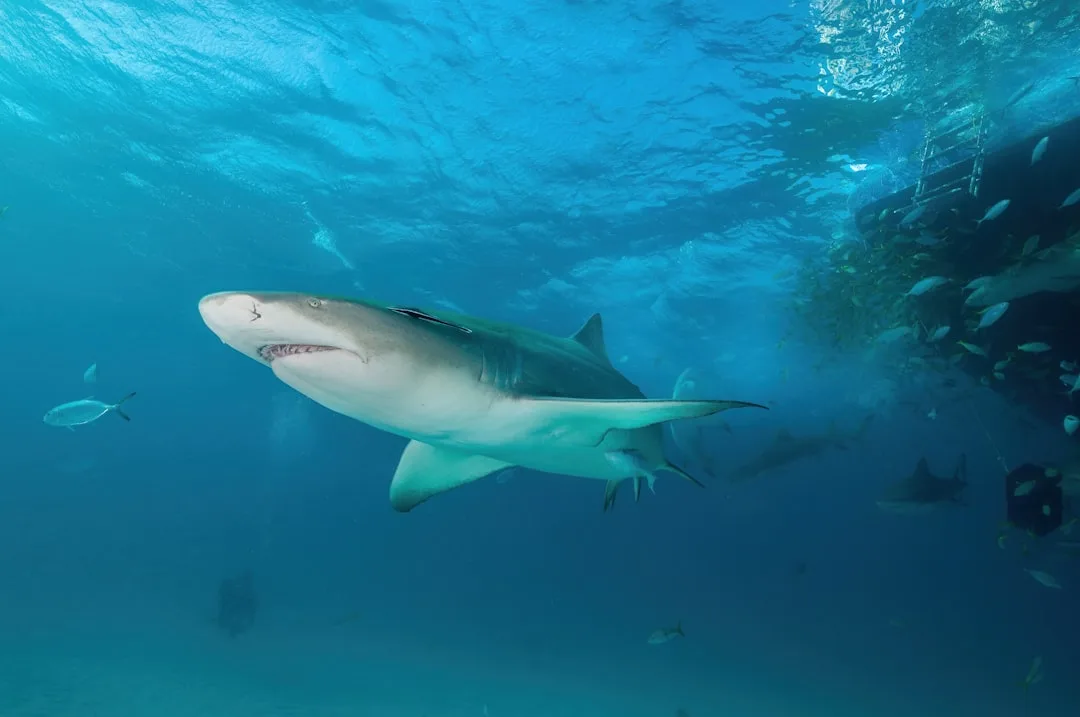
The bull shark is the most ecologically flexible large shark on Earth. It is the only widely distributed shark that routinely leaves the sea, swims thousands of kilometres up rivers, and lives indefinitely in pure freshwater.
It is also one of the three species most consistently involved in serious attacks on humans, alongside the great white and the tiger shark - and in most regional statistics it outranks both for coastal incidents. Carcharhinus leucas occupies an ecological niche almost no other apex predator can touch: shallow, murky, brackish, warm, crowded coastal water and the river systems that drain into it.
This guide covers bull shark biology and ecology in depth: taxonomy, anatomy, the rare physiology that lets the species move between salt and fresh water, hunting style, reproduction, range, conservation status, and the long history of encounters with people. It is a reference entry, not a summary - expect specifics: kilograms, kilometres, testosterone, bite force, and verified records.
Etymology and Classification
The scientific name Carcharhinus leucas was established by the Swiss-French naturalists Jean Louis Rodolphe Agassiz and Henri-Marie Ducrotay de Blainville in the 1830s, working from a specimen collected in the Mediterranean. Carcharhinus combines Greek roots meaning 'sharp-nosed', while leucas means 'white' - a reference to the pale underside that is standard in coastal requiem sharks.
The English name 'bull shark' comes from the animal's stocky, blunt-headed build and its documented habit of head-butting prey and intruders.
Regionally the same species is known as the Zambezi shark in southern Africa, the Lake Nicaragua shark in Central America, the Swan River whaler in Western Australia, and the Ganges shark in parts of India - though that last name properly belongs to a different, critically endangered species, Glyphis gangeticus.
Bull sharks belong to the order Carcharhiniformes, the ground sharks, and within that order to the family Carcharhinidae, the requiem sharks. Their closest relatives are the other large coastal Carcharhinus species - the dusky shark, the sandbar shark, and the blacktip shark. Genetic work suggests the bull shark lineage diverged early within Carcharhinus and has remained morphologically conservative for several million years.
Size and Physical Description
Bull sharks are built for power rather than speed. Compared to the streamlined bodies of mako or blue sharks, a bull shark is barrel-shaped, with a disproportionately large head, short blunt snout, small eyes, and heavy pectoral and caudal fins.
Females:
- Length: 2.4-3.5 metres typical, up to approximately 4 metres
- Weight: 180-300 kg typical, record around 315 kg
- Consistently larger than males at equivalent age
Males:
- Length: 2.0-2.5 metres typical
- Weight: 130-200 kg typical
- Mature at smaller size than females
Newborn pups:
- Length: 55-80 cm
- Weight: 3-5 kg
- Born fully formed and independently mobile
The dentition is classic for a macropredator. Upper teeth are broad, serrated triangles for slicing; lower teeth are narrower and designed for grip. Bite force has been measured at approximately 1,350 pounds per square inch at the front teeth, among the highest recorded in any shark relative to body size. The skin is covered with tightly packed placoid scales - dermal denticles - that reduce drag and resist abrasion on river bottoms and reef structures.
Colouration is an unremarkable countershade: grey to grey-brown above, white below, occasionally with darker tips on the pectoral fins in juveniles. This camouflage is optimised for the species' preferred ambush environment - turbid coastal and estuarine water where visibility is measured in centimetres rather than metres.
Osmoregulation: The Freshwater Trick
The single most distinctive feature of bull sharks is their ability to survive indefinitely in freshwater. Almost every other large marine shark that enters a river dies within days. Bull sharks do not.
The mechanism is a combination of three adaptations:
Kidney function. Bull shark kidneys actively recycle urea and retain salts when the animal is in low-salinity water. Marine sharks normally use retained urea to maintain body fluid concentration above seawater - a strategy that breaks down in freshwater because urea diffuses out. Bull sharks can down-regulate urea retention on demand.
Rectal gland. All sharks possess a rectal gland that dumps excess salt when the animal is in seawater. In bull sharks this gland is unusually active and can be rapidly scaled up when the animal returns to the sea, flushing accumulated salt load within hours.
Liver and blood chemistry. The bull shark liver produces and releases osmotically active compounds that buffer blood plasma across salinity ranges. Blood urea concentrations drop by up to 50% when the animal is in freshwater and rebound within days when it returns to sea.
The practical result is that bull sharks can move from the ocean into a river, and back again, faster than any other large shark. They do not need transitional brackish zones - though they often linger in them - and they show no measurable stress in pure freshwater. This is called euryhalinity, and while it is common in small fish, it is almost unique among macropredators above 100 kg.
River Penetrations and Lake Populations
Because of their freshwater tolerance, bull sharks turn up in places that seem biologically impossible. The following are verified records:
| River or lake | Country or region | Distance from sea / notes |
|---|---|---|
| Mississippi River | United States | Illinois (Alton), ~1,750 km, 1937 record |
| Amazon River | Brazil / Peru | Iquitos, ~4,000 km upstream |
| Zambezi River | Mozambique to Zambia | Hundreds of km upstream past gorges |
| Lake Nicaragua | Nicaragua | Reached via San Juan River rapids |
| Ganges / Brahmaputra | India / Bangladesh | Hundreds of km inland, often misidentified |
| Tigris-Euphrates | Iraq | Historic records from Baghdad, ~200 km |
| Swan River | Western Australia | Regular breeding population in Perth |
| Breede River | South Africa | Recent satellite-tag confirmations |
The Mississippi record, from Alton, Illinois, in 1937, is the species' poster case. A pair of fishermen caught a 2.4 m bull shark that had apparently swum from the Gulf of Mexico up the Mississippi and Illinois River systems over an undetermined period. The Lake Nicaragua case, meanwhile, forced ichthyologists to retract an earlier species description.
For decades biologists believed Lake Nicaragua hosted a distinct freshwater shark, Carcharhinus nicaraguensis, until tagging studies in the 1960s proved the lake sharks were simply bull sharks that had swum up the San Juan River, jumping rapids like salmon.
Zambezi bull sharks are responsible for most of the 'river shark' attacks in southern Africa. Breeding populations now live permanently in the Swan River in Perth, Australia, where they form one of the best-studied urban shark populations in the world.
Hunting and Diet
Bull sharks are opportunistic carnivores with one of the broadest diets of any shark. Their preferred environment - turbid coastal water, estuaries, river mouths, and shallow reefs - provides a constantly shifting prey base that rewards dietary flexibility.
Primary prey:
- Bony fish: mullet, tarpon, mackerel, catfish, snapper
- Rays and skates
- Smaller sharks, including juvenile bull sharks (cannibalism)
Secondary and opportunistic prey:
- Sea turtles and freshwater turtles
- Dolphins (usually injured or juvenile)
- Seabirds and waterfowl
- Crustaceans and molluscs
- Terrestrial mammals that enter water - dogs, livestock, antelope, even crocodiles
Hunting style is distinctive. Bull sharks do not pursue prey at high speed over long distances. They exploit murky water as cover, moving slowly until close, then strike with an initial investigative head-butt or ram before circling and biting.
The head-butt is thought to assess the size, texture, and resistance of the target - an adaptation to hunting in water too dark for reliable visual identification. Once committed, the bite is delivered with exceptional force and rarely released voluntarily.
In freshwater systems, bull sharks feed heavily on catfish, cichlids, and introduced game fish. In estuarine nurseries, juveniles feed on small fish and crustaceans. Large adults in coastal reefs will take rays, turtles, and smaller sharks - including their own species. Cannibalism is well documented, both in wild populations and in captivity, where it has caused problems for aquaria attempting to hold multiple bull sharks in a single tank.
Bite force measurements are among the highest recorded in any shark. A 2012 study on captive bull sharks recorded bite forces of approximately 6,000 newtons at the front teeth - equivalent to around 1,350 pounds per square inch - and considerably higher relative to body mass than in great whites.
Aggression and Testosterone
Bull sharks are routinely described in older literature as the most aggressive shark. More recent work suggests the label is oversimplified, but the underlying behaviour is real. Captive bull sharks are notoriously difficult to house. Wild bull sharks defend territories, approach divers repeatedly, and investigate stimuli by ramming.
Researchers have measured testosterone concentrations in bull shark blood that are among the highest recorded in any vertebrate - higher than African elephants in musth and far higher than typical male mammals. Whether this directly drives aggression or simply correlates with the species' overall physiology is still debated. Both male and female bull sharks show elevated testosterone, and the hormone plays roles in wound healing, musculature, and reproductive behaviour beyond aggression.
The aggressive reputation is also partly a product of habitat. Bull sharks live where humans enter water most: warm, shallow, murky coasts, rivers, and harbours. Encounter rates are correspondingly high, and a shark that approaches a human in knee-deep muddy water looks more aggressive than one that swims past a scuba diver at thirty metres.
Reproduction and Nurseries
Bull sharks are viviparous. Females carry embryos internally, connected to the mother by a yolk-sac placenta, for 10 to 11 months. Litter size is usually 6 to 13 pups, born fully formed at 55-80 cm and ready to hunt small fish within days. Births occur in warm months, timed to maximise nursery productivity.
The defining feature of bull shark reproduction is the freshwater nursery. Unlike most sharks, which pup in open coastal water, bull sharks select estuaries, river mouths, and the lower reaches of rivers as birth and juvenile habitat. Classic nurseries include the lower Mississippi, Mobile Bay, the Indian River Lagoon, the Zambezi Delta, the Swan River, and the Brisbane River.
Young sharks stay in these brackish to fully fresh environments for three to five years before gradually moving to saltier water. The strategy is straightforward: large marine predators, including other sharks, cannot tolerate the low salinity, so nursery mortality is dominated by weather, food limitation, and human fishing rather than predation.
Sexual maturity is reached slowly. Males mature at 14-15 years and around 1.8 m. Females mature at 15-20 years and around 2.0 m. Reproductive frequency is once every two years at best. Combined with small litter size, this makes the species demographically fragile - a fully mature female will produce fewer than 100 pups in her lifetime, and most will not survive to maturity.
Range and Movement
Bull sharks inhabit tropical and warm-temperate coasts of every major ocean. The species is circumtropical, effectively found wherever water temperatures remain above 20 degrees Celsius year-round.
Typical geographic distribution:
| Ocean basin | Key range |
|---|---|
| Western Atlantic | Massachusetts to southern Brazil, Gulf of Mexico |
| Eastern Atlantic | Morocco to Angola |
| Indian Ocean | Persian Gulf, East Africa, South Asia, Australia |
| Western Pacific | Japan to eastern Australia, Pacific islands |
| Eastern Pacific | Baja California to Ecuador |
Individual movement patterns combine short local residence with long seasonal migration. Tagged bull sharks in the Gulf of Mexico move hundreds of kilometres between summer and winter grounds. Sharks tagged on the east coast of Australia have been documented travelling more than 2,000 km along the coast in under a year. In river systems, movement can be vertical as well as horizontal, with sharks shifting between deep pools and shallow flats as water levels change.
Bull sharks are almost always found in water less than 30 metres deep, and most records are from less than 10 metres. They tolerate temperatures from 15 to 32 degrees Celsius but prefer 20 to 28 degrees. They are strongly associated with soft bottoms, estuarine mudflats, and mangrove fringes rather than clear-water coral reefs - although they visit reefs, they rarely dominate them the way great whites or tiger sharks do.
Conservation Status and Threats
The IUCN reassessed bull sharks in 2020 and uplisted the species from Near Threatened to Vulnerable, with a decreasing global population trend. Regional declines are steeper than the global figure suggests: populations in parts of the Gulf of Mexico, the Caribbean, and South-east Asia are estimated to have fallen by 50 per cent or more in the last three generations.
Primary threats:
- Fisheries. Bull sharks are taken in commercial and artisanal fisheries for meat, fins, skin, and liver oil. Because they are large, coastal, and abundant in developing-country fisheries, they are easy to catch and hard to monitor.
- Bycatch. Gillnets, longlines, and trawls set for teleost fish routinely kill bull sharks, often juveniles in nursery estuaries.
- Habitat loss. Estuarine and riverine nurseries are being filled, dredged, polluted, and dammed worldwide. Loss of nursery habitat reduces recruitment directly and permanently.
- River damming. Large dams cut off upstream migrations and destroy traditional nursery reaches. The Zambezi and Mississippi are both substantially altered from historical shark-accessible states.
- Targeted culling. Bull sharks are killed deliberately in beach protection programmes in Australia, South Africa, and Reunion, and on a smaller scale in the Gulf of Mexico.
- Pollution. Estuarine nurseries concentrate agricultural runoff, industrial effluent, and heavy metals, with documented bioaccumulation in juvenile sharks.
International trade is not currently regulated under CITES for bull sharks, although proposals for listing have been raised and the species shares fisheries with several already-listed requiem sharks. Most national regulation is weak, and enforcement in the developing-country fisheries that take most bull sharks is poor.
Slow growth, late maturity, small litters, and dependence on vulnerable nursery habitat make bull sharks demographically fragile. Recovery from regional depletion takes decades even with full protection.
Bull Sharks and Humans
Bull sharks are consistently ranked alongside great whites and tiger sharks as one of the three shark species most dangerous to humans. In most coastal attack statistics, bull sharks account for a larger share of unprovoked bites than either of the other two, simply because they live where people swim.
The International Shark Attack File lists bull sharks as responsible for more than 100 recorded unprovoked attacks globally, with more than 25 fatalities - though the true totals are likely higher because many attacks in turbid water cannot be confidently attributed to species.
Most attacks occur in the following circumstances:
- Shallow water with poor visibility (under one metre)
- Near river mouths, canals, or harbours
- At dawn or dusk
- When fishing activity is attracting prey close to shore
- In water temperatures above 20 degrees Celsius
The classic interpretation is mistaken identity - a bull shark in murky water investigates a human silhouette, treats it as potential prey, and delivers an initial bite that is not then pressed home. Many bull shark attacks involve a single bite and immediate disengagement, consistent with this model. However, bull sharks have also been documented in sustained attacks and in cases of apparent predation on injured or bleeding people, so mistaken identity is not the full explanation.
The 1916 Jersey Shore attacks in the United States - the inspiration for the novel Jaws - remain formally unresolved, but bull sharks are the most likely suspects for the inland river fatalities in Matawan Creek, New Jersey, which occurred roughly 25 km from the sea in brackish water.
Beach protection programmes in Australia (Queensland, New South Wales), South Africa (KwaZulu-Natal), and Reunion Island kill hundreds of bull sharks each year, though effectiveness at reducing attacks is contested and the ecological costs are substantial.
Related Reading
- Bull Shark: The Most Aggressive Shark That Swims in Rivers
- Sharks: The Ocean's Most Misunderstood Predators
- Do Sharks Actually Attack Humans
- How Many People Do Sharks Kill Per Year
- Tiger Shark: The Garbage Eater of the Seas
References
Peer-reviewed and governmental sources consulted for this entry include the IUCN Red List 2020 reassessment of Carcharhinus leucas, Heupel and Simpfendorfer's long-term nursery studies in north-eastern Australia, Thorson's 1960s Lake Nicaragua tagging programme, Pillans and Franklin's work on osmoregulatory physiology, and recent population genetics published in Marine Ecology Progress Series and Molecular Ecology.
Attack statistics draw from the International Shark Attack File maintained at the Florida Museum of Natural History.
Frequently Asked Questions
How big do bull sharks get?
Adult bull sharks (Carcharhinus leucas) typically measure 2.0-3.5 m and weigh 130-300 kg, with females considerably larger than males - a common pattern among requiem sharks. The largest verified specimens reach about 4 m and around 315 kg. Newborn pups are 55-80 cm and weigh 3-5 kg.
The species is not the longest shark in its habitat, but its stocky, barrel-shaped build and disproportionate head and jaw muscles make it pound-for-pound one of the most powerful coastal sharks, with a measured bite force around 1,350 pounds per square inch at the front teeth.
What do bull sharks eat?
Bull sharks are opportunistic generalist carnivores. Their diet varies with habitat but typically includes bony fish (mullet, catfish, tarpon), rays, smaller sharks (including other bull sharks), sea turtles, dolphins, seabirds, crustaceans, and occasionally terrestrial mammals that enter the water. In freshwater systems they feed heavily on catfish and other river fish.
Their hunting style combines ambush in murky water with head-butting investigative strikes followed by a crippling bite. Because they tolerate low visibility, brackish conditions, and shallow water better than any other large shark, bull sharks exploit food niches unavailable to great whites, tigers, or hammerheads.
How do bull sharks survive in freshwater?
Bull sharks survive in freshwater through a combination of rare physiological adaptations. Their kidneys recycle urea and retain salts when in freshwater, while a specialised rectal gland excretes excess salt when the animal returns to the sea. Their liver produces osmotically active compounds that stabilise body fluids across salinity ranges.
Unlike salmon, which require slow transitional adjustment, bull sharks can move between full seawater and pure freshwater within hours and show no measurable stress. This ability has been studied experimentally since the 1960s and remains one of the clearest examples of euryhalinity in a large marine predator.
Where do bull sharks live?
Bull sharks have the widest environmental tolerance of any shark. They are found in tropical and subtropical coastal waters of every major ocean - the western Atlantic from Massachusetts to southern Brazil, the eastern Atlantic from Morocco to Angola, the Indian Ocean from the Persian Gulf and southern Africa across to Australia, and the Pacific from Baja California to Ecuador and from Japan to eastern Australia.
They routinely enter estuaries, harbours, bays, and rivers. Documented penetrations include the Mississippi to Illinois, the Amazon more than 4,000 km inland, the Zambezi into Zimbabwe, the Ganges and Brahmaputra in India, and Lake Nicaragua via the San Juan River.
Are bull sharks dangerous to humans?
Bull sharks are considered among the three most dangerous sharks to humans, alongside great whites and tiger sharks, and are responsible for more inshore and coastal attacks than either. Most bull shark attacks occur in shallow, turbid water - exactly the environments where people swim, surf, wade, and fish.
Poor visibility, high testosterone-linked aggression, strong territoriality, and willingness to enter fresh or brackish water combine to make encounters disproportionately likely. Most attacks are believed to be cases of mistaken identity rather than predation, but the species’ size and bite force mean such bites are frequently severe.
How do bull sharks reproduce?
Bull sharks are viviparous - females carry embryos internally, nourished by a yolk-sac placenta, and give birth to live young after a 10-11 month gestation. Litters usually contain 6-13 pups. Nurseries are located almost exclusively in freshwater or brackish estuaries, rivers, and coastal lagoons, where young sharks are protected from ocean predators such as larger sharks.
Juveniles remain in these nurseries for several years before moving progressively to saltier water as they grow. Sexual maturity is reached at roughly 15-20 years for females and 14-15 for males. Females reproduce every other year.
How long do bull sharks live?
Wild bull sharks typically live 12-16 years, with some individuals reaching 20 or more. They grow slowly and mature late, which makes populations vulnerable to fishing pressure. Juvenile mortality is high in nursery rivers due to predation, drought-driven strandings, and human capture. Once past the first 1-2 years, survival rates improve significantly.
Aging is done by counting growth rings in the vertebrae, and recent studies suggest older published maximum ages may be underestimates because ring deposition slows in large adults.
Are bull sharks endangered?
The IUCN reassessed bull sharks in 2020 and uplisted the species from Near Threatened to Vulnerable with a decreasing global trend. Principal threats include targeted and bycatch fishing for meat, fins, and sport; destruction of estuarine nursery habitat; river damming that cuts off upstream migration; and pollution concentrating in coastal nurseries. Their slow maturation and low reproductive output make recovery from population declines extremely slow.
Local declines of 50% or more have been recorded in parts of the Gulf of Mexico, the Caribbean, and South-east Asia. International trade is not yet regulated under CITES, though listing has been proposed.