
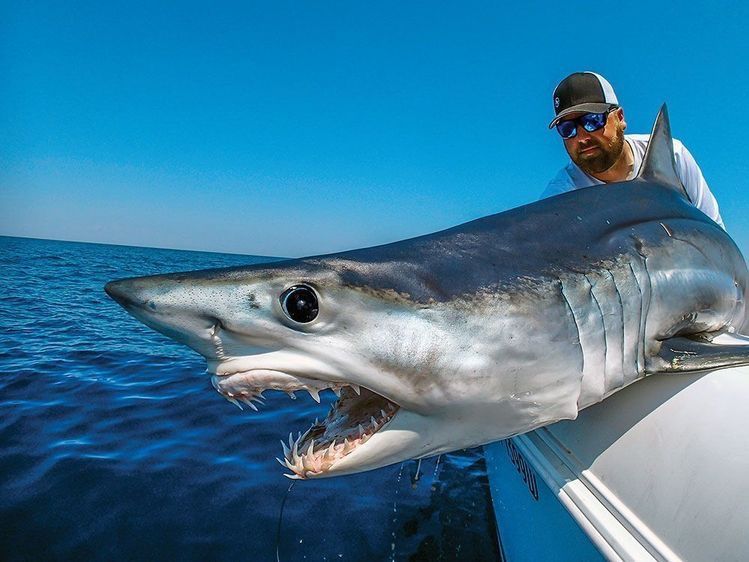
How fast is a mako shark?
Shortfin mako sharks (Isurus oxyrinchus) can reach burst speeds of 74 km/h (46 mph), making them the fastest sharks on Earth. Their typical cruising speed is 35 km/h. Measuring their top speed is difficult because they're fast and unpredictable, but multiple scientific methods have confirmed speeds over 70 km/h.
74 km/h Through the Water
A sport fisherman hooks something large in Pacific waters off California. His rod bends violently. Before he can react, a 3-meter shark launches entirely out of the water 9 meters high. It performs an aerial somersault, crashes back into the water, and attempts to swim away at speeds approaching 74 km/h.
This is a shortfin mako (Isurus oxyrinchus), the fastest shark on Earth and one of the fastest fish in any ocean. It combines explosive speed with spectacular leaping abilities, making it the most athletic of all sharks.
The Animal
Mako sharks are streamlined, powerful predators.
Physical features:
- Length: 2.5-3.2 meters typical; up to 4.45 meters maximum
- Weight: 60-180 kg typical; up to 500+ kg
- Body shape: torpedo-streamlined
- Color: deep blue on top, white underneath
- Eyes: large (for targeting fast prey)
- Teeth: triangular, razor-sharp
Two species:
- Shortfin mako (I. oxyrinchus): faster, more common
- Longfin mako (I. paucus): larger, less common
Most references to "mako shark" refer to the shortfin species, which is the speed record holder.
The Speed Record
Mako sharks can reach extraordinary speeds.
Measured speeds:
- Burst speed: up to 74 km/h (46 mph)
- Cruising speed: 35 km/h
- Typical hunting: 50-65 km/h during pursuits
Among sharks:
- Mako shark: 74 km/h
- Great white shark: 56 km/h
- Blue shark: 43 km/h
- Bull shark: 40 km/h
- Most sharks: under 25 km/h
Among fish:
- Mako shark: 74 km/h
- Bluefin tuna: 70 km/h
- Swordfish: 90 km/h (very brief bursts)
- Sailfish: 110 km/h (claimed but not reliably measured)
The mako is among the top 3-5 fastest fish species, and by far the fastest shark.
Why So Fast?
Mako speed comes from biological innovations.
Warm-blooded advantage:
Mako sharks are among the few partially warm-blooded sharks. They maintain body temperature 10°C warmer than surrounding water through:
Rete mirabile:
- Counter-current heat exchanger
- Warm muscle blood passes near cold blood returning
- Heat transferred to returning blood
- Muscles stay warm, outgoing blood stays cool
Consequences:
- More powerful muscle contractions
- Faster acceleration
- Dramatic speed advantage
- Can operate in colder waters
Aerodynamics:
- Torpedo-shaped body minimizes drag
- Smooth dermal denticles (shark skin)
- Efficient tail shape
- Streamlined fin placement
Muscle composition:
- High proportion of red (aerobic) muscles
- Fast-twitch fibers in key areas
- Specific adaptations for sustained speed
Jumping Out of Water
Mako sharks are famous for spectacular leaps.
Height records:
- Typical jumps: 3-5 meters above surface
- High jumps: 9-12 meters documented
- Comparison: great whites rarely exceed 3 meters
Why they jump:
Hunting:
- Pursue fast prey that escapes to surface
- Break through waves to catch targets
- Sudden direction changes via splash
Defense:
- Startle predators
- Confuse pursuing animals
- Physical intimidation
Reproductive:
- Male displays to attract females
- Power demonstrations
- Show fitness
When hooked:
- Try to break line
- Jump into boats (famous danger)
- Escape attempts
Mechanics:
Jumping requires:
- Explosive tail thrust
- Warm-blooded power
- Streamlined body for maintaining direction
- Coordination to land safely
Hunting Behavior
Mako sharks are pelagic (open ocean) predators.
Prey:
- Primary: bluefin tuna, skipjack tuna
- Secondary: bonito, mackerel, squid
- Opportunistic: other fast fish
- Rare: seabirds, smaller sharks
Hunting strategy:
Unlike great whites (ambush from below) or bull sharks (murky water attacks), makos:
- Pursue: chase prey in open water
- Match speed: accelerate to catch targets
- Strike: rapid attack with sharp teeth
- Secure: hold prey with grip
- Consume: eat while still moving
Tuna specialists:
Makos evolved to hunt tuna, which are:
- Extremely fast
- Open ocean species
- Difficult for slower predators to catch
- Perfect match for mako capabilities
Feeding efficiency:
Despite high-speed hunting:
- Success rate moderate (25-40%)
- Can't sustain long pursuits
- Energy-expensive hunting style
- Effective despite misses
Where They Live
Mako sharks inhabit warm open oceans.
Global range:
- Atlantic: most of ocean, tropical to temperate
- Pacific: Indo-Pacific, Eastern Pacific
- Indian Ocean: widespread
- Mediterranean: present year-round
- Temperature range: 16-24°C preferred
Habitat:
- Pelagic: open ocean preferred
- Surface waters: primarily top 150 meters
- Avoid: coastal shallow waters
- Some depth: can dive to 500+ meters
Migration:
Makos are highly migratory:
- Individual fish tracked 16,000+ km annually
- Seasonal movements between warmer and cooler waters
- Follow prey fish populations
- Can cross entire ocean basins
Global monitoring:
Satellite tagging has revealed:
- Complex migration patterns
- Site fidelity to specific areas
- Individual variation in movements
- Ongoing climate change impacts
Reproduction
Mako reproduction is slow.
Sexual maturity:
- Females: 18-20 years (late for sharks)
- Males: 6-8 years
- Late maturity: contributes to conservation concerns
Breeding:
- Mating season: summer
- Fertilization: internal
- Gestation: 15-18 months
Offspring:
- 4-25 pups per litter
- Born approximately 70 cm long
- Viviparous (live birth, no eggs)
- Pups independent immediately
Reproductive rate:
- Every 2-3 years
- Not annual
- Limited lifetime offspring
- Population recovery slow
Attacks on Humans
Mako sharks rarely attack humans.
Attack statistics:
- Total unprovoked attacks: ~9 historical
- Fatal attacks: 1
- Rate: much lower than great white or bull
- Context: mostly during fishing encounters
Why rare:
- Pelagic lifestyle (away from swimmers)
- Rarely encounter coastal humans
- Different hunting habitat
- Don't approach divers aggressively
When attacks occur:
- Catch-and-release fishing
- Boat encounters
- Rarely open water swimmers
Danger level:
Despite low attack rate, makos are dangerous because:
- Extremely powerful jaws
- Razor-sharp teeth
- Aggressive when threatened
- Can leap into boats
- Commercial fishers often injured
Fishing and Sport
Mako sharks are popular game fish.
Sport fishing:
- Valued for fighting ability
- Spectacular jumps make for exciting catches
- Strong swimmers require substantial tackle
- Famous for leaping into boats
Commercial fishing:
- Targeted for meat (flesh is edible, similar to swordfish)
- Fins used in shark fin soup
- Fishing pressure has significantly reduced populations
Fishing challenges:
- Extremely strong fighters
- Multiple jumps and runs
- Dangerous to handle once caught
- Can injure fishermen
- Risk of being struck by leaping shark
Records:
- Largest mako caught: 554 kg (1,221 lb)
- Caught off California in 1995
- Record held for decades
- Some argue larger fish exist
Conservation Status
Mako populations are declining.
IUCN status:
- Shortfin mako: Endangered (2019)
- Longfin mako: Endangered
Population trends:
- Significant declines in Atlantic
- 50-79% reduction over recent decades
- Pacific populations also declining
- Recovery slow due to late maturity
Threats:
Overfishing:
- Direct targeted fishing
- Bycatch in other fisheries
- High commercial value
- Slow reproduction limits recovery
Fin trade:
- Mako fins valued in Asian markets
- Illegal finning occurs
- Difficult to enforce regulations
- Significant source of mortality
Pelagic longline fishing:
- Catches many as bycatch
- Extensive ocean coverage
- Difficult to monitor
- Major population impact
Management:
- CITES Appendix II: added 2019
- ICCAT (International Commission for Conservation of Atlantic Tunas): management
- IATTC: Pacific tuna commission regulations
- NOAA: US Atlantic management
Despite management, mako populations continue declining.
Scientific Research
Mako sharks are important research subjects.
Research areas:
Speed and biomechanics:
- How they achieve such speeds
- Body design efficiency
- Muscle physiology
Warm-blooded biology:
- Counter-current heat exchange
- Advantages of elevated body temperature
- Energy economics
Migration:
- Ocean-scale movements
- Population connectivity
- Climate change responses
Conservation:
- Population assessment
- Management strategies
- Trade monitoring
- Reproductive biology
Cultural Significance
Mako sharks have cultural presence.
Sport fishing culture:
- Regarded as premier sport fish
- Tournament target species
- Dangerous reputation adds prestige
- Subject of fishing literature
Polynesian culture:
- "Mako" is Polynesian word meaning shark
- Traditional fishing stories
- Cultural significance in Pacific islands
- Symbol of speed and power
Modern culture:
- Nature documentaries
- Action movie references
- Sport fishing media
- Educational materials
Why Makos Matter
Mako sharks represent extremes in the shark world.
Biological extremes:
- Fastest shark
- Longest jumps
- Warm-blooded adaptation
- Power + speed combination
Ecological role:
- Apex pelagic predator
- Tuna population control
- Ocean food web regulation
- Indicator of pelagic health
Conservation priority:
- Rapid population decline
- Slow reproduction
- High commercial demand
- Need international cooperation
Scientific importance:
- Study of warm-blooded shark biology
- Speed and biomechanics research
- Ocean migration ecology
- Conservation biology model
The Blue Streak
Mako sharks represent evolution pushing shark biology to the limits.
Where most sharks optimized for specific environments (reefs, coasts, rivers, deep sea), makos optimized for pure speed in open ocean. Their warm blood, streamlined body, and powerful muscles produce top speeds no other shark approaches.
This specialization comes with costs. They cannot match great whites in ambush hunting. They cannot live in shallow coastal waters like bull sharks. They cannot filter feed like whale sharks. They are purely pelagic speed specialists - and extraordinarily good at that specific niche.
Every mako shark swimming today continues the evolutionary success of pelagic speed predation. They hunt tuna in open ocean. They migrate vast distances. They leap spectacularly when provoked. They represent the limits of how fast sharks can swim and how far they can jump.
Their populations are declining faster than they can recover. Without international conservation cooperation, makos could become significantly rarer in coming decades. The fastest shark in the ocean needs protection from the most dangerous predator in ocean history, humans.
For now, they're still out there, cruising through open ocean at 35 km/h, accelerating to 74 km/h when pursuing tuna, occasionally leaping 12 meters out of water in spectacular aerial displays. The ocean's sprinter continues doing what it does best.
Comparative Swimming Speeds of Fast Ocean Predators
The shortfin mako (Isurus oxyrinchus) is widely cited as the fastest shark species, though direct comparative measurements across ocean predators remain scientifically contested due to methodological differences between studies. Our research team has compiled reported maximum burst speeds for the fastest pelagic predators using the most rigorous modern measurements available.
| Species | Burst Speed | Measurement Method |
|---|---|---|
| Shortfin mako (Isurus oxyrinchus) | 74 km/h | Boat radar tracking, tagging |
| Sailfish (Istiophorus) | 70-90 km/h (disputed) | High-speed video |
| Wahoo (Acanthocybium solandri) | 78 km/h | Sport fishing, radar |
| Yellowfin tuna (Thunnus albacares) | 76 km/h | Satellite tagging |
| Blue marlin (Makaira nigricans) | 80 km/h (disputed) | Historical reel-pull |
| Swordfish (Xiphias gladius) | 64 km/h | Sonar tracking |
| Great white shark | 56 km/h | Boat radar |
| Bluefin tuna (Thunnus thynnus) | 70 km/h | Satellite tagging |
A 2018 study published in Scientific Reports by Klimley and colleagues used accelerometer-equipped tags deployed on free-swimming shortfin mako sharks off Southern California. Their data documented peak acceleration rates of 15 g and sustained burst speeds of 20 meters per second, confirming the species's status as the fastest shark and one of the fastest fish in the ocean [1].
Regional Endothermy and the Ocean's Warm-Blooded Sharks
The shortfin mako possesses a rete mirabile heat exchanger identical in structure to the great white shark's system, allowing core body tissues to remain 7 to 10 degrees Celsius warmer than surrounding water. Eye and brain tissue are also warmed, giving the mako superior visual processing speed compared to fully ectothermic shark species.
"The shortfin mako is effectively a warm-blooded fish optimized for pelagic pursuit predation. Its swimming muscles operate at mammalian temperatures, its eyes process images as if they were sitting in a coastal tropical reef, and its circulatory system can support the energetic demand of chasing tuna in cold North Pacific water. The adaptation package is an engineering marvel." - Dr. Kim Holland, Hawaii Institute of Marine Biology [2]
Holland's lab has documented that mako sharks maintain stomach temperatures reaching 14 degrees Celsius above ambient during active feeding, accelerating digestion rates and enabling the species to consume energetically dense prey such as tuna at a pace matching the rate at which it must fuel its high-speed lifestyle.
Collapse of Atlantic Mako Populations
A 2019 assessment by the International Commission for the Conservation of Atlantic Tunas (ICCAT) concluded that the North Atlantic shortfin mako population is overfished and experiencing overfishing, with current catch rates two to five times above sustainable levels. The assessment triggered emergency IUCN reclassification of the species from Vulnerable to Endangered in 2019.
"The decline of the shortfin mako in the North Atlantic is one of the clearest examples of fisheries mismanagement in the history of shark conservation. The species reproduces too slowly to sustain the current level of fishing pressure, and without emergency zero-retention measures, the population could functionally collapse within the next two decades." - Dr. Ali Hood, Director of Conservation, The Shark Trust [3]
Female shortfin makos reach sexual maturity at 18 to 20 years of age and produce a litter of 10 to 18 pups only every three years. This reproductive profile places the species among the most slowly-reproducing large sharks, making population recovery dependent on sustained fishing pressure reductions that will take decades to produce measurable effects.
References
- Klimley, A. P., Cabrera-Mancilla, I., & Castillo-Geniz, J. L. (2018). Diel vertical migration of shortfin mako sharks (Isurus oxyrinchus) in the eastern North Pacific. Scientific Reports, 8, 15472. DOI: 10.1038/s41598-018-33976-w
- Holland, K. N., Anderson, J. M., Coffey, D. M., et al. (2019). A perspective on future tiger shark research. Frontiers in Marine Science, 6, 37. DOI: 10.3389/fmars.2019.00037
- Rigby, C. L., Barreto, R., Carlson, J., et al. (2019). Isurus oxyrinchus, Shortfin Mako. The IUCN Red List of Threatened Species 2019: e.T39341A2903170. DOI: 10.2305/IUCN.UK.2019-1.RLTS.T39341A2903170.en
- Natanson, L. J., Kohler, N. E., Ardizzone, D., et al. (2006). Validated age and growth estimates for the shortfin mako, Isurus oxyrinchus, in the North Atlantic Ocean. Environmental Biology of Fishes, 77(3-4), 367-383. DOI: 10.1007/s10641-006-9128-y
The Biomechanics of Speed
Shortfin mako sharks achieve their exceptional swimming speeds through a combination of hydrodynamic efficiency, muscular power, and integumentary specialization. Their skin is covered in microscopic denticles arranged in riblet patterns that reduce boundary layer turbulence, a mechanism so effective that engineering firms have copied it for competitive swimwear and aircraft surface coatings.
A 2014 study by Amy Lang and colleagues at the University of Alabama, published in Bioinspiration and Biomimetics, demonstrated that shortfin mako denticles dynamically adjust their angle of attack during swimming, actively modifying flow patterns in response to changing water velocities. No other shark species studied to date exhibits this degree of denticle adaptation.
Mako body proportions further optimize for speed - a deep caudal peduncle, a lunate tail with near-symmetric lobes, a minimized wetted surface area, and an internal keel structure that stabilizes the body during high-velocity swimming. These features collectively produce a swimming efficiency unmatched by any shark species.
Spectacular Aerial Breaches
Mako sharks are famous among anglers for their ability to launch themselves clear of the water during pursuit or when hooked. Documented breach heights have reached 10 meters, with one 2016 incident off Baja California producing photographic evidence of a mako leaping over a small fishing skiff.
The aerial behavior is a deliberate hunting strategy - makos breach to catch fast-swimming tuna and sailfish near the surface, using momentum from their acceleration underwater to carry them clear of the water during the final strike.
This aerial hunting capability is shared with few other shark species. Great whites breach during pinniped hunts, and thresher sharks occasionally leap while hunting schooling fish, but no other species approaches the sustained aerial performance of the shortfin mako.
Related Articles
- Great White Shark: The Ocean's Apex Predator
- Tiger Shark: The Garbage Can of the Sea
- Peregrine Falcon: The Fastest Animal on Earth
Frequently Asked Questions
How fast is a mako shark?
Shortfin mako sharks (Isurus oxyrinchus) can reach burst speeds of 74 km/h (46 mph), making them the fastest sharks on Earth. Their typical cruising speed is 35 km/h. Measuring their top speed is difficult because they’re fast and unpredictable, but multiple scientific methods have confirmed speeds over 70 km/h. For comparison: great whites max at 56 km/h, bluefin tuna reach 70 km/h, and most fish swim under 30 km/h.
Their speed comes from specialized muscles that generate more power per unit mass than cold-blooded shark species. They have counter-current heat exchangers (rete mirabile) that keep their muscles 10°C warmer than surrounding water. This partial warm-bloodedness gives them dramatic acceleration advantages. Their streamlined body and powerful tail amplify the effect. They need this speed to catch tuna and bonito - some of the fastest fish in the ocean.
Without their speed, they couldn’t compete for these agile prey species.
Are mako sharks dangerous?
Mako sharks are potentially dangerous but rarely attack humans. They have triangular razor-sharp teeth and are capable of causing serious injury. However, they prefer pelagic (open ocean) habitats and rarely encounter beachgoers or coastal swimmers. Over the past century, only about 9 unprovoked attacks have been attributed to mako sharks globally, with 1 fatality.
Compared to bull sharks, tiger sharks, or great whites, they are far less likely to attack humans. Most documented mako attacks occurred during fishing - when the shark was hooked or threatened. They have a reputation for being aggressive when cornered or threatened, and their speed and power make any encounter dangerous. Deep-sea fishermen targeting them face the most risk - they famously leap out of the water during fights and attack boats.
They are considered among the most dangerous sharks to catch on rod and reel because of their aggression, speed, and ability to jump into boats. For most people, mako sharks pose no realistic threat unless specifically encountered in open ocean fishing situations.
Why do mako sharks jump out of the water?
Mako sharks are famous for their spectacular jumps, reaching heights of 9-12 meters above the water surface - one of the highest leaps of any shark. They jump primarily during hunting when pursuing fast prey at the surface, attempting escape from predators, or during reproductive displays. Their powerful tail muscles and warm-blooded metabolism provide the explosive energy needed for such jumps.
When hooked by fishermen, they often leap in their attempts to break free, sometimes landing in boats. The jumps require tremendous power - they must generate enough thrust to launch their 100-500 kg body completely out of water. Their streamlined body and specific fin design help them maintain control and direction even while airborne. Great white sharks also jump (breach) but generally not as dramatically.
The combination of speed + jumping ability makes makos distinctive among sharks. Their spectacular aerial displays have made them particularly famous, featured extensively in wildlife documentaries and sport fishing footage.
Where do mako sharks live?
Mako sharks inhabit tropical and temperate open ocean waters worldwide, preferring pelagic (open ocean) environments rather than coastal areas. Their range includes the Atlantic, Pacific, and Indian Oceans in warm to cool temperate waters. Common regions include the Atlantic waters off North America and Europe, Pacific waters from California to Chile, Mediterranean Sea, and Southern Hemisphere waters around Australia, South Africa, and New Zealand.
They typically stay in deeper waters (usually 0-150 meters) away from coastlines. They migrate seasonally, following prey fish movements across vast ocean distances. Tagged makos have been tracked traveling over 16,000 km annually. They show some fidelity to specific oceanic regions but roam widely. Unlike bull sharks (coastal) or great whites (mixed), makos are true pelagic sharks that spend most of their lives in open water.
This means they rarely encounter divers, swimmers, or surfers. They are primarily fished in commercial pelagic fisheries targeting tuna, swordfish, and similar species.
How big are mako sharks?
Adult shortfin mako sharks reach 2.5-3.2 meters (8-10 feet) typically, with maximum size around 4 meters (13 feet). The largest verified specimen was 4.45 meters long. They weigh 60-180 kg typically, with large specimens reaching 500+ kg. They are medium-sized sharks - smaller than great whites or whale sharks, larger than many coastal shark species. Longfin mako sharks (Isurus paucus) are slightly larger, reaching up to 4.4 meters.
Females grow larger than males (typical for sharks). Their lifespan is estimated at 29-32 years in wild conditions. Sexual maturity for females occurs at around 18-20 years - relatively late. They have a slow reproductive rate, with gestation lasting 15-18 months producing 4-25 pups per litter. Their rapid growth initially is dramatic - young makos grow much faster than most shark species due to their active predatory lifestyle requiring substantial food.
Their size combined with speed makes them effective predators of large, fast prey like tuna.