
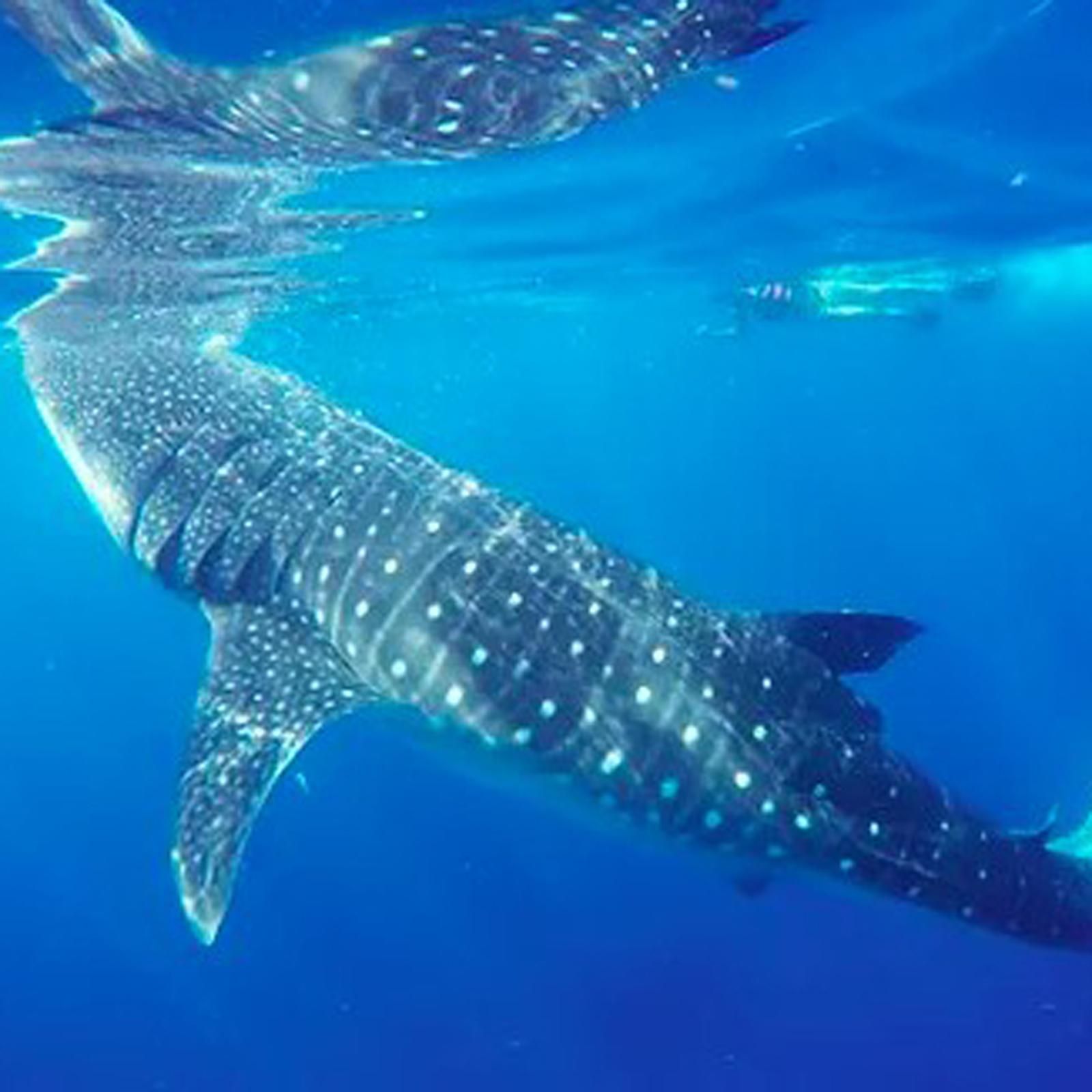
The whale shark is the largest fish alive on Earth. It is also one of the most misunderstood. Despite its mouth being a metre and a half wide and its body stretching longer than a city bus, the whale shark is a gentle filter feeder that cannot swallow anything larger than a grapefruit. Rhincodon typus is a shark, not a whale - the "whale" in its common name refers only to its size.
It is the sole living member of the family Rhincodontidae, a single surviving branch of a lineage that reaches back more than 450 million years into the shark family tree.
This guide covers every aspect of whale shark biology and ecology: size and anatomy, feeding behaviour, reproduction, migrations, social life, conservation status, and the relationship between whale sharks and the growing number of humans who encounter them in tropical seas. It is a reference entry, not a quick overview - so expect specifics: metres, tonnes, dive depths, population numbers, and the verified records behind the famous claims.
Etymology and Classification
The scientific name Rhincodon typus was given to the species in 1828 by Andrew Smith, the Scottish military surgeon and naturalist who described a specimen harpooned in Table Bay, South Africa. The genus name combines the Greek rhine (rasp or file) and odon (tooth), a reference to the hundreds of rows of tiny teeth the species carries despite not using them. The specific name typus simply means "of the type".
The whale shark is the only extant member of the family Rhincodontidae. Its closest living relatives are the carpet sharks of the order Orectolobiformes, which include nurse sharks, wobbegongs, and bamboo sharks - mostly small, bottom-dwelling species. The whale shark is a spectacular outlier among them: oceanic, giant, and pelagic.
Molecular clocks estimate that the Rhincodon lineage diverged from other carpet sharks roughly 60 million years ago, though the deep family history of all sharks stretches back more than 450 million years, long before trees, flowers, or mammals existed on land.
Common names reflect human awe at the animal's size. In Spanish-speaking countries of Central America it is tiburon ballena. In the Philippines it is butanding. In Mexico, divers simply call it el dominos because of its spots. In Vietnamese coastal communities it is sometimes called Ca Ong, or "Sir Fish", and traditionally venerated.
Size and Physical Description
The whale shark is the largest fish on Earth. The upper end of its size range is still debated because very large individuals are rare and difficult to measure, but the best-documented specimens put the species in a category of its own.
Typical mature adults:
- Length: 5.5-10 metres
- Weight: 5-10 tonnes
- Mouth width: up to 1.5 metres
Record individuals:
- Length: 18.8 metres (reliably measured)
- Weight: estimated 20 tonnes
- Mouth width: close to 1.5 metres in the largest animals
Newborn pups:
- Length: 40-60 centimetres
- Weight: under 1 kilogram
- Fully independent at birth
The body plan is unmistakable. The head is broad and flattened, with a mouth that sits at the very front of the snout rather than underneath as in most sharks. This terminal mouth position is an adaptation for filter feeding: it lets the animal scoop water as it swims forward rather than angling up to catch prey beneath it. Behind the mouth are five enormous gill slits, each equipped with modified gill rakers that function as the actual filtering surface.
The skin is up to 10 centimetres thick - one of the thickest hides of any living animal - and is marked with a highly distinctive pattern of pale spots and horizontal stripes over a dark grey or bluish-grey background. The underside is white. This pattern is not decorative: it is a biological fingerprint. No two whale sharks share the same spot arrangement, and the patterns remain stable throughout life.
Researchers take standard-angle photographs of the area behind the left gill slits and feed them into pattern-matching software, generating individual identification records in a global catalogue.
Two dorsal fins sit well back along the body, with the first dorsal larger than the second. The caudal fin is large and semi-lunate, providing efficient cruising propulsion rather than burst speed. Whale sharks generally travel at 3 to 5 kilometres per hour - a slow, steady pace that lets them cover enormous distances with minimal energy cost.
Teeth They Do Not Use
Whale sharks have 300 to 350 rows of teeth, around 3,000 individual teeth in total. Each tooth is only a few millimetres long, and none of them are used in feeding. They sit at the very edge of the jaw, deep behind the gill rakers, and play no measurable role in capturing, holding, or processing prey. Why this species retains such an elaborate dental apparatus is not fully understood.
One hypothesis is evolutionary inertia - ancestors had functional teeth, and there has been no selective pressure to lose them. Another is that the teeth play a minor role in ritualised interactions between individuals, perhaps during courtship, though this has never been conclusively observed in the wild.
Even more intriguing is a 2020 study that identified tiny tooth-like structures, called dermal denticles, embedded in the whale shark's eyeballs. These denticles appear to protect the eye surface from abrasion, since whale sharks lack functional eyelids.
Combined with the fact that whale sharks can retract their eyeballs partway into their sockets when threatened, the species has one of the most heavily armoured ocular systems of any vertebrate. The denticles are not related to the oral teeth but hint at how creatively shark lineages have deployed tooth-like tissue across the body.
Filter Feeding: How It Actually Works
Whale sharks are one of only three living shark species that filter-feed, alongside the basking shark (Cetorhinus maximus) and the megamouth shark (Megachasma pelagios). Each uses a different technique.
Whale sharks employ three feeding modes:
- Passive ram feeding. The shark swims forward with its mouth open, letting seawater flow in through the mouth and out through the gills. Prey becomes trapped against the gill rakers. This is the lowest-energy mode and is used during routine travel through productive water.
- Active suction feeding. The shark opens and closes its mouth rhythmically, creating suction pressure that draws water and prey in. This is used when the animal is stationary or moving very slowly, and it allows feeding in denser prey patches without requiring forward motion.
- Vertical feeding at the surface. Whale sharks rise vertically in the water column, positioning their mouths at the surface and gulping water as prey concentrate there. This is commonly observed during coral spawning events and fish-egg release.
Prey targets:
| Prey type | Role in diet |
|---|---|
| Copepods | Dominant in many plankton blooms |
| Krill and euphausiids | Major at temperate aggregation sites |
| Small schooling fish | Sardines, anchovies, herring |
| Fish and coral eggs | Seasonal, event-driven |
| Squid | At depth and during migrations |
| Jellyfish and salps | Occasional |
Filtering throughput is extraordinary. A large whale shark can move more than 600 cubic metres of water through its gill rakers per hour while feeding. The gill rakers have a minimum effective mesh of around 1 millimetre, meaning anything larger gets trapped. When feeding stops, the shark performs a "cough" - a sudden reverse flow that clears accumulated particles off the rakers.
Aggregations and Migration
Whale sharks are generally solitary but form the largest aggregations known for any shark species. These gatherings are driven almost entirely by food. When plankton blooms or fish spawning events create dense prey concentrations, whale sharks arrive from across ocean basins.
The best-known aggregations include:
- Ningaloo Reef, Western Australia. Peaks in March through June, driven by coral spawning and krill. One of the longest-studied populations in the world.
- Isla Mujeres and the afuera, Mexico. The afuera aggregation off Isla Mujeres holds the record for the largest known whale shark gathering - 800 or more individuals recorded simultaneously, feeding on little tunny egg spawn in summer.
- Isla Holbox, Mexico. A summer aggregation driven by similar fish-egg events in the Yucatan Channel.
- Donsol and Oslob, Philippines. Year-round and seasonal encounters tied to local plankton productivity.
- Mafia Island, Tanzania. Reliable aggregation from October to March.
- Maldives. Present year-round with seasonal movements between atolls.
- Galapagos Islands. Mainly large pregnant females passing through the Darwin Arch area.
Between these aggregations, whale sharks migrate thousands of kilometres. Satellite-tagged individuals have been tracked crossing entire ocean basins. One famous female, nicknamed Anne, travelled more than 20,000 kilometres from Panama to the western Indo-Pacific over roughly 841 days, setting a record for any tracked fish migration. Migration routes are not random - they appear to follow productive frontal systems, thermal gradients, and spawning calendars.
Dive Behaviour
Whale sharks are not only surface feeders. Tagged individuals regularly descend to several hundred metres, and extreme dives have been recorded to 1,928 metres - deeper than sperm whales routinely dive. At such depths water temperatures hover just above freezing and pressure exceeds 190 atmospheres. How whale sharks tolerate these conditions physiologically remains an area of active research.
Typical dive data:
| Metric | Value |
|---|---|
| Average cruising speed | 3-5 km/h |
| Typical daily vertical range | 0-200 m |
| Deep foraging dives | 500-1,000 m |
| Deepest recorded dive | 1,928 m |
| Dive duration at depth | Tens of minutes per dive |
Deep diving is thought to serve several purposes: foraging on deep-scattering-layer prey (squid, lanternfish, krill), thermoregulation, and possibly navigation using geomagnetic or thermal gradients. The energetic cost is considerable, and between deep dives the animal typically returns to warm surface water to rewarm its body.
Reproduction
Whale shark reproduction is one of the most poorly observed aspects of the species' life history, yet some remarkable facts are now established. Whale sharks are ovoviviparous: eggs hatch inside the female and live pups are born. This distinguishes them from many sharks that lay eggs in cases on the sea floor.
The single most informative specimen in whale shark reproductive biology was a pregnant female caught off Taiwan in 1995. She carried approximately 300 embryos at various stages of development, from fertilised eggs to pups ready to be born. This specimen demonstrated two critical facts:
- Whale shark litters are vastly larger than those of most shark species.
- Females store sperm from a single mating and release embryos in staggered batches over time.
Newborn pups measure 40 to 60 centimetres and are fully independent at birth, entering the open ocean immediately. Where exactly pups are born is not known. Very few juveniles under 3 metres have ever been observed, suggesting that young whale sharks spend their early years in deep open-ocean habitats rarely encountered by humans.
Sexual maturity comes late. Most estimates place it at 25 to 30 years of age and 7 to 9 metres of length. Mating events have almost never been observed in the wild. A single sequence of courtship behaviour was finally documented in 2019 at Ningaloo. This combination of very late maturity, rare observations, and large but infrequent litters means the species reproduces on a timescale measured in decades.
Lifespan and Longevity
Until recently, the whale shark's lifespan was estimated only indirectly. In 2020 researchers used bomb radiocarbon dating of vertebral growth bands - a method that compares ratios of carbon isotopes deposited during atmospheric nuclear testing in the mid-20th century - to verify whale shark ages. The results placed lifespans in the 80 to 130 year range, making the whale shark one of the longest-lived fish on Earth.
Combined with their late maturity, this longevity has strong conservation implications. A whale shark killed at age 20 has contributed nothing to the next generation. A whale shark killed at age 50 has produced only a handful of litters. Population recovery therefore takes many human generations, not years.
Conservation Status and Threats
The IUCN Red List classifies the whale shark as Endangered following a 2016 uplift from Vulnerable. Evidence indicates that global populations have declined by more than 50 per cent over the past 75 years, with particularly steep declines in the Indo-Pacific. The species is listed on CITES Appendix II, which regulates international trade, and on Appendices I and II of the Convention on Migratory Species.
Primary threats:
- Targeted fishing. Demand for whale shark fins, meat, and liver oil drives direct fisheries in parts of Asia despite protections. A single set of fins can be worth tens of thousands of dollars on illegal markets.
- Bycatch. Whale sharks are frequently caught unintentionally in industrial tuna purse-seine fisheries, where they aggregate around the same bait schools targeted by fishers.
- Ship strikes. Aggregation areas often overlap with major shipping lanes. Surface-feeding whale sharks are struck frequently, and scarred individuals are so common that researchers use boat-strike scars as secondary identification markers.
- Tourism pressure. Well-managed tourism provides economic incentives for protection. Poorly managed tourism habituates animals, disrupts feeding, and leads to injuries from propellers and crowding.
- Pollution. Whale sharks filter enormous volumes of seawater and are exposed to microplastics and persistent organic pollutants in quantities no terrestrial predator faces.
- Climate change. Warming surface temperatures are shifting plankton distributions and may already be redistributing aggregation sites. Ocean deoxygenation could further compress the habitable water column.
Protection measures vary by country. The Philippines, India, the Maldives, Mexico, Australia, Thailand, the United States, Taiwan, and several others have implemented complete legal protection for whale sharks. Enforcement is uneven. Because whale sharks spend much of their lives in international waters, effective conservation requires coordinated action across national boundaries.
Whale Sharks and Humans
Encounters between whale sharks and humans have shifted radically in the past fifty years. For most of recorded history the species was hunted - sometimes for subsistence, sometimes commercially. Today the dominant mode of interaction is tourism.
Snorkel tours and scuba encounters generate meaningful income for coastal communities at Ningaloo, Donsol, Oslob, Holbox, Mafia Island, the Maldives, and other aggregation sites. Done well, this tourism provides strong economic arguments against killing whale sharks.
Done badly, it creates its own problems. Touching, chasing, blocking, or flash photography can stress animals and alter natural feeding behaviour. Operators who provision sharks with food to guarantee encounters - as happened at Oslob - create lasting behavioural changes and expose animals to more boats, more propellers, and more potential for injury.
Best-practice codes developed by the Ningaloo scientific community have been widely adopted and include minimum distances, limits on swimmer numbers, no-touch rules, and capped daily encounter time per animal.
Whale sharks are physically incapable of harming a swimmer or diver. Their mouths cannot swallow anything larger than a grapefruit. Their teeth are vestigial. Their tails can cause accidental injury if a swimmer crowds them, but the species is, on every available record, completely non-aggressive toward humans. The real danger runs the other way: humans kill thousands of whale sharks every year directly and indirectly.
Related Reading
- Great White Shark: Apex Predator of the Open Ocean
- Basking Shark: The Other Giant Filter Feeder
- Sharks of the World: Diversity, Evolution, and Survival
- How Filter Feeding Evolved in the Ocean
References
Relevant peer-reviewed and governmental sources consulted for this entry include IUCN Shark Specialist Group assessments (2016, 2020, 2024), the Wildbook for Whale Sharks global database, the Ningaloo Ecosystem Tracker research program, and published research in Marine Biology, Journal of Fish Biology, Ecology, and Frontiers in Marine Science. Age verification follows Ong et al.
(2020) in Frontiers in Marine Science, which applied bomb radiocarbon dating to whale shark vertebrae. Population and migration figures reflect consolidated estimates through the most recent range-state meetings under the Convention on Migratory Species.
Frequently Asked Questions
How big is a whale shark?
Whale sharks (Rhincodon typus) typically measure 5.5 to 10 metres long as mature adults, with the largest reliably measured individual recorded at 18.8 metres and an estimated weight of roughly 20 tonnes. That makes the whale shark the largest fish in the ocean - larger than any bony fish, larger than any other shark, and larger than most whales apart from the baleen giants. Females grow larger than males on average.
Newborn pups emerge at 40 to 60 centimetres and grow slowly, reaching sexual maturity only at around 25 to 30 years and 7 to 9 metres of length.
What do whale sharks eat?
Whale sharks are filter feeders, a rarity among sharks. Their diet consists of plankton, krill, copepods, small schooling fish such as sardines and anchovies, fish and coral eggs, squid, and tiny crustaceans. They feed by swimming slowly with their enormous mouths open, letting water flow across modified gill rakers that strain out prey. A mature whale shark can process hundreds of cubic metres of seawater per hour.
Although they have 300 to 350 rows of tiny teeth, those teeth play no role in feeding. Whale sharks time their movements to plankton blooms, coral spawning events, and fish spawning aggregations, which is why they reliably appear in places like Ningaloo Reef in Western Australia, Isla Holbox in Mexico, and Donsol in the Philippines.
Where do whale sharks live?
Whale sharks inhabit tropical and warm temperate oceans worldwide, generally between 30 degrees north and 35 degrees south latitude. They are found in all three major tropical oceans - Atlantic, Pacific, and Indian - and prefer surface water temperatures between 21 and 30 degrees Celsius.
Seasonal aggregations form at predictable productive sites: Ningaloo Reef (Australia), Isla Mujeres and Isla Holbox (Mexico), Donsol and Oslob (Philippines), Mafia Island (Tanzania), the Maldives, the Galapagos, and the Red Sea. Outside these aggregations, individuals roam widely and can cover thousands of kilometres during long-distance migrations. Tagging data show some whale sharks crossing entire ocean basins.
Are whale sharks dangerous to humans?
Whale sharks are not dangerous to humans. Despite a mouth up to 1.5 metres wide, the species is physically incapable of swallowing a person - its throat narrows to only about 10 centimetres across. There are no documented cases of a whale shark intentionally harming a swimmer or diver. Tourists in Australia, Mexico, and the Philippines swim and snorkel alongside whale sharks daily under regulated programs.
The main safety concern goes the other way: large tail fins can cause accidental injuries if swimmers crowd the animal, and whale sharks themselves suffer from boat strikes, propeller wounds, and tourism stress when operators disregard minimum-distance rules.
How long do whale sharks live?
Whale sharks are among the longest-lived fish on Earth. In 2020 researchers used bomb radiocarbon isotope dating on growth bands in whale shark vertebrae to show that individuals can live 80 to 130 years, and possibly longer. Growth is slow: maturity comes at around 25 to 30 years and 7 to 9 metres of length. Females may produce pups only every few years once mature.
This late maturity and long generation time is a major conservation concern because populations recover very slowly from losses, and losing a mature breeding female removes decades of reproductive output.
How do whale sharks reproduce?
Whale sharks are ovoviviparous. Eggs develop and hatch inside the mother, and live pups are then born. A pregnant female caught off Taiwan in 1995 carried approximately 300 embryos at various stages of development, which showed scientists two important facts: females store sperm from a single mating and stagger the births of their pups over time, and litter sizes are vastly larger than in most shark species.
Newborn pups measure 40 to 60 centimetres, are fully independent at birth, and disperse immediately into the open ocean. Mating events have almost never been observed in the wild, and the exact birthing grounds remain largely unknown.
Are whale sharks endangered?
Yes. The IUCN Red List reclassified the whale shark from Vulnerable to Endangered in 2016 after evidence showed that global populations had declined by more than 50 per cent over the past 75 years.
Major threats include targeted fishing for fins, meat, and liver oil in parts of Asia, bycatch in tuna and other industrial fisheries, ship strikes in shipping lanes that overlap aggregation areas, poorly regulated tourism, plastic pollution, and rising sea temperatures that shift plankton distributions. The species is listed on CITES Appendix II and on Appendices I and II of the Convention on Migratory Species.
Several range states have implemented complete protection, and global recovery depends on coordinated action across international waters.
Can you identify individual whale sharks?
Yes, and the method is genuinely clever. Every whale shark carries a unique pattern of white spots and pale stripes on its dark grey back - essentially a fingerprint. Researchers photograph the area behind the gill slits and feed the image into pattern-matching software. One widely used algorithm was originally developed by astronomers to match star fields in telescope images.
The Wildbook for Whale Sharks database holds identification photos for more than 13,000 individuals contributed by scientists and citizen divers worldwide. This dataset has made whale sharks one of the best-monitored large fish species, despite their global range.