
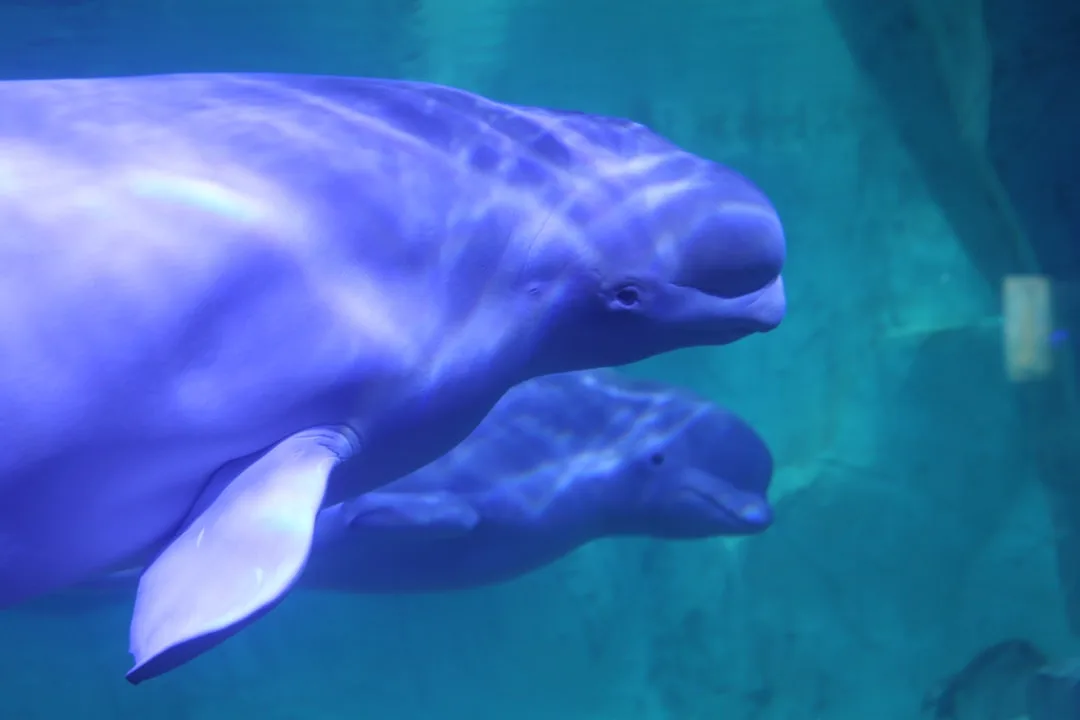
The beluga whale is the chatterbox of the Arctic. No other whale is so vocal, so facially expressive, so pale against the ice, or so tolerant of human contact.
Delphinapterus leucas is a mid-sized toothed whale, roughly four to five and a half metres long, that has evolved to live on the sea-ice edge - circumpolar, gregarious, and instantly recognisable by its bulbous forehead, stubby beak, and pure white adult skin. It is one of only two living members of the family Monodontidae, sharing the group with the narwhal.
This guide covers every major dimension of beluga biology and ecology: anatomy, vocalisation, diet, migration, reproduction, social life, conservation status, and the strange edges of the species' story - from the talking beluga NOC to the narluga hybrid skull to the crashing Cook Inlet population. It is a reference entry, not a summary, so expect specifics: kilograms, kilometres, decibels, populations, and verified records.
Etymology and Classification
The species was formally described by Peter Simon Pallas in 1776 and named Delphinapterus leucas, literally 'dolphin without a wing' (no dorsal fin) with a Greek species epithet meaning 'white'. The common name 'beluga' comes from the Russian belukha, itself derived from belyy - 'white'.
Confusingly, the name is shared with the beluga sturgeon, a huge Caspian fish famous for caviar, which is an entirely unrelated animal. In Inuktitut the beluga is known as qilalugaq, and Russian coastal peoples have used the name belukha since long before scientific classification.
Within the order Cetacea, belugas belong to the suborder Odontoceti - the toothed whales - and to the small family Monodontidae which contains only two living species: the beluga and the narwhal (Monodon monoceros). Genetic and fossil evidence places the split between the two around five million years ago. Despite that distance, the two species remain close enough that a confirmed first-generation hybrid has been identified from a skull collected in Greenland.
The full taxonomy runs: Animalia, Chordata, Mammalia, Cetacea, Monodontidae, Delphinapterus, D. leucas. No subspecies are currently recognised, although about 21 subpopulations differ in size, migration, genetics and contaminant burden strongly enough that several are managed as separate conservation units.
Size and Physical Description
Belugas are mid-sized among toothed whales - smaller than an orca, larger than a bottlenose dolphin. Adults show moderate sexual dimorphism, with males about a quarter larger and heavier than females.
Males:
- Length: 4.5-5.5 metres
- Weight: typically 1,100-1,600 kg
- Continues growing until about age 10
Females:
- Length: 4.0-4.5 metres
- Weight: 700-1,200 kg
- Stops growing near age 7
Calves at birth:
- Length: 1.5-1.6 metres
- Weight: 80-100 kg - about the size of a full-grown Labrador
- Colour: dark grey, brownish, sometimes almost bluish
The body is torpedo-shaped but stockier than most dolphins, with a short neck, small rounded flippers, and no dorsal fin. In place of a fin the beluga carries a tough dorsal ridge that runs along roughly the rear third of the back. Adults are pure, unmarked white - the only adult cetacean to be so. Calves are born dark and slowly pale through childhood, passing through blue-grey, slate, dirty cream and finally ivory white by ages seven to nine.
The head is the species' signature feature. A large, bulbous 'melon' sits on the forehead above a short beak, giving the animal its distinctive 'cartoon whale' silhouette. The melon is filled with specialised lipid tissue and acts as an acoustic lens, focusing and steering the whale's echolocation clicks.
Unusually among cetaceans, the melon is soft enough that it visibly deforms during vocalisation - bulging, pumping, flattening and compressing in real time as the whale directs its sound beam. Trained observers can sometimes guess what kind of call is coming next from the shape changes alone.
Uniquely among almost all living whales and dolphins, the beluga has unfused cervical vertebrae. The seven neck bones are separate rather than welded into a single immobile block, which gives the animal enough neck flexibility to turn its head roughly 90 degrees to the side, nod, and look down. Combined with the flexible lips and a rare ability to make facial movements, this produces the strikingly expressive face that has made belugas favourites in aquariums for a century.
Coat, Skin and Moulting
Beluga skin is unusually thick - up to 10 centimetres over the body - and contains a lot of fat that helps with insulation. It is also unusually fragile at the surface. Every summer the outer layer yellows, cracks and has to be physically removed, a process called epidermal moulting. Belugas handle this by congregating in shallow, warmer river estuaries and rubbing themselves against the gravel bottom.
The moulting aggregations are among the most spectacular wildlife gatherings in the Arctic. Sites like Cunningham Inlet on Somerset Island, the Churchill River Estuary in Manitoba, and the mouth of the Mackenzie can hold thousands of whales at a time, adults rolling in the shallows and calves learning the behaviour.
The warmer estuary water (up to 10 degrees Celsius above surrounding sea) also helps accelerate skin regrowth. Researchers have documented whales actively choosing gravel patches with specific textures, returning to favoured rubbing spots year after year.
Built for the Ice Edge
Belugas live through Arctic winters without migrating south. Their adaptations are different from those of the big baleen whales (which fatten up and leave) and different again from bowheads (which stay and break ice with their skulls).
Ice adaptations:
- Dorsal ridge instead of dorsal fin: no catch hazard under ice, can break thin ice from below
- Flexible neck: essential for navigating narrow breathing leads
- Tough forehead skin: protects the skull during ice breaking
- High fat content: 40 per cent or more of total body mass
- White adult colour: camouflage against sea ice from below and above
Thermal regulation:
- Blubber layer up to 15 centimetres thick on the body
- Counter-current blood flow in flukes and flippers
- Highly compressible rib cage, allowing deep dives without injury
- Ability to reduce peripheral circulation during long surface-interval exposures
Belugas routinely survive in water of -2 degrees Celsius - colder than fresh water can reach. They can detect and navigate to breathing leads more than a kilometre away under continuous ice cover, guided by a combination of echolocation and memory. Mass ice entrapments do occur, particularly when fast-moving freeze-up traps pods in shrinking polynyas; these events can kill hundreds of belugas at a time and have been documented from Hudson Bay, the Russian Arctic and north-west Greenland.
The Canary of the Sea
Beluga vocalisation is the feature that separates them from nearly every other whale. Early whalers in the 19th century, anchored in Arctic bays, reported hearing high clear calls coming up through the wooden hulls of their ships that sounded for all the world like distant songbirds. The whales were producing sound loud enough to transmit through ship timber. The nickname canary of the sea stuck, and is still the most common term for the species in popular writing.
Researchers have now catalogued more than 50 distinct beluga call types, grouped broadly into:
- Echolocation clicks (50-120 kHz) for finding prey and navigating under ice
- Whistles (frequency-modulated social calls, 0.3-12 kHz)
- Pulsed calls (squawks, buzzes, grunts, moans)
- Bell-like tones and chirps
- Trumpet-like and even bell-and-whistle compound calls
Signature calls appear to function something like individual names. Mother and calf pairs produce matched signatures within days of birth, and adult belugas sometimes greet known pod-mates with call exchanges that researchers can predict. Dialects differ between populations: Saint Lawrence belugas sound measurably different from Cook Inlet ones, and the differences are stable across generations.
The single most famous beluga vocalisation is also the strangest. In 1984 a young male beluga named NOC, held at the US National Marine Mammal Foundation in San Diego, began producing rhythmic, low-pitched sounds that closely resembled human speech. Staff repeatedly assumed a person was talking in the pool.
Formal analysis, published in Current Biology in 2012, showed that NOC had dropped his vocal frequency several octaves below normal beluga range to match human speech frequencies, apparently by overpressurising his nasal tract and manipulating vestibular sacs. He kept up the mimicry for about four years before gradually losing interest.
No other beluga has been observed spontaneously doing the same thing, which makes NOC's case both uniquely valuable and uniquely hard to interpret.
Hunting and Diet
Belugas are flexible generalist carnivores. They eat whatever is locally abundant, and their diet shifts dramatically with season, region and life stage.
Main prey categories:
- Schooling fish: Arctic cod, capelin, herring, salmon, smelt, sand lance
- Cephalopods: squid and octopus
- Benthic invertebrates: shrimp, crabs, marine worms
- Occasional: sculpins, flatfish, lampreys
A typical adult eats 18 to 27 kilograms per day. Hunting usually happens in coordinated groups: belugas herd fish against ice edges, shallow shelves or riverbanks, then pick them off individually. In open water they echolocate for prey and dive to catch it - routine dives are 20 to 100 metres deep, with maximum recorded dives past 870 metres and lasting up to 20 minutes.
Despite having teeth (about 40 peg-like ones arranged in a single row per jaw) belugas rarely chew. They suction-feed, using a rapid expansion of the throat to vacuum prey in. The protrusible lips form a tight seal that makes this efficient. Young calves nurse for 18 to 24 months on milk that is approximately 28 per cent fat.
Life Cycle and Reproduction
Beluga reproduction is slow by mammalian standards, more typical of long-lived primates than of smaller dolphins.
Reproductive timeline:
- Sexual maturity: females 8-14 years, males 11-15 years
- Mating season: late winter to early spring (February-May)
- Gestation: 14-15 months
- Birth season: late spring to summer (June-September)
- Lactation: 18-24 months
- Inter-birth interval: 2-3 years
Females give birth in warm, shallow estuarine water. Calving sites are passed down the maternal line, with the same estuaries used generation after generation. Newborns are dark, 1.5 to 1.6 metres long, and already capable of swimming alongside the mother. The calf nurses through its first long winter and often through a second. Calves typically stay with the mother up to 4 years, longer than most toothed whales, and sub-adults continue to associate with maternal kin for years afterward.
Calves gradually pale with age. First-year animals are dark grey; three-year-olds are a slaty blue; by age 5-6 they are a dirty cream; by age 7-9 they are adult white. Because of this predictable colour schedule, field researchers can age most belugas approximately from a single photograph.
Movement, Range, and Migration
Belugas undertake some of the best-documented long-distance migrations of any cetacean. Satellite tracking since the 1990s has mapped round trips of 6,000 kilometres or more per year in some Arctic populations. The general pattern is: summer in shallow, warm estuarine water for moulting and calving; autumn dispersal into offshore pack ice; winter along the pack ice edge using polynyas and leads; spring return to the summer estuaries.
| Metric | Value |
|---|---|
| Cruising swim speed | 3-9 km/h |
| Burst swim speed | up to 22 km/h |
| Typical dive depth | 20-100 m |
| Maximum recorded dive | ~870 m |
| Maximum recorded dive time | 20+ minutes |
| Annual migration distance | up to 6,000+ km |
Hudson Bay belugas are the best-studied migratory population. Approximately 57,000 animals spend summers in and around the Churchill, Nelson and Seal river estuaries on the west coast of the bay, then migrate north and east through Hudson Strait to overwinter in more open water off Labrador and West Greenland. Resident populations also exist.
The Cook Inlet belugas of Alaska do not migrate at all, instead shifting seasonally within the same shallow, silty, semi-enclosed body of water. The Saint Lawrence population similarly stays year-round in the lower river estuary and adjacent gulf waters.
Belugas can also swim backwards, a rare trick among cetaceans, and use the ability to negotiate tight ice leads, river channels and shallow flats where turning around is impossible.
Populations and Subpopulations
Scientists recognise roughly 21 beluga subpopulations, with total global numbers estimated at around 150,000 animals as of recent IUCN assessments.
| Region | Population estimate | Status |
|---|---|---|
| Hudson Bay complex | ~57,000 | Stable |
| Beaufort Sea | ~40,000 | Stable |
| Eastern Bering Sea | ~20,000 | Stable |
| Svalbard (Norway) | ~550 | Data deficient |
| Saint Lawrence Estuary | ~900 | Endangered (COSEWIC) |
| Cook Inlet (Alaska) | ~300 | Critically Endangered (IUCN) |
The Cook Inlet crisis is the most urgent regional concern. Aerial surveys estimated around 1,300 animals in 1979. The population declined steeply through the 1990s, was granted Endangered Species Act protection in 2008, and has continued to shrink despite hunting closures. Current estimates put the subpopulation at roughly 279 animals as of the most recent NOAA counts.
Proposed causes include shipping noise, oil and gas activity, reduced salmon runs, and contaminants from the heavily urbanised Anchorage region at the head of the inlet.
Conservation Status and Threats
The species as a whole is listed as Least Concern by the IUCN with a stable global trend, reflecting healthy numbers in core Arctic populations. This classification hides dramatic local problems. Several subpopulations - Cook Inlet, Saint Lawrence, Ungava Bay, Svalbard - are in critical condition or functionally extinct.
Primary threats:
- Contaminants. Belugas at the top of the Arctic and northern temperate food chain accumulate persistent organic pollutants (PCBs, DDT, PBDEs), methylmercury and microplastics in their blubber. Saint Lawrence carcasses have been found with contaminant loads high enough to classify them as hazardous waste under Canadian law, with measurable rates of cancer, infections and reproductive failure.
- Noise pollution. Shipping, seismic surveys for oil and gas, and sonar interfere with beluga communication and echolocation. Cook Inlet sits at the end of a busy shipping channel, and the Saint Lawrence carries one of the heaviest commercial shipping loads of any cetacean habitat.
- Climate change and ice loss. Reduced sea ice changes prey distribution, opens new shipping and industrial routes into previously remote habitat, and exposes belugas to increased predation from killer whales expanding into newly accessible Arctic waters.
- Bycatch and entanglement. Commercial and subsistence fisheries occasionally catch belugas in gillnets and weirs; entanglement survival rates are low.
- Subsistence hunting. Indigenous peoples across the Arctic hunt belugas for food and cultural purposes under quota systems. In most populations the harvest is sustainable, but some local stocks (Ungava Bay in particular) were depleted by historical commercial hunting and have not recovered.
- Habitat loss and disturbance. Hydro development, oil terminals and port expansion threaten key estuaries, especially in Russia and Alaska.
Protection regimes include the US Marine Mammal Protection Act, Canada's Species at Risk Act, Norway's wildlife protection law, CITES Appendix II listing of the entire species, and several Indigenous co-management agreements across the range.
Beluga Whales and Humans
Belugas have been hunted by Arctic peoples for at least 5,000 years. Archaeological sites in the Canadian Arctic, Russia and Alaska contain beluga bones in food middens along with specialised hunting equipment - toggling harpoons, nets and weirs - designed specifically for white whales. Traditional hunts typically targeted animals returning to estuaries in summer and were tightly woven into seasonal subsistence cycles.
Commercial beluga hunting surged in the 18th and 19th centuries as Europeans discovered a market for oil, leather and tongue. By the mid-20th century several populations - notably Saint Lawrence and Ungava Bay - had been reduced to a fraction of their original numbers. Commercial hunting has now been closed across most of the range, although subsistence and Indigenous hunts continue under quota.
Belugas have also had an outsized place in human captivity. Their tolerance for shallow warm water, their photogenic appearance, and their social responsiveness have made them popular in oceanariums since at least the 1960s. The ethics of captive belugas are heavily disputed; as of 2019 Canada banned the importation, breeding and display of cetaceans in captivity except for existing animals and sanctuaries.
Several captive belugas have been trained for US Navy research programmes, most famously NOC, whose talking behaviour made him one of the most studied individual cetaceans on record.
In the wild belugas are routinely curious about small boats, paddlers and swimmers, and have been documented approaching kayakers at close range and exchanging eye contact. Researchers studying their underwater vocalisations have reported that the whales sometimes clearly modify their calls in response to human presence.
Related Reading
- Beluga Whale: The Arctic's Vocal Singer
- Narwhal: The Unicorn of the Sea
- Orca: Killer Whale Intelligence
- Whales and Dolphins: The Singing Giants of the Deep
References
Relevant peer-reviewed and governmental sources consulted for this entry include the IUCN Red List assessment for Delphinapterus leucas (2017 onward), NOAA Fisheries status reviews of the Cook Inlet beluga population, COSEWIC assessments of the Saint Lawrence and Ungava Bay stocks, and published research in Current Biology, Marine Mammal Science, Polar Biology, Arctic and Endangered Species Research.
The documented narluga hybrid was confirmed in Skovrind et al., 'Hybridization between two high Arctic cetaceans', in Scientific Reports (2019). The NOC human-speech mimicry paper is Ridgway et al., 'Spontaneous human speech mimicry by a cetacean', in Current Biology (2012). Specific population figures reflect the most recent consolidated estimates as of the 2024 IUCN and NOAA updates.
Frequently Asked Questions
How big are beluga whales?
Adult beluga whales (Delphinapterus leucas) measure 4.0 to 5.5 metres in length and weigh 700 to 1,600 kilograms. Males are roughly 25 per cent larger than females and continue to grow until about age 10, while females stop growing near age 7. Calves are born at 1.5 to 1.6 metres long and already weigh 80 to 100 kilograms - the size of a large dog. Compared to their close relative the narwhal, belugas are slightly stockier and lack the characteristic tusk.
Among toothed whales, they are mid-sized: smaller than an orca and larger than a bottlenose dolphin.
Why are beluga whales called the canary of the sea?
Belugas produce one of the most complex vocal repertoires of any cetacean, with researchers cataloguing more than 50 distinct call types including clicks, whistles, trills, moans, chirps, squeals and bell-like tones. The sounds travel easily through ship hulls, and 19th-century whalers reported hearing them through wooden decks while anchored in Arctic bays - hence the ‘canary of the sea’ nickname.
Their melon, a fatty organ in the forehead, shapes and beams these sounds for both communication and echolocation. Individual belugas appear to use signature call types similar to names, and mother-calf pairs develop private vocal signatures within days of birth.
Where do beluga whales live?
Beluga whales inhabit Arctic and sub-Arctic waters across the Northern Hemisphere, with populations in Canada, Alaska (United States), Greenland, Norway’s Svalbard archipelago and Russia. Roughly 21 distinct subpopulations have been described, ranging from the resident Cook Inlet and Saint Lawrence Estuary stocks to the migratory Hudson Bay and Beaufort Sea herds.
Unlike most whales, belugas tolerate fresh and brackish water and regularly swim tens of kilometres up rivers such as the Churchill, the Mackenzie and the Amur. In summer they concentrate in shallow, warm coastal estuaries to moult and calve; in winter they follow the retreating pack ice and use breathing leads to survive under near-continuous ice cover.
Are beluga whales endangered?
The global species is listed as Least Concern by the IUCN with a stable overall population estimated at about 150,000 animals. However, this hides major regional problems. The Cook Inlet subpopulation in Alaska is listed as Critically Endangered and Endangered under the US Endangered Species Act, having declined from roughly 1,300 animals in the 1970s to under 300 today.
The Saint Lawrence Estuary population in Canada is listed as Endangered under COSEWIC and carries extreme contaminant burdens. Other populations face localised threats from oil and gas development, shipping noise, bycatch, climate-driven ice loss and subsistence hunting. Belugas are protected under the US Marine Mammal Protection Act and Canada’s Species at Risk Act.
What does the NOC talking beluga experiment show?
NOC was a young male beluga held at the US National Marine Mammal Foundation in San Diego who, beginning around 1984, began spontaneously producing rhythmic, low-frequency vocalisations that sounded uncannily like human speech. Researchers only formally documented and published the observations in 2012 in the journal Current Biology, including recordings in which a diver in NOC’s pool surfaced convinced a human had told him to ‘get out’.
NOC had dropped his vocal frequency several octaves below normal beluga range to match human speech frequencies, apparently by distorting his nasal tract and adjusting his vestibular sacs. The case is widely cited as evidence that cetaceans can voluntarily modify vocal production to imitate other species - a capability previously attributed mainly to parrots and songbirds.
Can beluga whales and narwhals interbreed?
Yes. Belugas and narwhals share the family Monodontidae and are each other’s closest living relatives, having diverged roughly 5 million years ago. A single anomalous whale skull collected in West Greenland in 1990 was confirmed by full genome analysis in 2019 to be a first-generation hybrid - a ‘narluga’ whose mother was a narwhal and father a beluga.
The hybrid had a skull larger than either parent species, no tusk, and a peculiar set of long, forward-angled teeth unlike either parent. Only the one confirmed hybrid has ever been documented, but isotope studies of the specimen’s teeth showed it foraged on seafloor prey rather than the mid-water squid preferred by narwhals, suggesting hybrids may occupy unusual ecological niches when they occur.
How long do beluga whales live?
Beluga whales typically live 35 to 50 years in the wild. Age is determined by counting growth layer groups in the teeth, a method recalibrated around 2006 when researchers realised earlier estimates had roughly halved true lifespans. Some individuals in the Saint Lawrence Estuary have been aged at more than 75 years, and captive animals have lived into their late 40s. Females reach sexual maturity at 8 to 14 years and males at 11 to 15 years.
A mature female produces one calf every two to three years and can continue reproducing into her 30s. Calf mortality is the highest-risk stage, with killer whale predation, ice entrapment and contaminant exposure all contributing to first-year losses.
Why do beluga whales not have a dorsal fin?
Belugas are one of only a few cetacean species that lack a true dorsal fin, replaced by a tough dorsal ridge running along the back. The leading hypothesis is that this is an adaptation for life under sea ice. A prominent fin would catch on ice underneath, snag in narrow breathing leads and increase heat loss from an exposed surface.
The dorsal ridge can be used to break thin ice from below when the whale surfaces to breathe, and its leathery skin is tough enough to withstand repeated impacts. The same feature is seen in their close relative the narwhal, which also lives year-round under Arctic ice, suggesting the trait is ancestral to the entire Monodontidae family.