
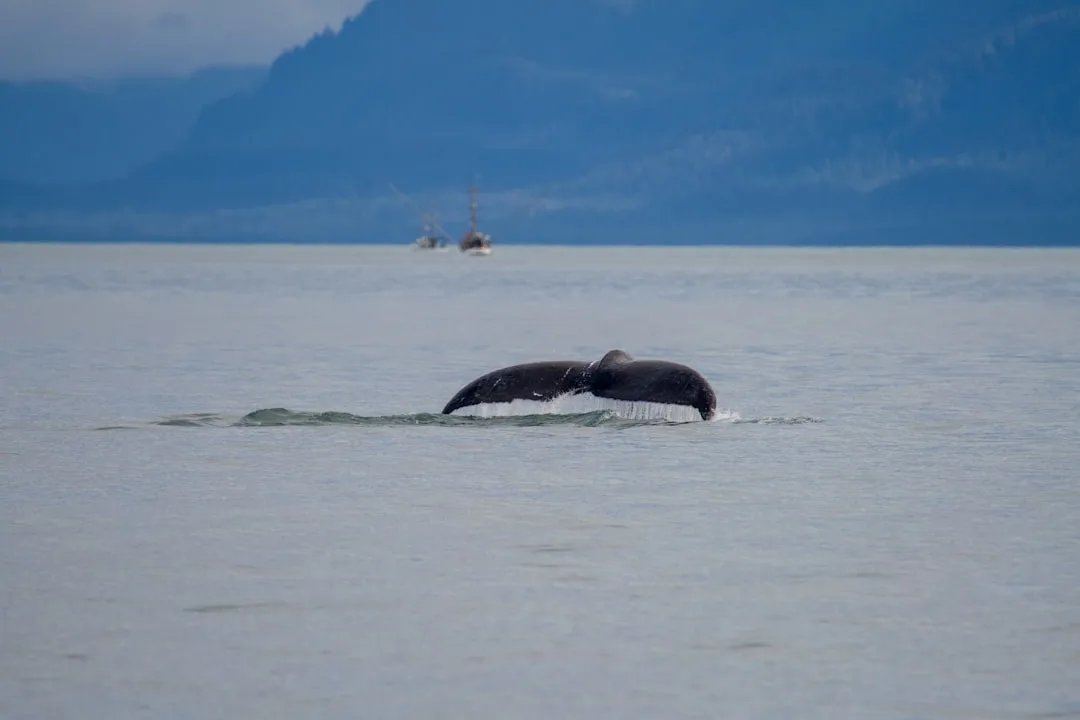
The humpback whale is one of the most recognisable, most studied, and most culturally complex animals in the ocean. It sings. It cooperates. It migrates farther than any other mammal on Earth. It leaps its entire body clear of the water for reasons science still cannot fully explain.
It carries a personal signature on its tail, remembers other individuals across decades, and routinely intervenes to save unrelated animals from orca attacks. Megaptera novaeangliae - literally 'big-winged New Englander' - is a medium-sized baleen whale, but almost everything else about it is unusual.
This guide covers every major aspect of humpback whale biology and ecology: size and anatomy, feeding, song, migration, social behaviour, reproduction, conservation status, and the unusual cross-species interventions that have made the species famous. It is a reference entry, not a summary, so expect specifics: metres, tonnes, kilometres, decibels, populations, and verified records.
Etymology and Classification
The scientific name Megaptera novaeangliae was established by Borowski in 1781 based on specimens from New England waters. The genus name Megaptera comes from the Greek mega (great) and pteron (wing) and refers directly to the species' enormous pectoral flippers, which can reach five metres in length - proportionally the largest appendage of any cetacean. The species name novaeangliae means 'of New England', the region where the first described specimens were taken.
The common name 'humpback' refers to the pronounced hump in front of the dorsal fin that becomes especially visible when the animal arches its back before a deep dive. In many whaling languages the species was known by names referring to the same feature or to the long flippers. In French it is often called baleine a bosse (hump whale), in Spanish yubarta, and in many Pacific Island languages by words that evoke its distinctive song.
Humpbacks sit within the family Balaenopteridae - the rorquals - alongside blue whales, fin whales, minke whales, and several others. Within the family humpbacks are an evolutionary outlier. Genetic and morphological evidence places them on their own branch, separate from both the giant Balaenoptera rorquals and the smaller minkes.
Three recognised subspecies correspond roughly to the North Pacific, North Atlantic, and Southern Hemisphere populations, with the isolated Arabian Sea population sometimes treated as a fourth.
Size and Physical Description
Humpback whales are mid-sized baleen whales. They are far smaller than blue or fin whales but considerably larger than minke whales. Sexual dimorphism runs in the direction typical for baleen whales: females are slightly longer and heavier than males.
Adults:
- Length: 14-17 metres (record ~19 metres for a large female)
- Weight: 25-40 tonnes, occasionally more in peak condition
- Pectoral flipper length: up to 5 metres, about a third of body length
- Fluke width: 4-5 metres across
Calves at birth:
- Length: 4-5 metres
- Weight: 700-900 kilograms - roughly the size of a small horse
Humpbacks have a robust, compact body compared with the more streamlined blue and fin whales. The head is broad and rounded rather than tapered, and its upper surface carries a distinctive pattern of raised bumps known as tubercles, each containing a single coarse hair. These tubercles are thought to provide tactile sensing, similar to the whiskers of other mammals.
The dorsal fin is small and often shaped like a step or stubby hook, sitting on top of the hump that gives the species its common name.
The pectoral flippers are the most immediately recognisable feature. White or pied in the Northern Hemisphere and mostly white in the Southern Hemisphere, they carry sharp scalloped edges and are used for communication, manoeuvring, defence, and social display. The tail fluke is large, dark above and white or mottled below, with a distinctive scalloped trailing edge.
The black-and-white pattern on the underside of the fluke is unique to each individual and has been used since the 1970s to catalogue and track specific humpbacks across decades and ocean basins - the original whale-fingerprinting method, still in wide scientific use today.
Adult humpbacks are typically encrusted with sessile organisms. A healthy adult can carry several hundred kilograms of acorn barnacles on the chin, flippers, and tail fluke, plus thick colonies of whale lice (cyamid crustaceans) that are found nowhere else in the world outside humpback skin. These hitchhikers do not appear to harm the whale significantly and are part of the reason every humpback looks a little different up close.
Feeding and Diet
Humpbacks are among the most flexible feeders in the baleen whale family. Unlike the krill-obligate blue whale, humpbacks routinely switch between krill and small schooling fish, tracking whichever prey is most abundant in a given region or season.
Primary prey:
- Antarctic krill (Euphausia superba) in the Southern Ocean
- Various Thysanoessa and Euphausia species in the North Pacific and North Atlantic
- Herring, capelin, mackerel, sand lance, and anchovies
- Occasionally squid and other pelagic invertebrates
A feeding adult humpback consumes roughly 1-1.5 tonnes of prey per day during the peak summer season on polar and temperate feeding grounds. On tropical breeding grounds humpbacks eat little to nothing for months, relying entirely on fat reserves built up during the feeding season. A migrating female nursing a calf can lose 20-30 per cent of her body mass over a single winter.
Feeding techniques:
- Lunge feeding. The whale accelerates horizontally into a prey patch with mouth open, expanding the ventral throat pleats to engulf a volume of water larger than its own body, then closes its mouth and forces the water out through its baleen plates.
- Bubble-net feeding. One or more whales dive beneath a fish school, then blow spiralling curtains of bubbles that corral prey into a dense column. The whales surge upward through the centre of the column with mouths agape. The technique is highly coordinated and often involves stable roles between individuals.
- Bubble-cloud feeding. A simpler solo variant in which a single whale releases a diffuse cloud of bubbles to startle or confuse prey before lunging.
- Flick feeding. The whale slaps its fluke on the surface to stun or concentrate prey, then lunges through the disturbed water.
Bubble-net feeding is one of the clearest examples of culturally transmitted cooperative behaviour in the animal kingdom. It is found in some populations - most famously Southeast Alaska and parts of Antarctica - but not others, and within cooperating groups individual whales often keep consistent roles across multiple hunts.
Researchers have observed the technique spreading between populations over decades, supporting the view that humpbacks learn hunting strategies from each other rather than relying purely on instinct.
Song and Vocal Culture
Humpback whales produce the most complex vocalisations known from any non-human animal. Only males are known to sing, and almost all singing takes place on the breeding grounds, though some singing has been recorded during migration and occasionally in feeding areas.
Structure of the song:
- Basic units: short sounds - moans, grunts, cries, and clicks
- Phrases: repeated sequences of several units
- Themes: repeated sets of phrases
- Song: an ordered sequence of themes, typically 10-20 minutes long
- Session: uninterrupted repetition of the song, often for several hours
Within a population every male at any given time sings essentially the same song. The song changes gradually through the breeding season, and new song versions emerge year by year - some themes are dropped, new ones added, and occasionally a major revolution occurs in which one population adopts a song from another.
The most extensively documented example is the 'song wave' in the South Pacific, where a song that originated among humpbacks off eastern Australia has been tracked moving eastward across the ocean, passing through French Polynesia, the Cook Islands, Tonga, Niue, and beyond, with each population replacing its existing song with the incoming one.
This cultural transmission of song between populations is one of the clearest known examples of animal culture - learned behaviour shared within a group, transmitted socially rather than genetically. It is the reason humpback song became the central example used by scientists and conservationists arguing that whales have complex internal lives worth protecting.
The function of the song remains debated. Candidate explanations include:
- Mate attraction and sexual display
- Male-male spacing and status signalling
- Long-range cohesion within breeding aggregations
- A combination of all of the above depending on context
Songs are produced at source levels above 180 decibels in the low-frequency range and can be detected hundreds of kilometres away through favourable ocean sound channels. Humpbacks also produce a large repertoire of non-song vocalisations, including short social calls, feeding calls associated with bubble-net hunting, and the soft, whisper-like vocalisations that calves use to communicate with their mothers at close range without attracting predators.
Migration and Movement
Humpbacks undertake the longest migrations of any mammal. Most populations follow a strict seasonal cycle between cold, productive high-latitude feeding grounds in summer and warm, calm tropical or subtropical breeding grounds in winter.
Typical migration patterns:
| Population | Feeding ground | Breeding ground |
|---|---|---|
| North Pacific (Hawaii stock) | Gulf of Alaska, Bering Sea | Hawaiian Islands |
| North Pacific (Mexico stock) | California, Oregon, Washington | Baja California, mainland Mexico |
| North Atlantic | Gulf of Maine, Iceland, Norway | Caribbean (Silver Bank, Dominican Rep.) |
| Southern Hemisphere E Aus. | Antarctic Area V | Great Barrier Reef, Tonga |
| Southern Hemisphere W Aus. | Antarctic Area IV | Kimberley coast, West Australia |
| Arabian Sea | Resident - no migration | Resident - no migration |
One-way trips between feeding and breeding grounds routinely exceed 4,000 kilometres, with total round-trip migrations reaching 8,300 kilometres or more. A humpback tracked from the Antarctic Peninsula to Colombia and then to Madagascar covered well over 9,800 kilometres, the longest confirmed migration of any mammal on record.
Why migrate so far? The standard explanation points to a trade-off. Polar and temperate waters offer enormous food abundance in summer but become unsuitable for newborn calves in winter - too cold, too stormy, too predator-rich. Tropical breeding grounds offer warm water, calm seas, and fewer orcas but almost no food for adults. The annual migration gives adults access to rich feeding and calves a safer birth environment.
Not all humpback movement is migratory. Individuals make long exploratory movements between populations, occasionally crossing hemispheres. The Arabian Sea population, which appears to be non-migratory and genetically isolated, is the only known resident humpback population in the world.
Breaching, Flippering, and Other Surface Behaviour
Humpbacks are among the most acrobatic large whales. They are famous for breaching - launching the body clear of the water and crashing back down in a spectacular spray. Breaches are common enough that they have been recorded in all populations and seasons.
Proposed functions of breaching:
- Dislodging parasites and skin commensals
- Long-range acoustic signalling (a breach produces a report audible more than a kilometre away)
- Play, especially in young animals
- Courtship and competitive display among males
- Herding prey during cooperative feeding
- Social communication at aggregations
Humpbacks also perform:
- Pectoral slaps. The whale rolls onto its back or side and slams one or both flippers against the surface.
- Lobtailing (fluke slapping). The whale raises its tail flukes and slaps them hard on the water.
- Spy-hopping. The whale rises vertically out of the water with its head above the surface, appearing to look around.
- Peduncle throws. The whale raises its tail peduncle and slams it sideways, a behaviour often associated with aggression or herding.
Why any of these are performed so often and so vigorously is not fully known. Most researchers treat them as multipurpose signals, used in different contexts for different reasons, with one clear common element: they all produce sound or visible disturbance that other whales can perceive at a distance.
Reproduction and Life Cycle
Humpback reproduction is keyed to the annual migration. Mating and calving both take place on the tropical breeding grounds, with calves born in winter and weaned on the return trip to feeding grounds.
Reproductive timeline:
- Sexual maturity: 5-10 years for both sexes
- Gestation: 11-12 months
- Inter-birth interval: typically 2-3 years
- Litter size: 1 calf (twins extremely rare)
- Nursing: about 10-12 months
- Weaning: during or shortly after the first migration back to feeding grounds
- Mother-calf separation: usually after the first year
On breeding grounds, males compete for access to females in a behaviour known as a competition group or heat run - several males follow a single female at high speed, jostling, ramming, and displaying until one succeeds. These heat runs can involve more than a dozen males, last for hours, and travel tens of kilometres across the breeding ground. Males also sing extensively on the breeding ground, typically hanging head-down below the surface while vocalising.
Calves are born at 4-5 metres and 700-900 kilograms, already the size of a small horse. They nurse on milk that is roughly 35-45 per cent fat - among the richest of any mammal - and gain weight rapidly throughout the first year. Mothers are protective and often accompanied by a secondary adult known as an escort, almost always a male, who may be positioning himself for future mating access.
On the long migration back to feeding grounds, calves swim close to the mother's body to draft off her movement, reducing energy costs during the trip.
Conservation Status and Recovery
The humpback whale is one of the clearest conservation success stories in the history of marine mammal protection.
Commercial whaling era:
- Pre-whaling global population: estimated 125,000
- Mid-twentieth-century low: fewer than 5,000 individuals worldwide
- Decline: more than 95 per cent in some populations
Industrial whaling pursued humpbacks intensively from the mid-nineteenth century onward and peaked in the early twentieth century with the arrival of factory ships and explosive harpoons in Antarctic waters. Several regional populations were driven to near-extinction. The International Whaling Commission introduced a full ban on commercial humpback hunting in the North Atlantic in 1955, extended it to the Southern Hemisphere in 1963, and to the North Pacific in 1966.
Post-protection recovery:
- Current global population: 80,000+ individuals
- IUCN Red List status: Least Concern, with an increasing population
- Most populations: near or above pre-whaling abundance
Recovery has been uneven. The Arabian Sea population, isolated and never subjected to heavy whaling but small to begin with, remains Endangered under its own IUCN assessment with only a few hundred animals. A few other regional groups remain small. But the species as a whole has rebounded so strongly that in 2008 the IUCN downgraded its global listing from Vulnerable to Least Concern.
Remaining threats:
- Ship strikes. Collisions with large vessels cause serious injury and mortality, particularly in coastal feeding areas.
- Fishing-gear entanglement. Humpbacks frequently become entangled in crab-pot lines, gillnets, and other fixed gear. Entanglement is a leading cause of serious injury in several populations.
- Noise pollution. Shipping, seismic surveys, and naval sonar can mask vocalisations and disrupt breeding and feeding behaviour.
- Chemical pollution. Long-lived persistent organic pollutants accumulate in blubber and are passed to calves through milk.
- Climate-driven prey shifts. Warming and shifting ocean currents affect krill and forage-fish abundance on feeding grounds, with uncertain long-term consequences.
- Habitat disturbance. Intensive whale-watching and shipping traffic near breeding grounds can reduce calf growth rates.
Cross-Species Behaviour
Humpbacks are known for a behaviour almost unheard of in the animal kingdom: they intervene in attacks by orcas against other species. More than 100 documented cases have been published since the early 1990s, drawn from every ocean basin.
In these incidents, humpbacks swim toward the sound of an attack - sometimes from several kilometres away - and use their large bodies, powerful flukes, and long flippers to drive the attacking orcas away. Confirmed beneficiaries include:
- Weddell seals and harbour seals
- California sea lions
- Grey whale calves
- Ocean sunfish
- Other humpback calves (frequently)
- Occasional fish schools
The behaviour is not universal - not every humpback responds to every orca attack - but it is common enough to be a recognised pattern. One leading hypothesis is that it reflects a generalised anti-orca response learned during calfhood, when orcas are the principal predator of young humpbacks.
Regardless of the exact mechanism, the effect is that humpbacks regularly provide meaningful protection to unrelated species from an apex predator, which is extremely unusual behaviour among non-human animals.
Humpback Whales and Humans
Humpbacks have been central to marine conservation in the modern era. Their recorded songs, released commercially in 1970 as the album 'Songs of the Humpback Whale', became one of the most influential pieces of media in the history of environmentalism and are credited with helping drive the public support that led to the 1986 moratorium on commercial whaling.
Today humpbacks anchor a large whale-watching industry worth hundreds of millions of dollars annually. Responsible operators in places like Hawaii, Alaska, the Dominican Republic, Tonga, and Baja California follow regulated approach distances and time limits designed to minimise disturbance. Poorly managed watching can increase calf energy costs and displace animals from preferred habitat, so effective regulation matters.
Researchers use photo-identification of individual tail flukes to track humpbacks across decades. Large open catalogues maintained by scientific organisations contain tens of thousands of named individuals. This data has made humpbacks the best-studied large whale in the world, with long-term life-history records comparable in scope to those maintained for a handful of terrestrial species like African elephants.
Traditional coastal communities in Tonga, Samoa, parts of Indonesia, and elsewhere have long histories of ceremonial and symbolic engagement with humpbacks. Contemporary Indigenous-led conservation partnerships in the South Pacific and along the Pacific coast of the Americas play a growing role in humpback monitoring and habitat protection.
Related Reading
- Humpback Whale Songs: The Ocean's Evolving Music
- Whales and Dolphins: The Singing Giants of the Deep
- Blue Whale: Largest Animal Ever
- Gray Whale: The Longest Migration
- Orca (Killer Whale): Intelligence and Culture
References
Relevant peer-reviewed and governmental sources consulted for this entry include IUCN Red List assessments for Megaptera novaeangliae (2018, updated), NOAA Fisheries humpback whale stock assessment reports, Australian Antarctic Division population surveys, and published research in Current Biology, Marine Mammal Science, Behavioral Ecology, Proceedings of the Royal Society B, and Journal of Cetacean Research and Management.
Specific population and migration figures reflect the most recent consolidated estimates from regional scientific committees of the International Whaling Commission and the published photo-identification catalogues maintained by Happywhale and regional partner organisations.
Frequently Asked Questions
How big are humpback whales?
Adult humpback whales (Megaptera novaeangliae) typically measure 14-17 metres in length and weigh 25-40 tonnes. Females are slightly larger than males, the reverse of the pattern seen in most land mammals. The longest verified humpback was a female measured at about 19 metres.
Their pectoral flippers reach up to 5 metres - the longest of any whale and roughly a third of the animal’s total body length, which is why the genus name Megaptera translates literally as ‘big wing’. Calves are born at 4-5 metres and weigh roughly 700-900 kilograms, already about the mass of a small horse.
What do humpback whales eat?
Humpback whales are baleen filter feeders with a more flexible diet than most of their relatives. In polar feeding grounds they feed heavily on krill, especially Antarctic krill in the Southern Hemisphere and various Thysanoessa species in the Northern Hemisphere. In temperate waters they switch to small schooling fish including herring, mackerel, capelin, sand lance, and anchovies.
An adult humpback consumes roughly 1-1.5 tonnes of prey per day during peak feeding season, then fasts or eats very little during the months spent on tropical breeding grounds. They feed using lunge feeding and the distinctive bubble-net technique, in which one or more whales dive beneath a prey school and blow spirals of bubbles that corral the fish into a dense column for the group to engulf from below.
Where do humpback whales live?
Humpback whales occur in all major oceans from the edge of the polar ice to the tropics. Most populations follow a highly predictable seasonal migration between cold, productive high-latitude feeding grounds in summer and warm, calm low-latitude breeding grounds in winter. Major feeding regions include the Gulf of Maine, the Gulf of Alaska, Antarctic waters, the Southern Ocean, and the North Atlantic.
Major breeding regions include Hawaii, the Caribbean, Baja California, the Silver Bank off the Dominican Republic, the Great Barrier Reef and Tonga in the South Pacific, the Gulf of Guinea off West Africa, and Madagascar. A population in the northern Indian Ocean around the Arabian Sea appears to be largely non-migratory - the only known resident humpback population in the world.
Why do male humpback whales sing?
Only male humpback whales produce the long, structured vocalisations known as humpback songs, almost always on the breeding grounds. A song consists of repeating themes and phrases organised into a hierarchy, typically lasts 10-20 minutes, and is often repeated for hours on end. Every male in a population sings essentially the same song at any given time, and the song changes gradually through the season.
Over longer timescales songs evolve year by year - musical themes are added, others are dropped, and entirely new songs can spread from one population to another across thousands of kilometres of ocean. The exact function is not settled. Current evidence suggests songs serve as a mating display, as a way to establish spacing between males, and possibly as a long-distance signal to aggregate or coordinate.
The cultural transmission of songs between populations is one of the clearest examples of non-human animal culture known to science.
What is bubble-net feeding?
Bubble-net feeding is a cooperative hunting technique unique to certain humpback whale populations, most famously documented in Southeast Alaska. A group of whales - sometimes just two, sometimes more than a dozen - coordinates an underwater manoeuvre in which one whale dives beneath a school of herring or similar prey and blows a spiral curtain of bubbles while circling upward. The bubble wall functions as a net that prey will not cross.
Other whales in the group may produce vocalisations to herd the fish further. The prey are concentrated into a dense column at the centre of the spiral, and the entire group then surges upward with mouths open, engulfing thousands of fish in a single lunge. Individuals within a cooperating group hold consistent roles across hunts, suggesting learned, stable social relationships.
The technique is culturally transmitted, not universal - humpbacks in some regions never use bubble nets at all.
How long do humpback whales live?
Humpback whales typically live 45-100 years, though precise longevity is difficult to measure because the most reliable ageing technique - counting wax layers in the ear plug - has only been widely applied for a few decades. The oldest verified individual estimated through earplug analysis was approximately 95 years old.
Some researchers argue pre-whaling humpbacks may have lived past a century, but industrial whaling destroyed most older age classes, biasing modern longevity data downward. Females reach sexual maturity around 5-10 years old. Most females produce a calf every 2-3 years, with gestation lasting 11-12 months and nursing continuing for about a year after birth.
Are humpback whales endangered?
The IUCN Red List currently classifies humpback whales globally as Least Concern, with a population that is increasing. This is a remarkable recovery. Industrial whaling reduced the global population from an estimated 125,000 animals to fewer than 5,000 by the 1960s, a decline of more than 95 per cent.
The International Whaling Commission banned commercial humpback hunting in 1966, and since then the species has rebounded to an estimated 80,000 or more individuals worldwide. Recovery is uneven between subpopulations. Most North Pacific, North Atlantic, and Southern Hemisphere populations are now near or above pre-whaling levels.
A few regional populations remain small and threatened, including the Arabian Sea population, which numbers only a few hundred individuals and is listed as Endangered in its own assessment. Current threats to humpbacks worldwide include ship strikes, entanglement in fishing gear, ocean noise pollution, chemical pollution, and regional climate-driven changes in prey distribution.
Do humpback whales really save other animals from orcas?
Yes - the behaviour is now well documented. Researchers have published more than 100 observations of humpback whales actively interfering with orca (killer whale) attacks, sometimes swimming long distances toward the sound of an attack in progress. The whales they defend are not only their own calves. Documented beneficiaries include Weddell and harbour seals, California sea lions, grey whale calves, ocean sunfish, and even the occasional fish schools.
The humpbacks use their size, powerful flukes, and long flippers to drive the orcas away, sometimes placing the target animal between themselves and the attackers. The reasons for this behaviour are debated. One hypothesis suggests the humpbacks are not strictly altruistic but generalising from an aggressive response to orcas they first learned as calves, when orcas are their principal predator.
Whatever the mechanism, the consistent result is that other species receive meaningful protection from an apex predator, which is rare in the animal kingdom.