
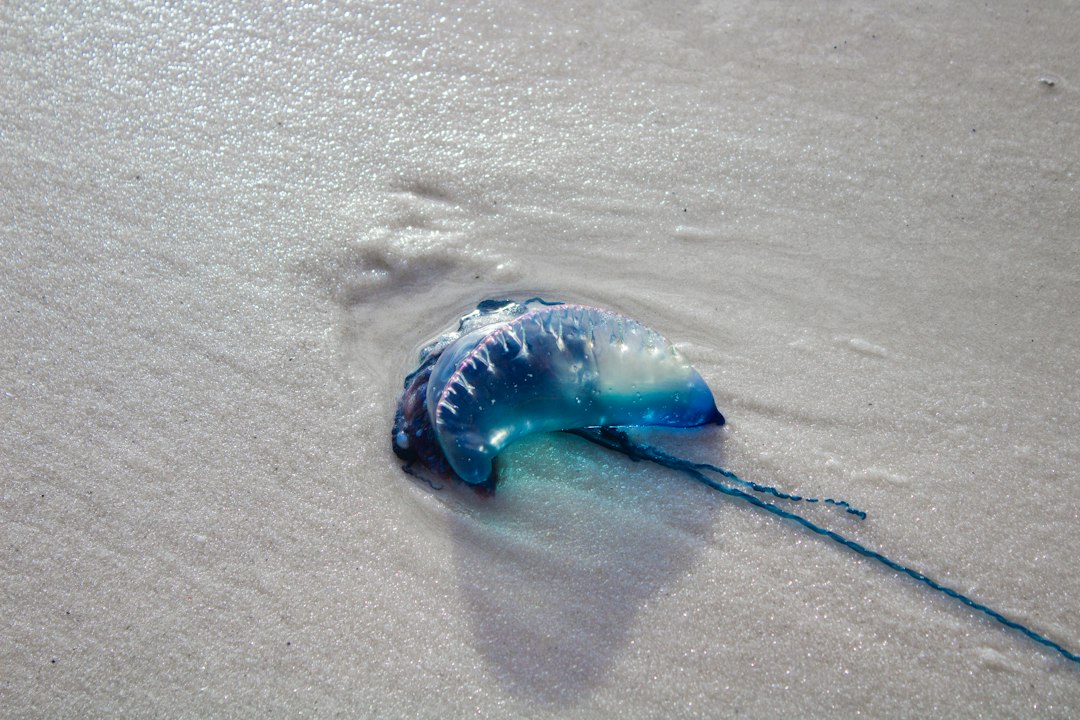
Floating at the surface of the open Atlantic on a blue-tinged gas-filled bladder, trailing tentacles that may extend 50 metres into the water column below, Physalia physalis is one of the most recognisable and most misunderstood organisms in the ocean. It is universally known as the Portuguese man o’ war. It is not a jellyfish. It is not, in the strict biological sense, an animal at all — or rather, it is simultaneously many animals and one organism, a colonial siphonophore composed of genetically identical polyps that have differentiated into entirely distinct functional forms and cannot survive without each other.
Understanding Physalia physalis requires setting aside assumptions built on the appearance of more familiar marine invertebrates. The float is not a bell. The tentacles are not arms. The stinging cells that make contact with a swimmer’s skin and remain active weeks after the organism washes ashore are the output of an organism whose evolutionary strategy is to deploy extreme, long-range chemical warfare in exchange for complete dependence on wind to move. It is an organism that builds a sail, catches the breeze, and drags a field of nematocysts through productive ocean water, paralysing anything protein-rich that contacts those threads.
Etymology and Classification
The common name “Portuguese man o’ war” dates to at least the eighteenth century and refers to the resemblance of the gas-filled float, coloured blue and pink with a crest that catches wind, to the sail configurations of Portuguese man-of-war warships during the Age of Sail. The name is also rendered “Portuguese man-of-war” and abbreviated to “man o’ war” in common usage. The Pacific form is popularly called the “bluebottle” in Australian and New Zealand usage, reflecting the float’s distinctive cobalt-blue colouration.
The genus name Physalia derives from the Greek physalis, meaning bladder or bubble, describing the pneumatophore. The species name physalis is a tautology of the genus — a naming convention once accepted but now discouraged. The genus currently contains two recognised taxa: Physalia physalis, the Atlantic and warm-water form with a larger float and longer tentacles, and Physalia utriculus, the smaller Pacific bluebottle with a single main tentacle rather than a multi-tentacle fishing apparatus. The two are treated as distinct species by some authorities and as conspecific variants by others; genetic studies have confirmed significant divergence but have not yet produced consensus on species boundaries.
Phylogenetically, Physalia belongs to the order Siphonophorae within the class Hydrozoa. Siphonophores are among the most ecologically successful of all oceanic predators and include organisms of extraordinary diversity, from the tiny Muggiaea colonies a few centimetres long to Praya dubia, which at 50 metres is arguably the world’s longest animal. The man o’ war differs from most siphonophores in being a free-floating surface dweller (pleustonic) rather than a midwater pelagic organism, a lifestyle adaptation that radically changes its relationship with wind, currents, and prey availability.
Physical Description
The Portuguese man o’ war’s most immediately visible feature is the pneumatophore, the gas-filled float that sits at the ocean surface. The float ranges from 9 to 30 cm in length in most specimens, though individuals up to 30 cm across have been documented in particularly large Atlantic animals. The float is elongated, translucent, and typically coloured in vivid shades of blue, pink, or violet, with a crest along the upper surface that acts as a sail. The specific colouration varies among individuals and may change slightly with age or health. In living specimens washed onto beaches, the float retains its colour for several hours before desiccation alters it.
The float contains a gas mixture that is approximately 90% nitrogen with smaller proportions of argon, oxygen, and notably carbon monoxide. This composition differs from simple atmospheric air and is actively regulated by the organism through a gas gland (pneumatophore gland) that secretes and reabsorbs gases. The float can be partially deflated to allow the organism to submerge temporarily and avoid breaking waves or very strong winds, but this is a slow process and cannot substitute for locomotion.
Below the float, the zooids of the colony are organised into three main functional types. Dactylozooids are the long trailing tentacle zooids, each a single structural unit but densely armed with nematocysts — stinging cells — along their length. In the Atlantic form, multiple dactylozooids trail from the float, and their combined extended length can reach 50 metres, making the man o’ war’s effective fishing area one of the largest of any pelagic predator per unit of body mass. Gastrozooids are the feeding polyps clustered beneath the float; they lack tentacles but possess a mouth and are capable of engulfing paralysed prey items transported up from the tentacles. Gonozooids handle reproduction and are responsible for producing medusoid or polypoid reproductive structures.
Each zooid is a distinct individual in the evolutionary sense, but all zooids in a colony are genetically identical, having budded from a founding individual. The colony is sometimes described as a superorganism — a concept that captures the functional integration of differentiated individuals but should not be taken to imply any central nervous coordination; siphonophores have distributed neural nets that allow local responses without any dominant nervous system centre.
Habitat and Range
Physalia physalis inhabits the surface layer of the open ocean across the Atlantic, Pacific, and Indian Oceans. It is most abundant between approximately 30 degrees north and 30 degrees south latitude, where surface temperatures remain above 22 degrees Celsius year-round, conditions optimal for the warm-water prey and pelagic ecosystem the man o’ war depends upon. However, prevailing winds regularly drive specimens far outside this range; men o’ war strand on beaches along the west coasts of Europe and the British Isles, on the eastern seaboard of the United States and Canada, and along the southern Australian coast, all well beyond the tropics.
The organism’s distribution is essentially determined by wind. It cannot swim or orient itself against surface currents. The float acts as a passive sail, and the direction of travel is governed entirely by wind speed, wind direction, and local current patterns. This dependence on wind creates a characteristic pattern of mass strandings: when persistent onshore winds drive surface water towards a coast over several days, enormous numbers of individuals accumulate and wash ashore simultaneously. On Australian beaches during north-east wind events, hundreds of thousands of bluebottles have been documented stranding along a stretch of coast within 24 hours.
The population structure is affected by the handedness of individual floats. The pneumatophore crest is tilted to the left in some individuals and to the right in others, so that wind pushes them in slightly different directions. This chirality means that a mixed population will automatically separate into two groups trending on divergent courses, achieving broader oceanic coverage than a uniform population would. The proportion of left-handed to right-handed individuals appears to be approximately equal across populations, which is consistent with a strategy that maximises spatial coverage.
Diet and Feeding Behaviour
The Portuguese man o’ war is a passive but highly effective predator of small pelagic animals. Its trailing tentacles represent a continuous fishing apparatus; any animal that contacts the nematocyst-bearing surface of a dactylozooid triggers an essentially instantaneous response from the stinging cells.
Nematocysts are the stinging organelles of cnidarians, produced within cnidocytes (stinging cells). Each nematocyst consists of a capsule containing a tightly coiled, hollow thread under high osmotic pressure. When triggered by mechanical or chemical stimulation — or by both simultaneously, as occurs when a fish contacts a tentacle — the operculum opens and the thread everts at high speed, penetrating the prey’s skin and injecting venom. The man o’ war carries an estimated 750,000 nematocysts across all tentacles of a moderately sized individual. Discharge is a one-time event; each nematocyst fires once, after which it must be replaced by the zooid.
The venom is a complex mixture of proteins, including phospholipases, proteases, and pore-forming toxins. Its primary effects are to depolarise cell membranes, cause cell lysis, and produce severe pain in vertebrate targets through stimulation of nociceptive nerve pathways. Fish and crustaceans are rapidly paralysed; the venom is not lethal to large vertebrates under most circumstances but is sufficiently potent to incapacitate small fish, shrimp, and zooplankton within seconds of contact.
Once prey is paralysed, the tentacle contracts — a response requiring coordination among the nematocyst-bearing cells and the muscular elements of the dactylozooid — drawing the prey upward toward the gastrozooids beneath the float. Multiple gastrozooids may participate in digesting a single prey item, secreting digestive enzymes externally before absorbing the resulting nutrient solution. The distribution of nutrients to all zooids within the colony occurs through the gastrovascular canal system that connects all zooid types.
Prey items identified from stomach content analysis include small fish up to several centimetres in length (especially larval and juvenile fishes), shrimp, amphipods, and a variety of other zooplankton. The man o’ war is capable of capturing prey at any depth within its tentacle range, so a specimen with fully extended 50-metre tentacles fishes from the surface to 50 metres below simultaneously.
Reproduction and Life Cycle
Reproductive biology of Physalia physalis is imperfectly understood relative to the animal’s notoriety. The colony reproduces through the gonozooids, specialised reproductive polyps that produce medusoid stages. Gonozooids occur in either male or female form; individual colonies appear to be either predominantly male or predominantly female in terms of gonozooid differentiation, though the genetic identity of all zooids within a colony means colony-level sex is a matter of which gonozooid type predominates rather than a fixed property of any individual.
Medusoid buds released from gonozooids produce free-swimming medusae that shed eggs or sperm. Fertilisation is external; eggs and sperm are released into the surrounding water where they meet by chance. Fertilised eggs develop into planula larvae, the standard cnidarian larval form, which eventually settle and metamorphose into new siphonophore colonies. The newly formed colony has a single founding pneumatophore and buds all subsequent zooid types from this initial structure.
Growth rate and longevity in Physalia physalis have not been precisely measured. The animal’s obligate surface life means it is exposed to UV radiation, predation, and physical damage from waves in ways that deeper-dwelling siphonophores avoid. Observed colonies range enormously in size and apparent age, with small recently formed individuals coexisting in the same current systems as large established colonies. Mass strandings regularly kill individuals from many size classes simultaneously, suggesting a continuous population rather than strongly synchronised cohorts.
Venom, Stings, and Human Interactions
The Portuguese man o’ war is responsible for a substantial number of human stings annually. In Australia alone, bluebottle stings send an estimated 10,000 people to first aid annually during beach season, and mass strandings create public health events that close beaches and generate emergency response. Along the Atlantic coast of Europe and North America, strandings produce smaller but significant numbers of stings each year. Deaths are rare but documented, occurring principally through secondary drowning when a stung swimmer is incapacitated in the water rather than through direct venom toxicity.
The experience of a man o’ war sting has been described consistently across documented accounts: immediate intense burning pain at the contact site, followed within minutes by red raised welts tracing the line of the tentacle contact. These welts may persist for hours or days and occasionally leave permanent scarring. Systemic reactions include muscle cramps, nausea, fever, and, in severe cases or sensitised individuals, anaphylactic shock. The severity of reaction correlates broadly with the surface area of skin contacted, the density of nematocysts delivered, and individual sensitivity.
First aid recommendations have evolved with research. The practice of applying fresh water to the sting site is now discouraged by most authorities, as hypotonic fresh water can trigger unfired nematocysts to discharge. Seawater rinse and careful mechanical removal of tentacle fragments are preferred initial steps. Application of hot water at 45 degrees Celsius has been evaluated in randomised controlled trials and shown to significantly reduce pain duration compared to cold water, ice, or topical anaesthetics. Vinegar, effective for some box jellyfish stings, remains controversial for Physalia stings and is not universally recommended.
Predators and Ecological Relationships
Despite its formidable venom, the Portuguese man o’ war has several natural predators. The loggerhead sea turtle (Caretta caretta) appears effectively immune to the nematocysts and feeds heavily on men o’ war where their ranges overlap. Turtles consume the float and zooids together, and observations suggest no reluctance or aversion to the stinging tentacles. Ocean sunfish (Mola mola) also consume men o’ war, particularly the float and gonozooids. The ocean sunfish’s thick, mucus-covered skin appears to protect it from nematocysts, though it does not seem entirely immune to all effects.
The man-of-war fish (Nomeus gronovii) exploits the colony as habitat. This small fish, reaching approximately 9 cm, lives among the tentacles and displays reduced sensitivity to the venom. It shelters from larger predators in the protective curtain of nematocysts and feeds on fragments of the man o’ war’s zooids as well as on small prey attracted near the float. Several species of glaucus sea slug (Glaucus atlanticus), the so-called blue dragon, prey on men o’ war, sequestering the nematocysts in their own cerata and using them for personal defence — a case of predator-converted weapon use.
The violet snail (Janthina janthina) and related species of the family Epitoniidae also feed on men o’ war. These gastropods float at the ocean surface on self-generated bubble rafts, drifting with the same wind-driven currents as their prey. They have evolved chemical resistance to the venom and consume zooids directly. All these specialist predators form an associated community that drifts with the man o’ war across the open ocean.
Conservation Status
Physalia physalis has not been evaluated by the IUCN and has no formal conservation status. The species is abundant across its range and is not directly threatened by harvesting or habitat destruction. Its conservation concern arises indirectly through changes to the open-ocean ecosystems it depends upon and the human activities that intersect with its strandings.
Ocean warming may affect the geographic distribution and abundance of the species. Warming surface waters expand the zone of suitable temperature for the man o’ war and increase the energy available to the prey communities it feeds upon. Some researchers have hypothesised that warming-related range expansions and frequency increases in strandings on temperate beaches may already be occurring, consistent with broader patterns of range shifts observed for pelagic cnidarians. Quantifying these changes is complicated by the lack of standardised long-term monitoring of a pelagic species whose distribution is intrinsically variable and wind-driven.
Plastic pollution represents an indirect concern. Floating plastic debris interacts with the same wind-driven surface currents that concentrate and transport men o’ war, and large debris fields can alter the distribution of both the organism and the fish communities associated with the man o’ war — with poorly understood effects on either the prey availability or the predator exposure of Physalia physalis.
Related Reading
- Bioluminescence: How Deep-Sea Creatures Create Their Own Light
- Most Dangerous Insects in the World
- Pistol Shrimp: Loudest Animal
- Blue-Ringed Octopus (Hapalochlaena lunulata)
References
Munro, C., Vue, Z., Behringer, R. R., & Dunn, C. W. (2019). Morphology and development of the Portuguese man of war, Physalia physalis. Scientific Reports, 9(1), 15522. https://doi.org/10.1038/s41598-019-51842-1
Yanagihara, A. A., & Shohet, R. V. (2012). Cubozoan venom-induced cardiovascular collapse is caused by hyperkalemia and prevented by zinc gluconate in mice. PLOS ONE, 7(12), e51368. https://doi.org/10.1371/journal.pone.0051368
Pontin, D. R., & Cruickshank, R. H. (2012). Molecular phylogenetics of the genus Physalia (Cnidaria: Siphonophorae) and the evolution of chirality. Invertebrate Systematics, 26(6), 449–462. https://doi.org/10.1071/IS12012
Lakkis, S., & Zeidane, R. (1991). Biologie de Physalia physalis en Méditerranée orientale. Rapports de la Commission Internationale pour l’Exploration Scientifique de la Mer Méditerranée, 32, 236.
Williamson, J. A., Fenner, P. J., Burnett, J. W., & Rifkin, J. F. (Eds.). (1996). Venomous and Poisonous Marine Animals: A Medical and Biological Handbook. University of New South Wales Press. ISBN: 9780868402796
Helmuth, B., & Doddington, M. (1999). The effects of tentacle length on prey capture in Physalia physalis. Marine Biology, 134(3), 461–470. https://doi.org/10.1007/s002270050563
Frequently Asked Questions
Is the Portuguese man o' war a jellyfish?
No. The Portuguese man o’ war is frequently mistaken for a jellyfish because both are soft-bodied, transparent, tentacled, and sting on contact. However, jellyfish are medusae — a single organism with a bell-shaped body — whereas the man o’ war is a siphonophore, a colonial organism composed of many individual polyps called zooids that are genetically identical but structurally and functionally specialised. Each zooid performs a specific role: the pneumatophore (float) provides buoyancy, dactylozooids bear the stinging tentacles, gonozooids handle reproduction, and gastrozooids digest prey. None of these zooids can survive independently, and together they function as a single coordinated entity.
How dangerous is a man o' war sting?
A man o’ war sting is extremely painful and can cause serious medical complications. The venom, delivered through hundreds of thousands of nematocysts along the tentacles, contains proteins and enzymes that disrupt cell membranes, cause intense localised pain and redness, and in severe cases can trigger systemic reactions including muscle cramps, fever, and cardiac arrhythmia. Deaths from man o’ war stings are documented but rare; most fatalities involve secondary drowning when swimmers are incapacitated at sea rather than direct venom toxicity. Anaphylactic shock in sensitised individuals is a genuine risk. Beachgoers are advised to seek medical attention after any significant contact and never to handle stranded specimens.
What should you do if stung by a Portuguese man o' war?
Immediate first aid involves carefully removing any visible tentacle fragments using tweezers or a card rather than bare fingers, as nematocysts can fire on contact. The affected area should be rinsed with seawater (not fresh water, which can trigger unfired nematocysts). Applying heat — a hot water soak at 45 degrees Celsius — has been shown in some studies to reduce pain by denaturing venom proteins. Vinegar, despite being recommended for some jellyfish stings, is controversial for Physalia stings and some evidence suggests it may worsen the reaction. Antihistamines and analgesics help with secondary reactions. Medical attention should be sought for large sting areas, systemic symptoms, or signs of anaphylaxis.
How long are the tentacles of a man o' war?
The tentacles of a Portuguese man o’ war typically trail 10 metres below the surface under normal conditions, but can extend to 50 metres when fully relaxed. This makes individual tentacles among the longest biological structures of any animal. The tentacles are highly contractile and can shorten to a metre or less when the animal is active or disturbed. Each tentacle is a specialised zooid called a dactylozooid, densely armed with nematocysts. Large specimens with 50-metre tentacles can effectively fish a volume of water several storeys tall and half a football pitch wide.
What does the Portuguese man o' war eat?
The man o’ war is a carnivore feeding primarily on small fish, shrimp, and other zooplankton that contact its trailing tentacles. When prey touches a tentacle, nematocysts fire instantaneously, injecting venom that paralyses or kills the prey item. The tentacles then contract to draw the prey up to the gastrozooids, specialised feeding polyps at the base of the colony that digest the catch and distribute nutrients to all zooids within the colony. Despite its passive appearance, the man o’ war is an effective predator of small fish up to several centimetres in length. It is itself preyed upon by loggerhead sea turtles, ocean sunfish (Mola mola), and several specialised pelagic species.
How does the Portuguese man o' war move?
Physalia physalis has no locomotive ability of its own. It is entirely at the mercy of wind and surface currents. The gas-filled pneumatophore acts as a sail, and the angle at which it sits on the water surface determines which way the wind pushes the colony. The remarkable feature of man o’ war population biology is that individuals are either left-handed or right-handed — the float tilts to one side or the other — which means a population catches wind from multiple angles and spreads more broadly across the ocean than a uniformly oriented population would. The animal can deflate its float partially to submerge and avoid breaking waves or very strong winds, but this is a passive response rather than directed navigation.
Where do Portuguese man o' war live?
Physalia physalis inhabits the open ocean surface across the Atlantic, Pacific, and Indian Oceans. It is most abundant in warm tropical and subtropical waters but is regularly blown into temperate zones by prevailing winds, washing ashore on beaches in Western Europe (including the British Isles), the east coast of North America, Australia, and many Pacific island chains. The Pacific form, sometimes called the bluebottle, is generally considered a smaller variant of the same species, though some authorities treat it as a distinct species Physalia utriculus. Mass strandings occur worldwide when onshore winds persist for several days.
Can animals live among the man o' war's tentacles?
Yes. The man-of-war fish (Nomeus gronovii) is a small pelagic fish that lives among the tentacles and is substantially immune to their venom. It shelters among the stinging threads, using the man o’ war as a refuge from larger predators, and feeds on fragments of the zooids themselves as well as on prey attracted to the float. The relationship is partially parasitic, as the fish consumes tissue from its host, and partially commensal, as the fish may occasionally attract prey close enough for the man o’ war to capture. Several species of nudibranch sea slugs also specialise in feeding on man o’ war zooids, sequestering the nematocysts in their own tissues for defence.