
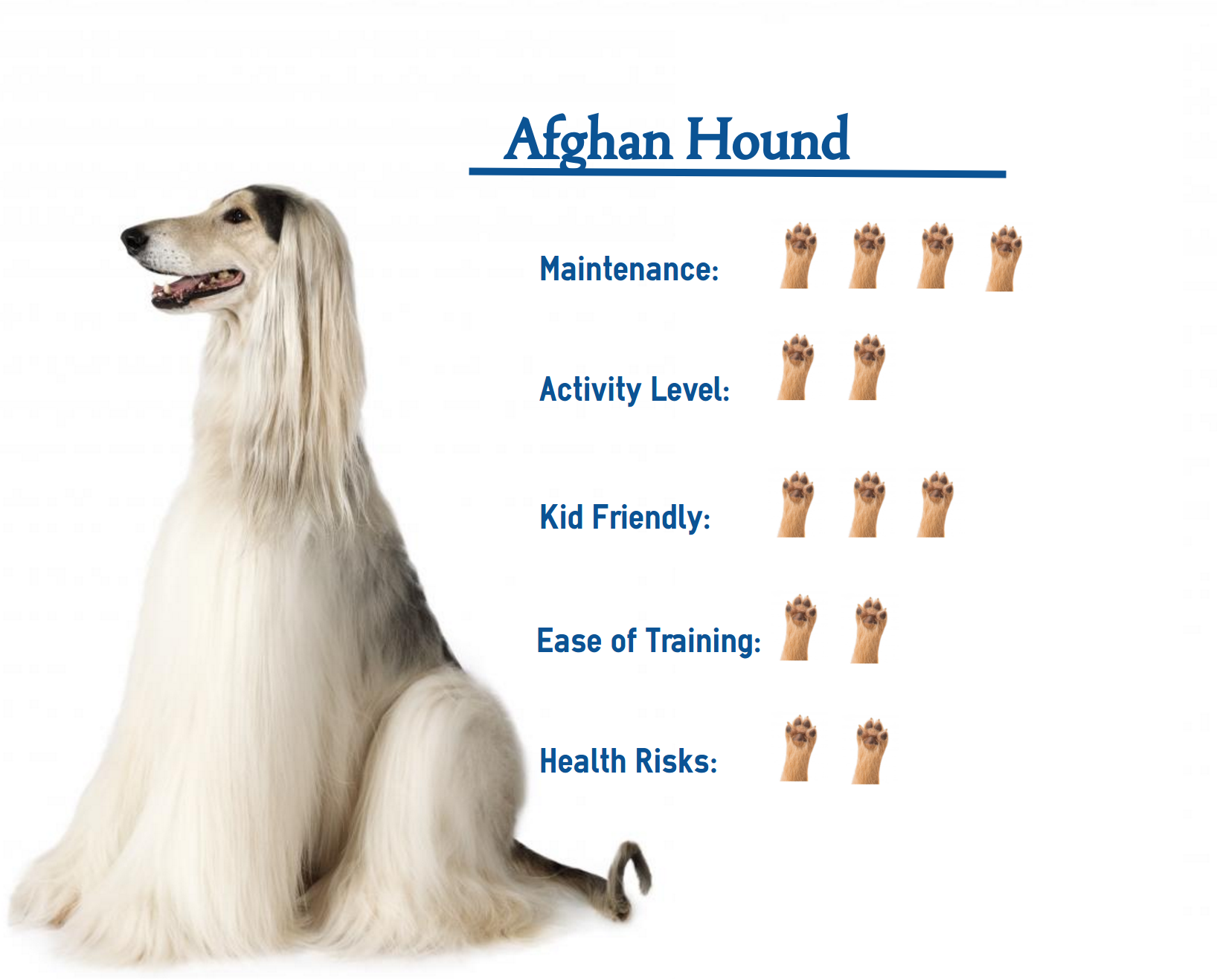
The Afghan Hound is one of the most genetically ancient and visually distinctive dog breeds in existence. Genetic analysis of dog breed relationships consistently places Afghan Hounds among the basal breeds, those most closely related to the ancestral wolf population and most distantly separated from the modern breeds developed through intensive 19th and 20th-century selective breeding.
The breed's lineage predates the kennel club era by thousands of years, and its essential character, independent, aloof, athletically formidable, and possessed of a coat requiring extraordinary maintenance, has remained stable across centuries of development in the mountains of Afghanistan.
In those mountains, the Afghan Hound served nomadic and semi-nomadic peoples as a coursing dog of extraordinary capability: fast enough to run down hare and gazelle across open terrain, agile enough to navigate rocky mountain passes, and tough enough to hunt leopard in the Hindu Kush.
The long, silky coat that makes the breed so immediately recognisable at dog shows and on the street is not a decorative artifice; it is a functional insulating system developed for the extreme temperature variations of Central Asian mountain environments, where days may be hot and nights below freezing.
Origins and History
The exact origins of the Afghan Hound are difficult to document with precision because the breed developed in a region that was geographically remote from Western record-keeping traditions. The breed's ancestral homeland is the mountain regions of Afghanistan, Pakistan, and northern India, where it was used by Pashtun and other nomadic peoples for hunting.
The first Afghan Hounds arrived in the United Kingdom in the early 20th century, brought back by British military officers and civil servants stationed in British India. The breed was first registered with the Kennel Club (UK) in 1926. The American Kennel Club recognised the Afghan Hound in 1926 as a member of the Hound Group.
Throughout the mid-20th century, the Afghan Hound became a significant show breed and developed a devoted following among those drawn to its extraordinary appearance. The show lines and the original working mountain dogs have diverged in coat volume and some conformation details, but the essential character, the independence, the speed, the extraordinary coat, is consistent across the breed.
In 2004, a scientific team in South Korea produced Snuppy, the first cloned dog, a male Afghan Hound, chosen specifically for the breed's robust health and clean genetic lines as a cloning subject.
Physical Characteristics
The Afghan Hound's physical profile is unlike any other breed. The combination of the long, silky, flowing coat; the narrow, refined head; the prominent hip bones (unusually prominent and high-set compared to other breeds, a breed characteristic, not a sign of undernutrition); the ring-curled tail; and the general impression of exotic, aristocratic elegance is entirely sui generis.
| Characteristic | Measurement |
|---|---|
| Height (males) | 68-74 cm (27-29 in) |
| Height (females) | 63-69 cm (25-27 in) |
| Weight (males) | 23-27 kg (50-60 lb) |
| Weight (females) | 20-25 kg (45-55 lb) |
| Lifespan | 12-14 years |
| AKC Group | Hound |
| Coat maintenance | 30+ minutes of brushing daily |
The coat is the Afghan Hound's most defining physical characteristic and its most demanding care requirement. The long, silky hair on the body, the characteristic topknot on the head, the feathered ears, and the short saddle of hair on the back all combine to create the breed's signature appearance. In adult show condition, the coat requires 30 or more minutes of careful brushing daily to prevent matting.
Bathing must be thorough and conditioning is essential, Afghan Hound hair tangles easily and a mat that is not addressed promptly becomes a dense, painful, and sometimes unsalvageable knot. The saddle of shorter hair on the back is a characteristic feature that owners may initially mistake for coat damage; it is breed-typical.
The breed's eyes are dark, almond-shaped, and carry an expression that is most accurately described as distant or regal, a look that reflects the breed's genuine temperamental independence.
Temperament
The Afghan Hound is consistently described as cat-like, and the description is apt. The breed is independent, sometimes aloof, demonstrably capable of affection on its own terms, and essentially impervious to the social approval of humans in the way that working breeds calibrated for close cooperation are not.
This does not mean the Afghan Hound is unaffectionate. Many Afghan Hound owners describe deep bonds with their dogs. But the bond is expressed on the dog's terms: the Afghan Hound will seek contact when it chooses, and will decline engagement when it does not. It will observe training requests with calm consideration and comply or not depending on its own assessment of the situation.
This is not defiance in the way a Border Collie that ignores a command is defiant; it is simply a dog whose evolutionary programming never required the same degree of human-directed compliance.
"The basal breeds, Afghan Hound, Basenji, Canaan Dog, and others that have been identified by population genetics studies as diverging earliest from the common wolf ancestor, tend to share temperament characteristics that distinguish them from later-developed herding and working breeds: greater independence, less eye-contact seeking, lower responsiveness to social cues from humans. These are not deficits; they are markers of the breeds' evolutionary heritage." Parker, H. G., et al. (2004). Genetic structure of the purebred domestic dog. Science, 304(5674), 1160-1164. https://doi.org/10.1126/science.1097788
The prey drive in Afghan Hounds is very high. The breed was developed to course gazelle and hare at speed, and the sight of a small, fast-moving animal activates a chase response that overrides essentially all training. Off-lead exercise must be in securely fenced areas.
The combination of speed (Afghan Hounds are very fast, competitive in lure coursing against Greyhounds and Whippets), independence, and a tendency to keep running when the chase impulse is engaged makes the breed genuinely dangerous near traffic if uncontrolled.
Health Conditions
The Afghan Hound is generally considered a healthy breed relative to many heavily bred show breeds, but specific hereditary conditions require attention.
| Health Condition | Prevalence / Notes |
|---|---|
| Necrotic myelopathy (Afghan Hound hereditary myelopathy) | Fatal progressive paralytic disease affecting puppies; autosomal recessive; DNA test available |
| Hypothyroidism | Elevated breed prevalence; thyroid testing recommended in breeding stock |
| Cancer | Afghan Hounds have elevated cancer rates in later life; osteosarcoma and other forms |
| Cataracts | Hereditary cataracts documented in the breed; ophthalmic examination recommended |
| Anesthesia sensitivity | Shared with other sighthound breeds, low body fat affects drug metabolism |
Afghan Hound hereditary myelopathy (also called necrotic myelopathy) is the most serious breed-specific health condition. This is a fatal progressive spinal disease affecting puppies, typically presenting between 3 and 13 months of age with progressive hindlimb weakness that advances to complete paralysis. There is no treatment.
The condition is caused by an autosomal recessive mutation, meaning both parents must carry the defective gene for offspring to be affected. A DNA test is available, and responsible breeders should test all breeding animals and not produce litters from two carrier parents.
"The identification of the genetic basis of Afghan Hound hereditary myelopathy, a mutation in the TECPR2 gene, enables reliable pre-breeding DNA testing that can eliminate the production of affected offspring. Breed clubs and responsible breeders should make DNA testing of breeding stock a requirement." Drogemuller, M., et al. (2014). Identification of a missense mutation in the TECPR2 gene in a dog breed with hereditary spastic paraplegia. PLOS ONE, 9(6), e100244. https://doi.org/10.1371/journal.pone.0100244
Grooming
Afghan Hound grooming is the most demanding regular care requirement of any dog breed commonly kept as a companion. The long, silky coat requires:
- Daily brushing of 30 to 45 minutes minimum
- Bathing every 1 to 2 weeks, with thorough conditioning
- Post-bath detangling with a wide-tooth comb and detangling spray before drying
- Blow-drying while brushing to prevent mats forming as the coat dries
- Careful attention to the coat behind the ears, in the armpits, and behind the knees, areas where mats form first
The coat should be brushed layer by layer, working from the skin outward, rather than working on the surface layer alone. A coat that appears unmatted on the surface may conceal significant matting close to the skin. Equipment needed: slicker brush, pin brush, wide-tooth comb, long-tooth comb, and professional-grade conditioning spray.
Many Afghan Hound owners use professional groomers, but between-appointment maintenance must still be performed daily by the owner. The alternative to daily brushing is periodic professional shaving of the coat and starting the regrowth process from scratch, an approach used by some owners of non-show Afghan Hounds.
See also How to Groom a Dog at Home for grooming techniques, and Afghan Hound Grooming Guide for breed-specific detailed guidance.
Training and Exercise
Training an Afghan Hound requires patience, a sense of humour, and an adjustment of expectations around compliance. The breed can learn basic obedience commands reliably, and many Afghan Hounds compete successfully in lure coursing, agility, and obedience trials. However, training methods must be positive and engaging, and owners must accept that the Afghan Hound will sometimes choose not to perform a known behaviour simply because nothing compelling is motivating compliance in that moment.
Short, positive sessions are more effective than long drill-based training. Food rewards work for most Afghan Hounds, though some are less food-motivated than other breeds. Play rewards can be effective for individuals with high play drive.
Exercise needs are substantial: the breed was developed for extended high-speed pursuit over mountain terrain and has the stamina and drive to sustain vigorous activity for long periods. Adult Afghan Hounds need at least 1 to 2 hours of exercise daily, including regular opportunities for off-lead running in large, securely fenced areas. See Exercise Needs by Dog Breed for comparative exercise requirements.
The breed is not suitable for owners who cannot provide consistent, substantial exercise, and is not suitable for first-time dog owners, see Best Dogs for First-Time Owners for guidance.
See also Greyhound for related sighthound information.
References
Parker, H. G., Kim, L. V., Sutter, N. B., et al. (2004). Genetic structure of the purebred domestic dog. Science, 304(5674), 1160-1164. https://doi.org/10.1126/science.1097788
Drogemuller, M., Jagannathan, V., Welle, M., et al. (2014). Identification of a missense mutation in the TECPR2 gene in a dog breed with hereditary spastic paraplegia. PLOS ONE, 9(6), e100244. https://doi.org/10.1371/journal.pone.0100244
Orthopedic Foundation for Animals. (2023). Breed Health Statistics: Afghan Hound. Retrieved from https://ofa.org
Afghan Hound Club of America. (2023). Health Committee: Hereditary Conditions. Retrieved from https://ahca.org/health/
American Kennel Club. (2023). Afghan Hound Breed Standard. Retrieved from https://www.akc.org/dog-breeds/afghan-hound/
Robinson, E. P. (1983). Anesthesia of sighthound breeds. Journal of the American Veterinary Medical Association, 183(8), 857-860.
Frequently Asked Questions
How much grooming does an Afghan Hound need?
Afghan Hound coat maintenance is the most demanding of any commonly kept companion dog breed. An adult Afghan Hound in full coat requires at least 30 to 45 minutes of brushing daily, bathing every 1 to 2 weeks with professional-grade conditioning, and blow-drying while brushing to prevent mats forming during the drying process. Without daily brushing, the long, silky coat mats rapidly, first behind the ears, in the armpits, and behind the knees.
Established mats cannot be brushed out and require professional removal or shaving. Owners should budget for professional grooming appointments every 6 to 8 weeks in addition to daily home care. The grooming commitment is a primary reason this breed is unsuitable for first-time dog owners.
What is Afghan Hound hereditary myelopathy?
Afghan Hound hereditary myelopathy (also called necrotic myelopathy) is a fatal inherited spinal disease affecting Afghan Hound puppies, typically presenting between 3 and 13 months of age. The condition causes progressive hindlimb weakness that advances to complete paralysis. There is no treatment. The disease is caused by an autosomal recessive mutation in the TECPR2 gene, meaning a puppy must inherit a defective copy from each parent to be affected.
A DNA test is available. Prospective buyers should ask breeders for DNA test results for both parents and should only purchase from litters where at least one parent is DNA-tested clear.
Are Afghan Hounds difficult to train?
Afghan Hounds are often described as difficult to train, but a more accurate description is that they require a different training approach than breeds developed for close human cooperation. The breed is intelligent; it observes, learns, and understands requests quickly. The issue is compliance: an Afghan Hound may know a command and choose not to perform it if the motivation is insufficient or the situation uncompelling.
Training methods must be positive and varied to maintain engagement. Sessions should be short and reward-based. Many Afghan Hounds compete successfully in lure coursing, agility, and obedience when trained with appropriate methods and patience. The breed is not suitable for owners who expect automatic compliance.
How much exercise does an Afghan Hound need?
Afghan Hounds need substantial exercise, at least 1 to 2 hours of daily activity, including regular sessions of off-lead running in securely fenced areas. The breed was developed for extended high-speed coursing in mountain terrain and has the drive and stamina to sustain vigorous activity for long periods. The most natural and satisfying exercise for Afghan Hounds is lure coursing, chasing a mechanised lure across a field.
Daily walks alone are insufficient for this breed’s exercise requirements. An Afghan Hound that is under-exercised develops anxiety, destructive behaviour, and hypersensitivity. The exercise commitment is substantial and must be factored into any decision to acquire the breed.
Why are Afghan Hounds considered one of the oldest breeds?
Population genetics studies of dog breeds have consistently identified Afghan Hounds (along with a small group of other breeds including the Akita, Basenji, Chow Chow, and Siberian Husky) as genetically basal breeds, those that diverged earliest from the ancestral wolf population and are most distantly related to the breeds developed through intensive modern selective breeding.
A landmark 2004 study by Parker et al. in Science analysed microsatellite markers across 85 breeds and identified this basal group. The Afghan Hound’s geographical isolation in Central Asian mountain regions contributed to the preservation of this ancient genetic character through many centuries of relatively closed breeding.
Can Afghan Hounds live with other pets?
Afghan Hounds generally get along reasonably well with other dogs of similar size and temperament, particularly if socialised from puppyhood. The prey drive toward smaller animals is significant: cats and small dogs can trigger the chase response, particularly if they run.
Introductions to household cats should be carefully managed, and cohabitation with small animals should be supervised until the relationship is well-established and the individual dog’s prey drive toward that specific animal is understood. Afghan Hounds raised alongside cats from puppyhood often learn to coexist peacefully, but this cannot be assumed, individual prey drive intensity varies within the breed.