
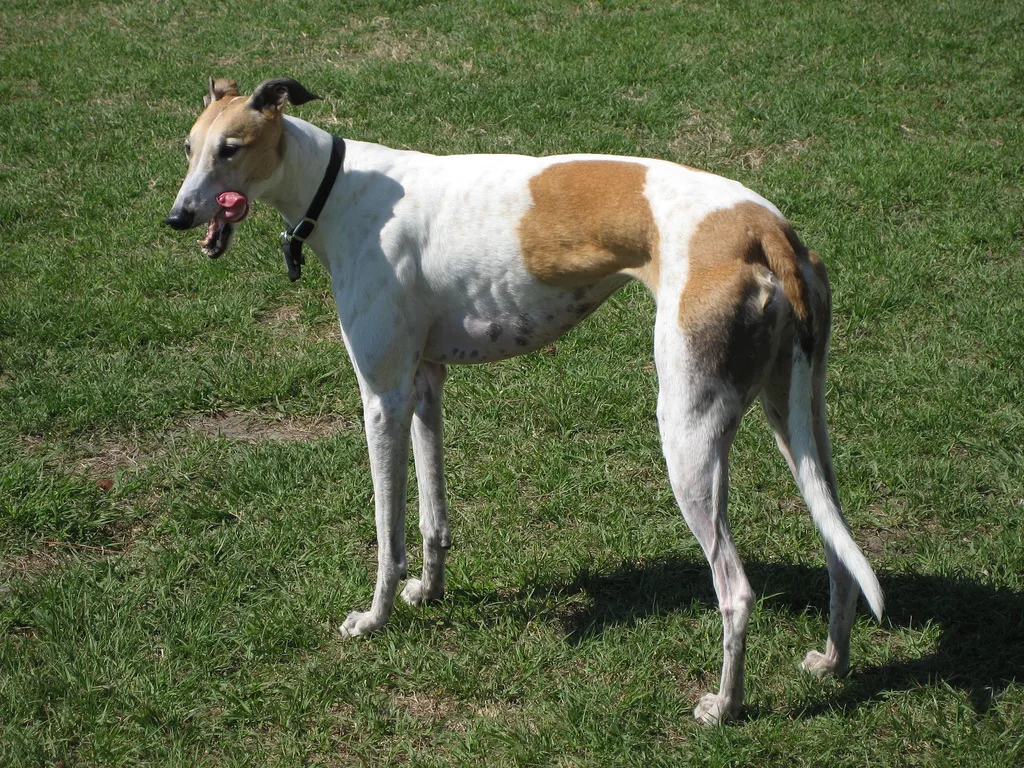
The Greyhound is the fastest domestic dog breed, capable of reaching sprint speeds of 68 to 72 kilometres per hour. It is also one of the oldest pedigree breeds in recorded history: Greyhound-type dogs are depicted in Egyptian tomb art dating to approximately 2900 BCE, making this one of a small number of dog breeds whose essential form has remained recognisable across nearly five millennia of human civilisation.
The same narrow-headed, deep-chested, long-legged sighthound silhouette that was captured in limestone carvings in ancient Egypt is the dog that finishes last in a queue for the sofa in millions of homes today.
That juxtaposition of extraordinary physical capability and notable domestic calm is the defining paradox of the Greyhound. The breed that holds the speed record for domestic dogs is routinely described by owners as the ultimate lounge dog, a creature of brief, explosive athletic performance followed by extended, enthusiastic rest. Understanding this duality is the foundation of understanding the Greyhound as a companion animal.
Origins and History
The Greyhound is among the most ancient of pedigree breeds, with a documented history extending back to ancient Egypt. Tomb art at Beni Hassan (circa 2900-2200 BCE) depicts dogs of recognisably Greyhound conformation. Ancient Greek and Roman writers, including Ovid and Arrian, wrote admiringly of the sighthound's speed and hunting ability. The breed appears repeatedly in medieval European literature and heraldry as a symbol of speed, grace, and noble breeding.
The name Greyhound does not describe the dog's colour, the breed is found in many colours, and grey is merely one of them. The etymology is debated: possible derivations include the Old English grig (dog), the Welsh graith (greyhound), or simply a corruption of an earlier name lost to time.
Greyhounds were used for coursing, the pursuit of hare and other game by sight rather than scent, throughout European history. The breed's speed, endurance over short distances, and exceptional visual acuity (the Greyhound has a 270-degree field of vision, compared to approximately 180 degrees in humans) made it the premier coursing dog across Europe from medieval times through the 20th century.
Organised Greyhound racing developed in the early 20th century, with the first circular track race held in Emeryville, California in 1919. The sport expanded rapidly and at its peak involved hundreds of thousands of racing Greyhounds worldwide.
The decline of the racing industry in the late 20th and early 21st centuries, legal prohibitions in multiple US states, declining attendance globally, and the growth of the Greyhound adoption movement, has resulted in large numbers of retired racing Greyhounds becoming available for adoption each year.
The American Kennel Club recognised the Greyhound in 1885.
Physical Characteristics
The Greyhound's body is a purpose-built speed machine. The double suspension gallop, the breed's characteristic gait in which all four feet leave the ground twice per stride, once when fully extended and once when fully contracted beneath the body, requires a specific combination of skeletal proportions, muscle architecture, and cardiovascular capacity that is unique to the breed.
| Characteristic | Measurement |
|---|---|
| Height (males) | 71-76 cm (28-30 in) |
| Height (females) | 68-71 cm (27-28 in) |
| Weight (males) | 27-40 kg (60-88 lb) |
| Weight (females) | 25-34 kg (55-75 lb) |
| Top speed | 68-72 km/h (42-45 mph) |
| Lifespan | 10-14 years |
| AKC Group | Hound |
Key anatomical features contributing to the Greyhound's speed:
Cardiovascular system: The Greyhound has a proportionally enlarged heart, the highest heart-to-body-weight ratio of any dog breed. The resting heart rate is lower than expected for body size, reflecting the efficiency of the cardiovascular system. Greyhound haematological values (red blood cell counts, haemoglobin concentration, haematocrit) differ significantly from other breeds due to the breed's exceptional oxygen-carrying requirements during sprint activity.
Muscular development: The hindquarters are powerfully developed, with the quadriceps, hamstrings, and gluteal muscles providing the explosive propulsion of the sprint. The breed carries more fast-twitch muscle fibre than most other dogs.
Skeletal proportions: The long, flexible spine participates actively in the stride cycle, the back arching and extending contributes materially to stride length. The deep, narrow chest accommodates the enlarged heart and lungs.
Low body fat: Greyhounds have extremely low body fat, typically 1 to 3 percent. This is functionally essential for speed but has significant health implications (see Health Conditions).
Temperament
The Greyhound's temperament surprises first-time owners familiar with the breed's athletic reputation. The stereotype is accurate in a specific context: Greyhounds are fast, focused, and driven when chasing. In the domestic context, however, the breed is notably calm, gentle, and low-energy for the majority of each day.
This is not a contradiction. The Greyhound is a sprinter, not an endurance athlete. The burst of intense activity that defines the sprint is biologically expensive and requires extended rest for recovery. In the domestic environment, where the sprint never occurs, the Greyhound's natural baseline behaviour is restful, relaxed, and surprisingly inactive. The breed has been called a "45 mph couch potato" by aficionados, and the description is accurate.
"The sighthound's temperament reflects the hunting strategy it evolved for. A coursing dog that wastes energy on unnecessary activity between hunts is a less effective hunter. The Greyhound's calm domestic demeanour is as much a functional adaptation as its speed." Coppinger, R., & Schneider, R. (1995). Evolution of working dogs. In J. Serpell (Ed.), The Domestic Dog: Its Evolution, Behaviour and Interactions with People. Cambridge University Press.
Greyhounds are gentle with people, including children, and are typically non-aggressive. They are often reserved rather than exuberantly friendly with strangers, more likely to observe quietly than to demand immediate attention. The breed is sensitive and responds poorly to harsh training methods.
The critical temperament consideration for Greyhound owners is the prey drive. A Greyhound that sights a small, fast-moving animal, a rabbit, a squirrel, or a small dog, may enter full chase mode with essentially no ability to respond to owner commands. This is not disobedience; it is the full expression of a hunting reflex that has been selected for over thousands of years.
Off-lead exercise must only occur in securely fenced areas. The breed's speed means that a Greyhound that bolts cannot be caught.
Health Conditions
The Greyhound is generally considered a healthy breed relative to many pedigree dogs. The breed has not been subject to extreme conformation selection in most of the ways that produce mechanical health problems in other breeds, and the racing industry, whatever its ethical problems, maintained significant selection pressure for physical soundness. Nonetheless, specific health considerations are important.
| Health Condition | Prevalence / Notes |
|---|---|
| Dental disease | Very common, thin enamel and fine teeth accumulate tartar rapidly; regular dental cleaning required |
| Osteosarcoma (bone cancer) | Elevated risk in large/giant breeds; Greyhounds have somewhat elevated prevalence |
| Hypothyroidism | Present in the breed; some research suggests lower thyroid hormone levels are normal baseline for Greyhounds |
| Anesthesia sensitivity | Critical, low body fat significantly alters drug metabolism; must inform veterinarian of breed before any procedure |
| Bloat/GDV | Deep-chested conformation; risk present though lower than some other large breeds |
| Cardiac disease | Heart murmurs present in a subset of the breed; regular cardiac monitoring recommended |
The anesthesia sensitivity issue is potentially life-threatening and requires emphasis. Greyhounds have extremely low body fat (1 to 3 percent), and many commonly used anesthetic agents are lipid-soluble; they are stored in fat tissue, and their duration and intensity are calibrated based on normal fat distribution.
In a Greyhound, drugs that would be safely metabolised by a fat-carrying dog can cause prolonged, dangerous anesthesia. Veterinarians who are not familiar with Greyhound-specific pharmacology may use standard dosing protocols that are inappropriate for the breed. Any owner of a Greyhound must inform their veterinarian of the breed before any surgical or pharmacological procedure that involves anesthesia. Thiobarbiturates (thiopental) are particularly contraindicated.
"Greyhounds and other sighthounds present specific anesthetic challenges due to their low percentage of body fat and high lean muscle mass. The prolonged recovery times seen with certain agents, particularly thiobarbiturates, in this breed group have been attributed to reduced redistribution from plasma into adipose tissue. Veterinarians should use sighthound-specific protocols." Robinson, E. P. (1983). Anesthesia of Greyhound dogs. Journal of the American Veterinary Medical Association, 183(8), 857-860.
Adopting a Retired Racing Greyhound
A substantial proportion of Greyhounds available for adoption are retired racing dogs, typically aged 2 to 5 years. These dogs have been kennelled, exercised, and race-trained in institutional environments; they have not been house pets. The transition to domestic life requires some specific management.
Retired racing Greyhounds:
- Are typically housetrained quickly, as kennel dogs are accustomed to scheduled outdoor elimination
- May never have seen stairs, glass doors, small children, cats, or domestic household items
- May need several weeks to learn that glass patio doors are solid barriers
- Have often lived exclusively among other Greyhounds and may need gradual introduction to other dog breeds
- Are generally gentle, manageable adults that learn domestic routines efficiently
The cat-compatibility question is important for households with cats. Some Greyhounds have been successfully socialised with cats through a structured introduction process. Others have a prey drive that makes safe cohabitation impossible. Reputable Greyhound adoption organisations (NGA rescue groups, various national Greyhound adoption programmes) conduct cat-compatibility testing before placement.
See also Adopting a Dog What to Expect, Whippet, and Italian Greyhound for related sighthound information.
Training
Training a Greyhound is more straightforward than many owners expect, given the breed's independent reputation. Greyhounds are gentle, sensitive, and responsive to positive reinforcement. They are not particularly food-obsessed, but they respond well to high-value treats and to calm, consistent handling.
The primary training priorities are: reliable recall in secure environments (which must be established before any off-lead exercise is attempted, even in areas that appear secure); loose-lead walking (the breed's speed and forward drive can make on-lead walking challenging without early training); and basic household manners (Greyhounds have a habit of counter-surfing due to their height, and establishing boundaries early prevents long-term problems).
Training sessions should be brief and positive. The breed is sensitive to raised voices and physical correction, and negative interactions produce a shutdown response that makes subsequent training more difficult.
Exercise
The Greyhound's exercise needs are more modest than the breed's speed record implies. An adult Greyhound needs approximately 40 to 60 minutes of exercise daily, which can include two moderate walks and one off-lead sprint session in a securely fenced area. The breed does not require the extended daily exercise of working breeds such as Border Collies or Labradors.
The critical requirement is a securely fenced space for off-lead running. A Greyhound that cannot occasionally run at full speed, or something approximating it, is missing a component of physical expression that is important to the breed's wellbeing.
Lure coursing, an organised sport involving Greyhounds chasing a mechanised lure, is an excellent outlet that simultaneously provides exercise, mental stimulation, and the expression of natural instinct. See How Fast Can Dogs Run for comparative speed data.
References
Gaughan, K. R., & Bruyette, D. S. (2001). Thyroid function testing in Greyhounds. American Journal of Veterinary Research, 62(6), 1009-1013. https://doi.org/10.2460/ajvr.2001.62.1009
Robinson, E. P. (1983). Anesthesia of Greyhound dogs. Journal of the American Veterinary Medical Association, 183(8), 857-860.
Zink, M. C. (2005). Peak Performance: Coaching the Canine Athlete (2nd ed.). Dogwise Publishing.
Orthopedic Foundation for Animals. (2023). Breed Health Statistics: Greyhound. Retrieved from https://ofa.org
American Kennel Club. (2023). Greyhound Breed Standard. Retrieved from https://www.akc.org/dog-breeds/greyhound/
Arrian. (2nd century CE). Cynegeticus (On Hunting). Trans. A.A. Phillips & M.M. Willcock (1999). Aris and Phillips. https://doi.org/10.2307/j.ctvvn9c2
Frequently Asked Questions
Are Greyhounds good apartment dogs?
Greyhounds are surprisingly well-suited to apartment living given their calm, low-energy indoor temperament. The breed’s nickname, ‘45 mph couch potato’, is earned. Adult Greyhounds sleep 16 to 18 hours per day and are content to rest for extended periods between exercise sessions.
The key requirements for apartment-dwelling Greyhounds are: daily walks of 40 to 60 minutes; access to a securely fenced area for occasional off-lead running; and a warm, comfortable sleeping surface, as the breed’s low body fat and thin coat make them cold-sensitive. Greyhounds are not typically excessive barkers, which helps in close-quarter living.
Why are Greyhounds sensitive to anesthesia?
Greyhounds have extremely low body fat, typically 1 to 3 percent. Many anesthetic drugs, particularly thiobarbiturates, are lipid-soluble: they are distributed from the bloodstream into fat tissue, and the redistribution away from the brain is what terminates their effect.
In a dog with very little fat tissue, these drugs remain in the bloodstream and active at the brain for much longer than in fat-carrying dogs, causing prolonged and potentially dangerous anesthesia. Standard dosing protocols designed for other breeds can cause extended recovery times or respiratory depression in Greyhounds. Any veterinarian treating a Greyhound must be informed of the breed and use sighthound-specific anesthetic protocols.
How fast can a Greyhound run?
Greyhounds have been clocked at sprint speeds of 68 to 72 kilometres per hour (42 to 45 miles per hour), making them the fastest domestic dog breed.
This speed is achieved through the double suspension gallop, a gait in which all four feet leave the ground twice per stride cycle, combined with the breed’s enlarged cardiovascular system, high proportion of fast-twitch muscle fibre, flexible spine that actively contributes to stride length, and extremely low body fat.
The speed is a short-distance sprint rather than sustained endurance: Greyhounds are built for brief explosive effort, not extended distance running.
What should I know about adopting a retired racing Greyhound?
Retired racing Greyhounds make excellent pets but require a thoughtful introduction to domestic life. Key points: they come from kennelled environments and have typically never experienced household items like glass doors, stairs, or small children; they housetrain quickly as they are accustomed to scheduled outdoor time; they may have lived exclusively with other Greyhounds and need gradual introduction to different dog breeds; and their prey drive must be assessed if cats or small animals are in the household. Most reputable Greyhound adoption organisations conduct cat-compatibility testing.
The transition to domestic life usually takes 4 to 8 weeks, after which most retired racers adapt very well.
Do Greyhounds need a lot of exercise?
Greyhounds need less exercise than many people expect given their speed and athletic build. An adult Greyhound typically needs 40 to 60 minutes of daily exercise, which can be split into two or three walks. What the breed does need, ideally weekly, is an opportunity for off-lead running in a securely fenced area. The physical and psychological expression of the sprint is important to the breed’s wellbeing even though the dog rests for most of the day.
Lure coursing, organised as a sport through the American Sighthound Field Association, is an excellent structured outlet. Greyhounds should never be exercised off-lead in unfenced areas, the combination of speed and prey drive makes recall unreliable.
Are Greyhounds good with children?
Greyhounds are generally gentle and patient with children who understand how to interact calmly with a dog. The breed’s sensitivity makes it less tolerant of rough handling, sudden loud noises, or unexpected grabbing than more boisterous breeds. Very young children who may inadvertently behave unpredictably should always be supervised with a Greyhound.
The breed’s tall, lean build means small children can inadvertently be knocked over by an excited dog moving quickly through a room. Greyhounds that have been raised around children or properly introduced to them are typically calm and affectionate family members.