
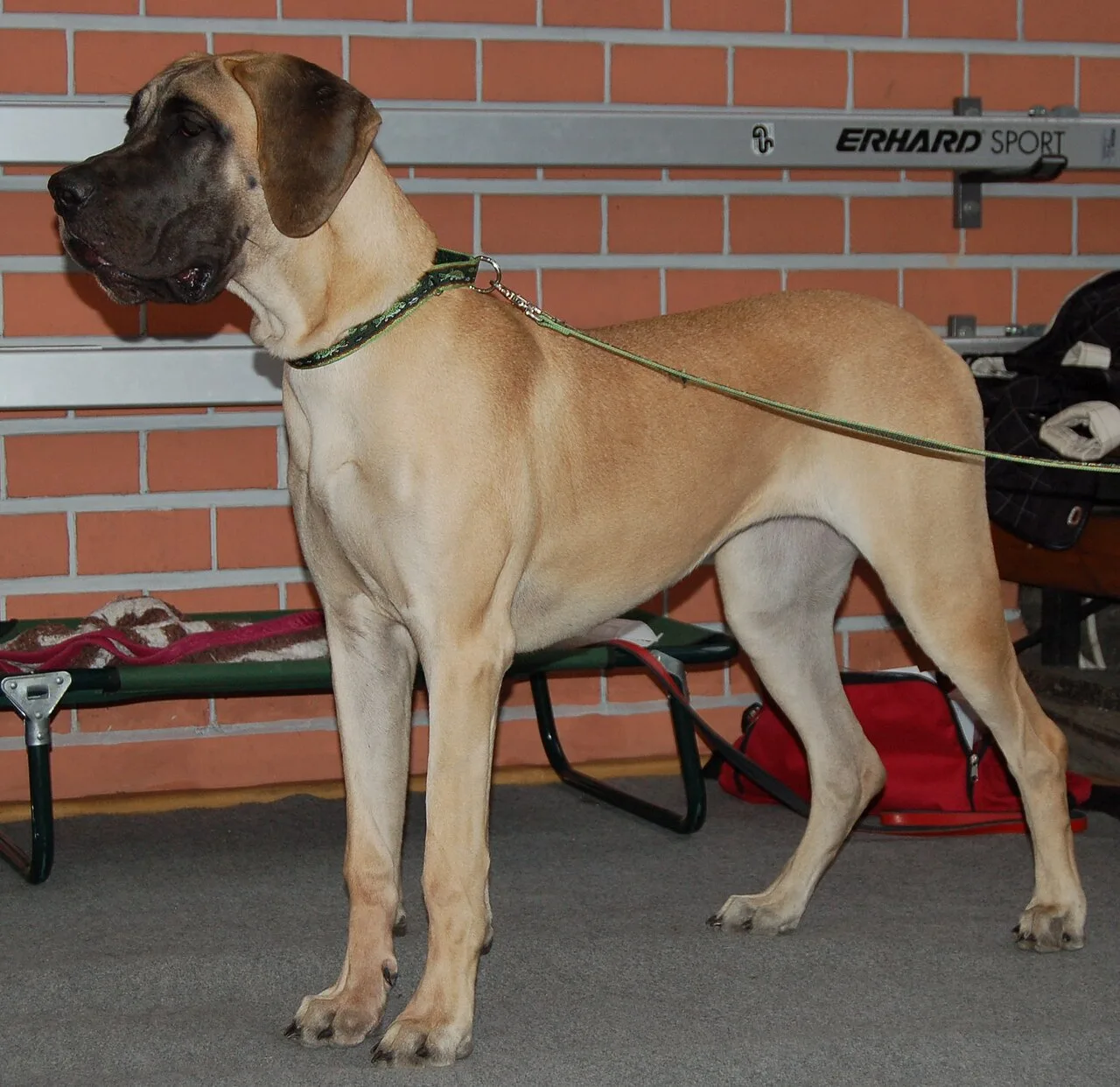
The Great Dane is the largest dog breed by height measured at the withers, a canine of such scale that it consistently provokes astonishment in people encountering a well-grown adult male for the first time.
A large male Great Dane at 86 centimetres at the withers and 82 kilograms is taller than many adult humans when standing on his hind legs, and even when standing normally, makes direct eye contact with a seated person. The Guinness World Records-recognised tallest dog ever documented was Zeus, a Great Dane from Michigan, measuring 111.8 centimetres at the withers in 2011.
This scale is the Great Dane's most immediately striking characteristic, but it is not the most important one for prospective owners to understand.
The Great Dane's short lifespan, averaging 6 to 8 years, the shortest average of any major recognized breed, and its specific health vulnerabilities, particularly gastric dilatation-volvulus (bloat), dilated cardiomyopathy, and bone cancer, are the considerations that most profoundly shape the experience of Great Dane ownership.
This guide covers the breed comprehensively: origins, physiology, temperament, health data, exercise, feeding, and the genuine trade-offs of living with the world's tallest dog.
Origins and History
Despite the name, the Great Dane is a German breed. The English name is a historical misattribution; the breed's accurate name in its country of origin is Deutsche Dogge (German Mastiff). The confusion arose from an 18th-century French naturalist, Georges-Louis Leclerc, Comte de Buffon, who described a similar large dog he had encountered in Denmark and called it the Grand Danois.
The name Great Dane entered English usage from this French description and persisted, while the German breeders retained Deutsche Dogge.
The Great Dane's ancestry is in the large German hunting mastiffs of the Middle Ages, used primarily for hunting boar, one of the most dangerous quarry in European hunting, requiring a dog of extraordinary size, power, and fearlessness. These German boar-hunting mastiffs were known as Saupacker (boar packer) and appear in German artwork and hunting manuscripts from the 15th and 16th centuries.
Historical crosses with Greyhound stock, likely occurring centuries ago, contributed the breed's height, lean musculature, and relative elegance of movement compared to heavier mastiff types.
The breed was formally standardised in Germany in 1880, when a group of German breeders and judges met in Berlin and agreed on the type that would define the Deutsche Dogge. The Deutsche Dogge Club was established in 1888. The American Kennel Club first registered the Great Dane in 1887, before formal breed club structure existed in North America. The Great Dane Club of America was founded in 1889 and is among the oldest breed clubs in the United States.
The Great Dane's role transitioned from boar hunter to companion, estate dog, and eventually show and family dog as large game hunting declined in Germany. The breed's combination of imposing size, elegant movement, and reported gentleness with its family made it a status symbol among German nobility in the 17th and 18th centuries.
Physical Characteristics
The Great Dane is the tallest of all recognised dog breeds. The AKC breed standard sets minimum heights; there is no maximum, and well-bred Great Danes frequently exceed the minimums substantially.
| Measurement | Male | Female |
|---|---|---|
| Minimum height at withers | 76 cm (30 in) | 71 cm (28 in) |
| Typical height range | 76-86 cm (30-34 in) | 71-81 cm (28-32 in) |
| Weight range | 54-82 kg (120-180 lb) | 45-59 kg (100-130 lb) |
| Zeus (GWR record, 2011) | 111.8 cm at withers | , |
The body is large, well-muscled, and rectangular in proportion, slightly longer than tall. The neck is long, well-arched, and carried high, giving the breed its characteristic aristocratic carriage. The head is large, long, and finely chiselled, distinctly different from the heavier, rounder head of the mastiff. The chest is broad and deep, reaching to the elbows. The hindquarters are broad and muscular.
The coat is short, thick, and clean, requiring minimal grooming. Recognised AKC colours include fawn (the iconic yellow-gold with black mask), brindle (fawn base with dark stripes), blue (steel blue-grey), black, harlequin (pure white base with irregular torn black patches), mantle (black and white, like a black saddle blanket), and merle. The harlequin pattern is unique to the Great Dane in the dog world.
Harlequin Great Danes are produced by the interaction of the harlequin (H) gene with the merle (M) gene. Dogs that are double harlequin (HH) are not viable as embryos. Dogs that carry both merle alleles (double merle, MM) in the context of harlequin breeding can be born white with high rates of blindness, deafness, or both, following the same mechanism as in double merle dogs of other breeds.
Responsible harlequin Great Dane breeding requires understanding of this genetic interaction to avoid producing affected offspring.
Temperament
The Great Dane's nickname "Gentle Giant" is well-earned and describes the breed's temperament with reasonable accuracy. Despite their imposing size, Great Danes are typically calm, friendly, and patient, not aggressive, high-strung, or physically unmanageable. The breed's temperament was shaped by its dual role as a hunting dog and a court companion dog, requiring both the courage to face boar and the manners to live indoors beside human nobility.
Great Danes are affectionate with their families to a degree that sometimes surprises people who expect a dog this large to be dignified and stand-offish. They are lap dogs at heart, or rather, they behave as though they are, without acknowledging that they weigh 70 kilograms. They will attempt to sit on owners, lean with their full weight, and press themselves against legs and furniture in a constant search for physical contact.
The breed is generally good with children and tolerant of handling, though the size differential alone creates management requirements. A Great Dane puppy that jumps up, which all puppies do, can knock over an adult, and an adult Great Dane in enthusiastic greeting can injure a child without any aggressive intent. Size management in the home is therefore not optional.
"The Great Dane's temperament makes it one of the more manageable very large breeds in household settings. The breed is not inherently reactive, not high-drive, and not suspicious of strangers. The management challenges are almost entirely a function of size, which affects everything from furniture to food costs to the calculation of how much damage an enthusiastic greeting causes." Great Dane Club of America, Breed Education Committee, 2022.
Great Danes are not high-energy dogs relative to their size. They do not need the sustained vigorous exercise of a working breed like the Siberian Husky. They are content with moderate daily exercise and a great deal of indoor resting, on the sofa, on dog beds, or on whatever comfortable horizontal surface is available. Despite their moderate energy level, they are not suited to small apartments because their sheer physical scale requires space.
Health: The Short Lifespan and Critical Conditions
The Great Dane's short average lifespan of 6 to 8 years is the most important health fact about the breed, and it must be understood before acquiring a Great Dane. This is not a projection or an average that masks a wide distribution of individuals living to 14 years, 8 years represents the upper end of a genuine, research-supported average.
A study by Kraus et al. published in PLOS ONE (2013) documented the inverse relationship between body size and longevity in dogs at the breed level, finding that larger breeds age faster at the cellular level. Great Danes represent the most extreme expression of this pattern.
The causes of death in Great Danes are concentrated in a small number of conditions:
Gastric Dilatation-Volvulus (GDV / Bloat): GDV is the single most urgent health concern for Great Dane owners. In this condition, the stomach fills with gas and twists on its long axis (volvulus), trapping gas, cutting off blood supply to the stomach wall and spleen, and leading to systemic shock and death within hours if untreated.
Great Danes are the highest-risk breed for GDV; a study by Glickman et al. in JAVMA (2000) identified Great Danes as having a lifetime GDV risk of approximately 37 percent, more than one in three dogs over a lifetime. GDV is a veterinary emergency requiring immediate surgical treatment.
Preventive gastropexy, surgical attachment of the stomach wall to the abdominal wall to prevent rotation, is strongly recommended in Great Danes, typically performed at the time of spay or neuter. Gastropexy prevents volvulus but not simple gastric dilatation (gas distension without rotation). After a prophylactic gastropexy, GDV mortality risk is dramatically reduced.
| Health Condition | Great Dane Prevalence | Notes |
|---|---|---|
| Gastric dilatation-volvulus (GDV) | ~37% lifetime risk | Highest-risk breed; gastropexy recommended |
| Dilated cardiomyopathy (DCM) | Significant breed concern | Leading cause of cardiac death |
| Osteosarcoma (bone cancer) | Elevated, giant breeds have higher rates | Front limb most common location |
| Hip dysplasia | ~14% of evaluated dogs | OFA data |
| Wobbler syndrome (cervical spondylomyelopathy) | Breed predisposed | Spinal cord compression in neck |
| Hypothyroidism | Elevated vs. average | Screening recommended |
Dilated Cardiomyopathy (DCM): DCM causes progressive enlargement and weakening of the heart muscle, leading to arrhythmias and congestive heart failure. Great Danes are among the large breeds with elevated DCM prevalence. Annual cardiac evaluation by a board-certified veterinary cardiologist, including echocardiogram and Holter monitoring, is recommended for breeding dogs and is strongly advised for pets as well.
Wobbler Syndrome (Cervical Spondylomyelopathy): Wobbler syndrome in Great Danes involves compression of the spinal cord at the cervical (neck) vertebrae. Affected dogs develop a characteristic wobbling gait in the hindquarters that worsens progressively. Both surgical and medical management options exist, with surgical outcomes depending on severity and duration of signs before intervention.
"Giant breed dogs like the Great Dane face a biological reality: the metabolic cost of their exceptional size accelerates cellular aging. Owners of giant breeds accept a trade, extraordinary scale and presence in exchange for a shorter-than-average time together." Kraus, C., Pavard, S., & Promislow, D. E. L. (2013). The size-life span trade-off decomposed: why large dogs die young. PLOS ONE, 8(7), e61687. https://doi.org/10.1371/journal.pone.0061687
See Great Dane Health Problems for the complete health reference.
Feeding: The Giant Breed Challenge
Feeding a Great Dane correctly is not a trivial matter. The breed's large frame grows extremely rapidly during puppyhood, and feeding management during this period directly affects the musculoskeletal health of the adult dog.
Great Dane puppies should be fed a large or giant breed puppy formula with controlled calcium and phosphorus levels.
Feeding a standard puppy food or, worse, supplementing with calcium, to a rapidly growing Great Dane puppy can cause developmental orthopaedic disease, a range of conditions including hypertrophic osteodystrophy, osteochondrosis dissecans, and panosteitis that affect joint and bone development and can cause permanent damage.
The nutrient ratios in large breed puppy formulas are calibrated specifically to slow the rate of bone and joint development to a more structurally safe pace.
| Life Stage | Approximate Daily Calories |
|---|---|
| Growing puppy (3-6 months) | 2,500-3,500 kcal/day in 3-4 meals |
| Growing puppy (6-12 months) | 2,500-4,000 kcal/day in 3 meals |
| Adult male Great Dane (70 kg) | 2,500-3,500 kcal/day |
| Adult female Great Dane (55 kg) | 2,000-2,800 kcal/day |
| Senior Great Dane | Reduce by 20-25%; monitor muscle mass |
GDV prevention feeding strategies:
- Feed two or three meals daily rather than one large meal
- Use a slow-feeder bowl to reduce the rate of food and air intake
- Avoid vigorous exercise within 60 to 90 minutes of any meal
- Feed at ground level, raised feeders were historically recommended but recent research does not support their use for GDV prevention and some studies have suggested a possible association with increased risk
See also: Spaying and Neutering Dogs Explained for the timing of prophylactic gastropexy. See Senior Dog Nutrition Guide for the adjustments needed in a breed that ages relatively quickly.
Exercise
Great Danes have moderate exercise requirements for their size; they are not high-drive working dogs needing sustained vigorous exercise. However, moderate for a 75-kilogram dog is still significant in absolute terms.
Adult Great Danes benefit from 30 to 60 minutes of moderate exercise daily. Long walks, free roaming in a securely fenced area, and gentle play sessions are appropriate. Running and jogging alongside a bicycle can be offered to fit adult Danes (18 months and older) in cool weather.
Critical puppyhood exercise restriction: Great Dane puppies should not be allowed sustained high-impact exercise, no extended running, no repeated jumping, no long stairs, until the growth plates are fully closed. In Great Danes, this occurs later than in smaller breeds, typically at 18 to 24 months.
Over-exercising the growing joints and bones of a Great Dane puppy is a documented risk factor for developmental orthopaedic disease. Short, controlled play sessions on soft surfaces are appropriate during the growth period.
Great Danes should not be over-exercised immediately before or after meals at any age, given the GDV risk.
See also: How Long Do Dogs Live for context on giant breed lifespan expectations. Great Dane Care Guide provides day-to-day management guidance.
Grooming
The Great Dane's short, dense coat requires minimal grooming effort relative to most breeds. The primary requirement is managing shedding, which is moderate and year-round.
Brushing: Weekly brushing with a rubber curry brush or soft bristle brush removes loose hair and stimulates healthy skin. During heavier shedding periods, twice-weekly brushing reduces the volume of hair deposited on furniture and clothing.
Bathing: Every 6 to 8 weeks, or as needed. The short coat dries quickly. Given the dog's scale, bathing at home requires either a walk-in shower or a purpose-built large dog bath. Professional grooming is straightforward but may require a groomer equipped for very large dogs.
Ears: Weekly inspection for redness, odour, or discharge. Great Danes' pendant ears reduce airflow to the ear canal, creating conditions for otitis externa. Routine gentle cleaning with a veterinarian-approved cleaner prevents buildup.
Nails: Every 3 to 4 weeks. The nails of a large dog can create significant traction damage to flooring if overgrown, and long nails affect the dog's gait.
Dental care: Daily brushing. Giant breeds benefit from enzymatic toothpastes that reduce plaque formation; dental disease increases systemic inflammatory burden, which has cardiac implications in a breed already predisposed to DCM.
Is a Great Dane Right for You?
The Great Dane is not a breed for everyone, and the decision to acquire one should be made with full awareness of its specific requirements and trade-offs.
The Great Dane suits: owners who specifically want a large, calm, physically impressive companion and are prepared to accept a likely lifespan of 7 to 10 years; households with sufficient indoor space for the dog to move freely (not appropriate for small apartments); owners who can budget for giant-breed food costs, veterinary care costs proportionate to the animal's size, and the realistic potential for significant medical interventions (gastropexy, cardiac monitoring, orthopaedic management); families with older children who understand size management.
The Great Dane is a poor fit for: owners who want a dog likely to be with them for 12 to 15 years; small homes without adequate floor space; owners not prepared for the emotional challenge of a shortened lifespan; anyone unable to manage a 75-kilogram dog physically in a veterinary or emergency context.
Financial reality: Great Dane puppies from reputable health-tested breeders cost USD 1,500 to 3,500. Annual food costs for an adult Great Dane run USD 1,200 to 2,000. Gastropexy surgery at the time of spay or neuter costs USD 500 to 1,500. GDV emergency surgery, if required despite prophylactic gastropexy, costs USD 3,000 to 8,000. Annual veterinary care including cardiac monitoring is substantially higher than for average-sized breeds.
References
Glickman, L. T., Glickman, N. W., Schellenberg, D. B., Raghavan, M., & Lee, T. L. (2000). Non-dietary risk factors for gastric dilatation-volvulus in large and giant breed dogs. Journal of the American Veterinary Medical Association, 217(10), 1492-1499. https://doi.org/10.2460/javma.2000.217.1492
Kraus, C., Pavard, S., & Promislow, D. E. L. (2013). The size-life span trade-off decomposed: why large dogs die young. PLOS ONE, 8(7), e61687. https://doi.org/10.1371/journal.pone.0061687
Orthopedic Foundation for Animals. (2023). Great Dane Hip Dysplasia Statistics. Retrieved from https://ofa.org
Great Dane Club of America. (2021). Health and Genetics Committee Resources. Retrieved from https://www.gdca.org/health/
Brourman, J. D., Schertel, E. R., Allen, D. A., Birchard, S. J., & DeHoff, W. D. (1996). Factors associated with perioperative mortality in dogs with surgically managed gastric dilatation-volvulus: 137 cases. Journal of the American Veterinary Medical Association, 208(11), 1855-1858.
Guinness World Records. (2012). Tallest dog ever: Zeus (Great Dane). Retrieved from https://www.guinnessworldrecords.com/world-records/tallest-dog-ever
Frequently Asked Questions
How long do Great Danes live?
Great Danes typically live 6 to 8 years, which is the shortest average lifespan of any major recognised dog breed. This short lifespan is a consequence of the biological trade-off between body size and longevity documented by researchers including Kraus et al. (2013) in PLOS ONE, who found that larger dog breeds age faster at the cellular level than smaller breeds.
The primary causes of death in Great Danes are cardiac disease (dilated cardiomyopathy), gastric dilatation-volvulus (bloat), and cancer (particularly bone cancer / osteosarcoma). Some individual Great Danes live to 10 or 12 years, but this is not the statistical expectation, and prospective owners should plan accordingly.
What is bloat (GDV) in Great Danes?
Gastric dilatation-volvulus (GDV), commonly called bloat, is a life-threatening condition in which the stomach fills with gas and then twists on its axis, trapping the gas and cutting off blood supply to the stomach wall and spleen. Great Danes have the highest lifetime GDV risk of any breed, approximately 37 percent, according to research by Glickman et al. (2000). GDV is a veterinary emergency requiring immediate surgery.
The most effective prevention is prophylactic gastropexy, surgical attachment of the stomach to the abdominal wall, typically performed at the time of spay or neuter surgery. After a gastropexy, the stomach cannot rotate and the GDV risk is dramatically reduced.
Are Great Danes good family dogs?
Great Danes are generally very good family dogs. Their temperament is calm, affectionate, and patient; they are not aggressive, reactive, or high-strung. They are typically good with children and tolerant of handling. The primary family management consideration is pure size: a 75-kilogram dog moving enthusiastically through a house can knock over furniture, knock over children, and inadvertently cause injury with no aggressive intent.
Training consistent size-appropriate manners (no jumping, sit for greetings) is important from puppyhood. The short lifespan means children in a family with a Great Dane will likely experience the dog’s death during their childhood or adolescence, which is an emotional consideration for some families.
How much does it cost to own a Great Dane?
Great Dane ownership has significant ongoing costs. Puppy purchase from a reputable breeder with health clearances runs USD 1,500 to 3,500. Annual food costs for an adult Great Dane are approximately USD 1,200 to 2,000, roughly three to four times the cost for an average-sized dog. Prophylactic gastropexy at the time of spay or neuter costs USD 500 to 1,500. Emergency GDV surgery costs USD 3,000 to 8,000.
Annual veterinary care including cardiac screening is substantially higher than for average breeds. Pet insurance with generous coverage limits is strongly recommended; standard low-limit policies may be inadequate for this breed’s potential medical costs.
Do Great Dane puppies need special food?
Yes. Great Dane puppies grow extremely rapidly and must be fed a large breed or giant breed puppy formula with controlled calcium and phosphorus levels. Feeding a standard puppy food with high calcium density, or supplementing with calcium, to a Great Dane puppy can cause developmental orthopaedic disease, a range of bone and joint conditions caused by growth that is too rapid or improperly mineralised.
Great Dane puppies should eat giant breed puppy formula until approximately 18 to 24 months of age. They should be fed three to four times daily as puppies to reduce single-meal stomach loading (GDV risk) and to support steady growth without overfeeding at any single meal.
What colours do Great Danes come in?
Great Danes are recognised in seven AKC-approved colours: fawn (yellow-gold with a black mask), brindle (fawn base with dark tiger stripes), blue (steel blue-grey), black, harlequin (pure white base with irregular torn black patches distributed across the body), mantle (black and white, resembling a black blanket over a white dog), and merle (grey with irregular darker grey or black patches).
The harlequin pattern is unique to the Great Dane among all dog breeds. Harlequin breeding involves genetic interactions with the merle gene; double merle combinations can produce white Great Danes with elevated rates of blindness and deafness, which is why responsible breeders carefully manage harlequin breeding combinations.