
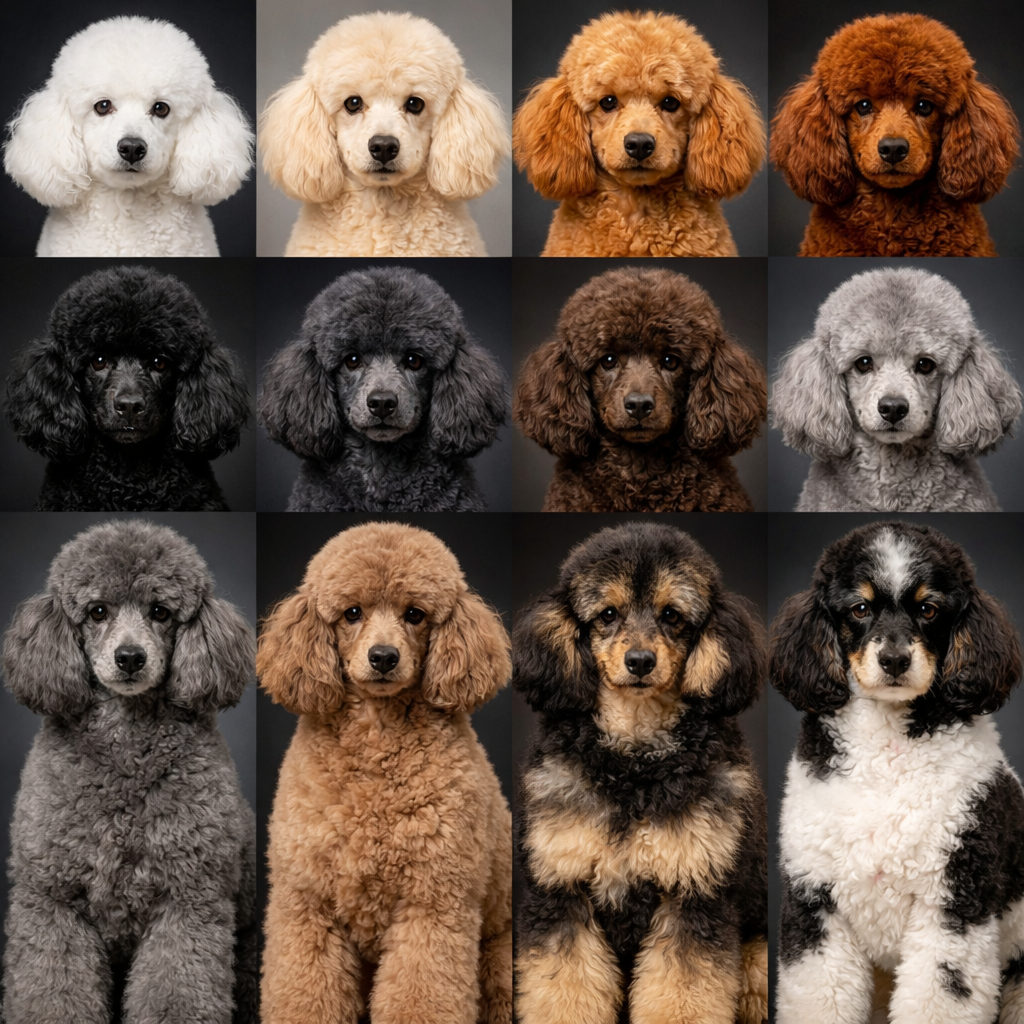
The Poodle is simultaneously one of the most intelligent breeds ever systematically studied, one of the most versatile in terms of working roles across history, and one of the most cosmetically distinctive.
Behind the elaborate clips and the aristocratic bearing that made the breed a symbol of French luxury is a water-retrieving hunting dog whose original working life was spent wading through marshes, whose distinctive trim was a practical adaptation to cold water, and whose mind ranks second among all dog breeds in documented learning speed according to the most widely cited intelligence study in canine science.
The Poodle exists in three official sizes - Standard, Miniature, and Toy - all classified as the same breed by the AKC, differing only in height and weight. Each size has a partially distinct health profile and slightly different typical use, but all share the same breed standard in all respects except dimension. This article covers the breed across all three sizes, noting where health, behaviour, or care considerations differ significantly.
Origin and Etymology
The name "Poodle" derives from the German word Pudel, an abbreviation of Pudelhund, meaning "splash dog" or "puddle dog" - a reference to the breed's original role as a water retriever. Despite the French association that dominates the breed's popular image, the Poodle originated in Germany as a waterfowl hunting dog.
German hunters used the dogs to retrieve waterfowl from ponds, marshes, and rivers. The dense, curly coat provided insulation against cold water. The familiar continental clip - with the hindquarters shaved short and pom-poms of hair left over the joints and chest - was not decorative in origin.
Hunters shaved the rear end to reduce drag and weight in water, while leaving the hair over the chest and major joints to insulate vital organs and protect against cold water and debris. The topknot was originally tied with a ribbon to keep hair from the dog's eyes while working.
The breed reached France, where it became enormously fashionable among the aristocracy and bourgeoisie, and came to be closely associated with French culture to the point of being named the national dog of France. The Toy Poodle was developed in the 18th century, primarily in England and France, as a companion dog for households that did not hunt. The AKC recognises all three sizes as a single breed and has done so since the breed's formal recognition.
Sizes and Physical Characteristics
The three AKC size varieties are distinguished entirely by height at the withers:
- Standard Poodle: over 38 cm (15 inches) at the withers
- Miniature Poodle: 28-38 cm (11-15 inches) at the withers
- Toy Poodle: under 28 cm (11 inches) at the withers
| Size | Height | Weight | Lifespan |
|---|---|---|---|
| Standard | Over 38 cm | 20-32 kg | 12-15 years |
| Miniature | 28-38 cm | 4.5-7 kg | 14-16 years |
| Toy | Under 28 cm | 2-3 kg | 14-18 years |
The AKC breed standard describes the Poodle as squarely built, with equal height at withers and length from chest to rump. The head is long and fine, with a slight but definite stop. The eyes are oval, dark, and set far apart. The ears hang close to the face and are long and wide. The neck is long and strong, arching gracefully into well-laid back shoulders. The body is short-coupled and muscular.
The coat is the defining physical feature. It is single-layered, dense, and curly, with a texture that differs from double-coated breeds. The curls can range from tight to loose depending on the individual. Accepted solid colours include black, white, brown, apricot, red, silver, silver beige, blue, cream, and cafe-au-lait. Parti-colour and patterned Poodles exist but are not accepted in AKC conformation showing.
The single-layer coat sheds minimally compared to double-coated breeds, which is the basis of the "hypoallergenic" reputation.
Intelligence: The Most Trainable Breed
Stanley Coren's 1994 book The Intelligence of Dogs compiled evaluations from 199 obedience trial judges across the United States and Canada to rank 110 breeds by working and obedience intelligence. The Standard Poodle ranked second overall, behind only the Border Collie.
The specific measures underlying this ranking are not abstract assessments but documented performance metrics:
- Poodles learn new obedience commands in fewer than five repetitions on average. Most breeds require 25 to 40 repetitions to achieve reliable performance.
- Poodles demonstrate compliance with a known command on the first ask at rates exceeding 95%. The average for breeds in the top intelligence tier is over 95%; most middle-tier breeds show 50-70% compliance.
"The Poodle is exceptional not just in speed of learning but in retention and generalisation. These are dogs that understand principles, not just specific cues. They apply learned rules to novel situations in a way that would be remarkable in many species." - Stanley Coren, The Intelligence of Dogs, 2nd edition, 1995
These performance metrics translate into a breed that is highly responsive to training but also requires mental stimulation to avoid boredom-driven problem behaviours. Poodles that receive insufficient mental engagement tend to develop anxiety, compulsive behaviours, or destructive habits. For a broader exploration of canine intelligence research see How Smart Are Dogs.
Poodles have historically served in roles that require precisely the combination of intelligence and retrieving instinct the breed offers: waterfowl hunting, circus performance, truffle hunting (particularly in Germany and France where their nose and willingness to work made them effective truffle dogs), service and therapy dog work, and as guide dogs for the visually impaired.
The Standard Poodle's combination of size, trainability, and low-shedding coat makes it one of the most common parent breeds used in guide dog programs that use Poodle crosses.
The Coat: Low-Shedding Reality and Grooming Requirements
The Poodle's reputation as a hypoallergenic breed requires careful qualification. No dog breed is truly hypoallergenic in the absolute sense. Pet allergies in humans are primarily triggered by a protein (Can f 1) found in dog saliva, urine, and dander (dead skin cells), not primarily by shed hair itself. The hair is a secondary vector because shed hair carries dander and dried saliva into the environment.
Poodles shed minimally. The curly single-layer coat traps shed hair within the coat rather than releasing it into the environment. This means less dander and dried saliva is distributed around the home, and many individuals who react to other breeds find Poodles tolerable. However, Poodles are not appropriate for people with severe dog allergies, and individual dogs vary in the amount of Can f 1 protein they produce.
"The concept of hypoallergenic dog breeds is a marketing simplification. While some breeds, including Poodles, do shed less and distribute less dander, no breed produces zero allergen, and sensitivity varies between individuals. Trials of individual dogs before adoption are more reliable than breed generalisation." - Dr. Lakiea Wright, Allergist, Brigham and Women's Hospital, speaking on BBC Radio 4 Medicine Now, 2019
The practical consequence of the low-shedding coat is that it grows continuously and must be clipped regularly. Without grooming, the coat mats into dense, painful knots that can trap moisture, debris, and parasites against the skin. Professional grooming is typically needed every six to eight weeks for most Poodles maintained in longer clips.
Pet owners who clip their dogs short (the "puppy clip" or "sporting clip") can extend the interval somewhat. For detailed breed-specific grooming guidance see Poodle Grooming Guide.
Health: Standard Poodle Conditions
Standard Poodles are a generally healthy, long-lived breed with specific vulnerabilities worth understanding before acquiring a dog.
Hip dysplasia: OFA data shows Standard Poodles with a hip dysplasia prevalence of approximately 13%, which is moderate and substantially lower than the rates seen in large working breeds such as the German Shepherd. Hip screening of breeding stock is nonetheless recommended.
Addison's disease (hypoadrenocorticism): Standard Poodles have one of the highest documented rates of Addison's disease of any breed. Addison's is an autoimmune destruction of the adrenal cortex, leading to inadequate production of cortisol and aldosterone. Untreated, the disease presents as an Addisonian crisis - severe weakness, vomiting, dehydration, and cardiovascular collapse.
It is manageable with lifelong hormone supplementation, but diagnosis can be delayed because early signs are vague and episodic. Studies suggest Standard Poodles are at three to four times the breed-average risk of developing the condition.
Gastric dilatation and volvulus (GDV, or bloat): Standard Poodles are at elevated risk for bloat, a condition in which the stomach rapidly fills with gas and twists on its axis. GDV is a surgical emergency with a mortality rate of 10-30% even with prompt treatment. Deep-chested breeds of substantial body weight carry elevated baseline risk.
Prophylactic gastropexy (surgical attachment of the stomach to the body wall to prevent twisting) is offered as an elective procedure and significantly reduces the risk of fatal GDV.
Progressive retinal atrophy (PRA): A group of inherited degenerative eye conditions that progressively destroy retinal photoreceptors, leading to night blindness and eventually complete blindness. DNA testing can identify carriers, and responsible breeders test breeding stock and avoid carrier-to-carrier pairings.
Sebaceous adenitis: A poorly understood inflammatory skin condition in which the immune system destroys sebaceous (oil-producing) glands in the skin, leading to scaling, hair loss, and secondary infections. Standard Poodles have higher rates than most breeds. Management involves medicated shampoos, oil treatments, and sometimes immunosuppressive therapy.
Health: Miniature and Toy Poodle Conditions
| Health Condition | Miniature Poodle Risk | Toy Poodle Risk |
|---|---|---|
| Patellar luxation | Elevated | Elevated |
| Dental crowding | Moderate | High |
| Tracheal collapse | Low-moderate | Elevated |
| Progressive retinal atrophy | Elevated | Elevated |
| Hypoglycaemia | Low | Moderate (especially puppies) |
| Legg-Calve-Perthes disease | Elevated | Elevated |
Patellar luxation is the most common musculoskeletal condition in small Poodles. The kneecap dislocates from its normal groove, causing intermittent lameness - the characteristic "skipping" gait seen in affected dogs. Grades I and II are often managed conservatively; Grades III and IV typically require surgical correction.
Dental crowding is a predictable consequence of reduced jaw size with the same number of teeth as larger dogs. Toy Poodles are particularly prone to early periodontal disease. Regular professional dental cleaning and daily toothbrushing are important. See the Dog Dental Care Complete Guide for complete guidance.
Tracheal collapse occurs when the cartilage rings of the trachea weaken and allow the tracheal wall to flatten during breathing, causing a honking cough. It is more common in Toy Poodles than in larger dogs. Management ranges from weight control and avoidance of neck pressure (using a harness rather than a collar) to bronchodilators, cough suppressants, and in severe cases, tracheal stenting.
Temperament and Suitability
Poodles are active, alert, and highly social dogs that require regular interaction and engagement. They are typically friendly toward people and other animals when well socialised, and they adapt well to a range of living situations including apartments, provided their exercise and mental stimulation needs are met.
Standard Poodles are energetic and athletic, requiring 30-60 minutes of vigorous exercise daily. They excel in agility, obedience trials, dock diving, and other canine sports. Miniature and Toy Poodles have proportionally reduced exercise requirements but still need regular activity and mental engagement.
The breed is often an excellent choice for people with mild dog allergies. For specific guidance on this topic see Best Dogs for Allergy Sufferers. Standard Poodles are also notable apartment candidates because their low-shedding coat and trainable nature offset the size; see Best Dogs for Apartments for comparative breed analysis.
Poodles tend to bond closely with their primary household members and can develop separation anxiety if left alone for extended periods. They are sensitive dogs that respond poorly to harsh training methods, performing best with positive reinforcement-based approaches that engage their intelligence and willingness to learn.
The Poodle in Canine Crossbreeding
The Poodle has become the most widely used parent breed in the contemporary crossbreeding market. Labradoodles, Goldendoodles, Cavapoos, Cockapoos, Bernedoodles, and dozens of other "doodle" crosses pair the Poodle's low-shedding coat and intelligence against the traits of another breed. This practice began formally with Wally Conron of the Royal Guide Dogs of Australia, who in 1989 created the first intentional Labradoodle for a visually impaired woman whose husband was allergic to dogs.
The health implications of these crosses are complex. First-generation crosses (F1) tend to show hybrid vigour and may have intermediate coat characteristics. Later generations can vary unpredictably. Responsible breeders of Poodle crosses health-test both parent breeds for conditions relevant to each; irresponsible breeders do not. The doodle market has expanded enormously and includes a wide range of breeding ethics.
References
Coren S. The Intelligence of Dogs: Canine Consciousness and Capabilities. New York: Free Press; 1994. ISBN 0-02-905839-8.
Bell JS, Cavanagh KE, Tilley LP, Smith FWK. Veterinary Medical Guide to Dog and Cat Breeds. Jackson, WY: Teton NewMedia; 2012.
Oberbauer AM, Keller GG, Famula TR. Long-term genetic selection reduced prevalence of hip and elbow dysplasia in 60 dog breeds. PLOS ONE. 2017;12(2):e0172918. https://doi.org/10.1371/journal.pone.0172918
Famula TR, Belanger JM, Oberbauer AM. Heritability and complex segregation analysis of hypoadrenocorticism in the Standard Poodle. Journal of Small Animal Practice. 2003;44(1):8-12. https://doi.org/10.1111/j.1748-5827.2003.tb00103.x
American Kennel Club. Poodle Breed Standard. https://www.akc.org/dog-breeds/poodle-standard/
Glickman LT, Glickman NW, Schellenberg DB, Raghavan M, Lee TL. Incidence of and breed-related risk factors for gastric dilatation-volvulus in dogs. Journal of the American Veterinary Medical Association. 2000;216(1):40-45. https://doi.org/10.2460/javma.2000.216.40
Packer RMA, Seath IJ, O'Neill DG, De Decker S, Volk HA. DachsLife 2015: an investigation of lifestyle associations with the risk of intervertebral disc disease in Dachshunds. Canine Genetics and Epidemiology. 2016;3:8. https://doi.org/10.1186/s40575-016-0038-1
Frequently Asked Questions
Are Poodles really the second most intelligent dog breed?
Yes, according to Stanley Coren’s widely cited 1994 study The Intelligence of Dogs, which ranked 110 breeds based on evaluations by 199 obedience trial judges. The Standard Poodle ranked second overall behind only the Border Collie. In practical terms, Poodles learn new commands in under five repetitions on average and comply with known commands on first request at rates exceeding 95%.
These figures reflect working and obedience intelligence specifically; other dimensions of intelligence such as instinctive or adaptive intelligence are harder to quantify but Poodles also perform well in problem-solving tests.
Are Poodles hypoallergenic?
Poodles are often described as hypoallergenic, but this term is technically inaccurate for any dog breed. Dog allergies are primarily triggered by a protein called Can f 1 found in dander, saliva, and urine, not by the hair itself. Poodles shed very little because their curly single-layer coat traps shed hair within the coat rather than releasing it into the environment, which means less dander and saliva-coated hair is distributed around the home.
Many people with mild to moderate dog allergies tolerate Poodles well. However, no dog produces zero allergen, and severely allergic individuals should spend time with a specific dog before adopting.
What are the three Poodle sizes?
The AKC recognises three size varieties as a single breed: Standard Poodles (over 38 cm at the withers, typically 20-32 kg), Miniature Poodles (28-38 cm, 4.5-7 kg), and Toy Poodles (under 28 cm, 2-3 kg). All three share the same breed standard in all respects except dimension.
Each size has a somewhat distinct health profile: Standards are prone to bloat and Addison’s disease; Miniatures and Toys are more prone to patellar luxation, dental crowding, and in Toys, tracheal collapse. The Toy was developed in the 18th century primarily as a companion; the Standard was the original working water retriever.
Why do Poodles need so much grooming?
The Poodle’s coat grows continuously because it sheds minimally. Unlike double-coated breeds that lose dead hair through seasonal shedding, Poodle coat accumulates. Without regular clipping and brushing, the coat mats into dense tangles that trap moisture and debris against the skin, causing irritation and secondary infections. Professional grooming every six to eight weeks is standard for dogs kept in longer clips.
Dogs clipped in a short ‘puppy’ or ‘sporting’ cut can go somewhat longer between groomings. Regular brushing between appointments prevents mat formation.
Where do Poodles originally come from?
Poodles originated in Germany as water retrievers used for hunting waterfowl. The German name Pudel (from Pudelhund, meaning splash or puddle dog) reflects this origin. The distinctive continental clip was a functional working adaptation: hunters shaved the rear end to reduce drag in water while leaving chest and joint hair for insulation and protection.
The breed became fashionable in France, where it was further developed and came to be associated with French culture. The Toy Poodle was developed later in England and France as a companion dog. France eventually named the Poodle its national breed.
What health problems do Standard Poodles have?
Standard Poodles have several specific health vulnerabilities. They have one of the highest rates of Addison’s disease (hypoadrenocorticism) of any breed, estimated at three to four times the average dog risk - this autoimmune condition destroys adrenal tissue and requires lifelong hormone replacement.
They are at elevated risk for gastric dilatation and volvulus (bloat), a potentially fatal stomach condition for which deep-chested large breeds are generally predisposed. Hip dysplasia affects approximately 13% per OFA data, moderate for a large breed. Progressive retinal atrophy and sebaceous adenitis are additional breed-associated conditions. DNA testing is available for several of these conditions and should be used in breeding programs.