
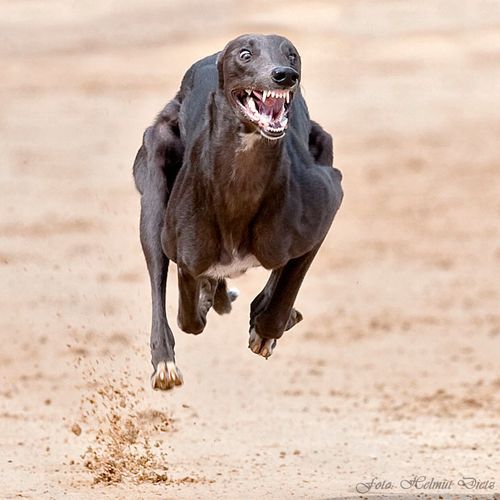
The fastest dog breed, the Greyhound, can reach speeds of 45 miles per hour (72 km/h), making it the fastest land animal over short distances relative to its size. Average dogs run at 15 to 20 miles per hour (24 to 32 km/h). Speed varies enormously by breed, body structure, limb length, muscle fiber composition, and individual fitness. Understanding dog running mechanics reveals why certain breeds were purpose-built for speed while others were built for endurance, power, or agility.
Top Speeds by Breed
Dog running speed reflects selective breeding history. Sighthounds, breeds built to chase prey by sight over open terrain, hold the top positions on speed rankings globally. Working breeds built for power and endurance occupy middle ranges. Companion and brachycephalic (short-nosed) breeds are slowest.
| Breed | Top Speed (mph) | Top Speed (km/h) | Notes |
|---|---|---|---|
| Greyhound | 45 | 72 | Fastest dog breed; double-suspension gallop |
| Saluki | 42 | 68 | Endurance at speed rivals Greyhound |
| Afghan Hound | 40 | 64 | Built for rough terrain at speed |
| Vizsla | 40 | 64 | Hunting breed with excellent sustained speed |
| Jack Russell Terrier | 38 | 61 | Surprisingly fast relative to body size |
| Dalmatian | 37 | 60 | Originally bred to run alongside carriages |
| Borzoi | 36 | 58 | Russian sighthound; elegant high-speed runner |
| Weimaraner | 35 | 56 | Long-legged hunting breed |
| Doberman Pinscher | 32 | 51 | Muscular; combination of speed and power |
| German Shepherd | 30 | 48 | Speed plus endurance; police work standard |
| Border Collie | 30 | 48 | Agility and direction change over raw speed |
| Labrador Retriever | 25 | 40 | Endurance runner; not top-end fast |
| Poodle | 22 | 35 | Underestimated; athletic breed |
| Beagle | 20 | 32 | Endurance scent-tracker; moderate speed |
| Bulldog | 7 | 11 | Brachycephalic; limited by airway anatomy |
| Basset Hound | 5-10 | 8-16 | Low-slung body not built for speed |
The Mechanics of the Greyhound's Speed
The Greyhound's extraordinary speed results from an unusual combination of anatomical features that work together in a highly optimized locomotor system.
Double-suspension gallop: Greyhounds use a double-suspension gallop, a gait pattern where the dog is completely airborne twice per stride cycle (once when all four legs are gathered under the body and once when all four are extended). This gait pattern allows each stride to cover an exceptional distance. At full speed, Greyhound stride length exceeds 9 feet (2.7 meters).
Flexible spine: The Greyhound's spine flexes and extends dramatically during the gallop, adding significant additional effective stride length beyond what the legs alone could produce. The lumbar muscles are proportionally enormous and drive spinal flexion-extension as a power source.
Muscle fiber composition: Greyhounds have an unusually high proportion of fast-twitch muscle fibers, approximately 70% compared to 52% in most other breeds. Fast-twitch fibers contract rapidly and powerfully but fatigue quickly, explaining why Greyhounds are sprint specialists rather than endurance runners.
Aerodynamic build: The Greyhound's narrow chest, tucked abdomen, streamlined head, and smooth short coat all reduce aerodynamic drag. The deep chest also accommodates proportionally large lungs and heart.
"The Greyhound is the product of thousands of years of selective breeding for a single function: catching prey in open terrain through pure speed. Every structural feature, from skeletal geometry to fiber type to respiratory capacity, has been refined toward that single functional goal." Usherwood, J. R. & Bertram, J. E. A. (2003), Journal of Experimental Biology
Speed vs. Endurance: Two Different Athletic Profiles
Speed and endurance represent fundamentally different physiological adaptations. Breeds optimized for each show very different structural and metabolic profiles.
Speed-optimized breeds (Greyhounds, Salukis, Whippets): High fast-twitch fiber proportion, light bone structure, deep flexible chest, narrow build. These breeds reach extraordinary maximum speeds but fatigue within minutes of sustained effort. Greyhounds at races are typically run for 500-800 meters; they cannot sustain top speeds beyond roughly 30 seconds.
Endurance-optimized breeds (Siberian Husky, Alaskan Malamute, Border Collie): High slow-twitch fiber proportion, denser bone, efficient cardiovascular systems, high capacity to metabolize fat. These breeds cannot match speed-optimized breeds in sprinting but can sustain efficient movement for hours or days. Iditarod-competing Huskies cover 1,000 miles in under 10 days, averaging 100+ miles per day.
Many breeds fall between these extremes, combining reasonable speed with good endurance: German Shepherds, Labradors, Weimaraners.
| Athletic Profile | Muscle Fiber | Top Speed | Sustained Running | Exemplar Breeds |
|---|---|---|---|---|
| Sprint specialist | ~70% fast-twitch | Very high (40+ mph) | Minutes | Greyhound, Whippet, Saluki |
| Speed-endurance | Balanced (50/50) | Moderate-high (28-35 mph) | 1-2 hours | German Shepherd, Doberman |
| Endurance specialist | ~60% slow-twitch | Moderate (20-25 mph) | Many hours | Husky, Malamute, Border Collie |
| Power | High fast-twitch, heavy muscle | Moderate (20-28 mph) | Limited | Rottweiler, Mastiff |
| Companion/brachycephalic | Variable | Low (5-15 mph) | Very limited | Bulldog, Pug, Basset Hound |
What Limits Dog Running Speed
Several anatomical and physiological factors set upper limits on individual dog running speed:
Airway anatomy: Brachycephalic breeds (Bulldogs, Pugs, French Bulldogs, Boxers) have severely compromised airway anatomy, foreshortened skull, elongated soft palate, narrowed nares, hypoplastic trachea. These dogs cannot achieve adequate gas exchange during intense exercise. Their maximum running speeds are dramatically limited by respiratory capacity, not muscular capacity.
Limb length and angle: Longer limbs allow greater stride length. Breeds with very short legs relative to body mass (Dachshunds, Basset Hounds, Corgis) have mechanically limited stride length that caps their maximum speed regardless of muscle quality.
Body mass and density: Heavier breeds require more energy per stride. Mastiffs, Great Pyrenees, and Saint Bernards have high body mass that limits both maximum speed and endurance. Their musculature is optimized for power in short bursts rather than sustained locomotion.
Age and fitness: Like human athletes, dogs are fastest in early to middle adulthood (2 to 5 years for most breeds) and decline with age. Unfit dogs are significantly slower than conditioned athletes of the same breed. A well-conditioned Greyhound at 3 years runs measurably faster than a sedentary Greyhound of the same age.
How to Safely Exercise a Running Dog
Dogs are natural runners and benefit from regular cardiovascular exercise. Safe running with dogs requires attention to several factors:
Breed-appropriate intensity: Brachycephalic breeds should never be exercised to visible respiratory distress. High-energy working breeds (Husky, Malinois, Border Collie) need sustained vigorous exercise to maintain behavioral health, walks are insufficient for these breeds.
Surface safety: Hard pavement increases impact on joints and pads and heats rapidly in warm weather. Grass and dirt surfaces are generally preferable. In summer, paw pads can sustain burns on asphalt within minutes at temperatures above 130°F (54°C).
Temperature limits: Dogs cool primarily by panting and have limited capacity to cool in high heat and humidity. Exercise in temperatures above 85°F (29°C) or humidity above 60% dramatically increases heatstroke risk. Brachycephalic breeds, obese dogs, and dogs with thick coats are highest risk.
Growth plate protection in puppies: Puppies should not engage in sustained running until growth plates close, typically at 12 to 18 months depending on breed size (larger breeds later). Repetitive impact on open growth plates risks permanent joint injury.
For more on dog exercise and health, see How Well Do Dogs Hear?, Signs of a Healthy Dog, How Long Do Dogs Live?, Exercise Needs by Dog Breed, and How Do Dogs See the World?.
References
Usherwood, J. R., & Bertram, J. E. A. (2003). Understanding brachiation: Insight from a collisional perspective. Journal of Experimental Biology, 206, 1631-1642. https://doi.org/10.1242/jeb.00306
Pasi, B. M., & Carrier, D. R. (2003). Functional trade-offs in the limb muscles of dogs selected for running versus fighting. Journal of Evolutionary Biology, 16(2), 324-332. https://doi.org/10.1046/j.1420-9101.2003.00512.x
Harkness, J. E., Turner, P. V., VandeWoude, S., & Wheler, C. L. (2010). Harkness and Wagner's Biology and Medicine of Rabbits and Rodents. Wiley-Blackwell.
Sharp, N. C. C. (2012). Animal athletes: A performance review. Veterinary Record, 171(4), 87-94. https://doi.org/10.1136/vr.e5234
Bramble, D. M., & Lieberman, D. E. (2004). Endurance running and the evolution of Homo. Nature, 432(7015), 345-352. https://doi.org/10.1038/nature03052
American Kennel Club. (2024). Fastest Dog Breeds. Retrieved from https://www.akc.org/expert-advice/lifestyle/fastest-dog-breeds/
Frequently Asked Questions
What is the fastest dog breed?
The Greyhound is the fastest dog breed, reaching speeds of up to 45 mph (72 km/h). Salukis and Afghan Hounds follow closely, both capable of speeds around 40-42 mph. All top-speed breeds are sighthounds bred to chase prey over open terrain.
How fast can an average dog run?
Most average domestic dogs run at 15 to 20 mph (24 to 32 km/h) at full sprint. Fit working breeds run faster, German Shepherds reach 30 mph, Weimaraners around 35 mph. Small and brachycephalic breeds are significantly slower.
Why are Greyhounds so fast?
Greyhounds combine a double-suspension gallop (airborne twice per stride), extreme spinal flexibility, approximately 70% fast-twitch muscle fibers, aerodynamic build, and proportionally large heart and lungs. Each stride can exceed 9 feet at full speed.
What is the slowest dog breed?
Bulldogs are among the slowest dog breeds, reaching approximately 7 mph (11 km/h). Their brachycephalic (flat-faced) anatomy severely limits airway capacity and oxygen exchange during exercise. Basset Hounds are similarly limited by short legs and low body profile.
Is it safe to run with my dog?
Most dogs can run safely with proper breed-appropriate intensity, good surfaces, and temperature management. Avoid running brachycephalic breeds, puppies under 12-18 months, or dogs in temperatures above 85°F. Hard pavement in summer can cause paw pad burns.
Can dogs run long distances?
Endurance breeds like Siberian Huskies can run 100+ miles per day in sled racing conditions. Border Collies, German Shepherds, and Labradors also sustain long distances well. Sprint breeds like Greyhounds excel at short bursts but fatigue rapidly on sustained efforts.