
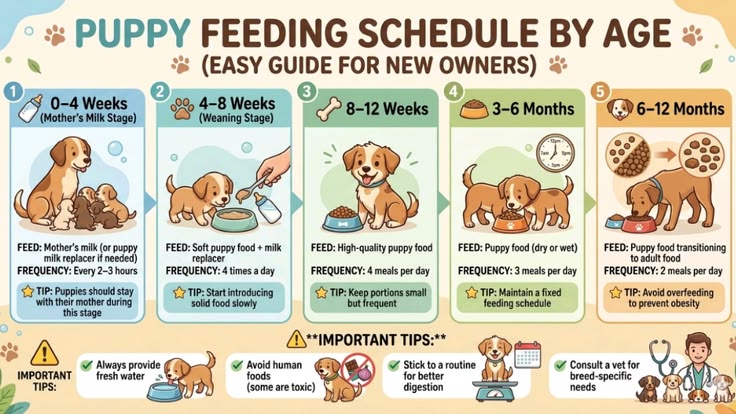
Getting a puppy's feeding schedule right is one of the most consequential things a new dog owner can do. A puppy's first year of life involves the most rapid growth and development it will ever experience. The nutritional foundation laid during this period directly influences skeletal density, muscle development, immune system function, and long-term metabolic health.
Feed too much and you risk obesity, skeletal overgrowth in large breeds, and digestive upset. Feed too little or too infrequently and you risk hypoglycaemia, stunted development, and behavioural problems driven by chronic hunger.
This guide covers every phase of puppy feeding from birth through the transition to adult food, including feeding frequency, portion sizing, caloric requirements, breed-size differences, transitioning between foods, and the warning signs that indicate a problem.
Newborn to 3 Weeks: Mother's Milk and Milk Replacer
Newborn puppies depend entirely on their mother's milk for nutrition and immunity. Colostrum, the first milk produced by the dam, is rich in maternal antibodies (immunoglobulins) that provide the puppy's only immune protection during the first weeks of life. Puppies must receive colostrum within the first 12-24 hours of birth; after this window, the intestinal permeability required to absorb immunoglobulins closes.
Puppies nurse on demand during the first three weeks, typically every 2-3 hours. A healthy nursing puppy will double its birth weight within 7-10 days.
If the dam is absent or cannot nurse: Use a commercial puppy milk replacer (not cow's milk or goat's milk, both cause diarrhoea due to different lactose concentrations and inappropriate nutrient profiles). Products such as Esbilac (Pet-Ag) and Royal Canin Babydog Milk are formulated to match canine milk composition. Feed at approximately 1 mL per 30 grams of body weight every 2 hours initially, gradually increasing as the puppy grows.
3-4 Weeks: Introduction of Solid Food (Weaning Begins)
Natural weaning begins when the dam reduces nursing availability and the puppies' deciduous (baby) teeth emerge. Around 3 weeks of age, puppies can begin exposure to solid food.
The transition food at this stage is a gruel: high-quality puppy food (wet or dry kibble) blended with warm puppy milk replacer or warm water to the consistency of oatmeal. Place this in a shallow dish, puppies will walk through it, sniff it, and eventually begin eating it.
At 3-4 weeks, solid food supplements rather than replaces nursing. Allow the dam to continue nursing as available. Gradually reduce the liquid-to-food ratio in the gruel over the next two weeks.
4-6 Weeks: Transition from Gruel to Wet/Dry Puppy Food
By 4-6 weeks, most puppies can manage wet food or softened kibble with minimal gruel texture. The dam's milk production typically decreases during this period.
At this stage, offer food 4-6 times daily in small amounts. Puppies have tiny stomachs and extremely high metabolic rates relative to body size; they cannot eat large meals and must eat frequently to maintain blood glucose.
6-8 Weeks: Full Weaning
By 6-8 weeks, puppies should be fully weaned and eating puppy-formulated food independently. This is typically the earliest appropriate age for puppies to leave their mother and littermates (8-12 weeks is the ideal range for most breeds from a social development standpoint).
At this age, feed 3-4 meals per day of a puppy-formulated food (labelled "for growth" or "for puppies" or "all life stages").
8-12 Weeks: Four Meals Per Day
The 8-12 week age range is when most puppies arrive in new homes. This is also the period of greatest vulnerability to hypoglycaemia, particularly in toy and small breeds.
Feeding frequency: 4 meals per day, spaced approximately 4-6 hours apart.
Why this frequency matters: Young puppies have limited glycogen storage capacity and cannot go extended periods without food. Toy breeds (Chihuahuas, Yorkshire Terriers, Pomeranians) are particularly prone to neonatal hypoglycaemia, which can present as weakness, tremors, loss of consciousness, and seizures.
Any toy breed puppy that appears lethargic or unresponsive between meals should have a small amount of sugar applied to the gums (corn syrup, honey, or even karo syrup) and be taken to a veterinarian immediately.
How much to feed: Follow the manufacturer's guidelines on the food packaging as a starting point, divided across four meals. Adjust based on the puppy's body condition; you should be able to feel but not see the ribs with light pressure. A puppy with visible ribs and a tucked waist may need more food; a puppy with no palpable ribs and a rounded belly is likely being overfed.
Transitioning from the breeder's food: When a new puppy arrives, continue feeding whatever food the breeder provided for at least the first week. Then transition gradually over 7-10 days: begin with 75% old food and 25% new food, shifting to 50/50, then 25% old / 75% new, then 100% new. Abrupt food changes cause diarrhoea.
3-6 Months: Three Meals Per Day
Between 3 and 6 months of age, most puppies can transition to 3 meals per day. Their stomach capacity has increased, and they can tolerate longer intervals between meals.
This is a period of rapid growth in most breeds. Appetite is generally very good, and puppies may seem perpetually hungry. Do not overfeed on the basis of enthusiasm, follow body condition scoring rather than the puppy's apparent hunger.
Large and giant breed puppies require controlled nutrition during this period. Overfeeding large breed puppies leads to excessively rapid bone growth, which increases the risk of developmental orthopaedic diseases including osteochondrosis dissecans (OCD), hypertrophic osteodystrophy (HOD), and hip dysplasia. Large breed puppy foods are specifically formulated with controlled calcium and phosphorus levels to support appropriate growth rates.
6-12 Months: Two Meals Per Day
Between 6 and 12 months, most puppies can transition to 2 meals per day, the schedule most adult dogs remain on throughout life. The exact timing of this transition depends on breed size.
The puppy's growth rate slows during this period, and caloric needs per kilogram of body weight begin to decrease toward adult maintenance levels (though total caloric requirements continue to increase as overall body weight increases).
When to Switch to Adult Food
The transition from puppy to adult food is one of the most important feeding decisions owners make. Puppy foods are formulated with higher protein, fat, calcium, and phosphorus than adult foods to support growth. Continuing to feed puppy food after growth is complete leads to excessive caloric intake and can cause obesity.
The timing of the switch depends on breed size:
Small breeds (adult weight under 10 kg): Growth is complete at approximately 9-12 months. Switch to adult food at 9-12 months.
Medium breeds (adult weight 10-25 kg): Growth is essentially complete at 12-14 months. Switch to adult food at 12 months.
Large breeds (adult weight 25-45 kg): Growth continues until 12-18 months. Switch to adult food at 12-15 months.
Giant breeds (adult weight over 45 kg, Great Danes, Mastiffs, Saint Bernards, etc.): Growth continues until 18-24 months. Switch to adult food at 18-24 months.
Puppy Feeding Schedule by Age and Breed Size
| Age | Small/Toy Breeds | Medium Breeds | Large Breeds | Giant Breeds |
|---|---|---|---|---|
| Birth - 3 weeks | Mother's milk / milk replacer | Mother's milk / milk replacer | Mother's milk / milk replacer | Mother's milk / milk replacer |
| 3-4 weeks | Gruel 4-6x daily | Gruel 4-6x daily | Gruel 4-6x daily | Gruel 4-6x daily |
| 4-8 weeks | Wet/softened food 4x daily | Wet/softened food 4x daily | Wet/softened food 4x daily | Wet/softened food 4x daily |
| 8-12 weeks | 4 meals/day; watch for hypoglycaemia | 4 meals/day | 4 meals/day | 4 meals/day |
| 3-6 months | 3 meals/day | 3 meals/day | 3 meals/day | 3 meals/day |
| 6-12 months | 2 meals/day | 2-3 meals/day | 2-3 meals/day | 2-3 meals/day |
| Switch to adult food | 9-12 months | 12 months | 12-18 months | 18-24 months |
Caloric Needs by Age and Weight
Puppies require significantly more calories per kilogram of body weight than adult dogs. The National Research Council's nutrient requirements for dogs provide baseline figures, though individual variation means these are starting points rather than absolutes.
| Puppy Weight | Daily Caloric Requirement (Approximate) | Adult Maintenance (Same Dog When Grown) |
|---|---|---|
| 2 kg (toy breed, ~10 weeks) | 260-310 kcal/day | 180-220 kcal/day |
| 5 kg (small breed, ~10 weeks) | 520-620 kcal/day | 350-400 kcal/day |
| 10 kg (medium breed, ~12 weeks) | 900-1,100 kcal/day | 550-700 kcal/day |
| 20 kg (large breed, ~16 weeks) | 1,500-1,800 kcal/day | 900-1,100 kcal/day |
| 40 kg (giant breed, ~6 months) | 2,400-2,800 kcal/day | 1,600-1,900 kcal/day |
Note: These are approximate figures. Caloric needs vary substantially based on activity level, reproductive status, metabolism, and individual variation. The dog's body condition score (BCS) is the most reliable ongoing indicator of whether caloric intake is appropriate.
How to Assess Body Condition in Puppies
The body condition score (BCS) is a standardised system used by veterinarians and used on a 9-point scale (Purina system) or 5-point scale (others).
Score 4-5/9 (ideal): Ribs palpable with slight pressure but not visible. Defined waist when viewed from above. Slight abdominal tuck when viewed from the side.
Score 3/9 or less (too thin): Ribs, spine, or hip bones visible or easily palpable with no fat cover. Exaggerated waist and tucked abdomen.
Score 6/9 or above (too heavy): Ribs difficult to feel under fat cover. No visible waist from above. Little or no abdominal tuck.
Check your puppy's BCS monthly through the first year. Growing puppies should maintain a BCS of 4-5/9. It is common for puppies to look slightly lean during growth spurts; this is less concerning than being overweight, which stresses developing joints.
What Type of Food Is Best for Puppies?
Puppy-specific formulation. Always choose food labelled "for puppies" or carrying an AAFCO nutritional adequacy statement for "growth" or "all life stages." Adult maintenance foods do not provide adequate calcium, phosphorus, protein, or caloric density for growing puppies.
Large breed puppy food. Puppies of breeds expected to reach over 25 kg adult weight should eat food specifically formulated for large breed puppies. These formulations have controlled calcium and phosphorus to support appropriate, not excessive, bone growth.
Wet vs dry. Both are appropriate for puppies. Wet food provides better hydration and is easier for puppies with developing dentition, but dental health benefits of dry food are limited in puppies and this factor matters more later. High-quality wet food for puppies is an excellent choice.
Frequency over amount. For young puppies, feeding frequency is more important than total daily quantity. A toy breed puppy that goes six hours without food is at genuine risk of hypoglycaemia.
Foods and Substances to Avoid in Puppies
Puppies are more vulnerable than adult dogs to many toxins due to their smaller body mass and developing detoxification systems. The following are particularly important to avoid:
- Grapes and raisins (acute kidney failure)
- Xylitol (hypoglycaemia, liver failure)
- Chocolate and caffeine (methylxanthine toxicity)
- Onions, garlic, leeks (haemolytic anaemia)
- Cooked bones (perforation, obstruction)
- Cow's milk (diarrhoea)
- Raw fish (thiaminase in some species)
- Macadamia nuts (weakness, tremors)
Cross-Links and Related Articles
- Raw Diet for Dogs: Pros and Cons
- What Can Dogs Eat: Safe and Unsafe Foods
- Foods Toxic to Dogs Complete List
- How Much to Feed a Dog by Weight
- Senior Dog Nutrition Guide
References
National Research Council. Nutrient Requirements of Dogs and Cats. Washington, DC: National Academies Press; 2006. doi:10.17226/10668
Richardson DC, et al. "Developmental orthopedic disease of dogs." Veterinary Clinics of North America: Small Animal Practice. 1997;27(4):935-964. doi:10.1016/S0195-5616(97)50088-9
Toll PW, Yamka RM, Schoenherr WD, Hand MS. "Obesity." In: Hand MS, et al., eds. Small Animal Clinical Nutrition. 5th ed. Mark Morris Institute; 2010:501-542.
AAFCO. "Association of American Feed Control Officials Official Publication 2023." Oxford, IN: AAFCO; 2023.
Freeman LM. "Nutritional management of dogs and cats with cardiovascular diseases." Veterinary Clinics of North America: Small Animal Practice. 2006;36(6):1392-1402. doi:10.1016/j.cvsm.2006.09.003
German AJ. "The growing problem of obesity in dogs and cats." Journal of Nutrition. 2006;136(7 Suppl):1940S-1946S. doi:10.1093/jn/136.7.1940S
Frequently Asked Questions
How often should I feed my puppy?
Feeding frequency depends on age. Puppies aged 8-12 weeks should eat 4 meals per day. From 3-6 months, transition to 3 meals per day. From 6-12 months, most puppies can manage 2 meals per day. Young toy breeds in particular should never go more than 4-5 hours without food due to hypoglycaemia risk.
When should I switch my puppy to adult dog food?
The timing depends on breed size. Small breeds (under 10 kg adult weight) should switch at 9-12 months. Medium breeds at 12 months. Large breeds (25-45 kg) at 12-18 months. Giant breeds (over 45 kg) at 18-24 months. Puppy food provides excess calcium and calories for dogs that have finished growing, which can lead to obesity.
How do I transition my puppy to new food?
Transition over 7-10 days to prevent digestive upset. Begin with 75% old food and 25% new food for 2-3 days, then 50⁄50 for 2-3 days, then 25% old and 75% new for 2-3 days, then 100% new food. Abrupt food changes cause diarrhoea, especially in young puppies.
What are the signs of hypoglycaemia in puppies?
Signs of low blood sugar in puppies include weakness, lethargy, trembling or shaking, glassy eyes, stumbling, and in severe cases, seizures or loss of consciousness. Toy breeds (Chihuahuas, Yorkshire Terriers, Pomeranians) are at highest risk. If you suspect hypoglycaemia, rub a small amount of corn syrup, honey, or karo syrup on the puppy’s gums and go to a veterinarian immediately.
Do large breed puppies need special food?
Yes. Large breed puppies should eat food specifically formulated for large breed puppies. These formulations have controlled calcium and phosphorus levels to support appropriate, not excessive, bone growth rates. Overfeeding large breed puppies causes excessively rapid skeletal development, which increases the risk of developmental orthopaedic diseases including osteochondrosis and hip dysplasia.
Can I feed a puppy human food?
Small amounts of safe human foods (cooked lean meat, carrots, cooked eggs) are acceptable as treats but should not make up more than 10% of the puppy’s diet. Never feed puppies: grapes, raisins, chocolate, xylitol-containing products, onions, garlic, macadamia nuts, cooked bones, or cow’s milk. Puppies are more vulnerable to food toxins than adult dogs due to smaller body mass and developing detoxification systems.