
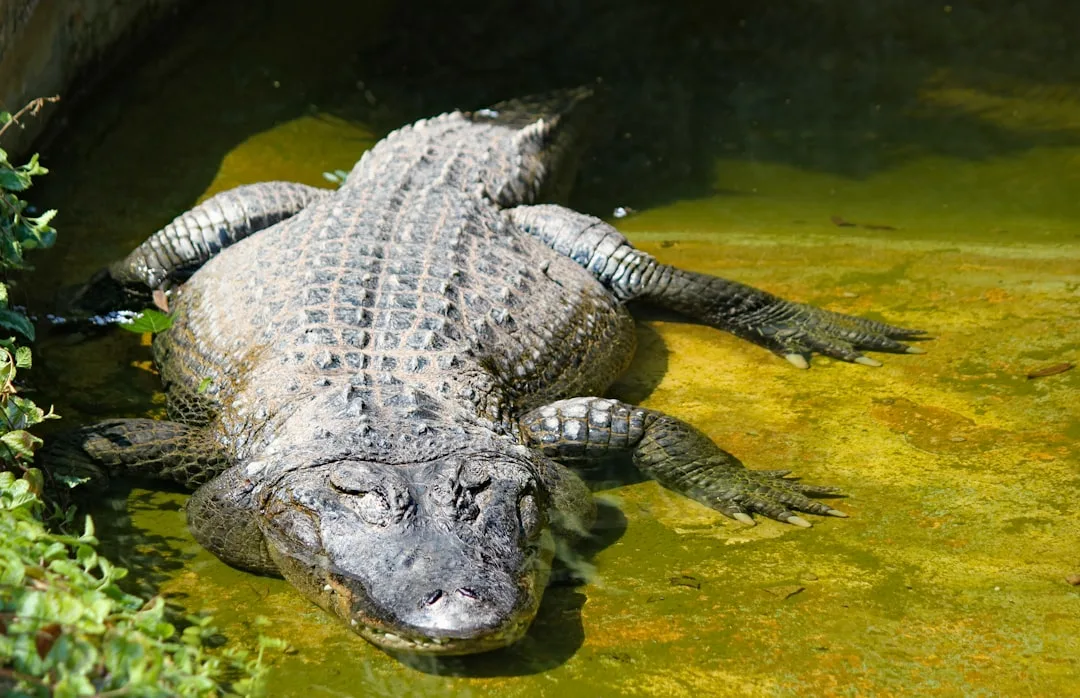
The American alligator is the apex predator of the freshwater wetlands of the southeastern United States, the heaviest reptile native to North America, and one of the clearest conservation success stories of the twentieth century.
Alligator mississippiensis was hunted to the brink of regional extinction during the first half of the twentieth century, listed as endangered in 1967, and fully recovered to a population of around five million adults by 1987 - a comeback compressed into a single human lifetime.
Today the species is the ecological architect of the Everglades, the bayous of Louisiana, and the swamps of Georgia, and a familiar if uneasy neighbour to tens of millions of Americans.
This guide covers every major aspect of American alligator biology and ecology: size and sexual dimorphism, sensory systems, bite mechanics, hunting behaviour, diet across life stages, temperature-dependent sex determination, parental care, brumation through ice, vocal communication, conservation history, and the relationship between alligators and the humans who share their swamps.
It is a reference entry, not a summary - so expect specifics: kilograms, kilometres, newtons, populations, incubation temperatures, and verified records.
Etymology and Classification
The scientific name Alligator mississippiensis was coined by French naturalist Francois Marie Daudin in 1802, taking the species epithet from the Mississippi River basin where early European naturalists first studied the species in detail.
The common word "alligator" itself traces back to Spanish el lagarto - "the lizard" - used by Spanish explorers in sixteenth-century Florida who did not have a word for such a large reptile. English sailors heard the phrase, compressed it into "alligarter", and later "alligator", which became the standard name across the English-speaking world.
Genetic and morphological analysis places A. mississippiensis within the family Alligatoridae, which also contains the Chinese alligator (Alligator sinensis) and six species of caiman.
The two Alligator species diverged from their caiman cousins roughly 65 million years ago, around the time of the extinction of the non-avian dinosaurs, and the American and Chinese alligators split from each other approximately 8 million years ago.
The general alligator body plan - broad rounded snout, armoured back, muscular laterally-flattened tail, overbite hiding the lower teeth - has barely changed in tens of millions of years.
Alligators are not crocodiles. Both belong to the order Crocodilia but sit in separate families (Alligatoridae versus Crocodylidae) that diverged from a common ancestor more than 80 million years ago.
Among the most reliable field differences are snout shape (broad and U-shaped in alligators; narrow and V-shaped in true crocodiles), pupil shape (round in alligators; vertical slit in crocodiles), and the visibility of lower teeth when the mouth is closed (hidden by the upper jaw in alligators; visible and interlocking in crocodiles).
Size and Physical Description
American alligators are large but not the largest crocodilians on Earth. They are outsized by saltwater crocodiles, Nile crocodiles, and the Orinoco crocodile. Sexual dimorphism is pronounced - males reach roughly twice the length and three to five times the mass of mature females.
Males:
- Length: 3.4-4.6 metres typical in mature adults
- Record length: 5.8 metres (Louisiana, circa 1890s)
- Weight: 230-450 kg in most adults
- Record weight: 473 kg
Females:
- Length: 2.6-3 metres at maturity
- Weight: 90-180 kg
- Rarely exceed 3.5 metres
Hatchlings:
- Length: 20-25 cm
- Weight: 50 grams
- Bright yellow-and-black banding for camouflage among reeds
Alligators are built for ambush predation from water. Their bodies are heavily armoured above by bony plates called osteoderms embedded in keratinised scales, and protected below by softer but still tough ventral scutes.
The tail accounts for roughly half of total length and provides most of the swimming power; a single sideways sweep can propel a full-grown adult metres through water or launch its body more than a metre vertically from a standing position. The legs are relatively short but powerful enough to support overland travel - alligators can achieve short bursts of 15-17 kilometres per hour across dry ground.
The head is broad and flat, with the eyes, ears, and nostrils arranged on the topmost surface so that the animal can remain almost entirely submerged while still seeing, hearing, and breathing. The eyes have round pupils rather than the vertical slits seen in crocodiles - one of the simplest field tests for distinguishing the two families.
Transparent third eyelids (nictitating membranes) close over the eyes during dives to protect them without blocking vision. The nostrils close by muscular action when submerged, and a flap of tissue at the back of the mouth called the palatal valve seals off the throat so the animal can open its jaws underwater to grab prey without inhaling or swallowing water.
Hunting and Diet
American alligators are hypercarnivores at every life stage, though the prey base shifts radically as they grow. Juveniles feed on insects, small amphibians, crayfish, minnows, and snails. Subadults take larger fish, frogs, snakes, turtles, water birds, and small mammals such as muskrats.
Mature adults target large prey including white-tailed deer, wild hogs, raccoons, river otters, nutria, beavers, and large wading birds; they will also kill smaller alligators, and cannibalism accounts for a meaningful share of total alligator mortality.
Primary prey categories:
- Fish (bass, gar, catfish, bowfin)
- Large turtles (including softshells and snapping turtles)
- Water birds (herons, egrets, ibises, anhingas)
- Mammals (raccoons, muskrats, nutria, wild hogs, white-tailed deer)
- Reptiles (water snakes, smaller alligators, occasional small crocodiles in overlap zones)
- Carrion of almost any kind
Hunting techniques:
- Ambush from water. The dominant technique. The alligator sits at the water's edge with only eyes and nostrils exposed, waits for prey to approach to drink, and lunges with a single explosive tail stroke. Strike distance from a stationary position is roughly one body length.
- Stalking. In open water the alligator submerges and approaches slowly beneath the surface, using the high eye and nostril placement to track prey on the surface.
- Death roll. Once a prey item is seized, the alligator clamps down with a bite force around 13,000 newtons in large adults and spins rapidly around its long axis to tear off limbs or chunks of flesh that are too large to swallow whole. Alligators cannot chew and so must either swallow prey whole or reduce it to pieces through rolling.
- Baiting. Alligators in Louisiana and Florida have been documented balancing sticks and twigs on their snouts during bird nesting season, attracting wading birds searching for nesting material. This is one of the few confirmed cases of tool use in any reptile.
- Cooperative herding. In places like the Everglades, multiple alligators sometimes form loose lines to herd schools of fish into shallow water where they can be captured more easily.
Success rates for ambush hunts vary from roughly five to thirty per cent depending on prey type, visibility, and the alligator's experience. Adults compensate for low success rates by eating infrequently when necessary - a large meal can sustain an adult for a month or more, and alligators can survive two years of complete starvation under experimental conditions by metabolising stored fat.
Alligators are also frequent scavengers and will feed on roadkill, drowned livestock, and fish kills during hot summer days when low dissolved oxygen kills fish in large numbers. The species is ecologically important as a carrion recycler as well as a predator.
Senses and Communication
American alligators have excellent senses adapted for a semi-aquatic ambush lifestyle. Vision is sharp, with a tapetum lucidum (reflective layer behind the retina) that produces the species' famous red-orange eyeshine under flashlight and gives excellent night vision.
Dome pressure receptors (DPRs) stud the skin of the face and jaws, detecting minute water-surface vibrations from prey movements metres away - a sensory system more sensitive than human fingertips. Smell is highly developed and used to locate carrion at long range; olfactory receptors line the long nasal passages.
Communication is unusually complex for a reptile. Biologists recognise ten or more distinct vocalisation categories, including:
- Bellow. Adult males and females produce deep, resonating bellows during the spring breeding season. Male bellows contain an infrasound component below the range of human hearing, and the vibration is powerful enough to cause the water on the animal's back to visibly jump and dance in a display nicknamed the "water dance". Groups of alligators often bellow in chorus, with one animal's call triggering the next.
- Hiss. A loud defensive sound produced with the mouth open, warning perceived threats.
- Cough and growl. Shorter threat or territorial sounds used in close encounters.
- Hatchling chirp. Embryos call from inside the egg in the final days of incubation. The sound prompts the mother to excavate the nest; she responds to the calls within seconds.
- Juvenile distress call. A high-pitched yelp that brings adult females racing to the source, regardless of whether the distressed juvenile is her own offspring. This is thought to underpin the species' crèche system in which multiple families share a protected nursery area.
Visual displays include head-slaps on the water surface, narial geysering (explosive water jets from the nostrils), jaw-clapping, and postural displays such as inflating the torso to appear larger. Chemical communication through glandular secretions from the throat and cloaca plays a role in territorial marking, although this is less well studied than in mammals.
Life Cycle and Reproduction
American alligator reproduction is tied to the warm season. Courtship begins in April, with peak bellowing and physical courtship displays in May and mating in late May to early June. Courtship is elaborate: pairs rub snouts, blow bubbles, and perform synchronised diving and surfacing displays. Males may court multiple females within a single season, and females may reject multiple suitors before accepting one.
Females build large mound nests from vegetation and mud in late June, laying 20-50 eggs (typically 30-40) in a central cavity. The vegetation generates metabolic heat through decomposition, raising and stabilising nest temperatures well above ambient. Incubation lasts 63-84 days depending on temperature.
Temperature-dependent sex determination:
American alligators have no sex chromosomes. Sex is determined entirely by the temperature of the egg during a critical window in the first third of incubation, roughly days seven to twenty-one.
| Incubation temperature | Resulting sex ratio |
|---|---|
| 30 degrees C or below | All female |
| 31-32 degrees C | Mostly female |
| 32-33 degrees C | Mixed, leaning male |
| 33-34 degrees C | All male |
| Above 34 degrees C | Embryos begin to die at high frequency |
Mothers influence outcomes through nest placement - cooler shaded nests produce daughters, warmer exposed nests produce sons. Climate change is expected to skew sex ratios in the wild toward males in the coming decades, although the ecological consequences remain a subject of active research.
Maternal care:
Mother alligators guard the nest aggressively for the full incubation period, sometimes driving off raccoons, black bears, and wild hogs that approach the mound. When the hatchlings begin chirping from inside the eggs, the mother excavates the nest carefully with her snout and feet.
She then carries the 20-centimetre hatchlings one or a few at a time to water inside her mouth, cradling them between teeth that could crush a turtle's shell, in one of the most celebrated examples of parental care among reptiles.
The mother typically stays with her hatchlings for at least the first year and sometimes for two or three, providing protection against predators and often sharing thermal basking sites. Multiple mothers may form crèches, pooling their juveniles in a single well-defended nursery area.
Hatchling mortality is high - wading birds, larger alligators, raccoons, otters, turtles, and large fish all take juveniles. Estimates suggest only ten to twenty per cent of hatchlings survive their first year, with continued heavy predation through the first metre of body length. Once an alligator exceeds roughly 1.5 metres it has essentially no natural predators other than larger alligators.
Females reach sexual maturity at about 1.8 metres in length, which takes ten to fifteen years in the wild. Males mature at about 2.2 metres, taking a few years longer. Alligators continue to grow slowly throughout life and reproductive output increases with size and age.
Brumation and Thermal Biology
American alligators are ectothermic - their body temperature tracks environmental temperature rather than being internally regulated. In summer they thermoregulate behaviourally, basking on banks during the cool of the morning to raise body temperature into the optimal 30-35 degrees C range, then retreating to water or shade to avoid overheating. Preferred body temperature during the active season is roughly 32-35 degrees C.
In winter, alligators enter brumation - a reptilian analogue of hibernation. As water temperatures drop below about 13 degrees Celsius, alligators become sluggish and stop feeding. Digestion halts below roughly 20 degrees Celsius because the gut microbiota become inactive. In the northern edges of the range - North Carolina, northern Arkansas, parts of Oklahoma and Texas - surface ice forms in winter, and alligators adopt an extraordinary strategy sometimes called "icing" or "snorkelling":
- The alligator positions itself near the surface as freezing begins
- Only the tip of the snout is held above the water surface
- As the water freezes, a layer of ice forms around the alligator, leaving the nostrils protruding
- The body remains submerged in water slightly above freezing, insulated by the ice layer
- The animal continues to breathe through the exposed nostrils for days or weeks until the thaw
Metabolic rates during brumation drop to a fraction of normal. Heart rates slow to one or two beats per minute, digestion ceases entirely, and the animal may not eat for four to five months. Brumation is energetically sustainable because alligators store large fat reserves in the tail and abdominal cavity during the warm season.
Population and Range
The American alligator is found across the coastal plain of the southeastern United States, with the core of the range in Florida and Louisiana. Current estimates put the total wild population at roughly five million adult alligators, by some margin the most numerous large crocodilian in the world.
State-level population estimates:
| State | Approximate wild population | Notes |
|---|---|---|
| Louisiana | 1.3-2 million | Highest density in the species |
| Florida | 1.3 million | Widely distributed in all 67 counties |
| Georgia | 200,000-250,000 | Stable along coastal plain |
| Texas | 400,000-500,000 | Concentrated along Gulf coast |
| South Carolina | 100,000 | Coastal marshes and low country |
| Alabama | 70,000 | Mobile-Tensaw Delta stronghold |
| Mississippi | 38,000 | Expanding in southern counties |
| Arkansas | 2,000-3,000 | Northern edge of range |
| North Carolina | 1,000 | Northern edge, cold-tolerant |
| Oklahoma | fewer than 500 | Southeastern corner only |
Range appears to be expanding slowly northward as winters become milder, with documented alligator sightings now well into southern Tennessee and the Virginia border. Urbanisation, wetland drainage, and road mortality remain management concerns, but none threaten the species as a whole.
Conservation History and Status
The IUCN Red List classifies Alligator mississippiensis as Least Concern with a stable or increasing global population. The species is listed on CITES Appendix II, which regulates international trade in alligator products.
The conservation history of the American alligator is one of the clearest documented recoveries of a large vertebrate in the modern era. Commercial hide hunting from the late nineteenth century through the 1960s reduced populations to an estimated few hundred thousand scattered animals and extirpated alligators entirely from much of their historic range.
Federal listing as endangered under the precursor to the Endangered Species Act in 1967 halted legal hide commerce. State-level protection in Florida, Louisiana, Georgia, and Texas cracked down on poaching through the 1970s.
Because alligators reproduce quickly - females lay 30-40 eggs per year and juveniles reach sexual maturity in about a decade - populations rebounded dramatically. The US Fish and Wildlife Service downlisted the species to Threatened in 1977 and removed it entirely from the endangered list in 1987, citing "biological recovery".
The species is now managed under a sustainable use model in which regulated hunting seasons, egg-collection permits, and alligator farms supply hide and meat markets without affecting wild populations.
Key modern management activities include:
- Nuisance alligator programmes. Every range state operates a programme in which trained trappers remove alligators that threaten humans, pets, or livestock.
- Egg ranching. Permitted operators collect a quota of eggs from wild nests each year, raise them in farms, and are required to return a proportion of hatchlings at roughly 1.2 metres in length back to the wild.
- Habitat protection. Federal and state wildlife refuges protect core wetlands in Florida (Everglades, Big Cypress), Louisiana (Atchafalaya Basin, coastal marshes), Georgia (Okefenokee), and elsewhere.
- Sex ratio monitoring. Given temperature-dependent sex determination, long-term monitoring tracks the ratio of hatchlings produced in the wild as a potential climate-change indicator.
The species is frequently cited as the earliest and most dramatic success story of the Endangered Species Act, and its recovery is routinely held up as an example of what coordinated federal and state wildlife management can achieve when the underlying threat - in this case unregulated commercial hide hunting - is removed.
Alligators and Humans
American alligators and people overlap heavily across the southeastern United States. Florida alone contains roughly 1.3 million alligators and 23 million people, meaning interactions are inevitable. Despite this overlap, lethal attacks remain rare.
Florida has recorded roughly 30 fatal alligator attacks since 1948, an average of one fatality every two to three years, alongside several hundred non-fatal bites. This rate is far below the per-animal rates observed with saltwater or Nile crocodiles.
Key patterns in attack statistics include:
- Most attacks occur on swimmers, waders, or snorkelers at the water's edge, not on people in boats or on dry land.
- Fed alligators account for a disproportionate share of serious incidents. Feeding wild alligators is a criminal offence in every state within the species' range.
- Dog attacks, particularly on unleashed pets near the water, are much more common than attacks on humans and are consistently under-reported.
- Attacks peak between April and October during the active season, with a secondary cluster in the breeding season when territorial males are most aggressive.
Public education programmes, targeted removal of problem animals, and habitat zoning have kept the rate of fatal incidents essentially flat despite alligator and human populations both growing dramatically over the past half-century.
American alligators also provide significant ecological services. Their feeding and wallowing behaviour creates "gator holes" - deep wet depressions that retain water through the dry season and serve as refugia for fish, amphibians, reptiles, and wading birds. In the Everglades these structures are so ecologically central that some biologists classify the alligator as a keystone species.
The species also supports substantial legal industries in hide, meat, and eco-tourism, generating hundreds of millions of dollars per year across the range states.
Related Reading
- Saltwater Crocodile: Largest Reptile Alive
- Nile Crocodile: The Man-Eater of Africa
- Crocodile vs Alligator: Key Differences
- Crocodilians: Ancient Predators That Outlived the Dinosaurs
References
Relevant peer-reviewed and governmental sources consulted for this entry include IUCN Crocodile Specialist Group status reports, the US Fish and Wildlife Service Endangered Species Act final delisting documentation (1987), Florida Fish and Wildlife Conservation Commission annual alligator harvest reports, Louisiana Department of Wildlife and Fisheries population surveys, and published research in Journal of Herpetology, Copeia, Ecology, and Proceedings of the Royal Society B.
Specific population figures reflect the most recent consolidated state-level estimates, and bite-force data are drawn from Erickson et al. (2012) measurements in PLOS ONE.
Frequently Asked Questions
How big do American alligators get?
Adult male American alligators (Alligator mississippiensis) typically measure 3.4-4.6 metres in length and weigh 230-450 kg. Females are noticeably smaller, averaging 2.6-3 metres and 90-180 kg. The largest verified American alligator was a 5.8-metre, 473-kg male killed in Louisiana in the early 1890s. Modern record individuals from Alabama and Florida have measured between 4.5 and 4.7 metres and weighed up to 450 kg.
Hatchlings emerge at about 20-25 cm and 50 grams, growing roughly 30 cm per year through their first decade before growth slows dramatically with age.
Where do American alligators live?
The American alligator is native to the freshwater wetlands of the southeastern United States. Its core range spans Florida, Louisiana, Georgia, South Carolina, Mississippi, Alabama, and parts of Texas, Arkansas, North Carolina, and Oklahoma. Florida and Louisiana together hold more than three-quarters of the species’ total population, with an estimated 1.3 million wild alligators in each state.
Preferred habitats include cypress swamps, slow-moving rivers, freshwater marshes, wet prairies, and the brackish edges of mangrove estuaries. Unlike the saltwater crocodile, the American alligator lacks functional salt glands and cannot tolerate full marine conditions for extended periods.
What do American alligators eat?
American alligators are opportunistic hypercarnivores. Juveniles feed on insects, amphibians, small fish, and snails. Subadults shift to larger fish, frogs, water birds, and small mammals such as muskrats and raccoons. Mature adults take prey up to and including white-tailed deer, wild hogs, large turtles, water birds, nutria, beavers, and smaller alligators. They also scavenge freely and are important recyclers of carrion in southern wetlands.
Research in the Everglades has shown that large adults occasionally consume fruit - including elderberries, wild grapes, and citrus - which appears to be incidental to prey capture but may aid in seed dispersal.
How long do American alligators live?
Wild American alligators typically live 30-50 years, with well-fed individuals in protected habitats occasionally exceeding 60 years. Captive alligators have reached over 70 years under zoo care, benefiting from stable temperatures, veterinary support, and reliable food. The oldest documented captive American alligator was Muja, resident of the Belgrade Zoo in Serbia since 1937 and still alive at more than 88 years old.
Accurate ageing in the wild is difficult because alligators continue to grow slowly throughout life and tooth-ring counts become unreliable in older animals. Longevity is supported by continuous tooth replacement, slow metabolism, and an unusually effective immune system.
Are American alligators dangerous to humans?
American alligators are dangerous but rarely lethal to people. Florida has averaged roughly one fatal alligator attack every two to three years since record-keeping began in 1948, with around 30 documented fatalities and several hundred injuries across that span. This is a much lower rate than saltwater or Nile crocodile attacks despite the enormous number of alligators and people sharing Florida waterways.
Most attacks involve swimmers, waders, or unattended pets at the water’s edge. Fed alligators - those that have learned to associate humans with food - account for a disproportionate share of serious incidents, which is why feeding wild alligators is a criminal offence in every state with a resident population.
How did American alligators recover from endangered status?
By the 1960s, commercial hide hunting had reduced American alligator populations to an estimated few hundred thousand scattered animals and the species was listed as endangered under the precursor to the Endangered Species Act in 1967. Federal protection halted legal hide trade, and state-level enforcement in Florida, Louisiana, Georgia, and Texas stopped poaching.
Because alligators reproduce quickly - females lay 30-40 eggs per year and juveniles mature in roughly a decade - populations rebounded dramatically. The US Fish and Wildlife Service downlisted the species to Threatened in 1977 and removed it entirely in 1987, citing ‘biological recovery.’ Sustainable ranching and egg-collection programmes now produce regulated commercial hide and meat without impacting wild stocks.
The recovery is frequently cited as the Endangered Species Act’s earliest and clearest success story.
How do alligators survive winter in icy water?
American alligators are ectothermic and cannot maintain body temperature through metabolism alone, but they tolerate freezing conditions through a behaviour called brumation - a reptilian equivalent of hibernation. As water temperatures drop below about 13 degrees Celsius, alligators become sluggish, stop feeding, and retreat to the bottom of swamps and ponds.
In the northern edges of their range, where surface ice forms, they perform ‘icing’ or ‘snorkelling’: the alligator positions itself at the surface just before freezing and holds its snout above the waterline while a layer of ice forms around it. The body stays submerged in warmer water below, and the animal continues to breathe through its exposed nostrils for days or weeks until the thaw.
Metabolic rates drop so low that an alligator may not eat for four to five months during brumation.
What is temperature-dependent sex determination in alligators?
American alligators do not have sex chromosomes. Instead, the temperature inside the nest during a critical window of embryonic development - roughly days seven to twenty-one of incubation - determines whether each egg develops into a male or a female. Eggs incubated at 30 degrees Celsius or below produce all females; eggs incubated above 33 degrees Celsius produce all males; intermediate temperatures produce mixed clutches skewing male.
Mothers influence the outcome by where they build their mound nests - deep-shaded vegetation nests tend to run cooler and produce females, while exposed levee nests run warmer and produce males. This mechanism, called temperature-dependent sex determination (TSD), is shared with all crocodilians, many turtles, and some lizards, and has raised concerns that a warming climate could skew alligator sex ratios over time.