
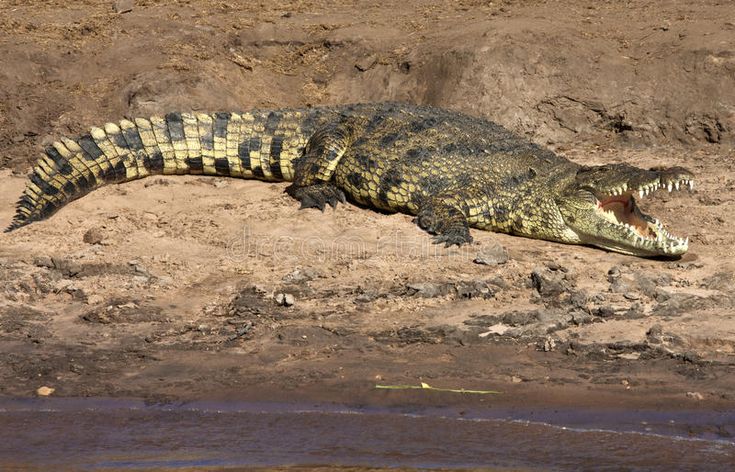
The Nile crocodile is Africa's apex freshwater predator and the second largest living crocodilian after the saltwater crocodile.
Crocodylus niloticus haunts rivers, lakes, and wetlands across the sub-Saharan continent, from the papyrus-choked margins of Lake Victoria to the seasonal pans of the Okavango Delta and the churning bottleneck of the Mara River, where the annual wildebeest migration funnels tens of thousands of prey animals past waiting jaws.
The species is famous for three things: its size, its bite, and its willingness to eat almost anything that comes within reach - including, with grim regularity, human beings.
This entry is a reference guide to the Nile crocodile. Expect specifics: centimetres, kilograms, newtons of bite force, nest temperatures, and verified records. Expect also the strange and unexpected - the cooperative hunts, the stomach stones, the temple mummies, and the 2011 discovery that the animal we had been calling the Nile crocodile for two centuries was in fact two distinct species living side by side along the river that gave it its name.
Etymology and Classification
The scientific name Crocodylus niloticus was formalised by Laurenti in 1768 from the Latin crocodilus and niloticus ("of the Nile"). The Greeks called the animal krokodeilos, literally "pebble worm," because they first encountered the species sunning on river shingle. In Arabic the crocodile is timsah, the word that gives the Egyptian Lake Timsah its name.
The full taxonomic placement is Animalia - Chordata - Reptilia - Crocodilia - Crocodylidae - Crocodylus - C. niloticus. Within the genus Crocodylus the Nile crocodile is closely allied with the saltwater crocodile (C. porosus), the Indo-Pacific lineage, and more distantly with the American crocodile (C. acutus).
The most important taxonomic event in the recent history of the species came in 2011. A team led by Evon Hekkala and Matthew Shirley published genetic evidence - both mitochondrial and nuclear - showing that what herpetologists had treated as one Nile crocodile was actually two reproductively isolated lineages. The eastern and southern African populations retain the name Crocodylus niloticus.
The western and parts of Central African populations were resurrected under an older name, Crocodylus suchus, the West African crocodile or "sacred crocodile." The two lineages diverged 3-6 million years ago and are morphologically similar but behaviourally distinct.
C. suchus is smaller, less aggressive, and tolerant enough of humans to have been handled ceremonially in ancient Egyptian temples, where mummified individuals have since been shown by DNA to belong to that species rather than the larger, more dangerous C. niloticus.
For this entry the focus is Crocodylus niloticus strictly. The boundary between the two species is not perfectly mapped - there is a contact zone along the Nile - but as a general rule, crocodiles from the Congo Basin westward are C. suchus and crocodiles from the East African lakes, the Zambezi, and southern Africa are C. niloticus.
Size and Physical Description
Nile crocodiles are large, heavily armoured archosaurs shaped by a body plan that has changed little in 80 million years.
Length and mass:
- Typical adult length: 3.5-5 metres from snout tip to tail tip
- Typical adult mass: 225-750 kg
- Record verified length: 6.45 metres (Mwanza, Tanzania, 1905)
- Record mass of large specimens: over 900 kg
- Hatchling length: 28-30 cm
- Hatchling mass: roughly 70 grams
Males grow larger than females throughout life. A 4-metre male is unremarkable in well-protected populations such as South Africa's St Lucia or Ethiopia's Lake Chamo. A 5-metre male is exceptional. Mass scales disproportionately with length - doubling length means roughly quadrupling mass - so a 5-metre bull outweighs a 4-metre bull by a factor near two.
Body structure:
The head is broad and V-shaped with prominent upward-facing eyes and nostrils that allow the animal to watch and breathe while remaining otherwise submerged. A translucent nictitating membrane sweeps sideways across the eye to protect it underwater. The tail is laterally compressed and muscular, contributing roughly half of total length and providing all the propulsion in water.
The dorsal surface carries rows of keratinised scutes reinforced with bony osteoderms, creating armour that deflects most natural threats.
Colour varies from olive-green or bronze over the back to cream-yellow on the belly. Juveniles show high-contrast dark banding that fades with age. Dome-shaped integumentary sense organs speckle the head, jaws, and body. These pressure receptors detect water disturbance finer than human fingertips can feel - a leaf hitting the surface several metres away generates a detectable signal.
Senses and the Jaw
Nile crocodile senses are built for ambush from water.
- Vision. Eyes sit high on the skull with a vertical-slit pupil that opens to almost the full aperture in low light. A tapetum lucidum reflects light back through the retina, the feature that makes crocodile eyes glow when a torch beam catches them across a river at night.
- Hearing. Ears are covered by a muscular flap that seals underwater. Above water, hearing is acute enough for mothers to locate hatchling chirps through 30-50 cm of nest sand.
- Pressure sense. Dome receptors across the head and body sense pressure waves in water. This is the primary targeting sense during ambush strikes.
- Smell. Well developed both above and below water. Carrion scent draws crocodiles from kilometres away.
- Taste. Present but secondary.
The jaws are the business end of the animal. Large Nile crocodiles generate bite forces measured at roughly 22,000 newtons - about 5,000 psi - at the rear teeth. Measurements by Gregory Erickson and colleagues place Nile and saltwater crocodiles among the strongest biters ever measured in living animals. The teeth themselves are not designed for cutting or chewing.
They are conical holding teeth that grip, pierce, and pin. Teeth are replaced throughout life; a single individual may grow and shed 3,000 teeth in a lifetime.
The muscles that close the jaw are enormous. The muscles that open the jaw, by contrast, are weak. This is why handlers and researchers can tape an adult crocodile's mouth shut with ordinary duct tape once the jaw is held closed. Open the jaws and nothing you can do with bare hands will resist them.
Hunting and Diet
Nile crocodiles are opportunistic generalists. Their diet shifts through life as size allows them to tackle larger prey.
| Life stage | Typical prey |
|---|---|
| Hatchling | Insects, spiders, small frogs, small fish |
| Juvenile (1-2 m) | Fish, amphibians, water birds, small mammals |
| Sub-adult (2-3 m) | Fish, birds, antelope up to medium size, warthog |
| Adult (3-5 m) | Fish, wildebeest, zebra, buffalo, domestic livestock, humans |
| Large adult (>5 m) | Cape buffalo, adult zebra, young hippo, almost any ungulate |
Fish remain a staple at every stage. On the East African lakes - Turkana, Albert, Chamo - tilapia, catfish, and tigerfish make up the bulk of adult diet. On river systems with heavy ungulate crossings, such as the Mara and the Grumeti, large crocodiles concentrate on mammal prey during the migration window and fast for long stretches when the herds have passed.
Ambush technique:
- Approach under cover of water. Crocodiles drift toward prey with only nostrils and eyes above the surface, often for 15-30 minutes.
- Strike. A tail-driven lunge explodes the animal half out of the water, jaws already opening. Distance of the strike can exceed two metres.
- Grip. Rear teeth lock. Front teeth rarely hold large prey alone.
- Drag into water. The prey is pulled below the surface, where the crocodile uses its aquatic advantage.
- Death roll. The crocodile seizes a limb or soft tissue and spins rapidly along its long axis, using rotational torque to tear the body apart. The roll is performed tail-first in the sense that the hindquarters initiate the spin; the head grips while the body twists.
Cooperative hunting:
One of the most remarkable behaviours documented in Nile crocodiles is cooperative and coordinated hunting. Researchers including Vladimir Dinets have described two clear patterns:
- Herding behaviour. Multiple crocodiles space themselves in a loose arc or line across a river channel, driving schools of fish toward shallow water where capture is easier.
- Role division around large carcasses. When a large mammal is held by one crocodile, others approach, grip other limbs, and roll in opposite directions. The shared torque dismembers the carcass, at which point each crocodile swims off with a portion.
Cooperative feeding in crocodilians challenges the old assumption that reptiles are too simple-brained for social coordination. Nile crocodiles may have among the smallest brain-to-body mass ratios of any vertebrate, yet they solve group-hunting problems that many mammalian predators never attempt.
The Death Roll and Gastroliths
The death roll is the signature feeding movement of large crocodilians. Measurements in Nile crocodiles and related species show that a 4-metre individual can generate enough rotational torque to twist a buffalo leg off at the hip. The roll serves three purposes: it disorients and drowns the prey, it separates bite-sized pieces from a carcass too big to swallow whole, and it reduces the risk of the crocodile losing its grip to thrashing defensive movements.
Gastroliths - stomach stones - are a second unusual feeding adaptation. Nile crocodiles deliberately swallow rounded pebbles. The accumulated mass sits in the stomach and is thought to serve two roles. First, the extra ballast helps large crocodiles dive and remain submerged at depth, counteracting buoyant fat reserves. Second, the stones may assist in grinding the tough hide, feathers, and bones of swallowed prey. The mass of gastroliths in a large adult can exceed 5 kg.
Reproduction
Nile crocodile reproduction follows a strict seasonal cycle keyed to the dry season along river banks.
Courtship and mating:
Mating occurs in water, typically during the mid-wet to early-dry season depending on latitude. Males defend territories with bellows, headslaps, and occasional violent fights. Courtship involves mutual snout rubbing and synchronised submergence.
Nesting:
The female excavates a nest chamber up to 50 cm deep in soft substrate - sand bars, earthen banks, sometimes gravel - well above the high-water mark. Clutches contain 25-80 eggs, typically around 50. Eggs weigh 110-130 grams and resemble large chicken eggs in shape though slightly more elongated. The female covers the clutch, stamps the surface down, and takes up guard within a few metres of the nest for the full 80-90-day incubation period. She rarely feeds during this vigil.
Temperature-dependent sex determination:
Sex is not set by chromosomes. It is set by incubation temperature during the middle third of development.
- Below approximately 31 degrees Celsius: females
- 31-34 degrees Celsius: males
- Above approximately 34 degrees Celsius: females
This is the same pattern seen in many turtles and in most crocodilians, but it creates serious vulnerability to climate change. A shift of a few degrees in nest-site temperature can skew sex ratios dramatically.
Hatching:
Near the end of incubation, hatchlings inside the eggs produce high-pitched chirps. The mother uncovers the nest on cue, and in some cases the father joins her. She lifts individual hatchlings into her mouth, using a soft gular pouch beneath her tongue to carry them - often several at a time - down to the water.
A female capable of crushing a wildebeest skull handles 70-gram hatchlings without a scratch. Observers frequently remark on the disconnect between the violence of the adult and the delicacy of the transport.
Early life:
Hatchlings form pods that remain in shallow, weedy margins under loose maternal supervision for a few weeks to several months. Mortality is brutal. Monitor lizards, marabou storks, fish eagles, large catfish, and bigger crocodiles account for heavy losses. Fewer than 2% of hatchlings reach breeding age. Those that survive grow roughly 30 cm per year for the first decade and reach sexual maturity around 12-15 years at about 2-3 metres in length.
Longevity and the "Grandma Crocs"
Nile crocodiles are among the longest-lived reptiles. Typical wild lifespan is 50-80 years. Exceptional individuals in well-studied populations - for instance at Lake Chamo in Ethiopia - are believed to exceed 80 years based on growth-ring analyses of bony plates. Unlike most mammals, female crocodiles do not undergo reproductive senescence in any dramatic way.
"Grandma" crocodiles - females well past 60 - continue to nest and produce viable clutches, albeit smaller. The combination of slow growth, late maturity, long reproductive life, and high early-life mortality gives the species a demographic profile more similar to a large whale than to a typical reptile.
Range and Habitat
The Nile crocodile occupies a vast slice of sub-Saharan Africa.
| Region | Key waters |
|---|---|
| Nile Basin | Nile, Lake Turkana, Lake Albert, Lake Victoria tributaries |
| East African Rift | Lake Tanganyika, Lake Malawi, Rufiji River, Ruaha River |
| Southern Africa | Zambezi, Okavango Delta, Kruger, St Lucia |
| Horn of Africa | Omo River, Lake Chamo, Awash drainage |
| Madagascar | Isolated populations, now genetically distinct |
The species tolerates a wide range of freshwater habitats, including ephemeral wadis in arid margins, slow tropical rivers, deep lakes, and extensive seasonal floodplains. Brackish estuaries are tolerated; full salt water is not. Nile crocodiles do not generally cross the open ocean, but they have been recorded in short coastal transits, which probably explains the Madagascan population.
Dense populations require year-round water and sufficient prey biomass. Deep pools that hold through the dry season serve as refuges during seasonal extremes.
Conservation Status
The IUCN Red List currently lists Crocodylus niloticus as Least Concern, reflecting widespread populations and successful recovery in many southern and eastern African countries. This masks significant regional variation and historical loss.
History of population collapse and recovery:
- 1940s-1970s: commercial skin hunting removed hundreds of thousands of crocodiles. Numbers crashed across the range.
- 1975: CITES enters into force. Most populations placed on Appendix I (no commercial trade).
- 1980s-1990s: several countries (Zimbabwe, Zambia, Botswana, South Africa, Ethiopia) transition to Appendix II under strict ranching and quota systems.
- 2000s-present: populations in southern and eastern Africa recover strongly. West and Central African populations - now mostly C. suchus - remain depleted and poorly monitored.
Current threats:
- Habitat loss. Dams, wetland drainage, agricultural encroachment.
- Pollution. Pesticide and industrial runoff concentrates in fatty tissue; affects eggshell quality and embryonic development.
- Human-crocodile conflict. Retaliatory killings after livestock or human attacks. Many problem-animal removals never enter official statistics.
- Illegal trade. Skin poaching continues at lower intensity in some regions.
- Climate change. Temperature-dependent sex determination makes the species sensitive to nest-temperature shifts. Changes in rainfall affect nesting substrate availability.
International trade is governed under CITES. Most populations are on Appendix II with ranching exemptions; a handful of West and Central African populations remain on Appendix I.
Nile Crocodiles and Humans
The relationship between humans and Nile crocodiles is old, deep, and violent.
Ancient Egypt and Sobek.
The crocodile god Sobek is attested from the Old Kingdom onward. Sobek was a deity of the Nile, of fertility, of military might, and of pharaonic power. Major cult centres included Crocodilopolis (Shedet, modern Faiyum) and Kom Ombo.
At Kom Ombo's double temple the western half was dedicated to Sobek, and archaeologists have recovered hundreds of mummified crocodiles in associated catacombs - everything from tiny hatchlings to near-adult animals, often ceremonially wrapped and buried alongside clutches of mummified eggs.
DNA analysis of several of these mummies has shown that the temple-handled crocodiles were predominantly Crocodylus suchus, the smaller and less aggressive sister species. The more dangerous C. niloticus was reserved for different treatment: it appears in temple iconography as a symbol of lethal power, not as a handleable cult animal.
Modern conflict.
Today the Nile crocodile kills more people than any other crocodilian, and probably more than any other large predator in Africa. Conservative estimates put annual human fatalities in the range of 200; broader analyses including under-reported rural deaths suggest 300-500 per year across the species range.
Most attacks occur at water-collection points, fishing camps, washing spots, and livestock watering sites - predictable routines that the crocodile learns to exploit. Unlike lion or leopard attacks, which are usually sudden and one-sided, crocodile attacks often leave no witness. The victim is pulled under in seconds and drowned before anyone can respond.
Communities along the Zambezi, the Shire, the Rufiji, and countless smaller rivers have developed coexistence strategies ranging from enclosed washing platforms and community watch programmes to targeted removal of problem animals. Some conservation NGOs work directly with local authorities to translocate or cull specific aggressive individuals rather than blanket-reduce populations.
Farming and trade.
Nile crocodile ranching is a well-established industry across southern and eastern Africa. Farms incubate wild-collected eggs or breed captive stock, raising hatchlings to 1.5-2 metres for skin and meat. Supply chain regulation under CITES has transformed the economics: legal, traceable skins command high prices from luxury leather houses, and a portion of farm revenue in several countries funds crocodile conservation and monitoring.
Related Reading
- Nile Crocodile: Africa's Man-Eater
- Saltwater Crocodile: The Largest Reptile Alive
- Crocodile vs Alligator: What's the Difference?
- Crocodilians: Ancient Predators That Outlived the Dinosaurs
- American Alligator
References
Relevant peer-reviewed sources consulted for this entry include the IUCN Crocodile Specialist Group status reports, Hekkala et al.
(2011) on the genetic split of Crocodylus niloticus and C. suchus published in Molecular Ecology, Shirley et al. subsequent morphological and phylogenetic work, Erickson et al. bite-force measurements published in PLOS ONE (2012), Dinets' field observations on cooperative hunting published in Ethology Ecology and Evolution (2015), CITES trade data, and regional population surveys from the Zimbabwe Parks and Wildlife Management Authority, Ezemvelo KZN Wildlife, and Ethiopia's Wildlife Conservation Authority.
Population figures reflect the most recent consolidated estimates from the IUCN Crocodile Specialist Group.
Frequently Asked Questions
How big do Nile crocodiles get?
Most adult Nile crocodiles (Crocodylus niloticus) measure 3.5-5 metres from snout to tail tip and weigh 225-750 kg. Males are consistently larger than females. Exceptional individuals break 6 metres, and the largest verified specimen was a 6.45-metre bull shot in Mwanza, Tanzania, in 1905. Hatchlings emerge at 28-30 cm and around 70 grams.
Growth is fastest in the first decade - roughly 30 cm of length per year - then slows dramatically as animals approach maturity around age 12-15. Reports of 7-metre crocodiles in the 19th century exist but are not verified by modern standards.
What do Nile crocodiles eat?
Nile crocodiles are opportunistic generalist carnivores. Hatchlings and juveniles feed on insects, crustaceans, amphibians, and small fish. Sub-adults add birds, reptiles, and mammals up to the size of antelope. Adults take prey as large as Cape buffalo, wildebeest, zebra, and occasionally young hippos. Fish remain a staple across all life stages, and in lakes such as Lake Turkana, tilapia and tigerfish dominate the diet.
Nile crocodiles routinely scavenge carcasses and have been observed stealing kills from lions and leopards that approach water. At the Mara River crossing, mass predation on migrating wildebeest is one of the best-known predator-prey spectacles on Earth.
Where do Nile crocodiles live?
The Nile crocodile occupies rivers, lakes, marshes, swamps, and seasonal floodplains across sub-Saharan Africa, with strong populations in the Nile Basin, the Zambezi, the Okavango, the Rufiji, the Congo tributaries, and the great lakes - Turkana, Tanganyika, Malawi, and Victoria. An isolated population persists in Madagascar. The species tolerates a wide range of conditions from near-desert wadis to dense tropical rainforest waterways.
Unlike saltwater crocodiles, Nile crocodiles rarely enter the open ocean, although they tolerate brackish estuaries and have been recorded crossing short stretches of salt water to colonise islands.
Are Nile crocodiles dangerous to humans?
Nile crocodiles are among the most dangerous large predators alive. Conservative estimates attribute around 200 human fatalities per year to the species, with some analyses placing the true annual toll closer to 300-500 across the African range. Fatal attacks cluster at water collection points, fishing camps, river crossings, and livestock watering areas - places where people enter the water predictably.
The crocodile is an ambush predator that can remain submerged for an hour and launch a strike with no visible warning. Coexistence is possible and widespread, but requires strict avoidance of the water’s edge at dawn and dusk, secure livestock enclosures, and community reporting of problem animals.
How powerful is a Nile crocodile's bite?
Measurements on large Nile crocodiles have recorded bite forces of roughly 22,000 newtons - about 5,000 psi - at the rear teeth. This exceeds the bite force of any living mammal and rivals that of the saltwater crocodile. The strength comes from enormous jaw-closing muscles and a skull built to transmit shear loads.
Curiously, the muscles that open the jaw are weak by comparison, which is why handlers can tape a crocodile’s mouth shut with ordinary adhesive tape once the jaw is held closed. The bite is designed for seizing and holding rather than chewing: prey is drowned and then dismembered with the death roll.
How do Nile crocodiles reproduce?
Females build earthen or sand nests on riverbanks, excavating a chamber up to 50 cm deep and laying 25-80 eggs. The mother guards the nest for 80-90 days of incubation, fasting through most of the period. When hatchlings chirp from inside the eggs, the female uncovers the nest and often carries the young to the water in a specialised gular pouch beneath her tongue.
Egg temperature determines sex: narrow windows of 31-34 degrees Celsius produce males, while cooler and warmer temperatures yield females. Hatchlings remain in pods under loose maternal protection for several weeks, but fewer than 2% reach adulthood because of predation by monitor lizards, herons, fish, and larger crocodiles.
Are Nile crocodiles endangered?
The IUCN Red List currently classifies Crocodylus niloticus as Least Concern, reflecting large populations across most of its range. Numbers collapsed in the mid-20th century due to skin hunting, but regulated trade under CITES and sustainable ranching programmes in countries including Zimbabwe, Zambia, and South Africa have allowed recovery.
Populations in West and Central Africa - many now attributed to the sister species Crocodylus suchus - remain depleted and poorly surveyed. Habitat loss, pollution, dam construction, and retaliatory killing after human-crocodile conflict are the main ongoing threats. International trade is controlled under CITES, with most populations on Appendix II and a few still on Appendix I.
What is the difference between Crocodylus niloticus and Crocodylus suchus?
In 2011, Schmitz and colleagues published genetic evidence that the animal biologists had treated as a single Nile crocodile species was in fact two - Crocodylus niloticus in East, Central, and Southern Africa, and Crocodylus suchus in West and parts of Central Africa. The two lineages diverged roughly 3-6 million years ago.
Crocodylus suchus tends to be smaller and noticeably less aggressive, which is consistent with ancient Egyptian records describing ‘sacred’ crocodiles handled in temples at Thebes. DNA from mummified temple crocodiles at several Egyptian sites matches C. suchus, not C. niloticus. The two species overlap along the lower Nile but remain genetically distinct.