
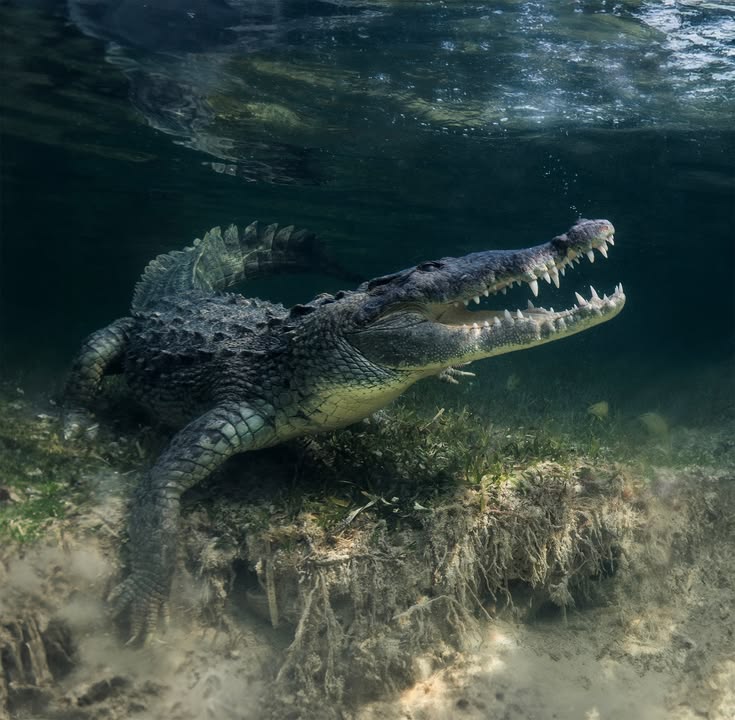
What is the difference between a crocodile and an alligator?
The most visible difference is snout shape: crocodiles have a narrow, V-shaped snout while alligators have a wide, U-shaped snout. Crocodiles also have a fourth lower tooth that remains visible when the mouth is closed, whereas alligator teeth are hidden. Crocodiles have functional salt-excreting glands on their tongues, allowing them to tolerate saltwater, while alligators lack this adaptation.
They were here before the first dinosaur took its first step, and they were still here long after the last one fell. Crocodilians - the order that includes crocodiles, alligators, gharials, and caimans - represent one of the most enduring lineages of large predators in the history of life on Earth.
Their ancestors emerged roughly 240 million years ago during the Triassic period, and in the intervening eons they have survived every catastrophic event the planet has thrown at them: volcanic mega-eruptions, asteroid impacts, ice ages, continental drift, and the five great mass extinctions that obliterated the majority of all living species.
They are not relics. They are not evolutionary leftovers clinging to survival through sheer luck. Crocodilians are among the most sophisticated predators alive today, equipped with sensory systems, cardiovascular physiology, and behavioral strategies that rival or exceed those of many mammals. Their brains are more complex than those of any other living reptile. Their parental care is unmatched in the reptilian world. Their bite force is the strongest of any animal ever measured.
To understand crocodilians is to understand what it truly means to be built for survival.
240 Million Years of Evolution: Surviving the Unthinkable
The evolutionary lineage of crocodilians - the clade Pseudosuchia - diverged from the lineage that would produce dinosaurs and birds during the early Triassic period, approximately 247 to 240 million years ago. This means that crocodilians and birds are, in fact, each other's closest living relatives - a fact that surprises many people who assume reptiles form a single, unified group distinct from birds.
The earliest pseudosuchians looked nothing like modern crocodiles. Many were fully terrestrial, long-legged, and upright. Some, like Postosuchus, were apex predators that walked on two legs and grew to over 4 meters in length. Others were armored herbivores. The diversity of body plans within the crocodilian stem lineage during the Triassic was extraordinary - far greater than what exists today.
The first major test came with the end-Triassic extinction (~201 million years ago), which wiped out roughly 76% of all species and eliminated most of the large pseudosuchians. But the smaller, more aquatic forms survived. This pattern would repeat itself throughout the Mesozoic era: lineages diversified, catastrophe struck, and the semi-aquatic generalists persisted.
During the Jurassic and Cretaceous periods, crocodilian relatives colonized the oceans. Thalattosuchia, a group of fully marine crocodilians, developed flippers and fish-like tails and ranged across the world's seas for over 100 million years. On land, Sarcosuchus imperator - the so-called "SuperCroc" - reached lengths of 11 to 12 meters and weighed an estimated 8,000 kg, dwarfing any crocodilian alive today [1].
Then came the event that defines all of paleontology: the Chicxulub asteroid impact 66 million years ago. The end-Cretaceous mass extinction annihilated roughly 76% of all species, including every non-avian dinosaur. Yet crocodilians survived.
The leading hypothesis is that their semi-aquatic lifestyle, ectothermic metabolism (requiring far less food than warm-blooded animals of similar size), and ability to endure prolonged fasting gave them critical advantages during the years of environmental collapse that followed the impact [2].
The modern order Crocodylia encompasses 27 recognized species distributed across three families:
- Crocodylidae (true crocodiles) - 16 species
- Alligatoridae (alligators and caimans) - 8 species
- Gavialidae (gharials) - 3 species (including the false gharial, whose placement is debated)
Saltwater Crocodiles: The Largest Living Reptile
The saltwater crocodile (Crocodylus porosus) is the undisputed heavyweight of the living reptile world. Adult males commonly reach 5 to 6 meters (16-20 feet) in length and weigh between 450 and 750 kg (1,000-1,650 lbs). Exceptional individuals surpass even these figures. The largest saltwater crocodile ever reliably measured was Lolong, captured alive in Bunawan, Agusan del Sur, Philippines, in September 2011.
Lolong measured 6.17 meters (20 feet 3 inches) and weighed approximately 1,075 kg (2,370 lbs). He was certified by Guinness World Records as the largest crocodile in captivity before his death in 2013 [3].
But Lolong may not represent the upper limit. Unverified historical accounts from Australia and Borneo describe saltwater crocodiles exceeding 7 meters. Given that these animals exhibit indeterminate growth - meaning they continue to grow throughout their lives, which can span 70 years or more - such sizes are biologically plausible for very old individuals in undisturbed habitats.
Bite Force and Hunting
The saltwater crocodile possesses the strongest bite force ever directly measured in any living animal: approximately 3,700 pounds per square inch (psi), or roughly 16,460 Newtons. For comparison, a lion generates about 650 psi, a great white shark approximately 625 psi, and a human roughly 162 psi.
This extraordinary force is generated by massive adductor muscles that fill the temporal region of the skull, combined with a rigid skull architecture that transfers force efficiently to the teeth [4].
"The crocodilian skull is arguably the most mechanically optimized biting structure in the vertebrate world. Every element - the secondary palate, the pterygoid flanges, the massive adductor chambers - serves to maximize force transmission to the tooth row." - Gregory Erickson, Florida State University, in Scientific Reports (2012)
Despite this crushing power, the muscles that open a crocodile's jaw are comparatively weak. A human can hold a crocodile's mouth shut with their bare hands - though getting into the position to do so is, obviously, another matter entirely.
Saltwater crocodiles are ambush predators of the highest order. They can remain motionless for hours, submerged with only their eyes and nostrils above the waterline, waiting for prey to approach the water's edge. Their strike, when it comes, is explosive: a lunge of up to half their body length, powered by the tail and hind limbs, lasting less than a quarter of a second.
Range and Habitat
The saltwater crocodile has the widest distribution of any crocodilian species, ranging from the eastern coast of India through Southeast Asia, northern Australia, and into the western Pacific islands. They are the most marine-adapted of all crocodilians, capable of crossing hundreds of kilometers of open ocean by riding surface currents. Satellite-tagged individuals have been recorded traveling over 590 km across the Coral Sea.
Nile Crocodiles: Ambush Masters of Africa
The Nile crocodile (Crocodylus niloticus) is Africa's largest freshwater predator and the second largest of all crocodilian species. Adult males typically reach 3.5 to 5 meters in length and weigh 225 to 750 kg. They range across sub-Saharan Africa, the Nile basin, and Madagascar.
The Death Roll
Nile crocodiles are perhaps most famous for the death roll - a spinning maneuver used to dismember large prey. After seizing an animal in its jaws, the crocodile locks its teeth and rotates its entire body along its longitudinal axis with tremendous force. This twisting motion tears limbs and chunks of flesh from prey too large to be swallowed whole. The death roll generates rotational forces that can exceed 8,000 Newtons and is one of the most violent feeding behaviors in the animal kingdom.
The Great Migration Gauntlet
One of nature's most dramatic predator-prey encounters plays out annually along the Mara River in Kenya and Tanzania. During the great wildebeest migration, approximately 1.5 million wildebeest must cross the river - and waiting for them are some of the largest Nile crocodiles on the continent. These crossings are scenes of extraordinary violence and chaos.
Crocodiles stationed at established crossing points may feed only a handful of times during the migration season, but each successful kill can provide enough sustenance for weeks. Studies estimate that Nile crocodiles kill roughly 3,000 to 5,000 wildebeest during each migration cycle.
Gustave: The Legendary Man-Eater
No account of Nile crocodiles is complete without the story of Gustave, a massive male Nile crocodile inhabiting the shores of Lake Tanganyika and the Ruzizi River in Burundi. Gustave is reputed to be one of the largest Nile crocodiles ever observed, with estimated length of over 5.5 meters (18 feet) and an estimated age exceeding 60 years.
Gustave has been attributed with the deaths of over 300 people along the lake's shoreline, though this figure is difficult to verify. What is documented is a long series of attacks on fishermen, bathers, and villagers spanning decades. Multiple attempts to capture or kill Gustave have failed.
In 2004, a team led by French herpetologist Patrice Faye, working with the documentary crew from the film Capturing the Killer Croc, constructed a massive cage trap baited with live goats. Gustave was observed circling the trap but never entered it. He bears numerous scars, including bullet wounds and a distinctive dark patch on the top of his skull.
As of the last confirmed sightings, Gustave remains alive and uncaptured - a living embodiment of the power and cunning of his species [5].
American Alligators: A Conservation Triumph
The American alligator (Alligator mississippiensis) stands as one of the most remarkable conservation success stories in modern wildlife management. By the mid-1960s, unregulated hunting for hides and habitat destruction had reduced alligator populations across the southeastern United States to dangerously low levels. The species was listed as endangered in 1967 under the Endangered Species Preservation Act.
What followed was a textbook recovery. Strict hunting bans, habitat protections, and the development of regulated alligator farming (which reduced pressure on wild populations by providing an alternative source of hides) allowed numbers to rebound dramatically. By 1987, the American alligator was removed from the endangered species list.
Today, the wild population is estimated at approximately 5 million individuals across the southeastern United States, from North Carolina to Texas. Louisiana alone is home to roughly 2 million alligators [6].
Keystone Species of the Everglades
In the Florida Everglades, American alligators function as a keystone species - an organism whose influence on its ecosystem is disproportionately large relative to its abundance. During the dry season, alligators excavate and maintain "gator holes": depressions in the limestone bedrock that retain water when surrounding marshes dry up.
These gator holes become critical refuges for fish, turtles, snails, wading birds, and countless invertebrates. Without alligator-maintained gator holes, many of these species would face severe population declines during seasonal droughts.
Alligators also modify their environment through nest building. Female alligators construct large mound nests from vegetation and mud that, as the organic material decomposes, generate heat that helps incubate the eggs. These nest mounds, accumulated over years and generations, create elevated ground that supports the growth of trees and shrubs in otherwise flat, marshy terrain - effectively engineering the landscape itself.
Physical Characteristics
American alligators are considerably smaller than saltwater and Nile crocodiles. Males typically reach 3.4 to 4.6 meters (11-15 feet) and weigh 200 to 450 kg. The largest verified specimen was recorded at 4.54 meters (14 feet 9.25 inches) from Louisiana. They can live 35 to 50 years in the wild and up to 70 years in captivity.
Gharials: The Needle-Snouted Fish Specialist
The gharial (Gavialis gangeticus) is the most visually distinctive of all crocodilians and one of the most critically endangered large reptiles on Earth. Its extraordinarily long, narrow snout - lined with over 100 interlocking teeth - is a precision instrument evolved for catching fish. The gharial's jaws can snap shut laterally through water with minimal resistance, allowing it to seize fast-moving fish with a speed and efficiency that no other crocodilian can match.
Adult male gharials develop a bulbous growth on the tip of their snout called a ghara (from the Hindi word for "pot"), which is used to produce buzzing vocalizations during mating displays and to blow bubbles that attract females. Males can reach 5 to 6 meters in length, though they are more lightly built than crocodiles of similar length, weighing 150 to 250 kg.
Critical Endangerment
Gharials once ranged across the river systems of the Indian subcontinent, from the Indus to the Irrawaddy. Today, their range has collapsed to a few scattered populations in northern India and southern Nepal. The wild population is estimated at fewer than 650 adults, a decline of over 96% since the 1940s.
The primary drivers of this decline are dam construction (which fragments habitat and alters river flow), sand mining on nesting beaches, entanglement in fishing nets, and depletion of fish stocks.
Conservation efforts, particularly captive breeding and release programs led by the Madras Crocodile Bank Trust and the Gharial Conservation Alliance, have shown some success. However, survival rates of released juveniles remain low, and the species' recovery depends on protecting the handful of remaining river stretches where viable breeding populations persist [7].
Crocodile vs. Alligator vs. Gharial vs. Caiman: A Comparison
| Feature | Crocodile | Alligator | Gharial | Caiman |
|---|---|---|---|---|
| Snout Shape | Narrow, V-shaped | Wide, U-shaped | Extremely narrow, elongated | Broad, similar to alligator |
| Visible Teeth (mouth closed) | 4th lower tooth visible | Teeth hidden by upper jaw | All teeth interlock visibly | Teeth mostly hidden |
| Salt Tolerance | High (functional salt glands) | Low (non-functional salt glands) | Low | Low |
| Maximum Size | 6+ meters (saltwater croc) | 4.5 meters (American alligator) | 6 meters | 5+ meters (black caiman) |
| Bite Force | Up to 3,700 psi | Up to 2,980 psi | Relatively weak (fish specialist) | Up to 1,500 psi (estimated) |
| Aggression to Humans | High (saltwater, Nile) | Moderate | Very low | Low to moderate |
| Primary Diet | Mammals, fish, birds, reptiles | Fish, turtles, mammals, birds | Almost exclusively fish | Fish, capybaras, mammals |
| Habitat | Freshwater and saltwater | Freshwater (swamps, marshes) | Large, fast-flowing rivers | Freshwater (rivers, wetlands) |
| Distribution | Africa, Asia, Australia, Americas | USA, China | India, Nepal | Central and South America |
| Conservation Status | Varies by species | Least Concern (American) | Critically Endangered | Varies by species |
Crocodilian Parenting: The Most Devoted Reptile Parents
Crocodilians exhibit a level of parental care that is unique among reptiles and closer in many respects to what is observed in birds - which makes sense, given that crocodilians and birds are each other's closest living relatives.
Temperature-Dependent Sex Determination
Unlike mammals, whose sex is determined by chromosomes (XX/XY), crocodilians have temperature-dependent sex determination (TSD). The sex of the offspring is determined by the temperature at which the eggs incubate during a critical window roughly one-third of the way through the incubation period.
In most crocodilian species, temperatures of 31.7 to 34.5 degrees Celsius produce predominantly males, while temperatures above or below this range produce predominantly females. This means that even small changes in ambient temperature - such as those caused by climate change - could dramatically skew sex ratios in wild populations.
Nest Guarding and Hatchling Care
Female crocodilians guard their nests fiercely for the entire incubation period, which ranges from 65 to 95 days depending on the species. When the eggs are ready to hatch, the young begin calling from inside the eggs - high-pitched chirping sounds that signal the mother to excavate the nest. In many species, the mother gently picks up hatchlings in her jaws and carries them to the water.
This behavior has been observed in Nile crocodiles, American alligators, saltwater crocodiles, and multiple other species.
"The female crocodile is one of the most attentive mothers in the reptile world. She will defend her nest against any intruder, respond to the calls of her hatching young, and carry them gently to water in jaws capable of crushing bone." - Adam Britton, crocodile biologist, Charles Darwin University
Mothers remain with their young for weeks to months after hatching, defending them against predators including monitor lizards, large fish, birds of prey, and even other crocodiles. Despite this protection, hatchling mortality is extraordinarily high: an estimated 99% of crocodilian hatchlings do not survive to adulthood. The few that do may live for decades - and in some species, over a century.
Crocodile Tears: Real Biology, Not Just a Metaphor
The phrase "crocodile tears" - meaning insincere or false grief - dates to at least the 14th century, when the medieval traveler Sir John Mandeville wrote that crocodiles wept while devouring their prey. For centuries, this was dismissed as pure myth. But in 2007, neurologist D. Malcolm Shaner and zoologist Kent Vliet published a study in BioScience documenting that alligators and caimans (and by extension likely all crocodilians) do indeed produce tears while feeding [8].
The tears are not emotional. They result from the mechanical action of jaw movement forcing air through the sinuses, which stimulates the lacrimal (tear-producing) glands. The hissing and huffing that accompanies feeding further pressurizes the sinus cavities. The result is that crocodilians genuinely do "cry" while eating - not from remorse, but from physiology. The medieval observers were right about the phenomenon, even if their interpretation was wrong.
The Crocodile Bird: A Symbiosis Questioned
One of the oldest natural history stories involves the Egyptian plover (Pluvianus aegyptius), also known as the "crocodile bird." According to Herodotus, writing in the 5th century BCE, these small birds would enter the open mouths of Nile crocodiles to pick leeches and food debris from their teeth - a classic example of mutualistic symbiosis.
Modern field biologists have been unable to reliably document this specific behavior. While Egyptian plovers do forage near resting crocodiles and may occasionally pick parasites from crocodile skin, the dramatic image of a bird standing inside a crocodile's open mouth appears to be, at best, an extremely rare occurrence rather than a regular mutualism.
Some researchers suggest that Herodotus may have been reporting secondhand accounts embellished over time. Nevertheless, crocodiles are known to tolerate the close presence of certain bird species, and the relationship - if not quite as dramatic as legend suggests - likely involves some genuine mutualistic benefit, with birds gaining food and crocodiles gaining parasite removal [9].
Human-Crocodile Conflict: Living Alongside Apex Predators
Crocodilians kill an estimated 1,000 to 2,500 people annually worldwide, making them the large animal group most dangerous to humans after mosquitoes, snakes, and dogs. The majority of fatal attacks are attributed to Nile crocodiles in sub-Saharan Africa and saltwater crocodiles in Southeast Asia and northern Australia.
The dynamics of human-crocodile conflict are driven by shared reliance on water. In rural communities across Africa, Asia, and Oceania, daily activities - washing, fishing, collecting water, bathing, crossing rivers - bring people into direct contact with large crocodilians. Unlike shark attacks, which are often exploratory (the shark bites and releases), crocodile attacks are typically predatory - the animal intends to kill and consume.
Mitigation strategies vary by region and include:
- Physical barriers (fences, enclosures around water access points)
- Community warning systems and education programs
- Problem animal removal (translocation or lethal control of specific individuals)
- Spotlight surveys to monitor crocodile presence near human settlements
- Compensation programs for attack victims and their families
In Australia, the Northern Territory manages human-crocodile conflict through a comprehensive program that combines strict protections for wild populations with aggressive removal of "problem crocodiles" that enter populated areas. Since the saltwater crocodile was protected in 1971, the Australian population has rebounded from roughly 3,000 to an estimated 100,000 to 200,000 individuals - creating an ongoing challenge of coexistence.
Crocodile Farms: Economics, Conservation, and Controversy
Commercial crocodile farming is a multi-billion-dollar global industry that produces leather goods, meat, and other products from captive-bred animals. The largest farming operations exist in Australia, Thailand, South Africa, Zimbabwe, Colombia, and the United States (primarily Louisiana and Florida).
The relationship between farming and conservation is complex and sometimes paradoxical. On one hand, crocodile farms have reduced poaching pressure on wild populations by providing a legal, sustainable source of skins. The American alligator's recovery was facilitated in part by the development of Louisiana's alligator farming industry, which now produces over 300,000 skins annually.
Similarly, regulated ranching programs in Zimbabwe and Australia create economic incentives for local communities to protect wild crocodile habitat.
On the other hand, animal welfare concerns are significant. Investigations by organizations such as PETA have documented crowded conditions, stress behaviors, and inhumane slaughter methods at some facilities. The luxury fashion industry's demand for crocodile leather - a single Hermes Birkin bag made from Nile crocodile skin can retail for over $50,000 - raises ethical questions about the commodification of these animals.
The most defensible models are those that combine farming with conservation. Programs in Papua New Guinea and the Northern Territory of Australia allow indigenous communities to harvest wild crocodile eggs under strict quotas, rear the hatchlings on farms, and return a percentage of juveniles to the wild. These "ranching" programs generate income for remote communities while maintaining or increasing wild populations - a pragmatic approach that aligns economic and conservation incentives.
The Future of Crocodilians
Despite their extraordinary evolutionary resilience, crocodilians face a suite of modern threats that differ fundamentally from the mass extinctions of the past. Habitat destruction - the draining of wetlands, damming of rivers, and conversion of coastal mangroves to shrimp farms and development - is the most pervasive threat.
Climate change poses a particular risk through its effect on temperature-dependent sex determination: warming temperatures could produce severely female-skewed populations in some species. Pollution, particularly from agricultural runoff and heavy metals, accumulates in crocodilian tissues and can impair reproduction and immune function.
Of the 27 recognized crocodilian species, 7 are classified as Critically Endangered or Vulnerable by the IUCN. The Philippine crocodile (Crocodylus mindorensis), with fewer than 100 mature individuals in the wild, is among the most endangered reptiles on Earth. The Chinese alligator (Alligator sinensis), once widespread along the Yangtze River, now numbers fewer than 150 in the wild, though captive breeding programs hold several thousand individuals.
Yet there is also cause for cautious optimism. The recoveries of the American alligator, the saltwater crocodile in Australia, and the Morelet's crocodile in Mexico demonstrate that crocodilian populations can rebound rapidly when given legal protection and adequate habitat. These are animals that have survived 240 million years of planetary upheaval. Given even a modest degree of human restraint, there is every reason to believe they will survive us too.
References
[1] Sereno, P.C., et al. (2001). "The Giant Crocodyliform Sarcosuchus from the Cretaceous of Africa." Science, 294(5546), 1516-1519.
[2] Mannion, P.D., et al. (2015). "Climate constrains the evolutionary history and biodiversity of crocodylians." Nature Communications, 6, 8438.
[3] Britton, A.R.C., et al. (2012). "Lolong: The World's Largest Crocodile in Captivity." National Geographic News, November 2012. Guinness World Records certification.
[4] Erickson, G.M., et al. (2012). "Insights into the Ecology and Evolutionary Success of Crocodilians Revealed through Bite-Force and Tooth-Pressure Experimentation." PLOS ONE, 7(3), e31781.
[5] Faye, P. (2002). "Gustave: The Giant Crocodile of Burundi." Herpetological field reports, Lake Tanganyika Biodiversity Project.
[6] U.S. Fish and Wildlife Service. (1987). "Reclassification of the American Alligator." Federal Register, 52(107), 21059-21064.
[7] Gharial Conservation Alliance. (2019). "Gharial Conservation Status Report." Madras Crocodile Bank Trust / IUCN Crocodile Specialist Group.
[8] Shaner, D.M., and Vliet, K.A. (2007). "Crocodile Tears: And thei eat their food alwaie weeping." BioScience, 57(7), 615-617.
[9] Cloudsley-Thompson, J.L. (2005). Ecology and Behaviour of Mesozoic Reptiles. Springer-Verlag. Chapter on crocodilian symbiosis and commensalism.
Frequently Asked Questions
What is the difference between a crocodile and an alligator?
The most visible difference is snout shape: crocodiles have a narrow, V-shaped snout while alligators have a wide, U-shaped snout. Crocodiles also have a fourth lower tooth that remains visible when the mouth is closed, whereas alligator teeth are hidden. Crocodiles have functional salt-excreting glands on their tongues, allowing them to tolerate saltwater, while alligators lack this adaptation.
Crocodiles also tend to be more aggressive and are generally larger than alligators.
How big can a saltwater crocodile get?
Saltwater crocodiles are the largest living reptiles on Earth. Adult males commonly reach 5 to 6 meters (16-20 feet) in length and weigh 450 to 750 kg (1,000-1,650 lbs). Exceptional individuals can exceed 6.3 meters and 1,000 kg. The largest reliably measured saltwater crocodile, Lolong, was captured in the Philippines in 2011 and measured 6.17 meters (20.24 feet).
How long can a crocodile hold its breath underwater?
Most crocodilians can hold their breath for 15 to 20 minutes during normal activity. However, when remaining still and conserving oxygen, large crocodiles can stay submerged for up to 2 hours. They achieve this through a highly efficient cardiovascular system that includes a four-chambered heart, the ability to shunt blood away from the lungs, and specialized hemoglobin that releases oxygen more efficiently under low-oxygen conditions.