
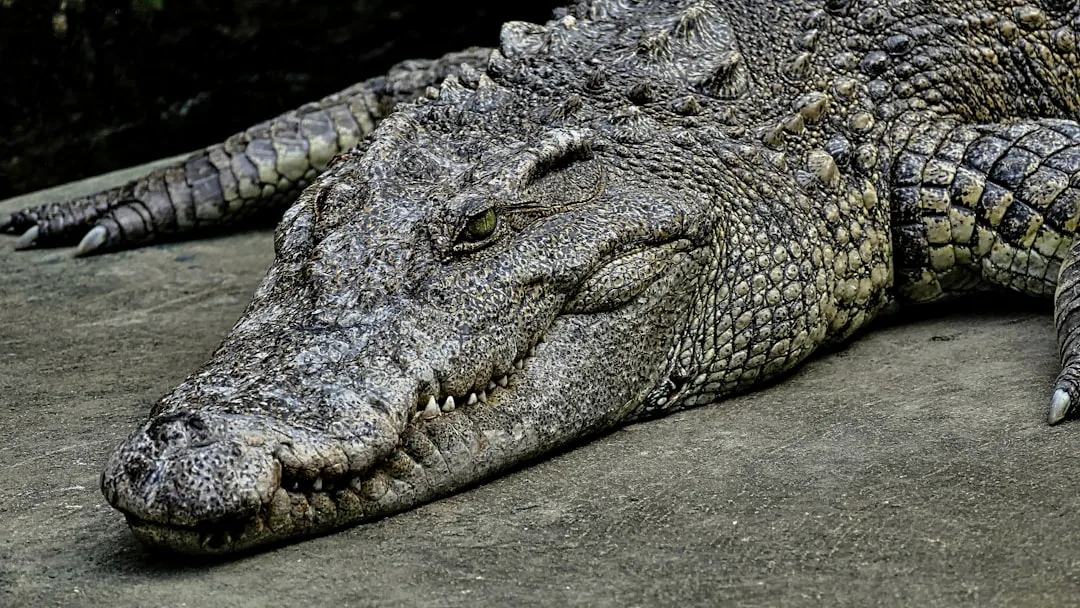
How dangerous are Nile crocodiles?
Nile crocodiles (Crocodylus niloticus) kill approximately 200 humans annually in Africa - making them the most dangerous reptile on Earth and second only to hippos among large animals for human deaths. Their attacks cover multiple scenarios: ambushing swimmers and people fetching water, pulling people from boats, attacking children playing near rivers, and occasionally attacking larger groups.
200 Human Deaths Per Year
A woman washing clothes in an African river doesn't see what's beneath the surface. She hasn't heard anything. The water looks normal. Then something explodes upward, five meters of Nile crocodile grabbing her by the arm, pulling her into deeper water, initiating the "death roll" that will drown her within seconds.
This scene plays out approximately 200 times per year across sub-Saharan Africa. Nile crocodiles kill more humans annually than lions, leopards, and elephants combined. They are, by death count, the second-most-deadly large animal in Africa after hippos.
Yet they are also vital parts of African ecosystems, ancient lineages that predate most mammals, and animals whose behavior humans are still learning to understand and coexist with.
Size
Nile crocodiles are the second-largest crocodilians alive.
Adult dimensions:
- Length: 3.5-5 meters typical; 6+ meters exceptional
- Weight: 225-750 kg typical; 1,000+ kg exceptional
- Largest verified: 6.14 meters, 910 kg
- Skull length: up to 70 cm
- Teeth count: 60-70
Sexual dimorphism:
Males are significantly larger than females:
- Males: up to 5+ meters, 500+ kg
- Females: up to 4 meters, 250 kg maximum
Compared to other crocodilians:
- Saltwater crocodile: largest (up to 6.5 meters)
- Nile crocodile: second largest
- American crocodile: 4-5 meters
- American alligator: up to 4.5 meters
Growth and longevity:
- Nile crocodiles grow continuously throughout life
- Adults reach breeding size at 10-15 years
- Typical lifespan: 45-80 years
- Captive: up to 100+ years
The Bite Force
Nile crocodile jaws generate extraordinary pressure.
Measured bite force:
- Approximately 5,000 PSI (pounds per square inch)
- Some researchers measure up to 8,000 PSI in largest individuals
- Among the strongest bite forces ever recorded in any animal
For comparison:
- Human bite: 150 PSI
- Lion bite: 650 PSI
- Great white shark: 4,000 PSI
- Saltwater crocodile: 3,700 PSI
- Nile crocodile: 5,000-8,000 PSI
What this enables:
- Crushing turtle shells
- Breaking bones of large mammals
- Severing limbs in death rolls
- Killing prey instantly
Teeth design:
Crocodile teeth are designed for gripping, not cutting. They:
- Conical shape
- Long and sharp
- Continuously replaced throughout life
- Single crocodile may grow 3,000+ teeth over lifetime
Hunting Strategy
Nile crocodiles have refined ambush hunting over millions of years.
The ambush:
- Surveillance: lying motionless in shallow water or submerged
- Targeting: identifying prey along shorelines or in water
- Approach: moving toward target while remaining hidden
- Launch: explosive lunge from water (up to 2m vertical jump)
- Grab: seizing prey with massive jaws
- Drag: pulling prey into deeper water
- Drown: holding prey underwater until drowned
- Consume: eating then or storing for later
The death roll:
Once prey is caught, crocodiles perform the "death roll":
- Spin body rapidly while gripping
- Tears prey apart or drowns quickly
- Disorients prey
- Breaks necks of large victims
- Prevents prey from fighting back
Prey selection:
Nile crocodiles eat:
- Fish (50-70% of regular diet)
- Antelope and wildebeest coming to drink
- Zebras at crossing points
- Cape buffalo (even adults)
- Other crocodiles
- Birds
- Turtles
- Occasionally lions and leopards
- Humans
Target vulnerability:
They specifically target:
- Animals at water's edge
- Crossing animals in shallow water
- Injured or weak individuals
- Young animals separated from herds
- Distracted humans accessing water
Human Fatalities
Nile crocodiles kill approximately 200 humans per year in Africa.
Attack patterns:
Water gathering:
- Women and children collecting water
- Early morning or evening attacks common
- Rural communities most affected
Fishing:
- Fishermen in small boats
- Wading in shallow water
- Net-handling vulnerable
Bathing and swimming:
- Both traditional and tourism-related
- River crossings in rural areas
- Children playing
Livestock watering:
- Herders leading cattle to water
- Attacks when cattle drink (humans nearby)
- Sometimes crocodiles attack both humans and livestock
Geographic concentrations:
Most fatalities occur in:
- Zimbabwe and Zambia (Zambezi River)
- Mozambique
- Tanzania (Rufiji River, Lake Victoria)
- Kenya
- South Africa (Kruger region)
- Madagascar
Man-eating individuals:
Some crocodiles become specialized human hunters:
- Gustave (Burundi): famous 6-meter crocodile, killed 300+ people
- Various regional specialists
- Often older, larger crocodiles
- Patterns suggest learned behavior
Biology
Nile crocodile biology reflects 200 million years of crocodilian evolution.
Skin and scales:
- Hard bony plates (osteoderms) in dorsal skin
- Protects from bites and environment
- Under skin: dense bone armor
- Ventral skin softer (valuable for leather)
Internal anatomy:
- Four-chambered heart (like birds and mammals)
- Diaphragm-like muscle for respiration
- Efficient circulatory system
- Stomach stones (gastroliths) help grind food
Sensory systems:
- Vision: excellent underwater and above
- Hearing: acute; can detect pressure waves
- Smell: can detect carrion from kilometers away
- Touch: sensitive facial scales detect water pressure
- Temperature: can detect thermal differences
Cold-blooded advantages:
- Low energy needs
- Can go weeks without eating
- Large size possible without high metabolism
- Efficient use of solar heating
Habitat
Nile crocodiles inhabit diverse African freshwater environments.
Range:
- 26 African countries south of Sahara
- Madagascar
- Historical range extended into Egypt
Habitats:
- Major rivers (Nile, Zambezi, Okavango, etc.)
- Large lakes (Victoria, Tanganyika, Malawi)
- Estuaries and coastal areas
- Marshes and swamps
- Dams and reservoirs
- Flood plains
Preferred conditions:
- Water depth: 1.5-3 meters (can use deeper)
- Stable water levels (sensitive to drought)
- Sandy or muddy banks for basking
- Vegetation for hiding
- Access to prey trails
Dry season adaptations:
When water dries up:
- Some populations estivate in underground chambers
- Others travel overland to find water
- Many juveniles die during droughts
- Adults show remarkable drought tolerance
Reproduction
Nile crocodile breeding involves unusual parental care for reptiles.
Breeding season:
- Most populations: dry season (June-November in East Africa)
- Mating occurs in water
- Males display via bellows and body movements
Nesting:
- Females dig burrows near water
- Lay 25-80 eggs
- Nest chambers: 30-45 cm deep
- Eggs covered with sand
Incubation:
- 80-90 days
- Temperature-dependent sex determination
- Mothers guard nest from predators throughout
Hatching:
- Hatchlings call from eggs
- Mother digs them out
- Carries them to water in her mouth
- This parental care is unusual for reptiles
Juvenile mortality:
- Extreme mortality (90%+) in first year
- Predation by birds, fish, larger crocodiles
- Fewer than 1% survive to breeding age
- Adults face few natural predators
Male behavior:
- Don't directly care for young
- Defend territory including nesting areas
- May eat hatchlings from other males' nests
Cultural Significance
Nile crocodiles have deep cultural presence.
Ancient Egyptian religion:
- Sobek: crocodile-headed god
- Mummified crocodiles in Egyptian tombs
- Sacred in temples (especially at Kom Ombo)
- Symbol of power and fertility
Modern African cultures:
- Central to folklore in many African regions
- Traditional medicine uses of various body parts
- Religious associations in some communities
- Cultural importance varies by ethnic group
Western culture:
- Frequent in nature documentaries
- Zoo attractions
- Adventure literature
- Crocodile hunting (now largely banned)
Conservation
Nile crocodile status is currently stable.
IUCN:
Least Concern globally
Population:
Estimated 250,000-500,000 adult crocodiles
Conservation:
- Protected in all range countries
- Major populations in national parks
- Commercial farming reduces wild harvesting
- CITES Appendix II (regulated trade)
Threats:
Habitat loss:
- Agricultural expansion near rivers
- Dam construction (changes flow patterns)
- Draining of wetlands
Pollution:
- Agricultural runoff
- Mining waste
- Industrial pollution in river systems
Human-crocodile conflict:
- Retaliatory killings after attacks
- Preemptive killings near communities
- Illegal hunting for meat
Climate change:
- Temperature affects egg hatching
- Drought reduces habitat
- Altered rainfall patterns
Regional concerns:
While globally stable, some regional populations face threats:
- West Africa: significant decline due to habitat loss
- Some local rivers losing crocodile populations
- Large individuals increasingly rare in heavily populated areas
Human-Crocodile Conflict
Managing conflict requires understanding.
Why conflict occurs:
- Growing human populations encroach on water sources
- Subsistence fishing puts people in water
- Children play in/near water
- Limited alternative water sources in rural areas
Solutions attempted:
- Fencing: crocodile-proof barriers at water points
- Safe areas: designated crocodile-free zones (created by removal)
- Education: teaching safer water practices
- Alternative water: wells and pumps away from rivers
- Crocodile management: selective removal of dangerous individuals
Successful examples:
- Kruger National Park: protected area reduces contact
- South African game reserves: managed tourism minimizes risk
- Zimbabwe: CAMPFIRE program provides community benefits from crocodile revenue
Ongoing challenges:
- Poverty limits alternative water access
- Cultural practices increase exposure
- Climate change reduces safe alternatives
- Population growth continues encroachment
Crocodile Farming
Commercial farming has conservation benefits.
Industry scale:
- Major producers: Zimbabwe, South Africa, Kenya, Madagascar
- Annual skin production: millions
- Export to luxury goods markets (leather, shoes, bags)
- Meat sold locally and internationally
Conservation benefits:
- Reduces demand for wild-caught crocodiles
- Provides economic alternative to illegal hunting
- Generates conservation funding
- Sustains employment in rural areas
Regulation:
- CITES oversight of international trade
- Certified farms must meet welfare standards
- Production limits based on sustainability
- Monitoring prevents wild population impacts
The Ancient Lineage
Crocodilians as a group have existed for 200+ million years.
Evolutionary history:
- Crocodilian ancestors appeared in Late Triassic
- Survived the extinction that killed dinosaurs
- Survived multiple climate changes
- Adapted to various environments over time
Nile crocodile specifically:
- Species as currently recognized: several million years
- Similar ancestors in African fossils
- Continental drift shaped population isolation
- Genetic studies show complex evolutionary history
Why they persist:
- Efficient metabolism
- Flexible diet
- Long lifespan
- Strong predators
- Survived mass extinctions
They saw dinosaurs and outlasted them.
Dinosaurs went extinct 66 million years ago. Crocodilians persisted. They continue doing what crocodilians have been doing for 200+ million years: ambushing prey at water's edge, reproducing in sandy banks, surviving through ecological changes that killed most contemporary species.
Living With Ancient Predators
Nile crocodiles represent a particular challenge of human-wildlife coexistence.
They kill people, directly, regularly, in substantial numbers. They are not a "myth of danger" or "rarely fatal." They genuinely pose lethal threats to African rural communities.
Yet they also:
- Provide crucial ecosystem services
- Represent ancient evolutionary lineages
- Support local economies through tourism and farming
- Persist despite centuries of human impact
Effective coexistence requires:
- Acknowledging real danger
- Providing alternatives to dangerous river access
- Respecting their ecological roles
- Managing populations where necessary
- Developing local economies that don't require risk
The challenge isn't eliminating Nile crocodiles; they belong in their ecosystems, and elimination would cause ecological damage. The challenge is reducing the conflicts where their hunting strategy (ambush at water's edge) meets the reality of rural African life (people needing water regularly).
Every Nile crocodile waiting submerged in a river is part of Africa's natural heritage. Every human death is a tragedy. Balancing these realities defines ongoing crocodile conservation and management throughout their range.
Documented Fatal Attack Statistics
The Nile crocodile (Crocodylus niloticus) is the deadliest crocodilian species to humans by a considerable margin. CrocBITE, an international database maintained at Charles Darwin University, catalogues reported crocodilian attacks on humans globally. Our research team compiled a summary of fatal attack statistics for the major species.
| Species | Estimated Annual Fatalities | Primary Range | Attack Pattern |
|---|---|---|---|
| Nile crocodile (Crocodylus niloticus) | 745 | Sub-Saharan Africa | Rural subsistence contexts |
| Saltwater crocodile (Crocodylus porosus) | 50-80 | Indo-Pacific | Coastal and riverine |
| Mugger crocodile (Crocodylus palustris) | 20-40 | South Asia | Village water sources |
| American crocodile (Crocodylus acutus) | 2-5 | Central America | Rarely fatal |
| American alligator (Alligator mississippiensis) | 1 | Southeastern US | Recreational contexts |
A 2015 study published in Journal of the Medical Association of South Africa analyzed hospital records from Mozambique, Zimbabwe, and South Africa and concluded that Nile crocodile attacks account for approximately 745 human deaths annually across sub-Saharan Africa - more than all shark species combined worldwide, more than lions, and more than any other predatory vertebrate [1].
Gustave and the Problem of Individual Man-Eaters
A specific Nile crocodile nicknamed Gustave became the subject of international attention after he was credibly linked to over 300 human deaths along the Ruzizi River in Burundi between the 1980s and 2000s. Gustave measured approximately 6 meters in length and was estimated to weigh over 900 kilograms, making him one of the largest Nile crocodiles ever documented.
"Man-eating in Nile crocodiles is almost always a learned individual behavior. Young crocodiles focus on fish and small mammals, but large old individuals develop specialized hunting techniques that include habitual predation on humans who gather at water sources. Gustave represented the extreme endpoint of this trajectory - a single animal that had specialized his entire adult life on ambushing people at specific riverbank locations." - Patrice Faye, French herpetologist and Gustave researcher [2]
Multiple attempts to capture or kill Gustave between 2002 and 2008 failed, and his current status is unknown. The case illustrates the limits of conflict-mitigation strategies in river systems where specific large individual crocodiles have developed man-eating behaviors, and underscores the role of the largest individuals in dominating attack statistics.
The Nile Crocodile Genome
A 2014 genomic study by the Smithsonian Tropical Research Institute, published in Science, sequenced the complete genome of Crocodylus niloticus as part of the three-species crocodilian genome project. The Nile crocodile genome contains approximately 2.7 billion base pairs distributed across 16 chromosomes, with an evolutionary substitution rate among the slowest ever measured in vertebrates.
"The Nile crocodile genome shows remarkable conservation of gene content relative to the genomes of modern birds. The two lineages have been separated for approximately 240 million years, yet they share most of the core genetic architecture inherited from their common archosaurian ancestor. The Nile crocodile is, in a very real sense, a living window into the genetic biology of the dinosaur age." - Dr. Ed Green, University of California Santa Cruz [3]
Comparative genomics research has further refined the phylogenetic placement of Nile crocodiles, confirming that what was long considered a single species is actually two genetically distinct lineages - Crocodylus niloticus (eastern and southern African populations) and Crocodylus suchus (western African populations). The two species were formally separated in 2011 based on genetic evidence, though they remain difficult to distinguish morphologically.
References
- Wallace, K. M., Leslie, A. J., & Coulson, T. (2013). Living with predators: a focus on the issues of human-crocodile conflict within the lower Zambezi Valley. Wildlife Research, 40(7), 629-636. DOI: 10.1071/WR13030
- Pooley, S. (2016). A cultural herpetology of Nile crocodiles in Africa. Conservation and Society, 14(4), 391-405. DOI: 10.4103/0972-4923.197609
- Green, R. E., Braun, E. L., Armstrong, J., et al. (2014). Three crocodilian genomes reveal ancestral patterns of evolution among archosaurs. Science, 346(6215), 1254449. DOI: 10.1126/science.1254449
- Schmitz, A., Mansfeld, P., Hekkala, E., et al. (2003). Molecular evidence for species level divergence in African Nile crocodiles. Comptes Rendus Palevol, 2(8), 703-712. DOI: 10.1016/j.crpv.2003.07.002
Related Articles
- Saltwater Crocodile: The Largest Living Reptile
- Crocodile vs Alligator: The Difference
- Crocodilians: Ancient Predators That Outlived the Dinosaurs
Frequently Asked Questions
How dangerous are Nile crocodiles?
Nile crocodiles (Crocodylus niloticus) kill approximately 200 humans annually in Africa - making them the most dangerous reptile on Earth and second only to hippos among large animals for human deaths. Their attacks cover multiple scenarios: ambushing swimmers and people fetching water, pulling people from boats, attacking children playing near rivers, and occasionally attacking larger groups.
Adult Nile crocodiles reach 5 meters and 500 kg, with jaws capable of 5,000 PSI bite force - enough to crush human bones instantly. Their attack strategy involves submerging below the surface, stalking silently, then lunging rapidly to grab prey. They drag victims into deeper water to drown them, then store bodies underwater for days before consumption.
Human fatalities primarily occur in rural African communities where people must access rivers for water, bathing, and fishing. Large crocodiles targeting humans specifically (known as ‘man-eaters’) have been documented, with some individuals responsible for dozens of deaths before being killed or removed.
How big do Nile crocodiles get?
Adult Nile crocodiles reach 3.5-5 meters (11.5-16 feet) in length and weigh 225-750 kg (500-1,650 pounds) typically, with exceptional individuals exceeding 6 meters and 1,000 kg. The largest verified Nile crocodile was 6.14 meters long, weighing approximately 910 kg. Males are larger than females (females max at about 4 meters and 250 kg). This makes them the second-largest crocodilian species after saltwater crocodiles (which can exceed 6 meters).
Their skulls are massive relative to their bodies, with jaws containing 60-70 conical teeth designed for gripping rather than cutting. Their bodies are covered in hard bony plates (osteoderms) providing armor against attacks. They can live 45-80 years in the wild, with some captive individuals living over 100 years. Juvenile mortality is high, but surviving adults grow continuously throughout life.
The largest crocodiles are typically very old individuals who have avoided predation for decades.
What do Nile crocodiles eat?
Nile crocodiles are opportunistic apex predators that eat virtually anything they can catch. Primary prey includes fish (50-70% of diet), antelope and other mammals coming to drink at rivers, birds, turtles, reptiles, and other crocodiles. Large Nile crocodiles can kill full-grown cape buffalo (900 kg), wildebeest, and zebras. They’ve been documented killing lions, leopards, and even hippos in occasional encounters.
They hunt primarily through ambush: submerging near animal paths to water, then exploding upward to grab prey. They can launch 1.5-2 meters out of water from a standstill. Once they grab prey, they use the ‘death roll’ technique - spinning their body to tear off limbs or drown victims. They store kills underwater for days or weeks, allowing tissue softening that makes consumption easier. Adults eat 1-2 large meals per year plus smaller prey regularly.
Hatchlings eat insects and small fish initially. Human attacks, while attention-grabbing, represent a small fraction of total Nile crocodile predation - they primarily eat whatever is available in their environment.
Where do Nile crocodiles live?
Nile crocodiles inhabit freshwater rivers, lakes, swamps, and estuaries across 26 African countries south of the Sahara. They also live in Madagascar. Their range includes most of sub-Saharan Africa from Senegal across to Ethiopia, through East Africa to South Africa. The most famous populations live in the Nile River system, the Okavango Delta, Lake Victoria, Lake Tanganyika, and Kruger National Park.
They thrive in both permanent water bodies and seasonal flood systems. They prefer water depths of 1.5-3 meters but venture into deeper or shallower water when needed. During dry seasons, some populations estivate (enter dormancy) in underground chambers. They’re strong swimmers and can cross saltwater channels, explaining their reach to Madagascar.
Climate change and habitat loss have reduced their range, but they remain abundant in most of their historical territory. Major human-crocodile conflict zones exist where growing human populations increasingly use crocodile habitats for farming, fishing, and water supply - creating frequent dangerous encounters.
Are Nile crocodiles endangered?
Nile crocodiles are currently listed as Least Concern by the IUCN, though specific regional populations face various pressures. Global populations are estimated at 250,000-500,000 adult individuals. They are considered stable across most of their range due to: legal protection in most countries, commercial farming that reduces wild hunting pressure, and effective conservation in major national parks.
However, local threats include: habitat loss from agricultural expansion and dam construction, pollution of river systems affecting prey and reproduction, human-crocodile conflict leading to retaliatory killings, illegal hunting for skins and meat, and incidental trapping in fishing nets. Crocodile farming is commercially important in several African countries - regulated farms produce skins for luxury goods without impacting wild populations.
Conservation has benefited from recognition that crocodiles play vital ecological roles: they control fish populations, concentrate nutrients in their waste near rivers, and serve as ecosystem indicators. Some regional populations (particularly in West Africa) have declined significantly due to habitat loss and direct persecution. Their future depends on maintaining water ecosystems and managing human-crocodile conflict sustainably.