
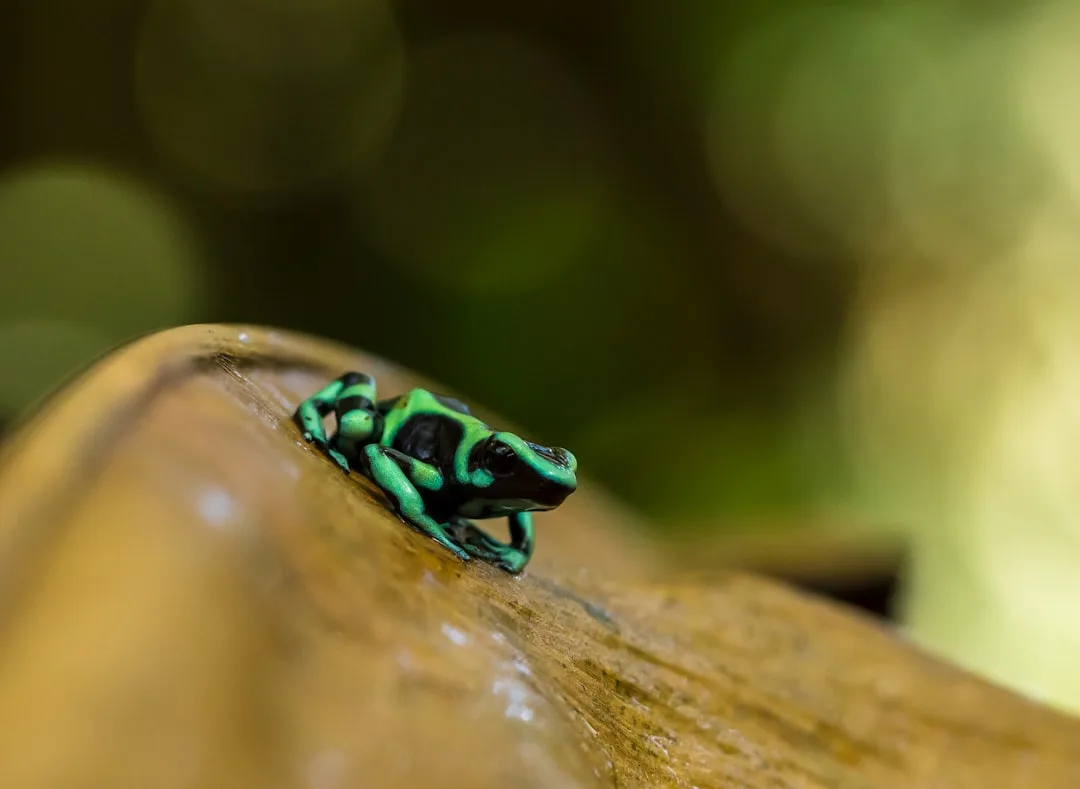
The poison dart frog is the common name for members of family Dendrobatidae, a group of roughly 180 species of small, brightly coloured, day-active amphibians endemic to the tropical forests of Central and South America.
The group is biologically remarkable on almost every axis: it contains the most toxic vertebrate ever measured, it includes species whose colours vary between valleys along a single mountain range, and it features parental behaviour so elaborate that some frogs appear to recognise their own tadpoles individually.
This guide treats the family as a whole but returns repeatedly to one species - Phyllobates terribilis, the golden poison frog - as the central case study. The golden poison frog is restricted to a narrow strip of Colombian rainforest, produces a skin toxin with no known antidote, and is the source of the poison used historically by Embera hunters to coat blowgun darts. It is also the reason the whole family became famous.
This is a reference entry, not a summary. Expect specifics: milligrams of toxin, metres of elevation, species counts, and verified records.
Etymology and Classification
The family name Dendrobatidae comes from the Greek dendro (tree) and bates (walker), reflecting the habit of many species to climb low vegetation and breed in water pools held by bromeliad leaves. The English common name 'poison dart frog' - sometimes 'poison arrow frog' - traces to indigenous hunting practice, explored later in this entry.
The genus name Phyllobates derives from Greek phyllo (leaf) and bates (walker or climber). The species epithet terribilis was coined by the herpetologist Charles Myers in 1978 to reflect the frog's extreme toxicity. Local Embera names include kokoi, a sound echoing the frog's call.
Dendrobatidae sits within order Anura - the frogs and toads - alongside hundreds of other frog families. Within Dendrobatidae the most toxic genera are Phyllobates (five species, three of which are used for dart poison) and Oophaga and Dendrobates, both of which contain dozens of vivid species. Less toxic genera such as Ranitomeya, Ameerega, and Adelphobates make up most of the family.
Taxonomic relationships inside Dendrobatidae have been revised repeatedly since the 1990s as molecular phylogenetics has reshaped the group. Many species previously in Dendrobates have been moved to Oophaga or Ranitomeya.
Size and Physical Description
Dendrobatids are small frogs. Across the family, snout-to-vent length ranges from roughly 10 mm (some Ranitomeya) to about 60 mm (large Phyllobates and Oophaga). The golden poison frog is among the largest members of the family.
Golden poison frog (P. terribilis):
- Length: 4.7-5.5 cm snout to vent
- Weight: approximately 3 g
- Colour: uniform bright yellow, orange, or mint green depending on population
- Build: stocky, smooth-skinned, short-legged
Family Dendrobatidae overall:
- Length: 1-6 cm
- Weight: 0.5-5 g
- Colour: almost every visible hue, with bold contrasting patterns on many species
- Sexual dimorphism: females slightly larger and bulkier in most species
Skin surface is smooth, not warty, and almost always glossy in living frogs. Under magnification the surface is studded with two categories of glands: mucous glands, which keep the skin moist, and granular glands, which store alkaloid toxins in specialised cells called dermal granular glands. In toxic species these glands are concentrated along the back, flanks, and legs - the regions most likely to encounter a predator's mouth.
Eyes are large and forward-facing, supporting binocular vision useful for prey capture. The tympanum (external eardrum) is visible behind each eye. Each foot bears four fingers at the front and five toes at the rear, tipped with expanded adhesive discs in climbing species and simple rounded pads in ground dwellers.
Toxicity: The Chemical Weapons of a 3-Gram Frog
Batrachotoxin, the signature alkaloid of Phyllobates terribilis, is the most potent non-peptide toxin known. By mass it is about 250 times more toxic than strychnine and roughly 15,000 times more toxic than curare.
Batrachotoxin specifications:
| Metric | Value |
|---|---|
| Chemical class | Steroidal alkaloid |
| LD50 (subcutaneous, mouse) | 2 micrograms per kilogram |
| Fatal dose for adult human | Estimated 100-150 micrograms |
| Amount per adult P. terribilis | Approximately 1,000 micrograms (1 mg) |
| Humans potentially killed | ~10 per frog |
| Mice potentially killed | ~20,000 per frog |
| Antidote | None known |
Batrachotoxin binds irreversibly to voltage-gated sodium channels in nerve and muscle cells. Normally these channels open and close in millisecond cycles to transmit electrical signals. With batrachotoxin bound, the channels lock open, sodium floods the cell, and depolarisation becomes permanent. The result is immediate loss of nerve and muscle function.
Paralysis, arrhythmia, and cardiac arrest follow within minutes of sufficient exposure. The molecule is dangerous even through intact skin contact in the microgram range.
Not every dart frog is dangerous to humans. Toxicity varies enormously across the family:
- Phyllobates terribilis: most toxic vertebrate known
- P. bicolor and P. aurotaenia: roughly 20 times less toxic than P. terribilis but still dart-poison grade
- Oophaga and Dendrobates: toxic enough to cause severe symptoms in humans, rarely fatal
- Ranitomeya, Adelphobates: mildly toxic, unpleasant but survivable
A critical detail: dart frogs do not synthesise these compounds. They sequester them. The precursors come from a specific dietary mix of alkaloid-bearing arthropods - certain ants (especially small myrmicine and formicine species), oribatid mites, melyrid beetles, and a handful of millipedes.
Captive frogs raised on commercial fruit flies and crickets have no source for these precursors and lose detectable toxicity within weeks. This has been demonstrated repeatedly in controlled feeding studies and is why pet-trade dart frogs are safe to handle.
Aposematic Colouring
The eye-searing colours of dart frogs serve a single evolutionary function: warning. Aposematic signalling works because visually hunting predators - snakes, birds, small mammals - learn fast. A naive predator attacks one dart frog, experiences bitter taste, nausea, or paralysis, and avoids anything similarly coloured thereafter. Natural selection then rewards the boldest, brightest individuals because they are attacked least.
Representative warning colour schemes:
- Bright yellow to orange - Phyllobates terribilis
- Green and black - Dendrobates auratus
- Blue with black spots - Dendrobates tinctorius (the 'blue poison frog')
- Red with blue legs - Oophaga pumilio (Panamanian strawberry morph)
- Metallic green - Epipedobates tricolor
Local colour variation in dart frogs is extreme. The strawberry poison frog (Oophaga pumilio) alone displays more than 15 distinct morphs across the Bocas del Toro archipelago of Panama - an area smaller than the US state of Connecticut. One island's frogs are solid red, another's are blue and black, another's are bright green.
This diversification appears to be driven by a combination of genetic drift on small islands, differences in local predator communities, and sexual selection by females who prefer males matching the local 'correct' colour.
Some dart frog species participate in Mullerian mimicry rings, where several toxic species within the same habitat converge on similar colour patterns. Shared patterns accelerate predator learning - a predator that samples one species avoids all of them. Mullerian mimicry has been documented between Ranitomeya species in Peru and between Dendrobates species in Colombia.
Diet
Dart frogs are diurnal insectivores. Hunting takes place during the warm, wet hours of the rainforest day, when small arthropods are active on the forest floor and lower vegetation. Capture is by sit-and-wait ambush: the frog sights a moving prey item, orients its body, and flicks out its sticky tongue in a fraction of a second.
Typical prey items (wild):
- Ants (the dominant prey in most species; essential for toxin sequestration)
- Oribatid mites
- Springtails
- Small beetles (especially melyrids)
- Termites
- Fruit flies and other dipterans
- Tiny spiders
Wild dart frogs may consume several hundred prey items per day, with ants making up over half the diet in many species. Gut-content studies of P. terribilis have shown that a narrow subset of small ants supplies most of the batrachotoxin precursors.
Captive diets rely almost entirely on Drosophila fruit flies (two cultured species, the wingless D. melanogaster and the larger flightless D. hydei), plus springtails, pinhead crickets, bean weevils, and isopods. These feeder insects lack the alkaloid chemistry of wild prey, which is why captive dart frogs lose their toxicity.
Reproduction and Parental Care
Dart frog reproduction is elaborate and tightly bound to the rainforest canopy. Most species breed year-round in the consistently wet tropics, with peaks during rainy seasons.
Typical breeding sequence (generalised):
- Males call from elevated perches - a quiet trill or buzz, quite unlike the loud calls of many other frogs.
- A receptive female follows the calling male to a moist leaf, bark crevice, or shallow depression.
- The pair performs a courtship that may include stroking, chasing, and careful orientation on the egg-laying surface.
- The female deposits 2 to 40 gelatinous eggs. Clutch size depends on species.
- The male fertilises the clutch externally.
- One parent, usually the male, guards the clutch for 10 to 20 days, returning to moisten the eggs with urine or by carrying water in the cloaca.
- Tadpoles hatch as small black larvae roughly 5 mm long.
- The guarding parent backs into the hatching mass. Tadpoles wriggle onto the adult's damp skin and attach. A parent may carry 1 to 30 tadpoles on its back at one time.
- The parent climbs into the understorey or canopy and deposits tadpoles, usually one per site, into water-filled bromeliads, tree holes, bamboo stumps, or other phytotelmata.
- Depending on species, one or both parents continue to visit each tadpole pool. Oophaga females lay unfertilised trophic eggs to feed their tadpoles.
This tadpole-transport behaviour places enormous cognitive demand on small-brained amphibians. Field studies have shown that adults remember the exact locations of multiple pools containing their own tadpoles, revisit them at precise intervals, and deposit food only in pools containing their own young. In strawberry poison frogs this appears to include individual recognition of offspring, an ability once thought restricted to birds and mammals.
Tadpole development takes 6-12 weeks depending on temperature and food availability. Metamorphosed froglets emerge fully coloured in most species, toxin-free until they start eating wild alkaloid prey.
Habitat and Range
Family Dendrobatidae is restricted to the New World tropics. The family's geographic range runs from southern Nicaragua through Costa Rica, Panama, Colombia, Venezuela, the Guianas, Ecuador, Peru, Bolivia, and western Brazil. No dart frogs occur naturally in the Old World, on any island outside the American tropics, or at high elevations above roughly 2,000 m.
Habitat preferences:
| Habitat type | Use |
|---|---|
| Primary rainforest leaf litter | Foraging, calling, egg laying |
| Understorey vegetation | Male calling perches, refuge |
| Bromeliad tanks | Tadpole rearing |
| Tree holes, bamboo stumps | Tadpole rearing |
| Stream margins | Some Ameerega species only |
| Secondary forest, plantations | Limited use, species-dependent |
Golden poison frogs occupy a particularly narrow range - only the rainforest lowlands of the Choco department on Colombia's Pacific coast, one of the wettest regions on Earth with annual rainfall exceeding 5,000 mm. Within that region the species prefers the damp leaf litter of primary forest at elevations below 200 m.
Most dart frogs require stable humidity above 80%, daytime temperatures between 22 and 27 degrees Celsius, and a reliable supply of small arthropod prey. They are highly sensitive to habitat disturbance, pesticide drift, and changes to microclimate.
Populations and Conservation Status
The IUCN Red List evaluates dart frogs species by species, and results are scattered across categories from Least Concern to Critically Endangered. Several patterns emerge:
- Species with small geographic ranges (single valleys, small island archipelagos) are disproportionately threatened.
- Species at higher elevation are more threatened because montane cloud forest is being cleared faster than lowland forest in many countries.
- Species popular in the pet trade have been over-collected historically, although regulation and captive breeding have eased this pressure.
- Species in regions dominated by coca cultivation, gold mining, or large-scale logging face concentrated habitat loss.
Primary threats:
- Habitat loss. Deforestation in the Choco, the upper Amazon basin, and the Ecuadoran foothills removes the narrow forest bands that many species depend on. Conversion to pasture, palm plantations, coca fields, and open-pit gold mines is difficult to reverse.
- Chytrid fungus. Batrachochytrium dendrobatidis is a skin pathogen that has caused catastrophic declines in amphibians worldwide since the 1990s. Dart frogs in high-humidity cloud forest appear particularly vulnerable.
- Pet trade. Smuggled wild-caught specimens still reach international markets despite CITES regulation. Responsible keepers today buy captive-bred stock.
- Pollution. Dart frogs breathe partly through their skin and are acutely sensitive to agrochemical runoff, mercury contamination from artisanal gold mining, and petroleum pollution from extraction operations.
- Climate shifts. Changes to rainfall patterns destabilise bromeliad water tanks and other microhabitats required for tadpole rearing.
The golden poison frog (P. terribilis) is listed as Endangered. Its total global range covers roughly 100 square kilometres. Local conservation efforts led by Colombian NGOs and Embera communities include land purchase, sustainable cacao farming, and ecotourism.
Poison Dart Frogs and Humans
The relationship between dart frogs and people is ancient. The Embera Choco, Noanama, and neighbouring peoples of western Colombia have used Phyllobates toxins to coat blowgun darts for at least several centuries and probably much longer.
The method is practical and precise: a hunter pins a living frog with a stick or threads a sharpened skewer through the mouth, then rubs the tip of each dart along the frog's moist back. The dart tips yellow visibly as toxin transfers to the wood. A single golden poison frog can dose 30 to 50 darts. Potency on the darts remains lethal to small monkeys and birds for up to two years.
Only three dart frog species - P. terribilis, P. bicolor, and P. aurotaenia - have been documented in dart poison use. The remaining roughly 177 species of the family are toxic to varying degrees but have never been used this way, either because their toxins are insufficiently lethal, because they are too small to yield enough toxin, or simply because they do not occur where dart-blowgun hunting was practised.
Scientific interest in dart frog toxins exploded in the 1960s and 1970s, after John W. Daly of the US National Institutes of Health began systematically extracting alkaloids from wild-caught specimens. Daly and colleagues eventually catalogued more than 800 distinct alkaloids from dendrobatid skin. The most famous discovery was epibatidine, isolated in 1992 from Epipedobates tricolor.
Epibatidine binds to nicotinic acetylcholine receptors and produces pain relief roughly 200 times more potent than morphine, without acting through opioid pathways. Unfortunately the therapeutic window is so narrow that no direct clinical use proved safe. Pharmaceutical analogues such as tebanicline reached clinical trials for chronic pain but were discontinued because of cardiovascular side effects.
Research on dart frog alkaloids continues as a source of molecular scaffolds for drug design and as a tool in neuroscience.
In the pet trade, dart frogs have become a significant hobbyist specialty since the 1980s. Responsible keeping relies on captive-bred animals, bioactive vivariums that simulate rainforest microclimates, and careful temperature and humidity control. Because captive dart frogs lose their toxicity on insect feeder diets, handling is physically safe - although routine handling still stresses the frogs and is discouraged.
Related Reading
- Dart Frogs of the Choco: Biology, Toxicity, and Conservation
- How Amphibians Breathe Through Their Skin
- Frogs of the World: Diversity, Biology, and Strangeness
- Chytrid Fungus and the Global Amphibian Crisis
References
Relevant peer-reviewed sources consulted for this entry include IUCN Red List assessments for individual Dendrobatidae species (2022, 2023, 2024), John W. Daly and colleagues' alkaloid catalogue papers in Journal of Natural Products and Toxicon, Charles W.
Myers and Daly's original 1978 description of Phyllobates terribilis in the Bulletin of the American Museum of Natural History, and published research in Proceedings of the National Academy of Sciences, Evolution, Herpetologica, and Journal of Chemical Ecology. Toxicity values follow Daly et al. and subsequent confirmatory studies. Range and morph data follow Summers and Amezquita et al. on Oophaga and Ranitomeya.
Frequently Asked Questions
How toxic is the golden poison frog?
The golden poison frog (Phyllobates terribilis) is the most toxic vertebrate known to science. An adult carries roughly 1 mg of batrachotoxin in its skin - enough to kill 10 adult humans or 20,000 mice. Batrachotoxin is a steroidal alkaloid that locks sodium channels permanently open, causing paralysis, cardiac arrest, and death within minutes. Contact with broken skin or mucous membranes can be fatal, and there is no known antidote.
Batrachotoxin is roughly 100 times more toxic than any other alkaloid found in the genus Phyllobates and about 15,000 times more toxic than the same dose of curare.
Where do poison dart frogs live?
Family Dendrobatidae is restricted to the New World tropics - the rainforests of Central and South America from Nicaragua south through Colombia, Ecuador, Peru, Bolivia, Venezuela, the Guianas, and western Brazil. The golden poison frog specifically lives only in a small section of rainforest along the Pacific coast of Colombia, in the Choco department, where annual rainfall exceeds 5,000 mm.
Most dart frogs inhabit the leaf litter of the forest floor, although several climb into the understorey to breed in bromeliads. They require consistently humid, shaded conditions and narrow temperature ranges between 22 and 27 degrees Celsius.
Why are poison dart frogs so brightly coloured?
Their colours are a textbook example of aposematism - warning signalling. Bright yellow, orange, red, blue, and green patterns advertise toxicity to visually hunting predators such as snakes and birds. Once a naive predator tastes a dart frog and survives, it learns to avoid any similarly coloured frog for life.
Evolution amplifies this over generations: the brightest, boldest-coloured frogs are attacked least, so those colours spread through the population. Multiple dart frog species in overlapping ranges often converge on the same colour scheme - a pattern called Mullerian mimicry - because sharing a warning signal reinforces predator learning for every species involved.
Why do captive-raised poison dart frogs lose their toxicity?
Poison dart frogs do not synthesise their own toxins. They sequester alkaloid compounds from prey - specifically, from a narrow subset of ants (especially Solenopsis and Brachymyrmex), oribatid mites, melyrid beetles, and certain millipedes. The frogs absorb these alkaloids through the gut wall, store them in granular skin glands, and can maintain toxicity indefinitely on a wild diet.
Captive frogs fed fruit flies, crickets, and other commercial feeder insects never encounter these alkaloid sources. Within a few weeks their skin toxicity drops to undetectable levels. This is why pet-trade dart frogs are completely safe to handle while wild ones can be lethal.
How do poison dart frogs care for their young?
Parental care in Dendrobatidae is among the most elaborate of any amphibian family. Females lay 2 to 40 eggs on damp leaf litter. Males guard and moisten the clutch, urinating on the eggs during dry spells. When tadpoles hatch, the parent - usually the male in Phyllobates and Dendrobates, usually the female in Oophaga - backs into the clutch and allows the tadpoles to wriggle onto its damp skin.
The adult then climbs into the canopy and deposits the tadpoles one at a time into individual pools of water held in bromeliad leaves, tree holes, or bamboo stumps. Strawberry poison frog (Oophaga pumilio) mothers return to each pool every few days and lay unfertilised trophic eggs as food for their own tadpole - a level of individual offspring recognition rare in amphibians.
Why are they called dart frogs?
The name comes from the Embera Choco, Noanama, and related indigenous peoples of western Colombia, who for centuries coated the tips of blowgun darts with poison from three Phyllobates species - most famously the golden poison frog. A hunter would pin a living frog to the ground with a stick or skewer, then rub the dart tip along the frog’s back until the tip glistened with skin secretions.
A single frog could dose 30 to 50 darts, and the poison remained lethal for up to two years. Only three dart frog species have ever been documented as being used this way. The remaining roughly 177 species in Dendrobatidae are poisonous but have never been used for hunting.
Are poison dart frogs endangered?
Conservation status varies sharply by species. The IUCN Red List includes dart frog species in every category from Least Concern to Critically Endangered. The golden poison frog is listed as Endangered because its entire global range covers only about 100 square kilometres of Colombian rainforest that is under pressure from logging, gold mining, and illegal coca cultivation.
Across the family, the two largest threats are habitat loss and chytrid fungus (Batrachochytrium dendrobatidis), a skin pathogen that has devastated amphibians worldwide. Illegal collection for the international pet trade also remains a problem, although most dart frogs sold legally today are captive-bred.
Can poison dart frog toxins be used as medicine?
Yes, with caveats. The most significant discovery is epibatidine, isolated in 1992 from the Ecuadoran dart frog Epipedobates tricolor. Epibatidine binds to nicotinic acetylcholine receptors and produces analgesia roughly 200 times more potent than morphine without triggering opioid dependence. Unfortunately it is too toxic at analgesic doses for clinical use in humans - the therapeutic window is effectively zero.
Pharmaceutical companies have since designed non-toxic analogues (such as tebanicline) that reached clinical trials but did not reach market. Dart frog alkaloids continue to be valuable tools in neuroscience research on ion channels and pain pathways, and several remain under active study as drug-design scaffolds.