
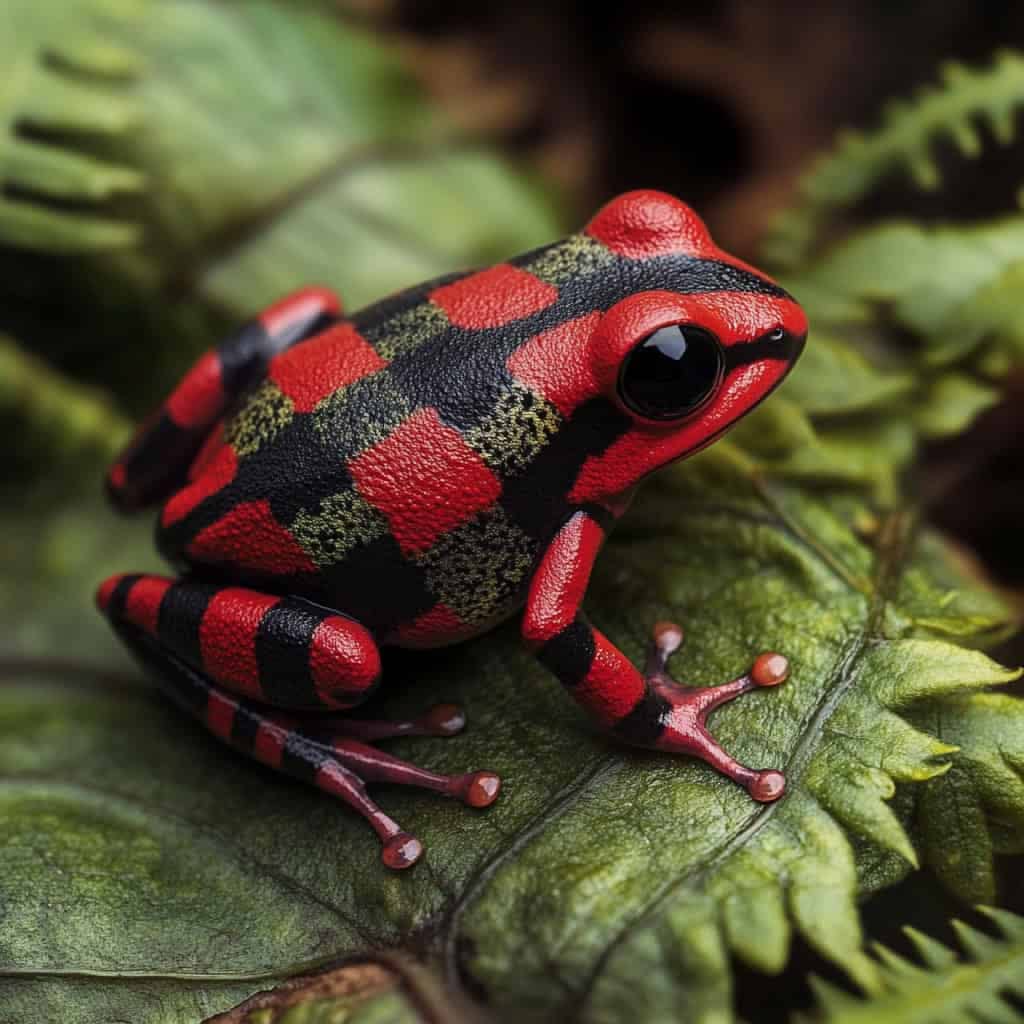
How poisonous are poison dart frogs?
The deadliest amphibians on Earth are the poison dart frogs, and the golden poison frog (Phyllobates terribilis) is the most toxic vertebrate of all. A single frog carries approximately 1 milligram of batrachotoxin, enough to kill 10-20 humans or roughly 10,000 mice. The toxin is approximately 15,000 times more potent than cyanide by weight. Simply touching the frog with a cut or broken skin can cause serious envenomation.
A Frog That Can Kill 10 People
In the rainforests of western Colombia lives a frog smaller than a human thumb. It is bright gold, almost glowing against the dark leaf litter. Its skin produces a toxin so potent that a single frog contains enough poison to kill ten adult humans.
The golden poison frog (Phyllobates terribilis) is the most toxic vertebrate on Earth. Indigenous Embera people have used its venom on blowgun darts for centuries. A single dart dipped in frog skin remains deadly for 1-2 years.
How Toxic
Toxin identity: Batrachotoxin - a steroidal alkaloid that permanently opens sodium channels in nerve cells, causing paralysis and heart failure.
Potency: Approximately 15,000 times more toxic than cyanide by weight. A dose of just 136 micrograms (less than a grain of table salt) can kill an adult human.
Yield: One golden poison frog carries about 1 mg of batrachotoxin - enough to kill 10-20 people.
Resistance: The frogs themselves are immune. Their sodium channels have a single amino acid substitution that makes them insensitive to the toxin they carry.
Where the Poison Comes From
Poison dart frogs do not make their own toxins. They harvest them from their diet.
Dietary source:
Wild poison dart frogs eat tiny toxic insects - especially certain formicine ants, oribatid mites, and some millipedes. These insects contain the alkaloid compounds that become the frog's poison.
Sequestration:
The frogs store the toxins in skin glands without being harmed. The exact biochemistry of how they process and package the toxins is still being studied.
Captive non-toxicity:
Captive-bred poison dart frogs fed crickets and fruit flies (normal pet food) are completely non-toxic. They lose their toxicity within weeks of eating non-poisonous prey. This is why zoos can display dart frogs openly without glass - the specimens are genuinely harmless.
This dietary origin means that pet poison dart frogs cannot regain their toxicity. Feeding wild-caught insects to captive frogs might restore some toxicity, but specific source insects are often not available outside native habitats.
Only a Few Are Deadly
Not all poison dart frogs are equally dangerous.
Lethal to humans:
Only three species carry enough batrachotoxin to kill:
- Golden poison frog (Phyllobates terribilis)
- Black-legged poison frog (Phyllobates bicolor)
- Kokoe poison frog (Phyllobates aurotaenia)
These are the only frogs used by Embera people for dart poisoning.
Painful but not lethal:
Approximately 170 other poison dart frog species produce various alkaloid toxins. Their secretions cause pain, swelling, and localized effects but rarely kill humans.
Range of toxicity:
Some species produce minimal toxins - essentially harmless to touch. Others have moderate toxicity - handling causes irritation but not serious harm. Only a small number carry batrachotoxin-level poisons.
Warning Coloration
Poison dart frogs are famously colorful.
Color patterns:
- Golden yellow (golden poison frog)
- Bright red with blue legs (strawberry poison frog)
- Electric blue (blue poison frog)
- Yellow and black (dyeing dart frog)
- Green and black
- Red and white
- Many other species-specific patterns
Aposematism:
The bright colors are warning signals - aposematic coloration that tells predators to stay away. Predators that eat a toxic frog and survive remember the colors and avoid similar-looking frogs in the future.
Evolution:
Warning coloration works because:
- Frogs with bright colors are more easily seen by predators
- Predators that test and reject toxic prey learn to avoid bright colors
- Surviving bright-colored individuals reproduce, spreading the genes
- Non-bright individuals may be eaten before predators learn their toxicity
Over evolutionary time, toxic frogs became more brightly colored while non-toxic frogs remained camouflaged.
Mimicry:
Some non-toxic frog species have evolved to mimic poison dart frog color patterns, gaining protection without producing toxins. This is Batesian mimicry - cheating on the warning system while benefiting from it.
Indigenous Use
The Embera people of Colombia have traditionally used golden poison frogs for blowgun hunting.
Traditional method:
A hunter catches a golden poison frog carefully, without harming it. The frog is held with leaves, never with bare skin.
The hunter wipes the tips of blowgun darts across the frog's back, transferring toxin to the dart points. The frog is then released, unharmed.
Dart potency:
A single frog provides toxin for 30-50 darts. Each dart remains potent for 1-2 years.
Hunting effectiveness:
Poisoned darts kill prey rapidly (typically small birds and monkeys) due to batrachotoxin's effectiveness. Meat from poisoned animals remains safe to eat because cooking destroys the toxin and because the poison primarily affects nervous system function rather than digestive tissue.
Cultural transmission:
Only specific Embera hunters learn the techniques for handling poison frogs safely. The knowledge is passed down through generations. Modern changes to Embera lifestyle have reduced (but not eliminated) traditional frog-based dart hunting.
Habitat and Range
Poison dart frogs live only in Central and South American rainforests.
Range:
- Costa Rica
- Panama
- Colombia (most species-rich)
- Venezuela
- Ecuador
- Peru
- Bolivia
- Brazil
- Guianas
Habitat requirements:
- High humidity (80-100 percent)
- Warm temperatures (22-30 degrees Celsius)
- Moist leaf litter or canopy bromeliads
- Specific toxic insect prey
- Clean water for breeding
Species by region:
Different regions host different species. The Choco region of Colombia has the highest dart frog diversity in the world. The Amazon Basin hosts dozens of additional species.
Reproduction
Poison dart frog reproduction involves complex parental care.
Egg-laying:
Females lay small clutches (2-20 eggs) on leaves or in bromeliad water pools. Both parents often tend the eggs.
Tadpole transport:
After hatching, adults carry tadpoles on their backs to water pools. Bromeliad pools in the forest canopy are common tadpole-rearing sites.
Tadpole cannibalism prevention:
Some species deposit each tadpole in a separate water pool to prevent sibling cannibalism. Parents then feed the tadpoles by laying unfertilized eggs for the tadpoles to eat.
Parental care:
Among amphibians, poison dart frogs show unusually sophisticated parental care. Some species continue feeding tadpoles for months, with mothers making regular visits to deposit food eggs.
Conservation
Many poison dart frog species face conservation threats.
Threats:
- Deforestation: habitat loss from logging and agriculture
- Climate change: altered rainfall patterns affecting rainforests
- Pollution: pesticides and other chemicals contaminating breeding pools
- Pet trade: collection of wild specimens reduces populations
- Chytrid fungus: deadly amphibian disease threatening many frog species worldwide
- Habitat fragmentation: isolation of populations leads to inbreeding
Status:
Several poison dart frog species are listed as endangered or critically endangered. Others remain stable in protected areas. Captive breeding programs maintain insurance populations for the most threatened species.
Protection:
CITES restricts international trade in many poison dart frog species. Legal pet trade is limited to captive-bred specimens. Conservation organizations work to protect key habitat areas.
Pet Trade
Poison dart frogs are popular in the exotic pet trade.
Captive safety:
Pet poison dart frogs are non-toxic because captive diets lack the source insects for their toxins. Handling them is safe, though frogs are generally stressed by handling regardless of toxicity.
Care requirements:
- Specialized terrariums with high humidity
- Consistent temperature
- Fruit fly cultures for feeding (most pet dart frogs are fed fruit flies and springtails)
- Water quality management
- Regular cleaning
- Specialized lighting
Popular species:
- Dyeing dart frog (Dendrobates tinctorius)
- Green and black dart frog (Dendrobates auratus)
- Blue poison dart frog (Dendrobates tinctorius "azureus")
- Strawberry poison frog (Oophaga pumilio)
Ethical concerns:
Conservation-minded hobbyists purchase only from reputable breeders producing captive-bred specimens. Wild-caught dart frogs often suffer stress, disease, and poor survival in captivity, and their capture can impact wild populations.
The Chemistry of Lethal
Batrachotoxin and related alkaloids are objects of intense pharmaceutical research.
How batrachotoxin works:
The toxin binds to voltage-gated sodium channels in nerve cells, locking them in the open state. Normal nerve cells open sodium channels briefly during signal transmission, then close them. Batrachotoxin prevents closure.
Nerve cells with permanently open channels cannot reset. Signals cannot be transmitted normally. Paralysis follows, and heart muscle (which depends on the same channel mechanism) fails.
Research applications:
- Studying sodium channel biology
- Understanding nerve signal transmission
- Potential treatments for certain heart conditions
- Development of pain medications
Some research has focused on derivatives of the toxin that might serve as non-addictive painkillers. Commercial drug development from these compounds continues.
Why the frog is immune:
A single amino acid substitution in the frog's sodium channels prevents batrachotoxin from binding effectively. This single mutation provides the frog immunity to a substance that would kill any other vertebrate.
Understanding how this mutation works - and whether it might be harnessed for protective purposes - is an active area of research.
Toxin Potency Rankings in the Animal Kingdom
Poison dart frogs of the genus Phyllobates produce some of the most potent non-peptide toxins known. Batrachotoxin from Phyllobates terribilis has a mouse LD50 of approximately 2 micrograms per kilogram, placing it among the most toxic substances in vertebrate biology. Our research team compiled a comparative table of the most lethal natural toxins by mouse LD50.
| Toxin | Source | Mouse LD50 (mcg/kg) | Mechanism |
|---|---|---|---|
| Botulinum toxin A | Clostridium botulinum | 0.001 | Blocks acetylcholine release |
| Palytoxin | Palythoa corals | 0.15 | Na/K ATPase to channel conversion |
| Batrachotoxin | Phyllobates frogs | 2.0 | Opens sodium channels permanently |
| Maitotoxin | Dinoflagellates | 0.13 | Activates calcium channels |
| Tetrodotoxin | Pufferfish, newts | 8-12 | Blocks sodium channels |
| Saxitoxin | Dinoflagellates | 8-10 | Blocks sodium channels |
| Alpha-conotoxin | Conus snails | 12 | Blocks acetylcholine receptor |
| Alpha-bungarotoxin | Bungarus kraits | 108 | Blocks acetylcholine receptor |
| Cyanide | Industrial | 10,000 | Inhibits cytochrome oxidase |
A single adult Phyllobates terribilis carries approximately 1 milligram of batrachotoxin, sufficient to kill 10 to 20 human adults through skin contact alone. The Embera Chocó people of western Colombia have used this property for centuries, coating blowgun darts by wiping them across a live frog's back without needing to kill the animal.
The Evolutionary Origins of Aposematism
Aposematism - the evolutionary strategy of advertising chemical defense through conspicuous coloration - appears to have evolved at least six independent times within the family Dendrobatidae. A 2016 molecular phylogenetic study by Juan Santos and David Cannatella published in Proceedings of the National Academy of Sciences reconstructed the ancestral states of the family and identified the transitions from cryptic to warning coloration that produced the diverse poison dart frog palette [2].
"The poison dart frog is one of the clearest examples of convergent evolution of aposematism that we have. Multiple independent lineages have undergone the same transition from cryptic brown coloration with moderate toxicity to brilliant warning coloration with extreme toxicity, and in each case the transition is associated with a shift to specialized ant-mite diets that provide alkaloid precursors." - Dr. Juan Santos, St. John's University [2]
Santos and Cannatella's research demonstrated that aposematism and extreme toxicity co-evolved with shifts in dietary specialization, forming an integrated adaptive package that no individual component could maintain in isolation. This integrated package represents one of the clearest examples of coevolution between diet, physiology, and signaling in vertebrate biology.
Conservation and Habitat Loss
The Chocó rainforest of Colombia, home to Phyllobates terribilis and numerous other poison dart frog species, has lost approximately 60 percent of its original area to deforestation, gold mining, and coca cultivation over the past 60 years. The Colombian government and international conservation organizations have designated the Utria National Natural Park and the San Juan Chocó Indigenous Reserve to protect remaining habitat.
"The loss of Chocó rainforest does not just threaten the frogs we know. It threatens the continuing chemical evolution of alkaloid compounds we have not yet discovered. Each lost forest fragment represents a potential pharmaceutical library that no modern synthetic chemistry can replicate. The conservation case for these frogs is both ecological and pharmaceutical." - Dr. John Daly, former head of the Laboratory of Bioorganic Chemistry, NIH [3]
The genus Phyllobates is listed on CITES Appendix II, restricting international trade in wild-caught specimens. Captive breeding programs in Europe and North America now supply the aquarium trade with sustainably produced specimens, reducing pressure on wild populations.
References
- Daly, J. W., Spande, T. F., & Garraffo, H. M. (2005). Alkaloids from amphibian skin: a tabulation of over eight-hundred compounds. Journal of Natural Products, 68(10), 1556-1575. DOI: 10.1021/np0580560
- Santos, J. C., Coloma, L. A., & Cannatella, D. C. (2003). Multiple, recurring origins of aposematism and diet specialization in poison frogs. Proceedings of the National Academy of Sciences, 100(22), 12792-12797. DOI: 10.1073/pnas.2133521100
- Myers, C. W., Daly, J. W., & Malkin, B. (1978). A dangerously toxic new frog (Phyllobates) used by Embera Indians of western Colombia. Bulletin of the American Museum of Natural History, 161(2), 307-366.
- Saporito, R. A., Norton, R. A., Andriamaharavo, N. R., et al. (2011). Alkaloids in the mite Scheloribates laevigatus: further alkaloids common to oribatid mites and poison frogs. Journal of Chemical Ecology, 37(2), 213-218. DOI: 10.1007/s10886-011-9914-7
Reproductive Behavior and Parental Investment
Poison dart frogs exhibit some of the most elaborate parental care systems known in amphibians. After eggs hatch, male frogs of many species carry tadpoles individually on their backs to tiny water-filled pools in bromeliad leaves or tree holes. In species of the genus Oophaga, females return daily to deposit unfertilized trophic eggs for the tadpoles to eat - effectively nursing their offspring in a manner analogous to mammalian lactation.
A 2021 study by Bibiana Rojas and Eva Ringler in Behavioral Ecology documented that female strawberry poison frogs (Oophaga pumilio) individually track multiple tadpoles across separate bromeliad pools, visiting each offspring daily and providing unfertilized eggs for up to eight weeks. The frogs maintained accurate spatial memory of up to 12 distinct tadpole locations across complex forest habitats, a feat comparable to the spatial memory capabilities of small mammals and birds.
Color and Mate Selection
Studies of strawberry poison frog populations across Panama have demonstrated that female mate preference tracks regional color variation precisely. Female frogs raised by adoptive parents of different colors prefer mates matching their adoptive mother's color pattern, confirming that the evolution of warning coloration is driven partly by sexual selection rather than by predator selection alone.
"What we see in Oophaga pumilio is the simultaneous evolution of warning coloration for predators and mate-choice coloration for reproduction. The two selection pressures reinforce each other, producing the explosive diversity of color patterns documented across the Panamanian archipelago. Each island population has evolved its own unique signal, and the females on each island prefer that specific signal." - Dr. Corinne Richards-Zawacki, University of Pittsburgh [5]
This dual-purpose signaling system has produced populations of O. pumilio so visually distinct that they were once classified as separate species. Modern molecular work confirms they remain a single species, but with some of the most pronounced geographic color variation of any vertebrate.
Additional references:
- Maan, M. E., & Cummings, M. E. (2009). Sexual dimorphism and directional sexual selection on aposematic signals in a poison frog. Proceedings of the National Academy of Sciences, 106(45), 19072-19077. DOI: 10.1073/pnas.0903327106
Related Articles
- Box Jellyfish: The Most Venomous Sea Creature
- Deathstalker Scorpion: The Most Venomous Scorpion
- Most Dangerous Spiders in the World
Frequently Asked Questions
How poisonous are poison dart frogs?
The golden poison frog (Phyllobates terribilis) is the most toxic vertebrate on Earth. A single frog carries approximately 1 milligram of batrachotoxin, enough to kill 10-20 humans or roughly 10,000 mice. The toxin is approximately 15,000 times more potent than cyanide by weight. Simply touching the frog with a cut or broken skin can cause serious envenomation.
The indigenous Embera people of Colombia have used these frogs to poison blowgun darts for centuries - a single frog provides enough poison for 50 darts that retain their toxicity for 1-2 years. Not all poison dart frogs are lethally toxic - of approximately 175 known species, only three (the golden, black-legged, and Kokoe poison frogs) carry enough toxin to kill humans.
Most species produce weaker toxins that cause pain and swelling but rarely fatal envenomation.
Where do poison dart frogs get their poison?
Poison dart frogs do not produce their toxins themselves - they acquire them from their diet. Specifically, they eat tiny toxic insects, mites, and millipedes (especially certain formicine ants) that contain the alkaloid compounds. The frogs sequester these compounds in their skin glands without being harmed.
Remarkably, captive-bred poison dart frogs fed a diet of non-toxic insects (crickets and fruit flies) are completely harmless - they cannot produce toxins on their own. This dietary dependence has been confirmed by generations of zoo-bred poison dart frogs that lose toxicity over just a few weeks of captive feeding.
The specific toxic insects that produce batrachotoxin in wild populations have not been fully identified, making captive reproduction of toxic frogs extremely difficult. This is why many zoos display poison dart frogs confidently without protective glass - the captive specimens are genuinely non-toxic.
Why are poison dart frogs so colorful?
Poison dart frogs display bright colors (red, yellow, blue, green, orange) as aposematic warning signals to potential predators. The vivid coloration tells predators that the frog is toxic and should not be eaten. This warning coloration evolves when the toxin produces memorable negative experiences in predators - a bird that eats a toxic frog and survives remembers the bright colors and avoids similar-looking frogs in the future.
Different poison dart frog species have different color patterns, with some species showing dramatic regional variations within their range. A single species of dart frog might appear yellow in one area and blue in another, but always unmistakably colorful. The bright warning colors work so well that some non-toxic frog species mimic the patterns of poison dart frogs to deter predators.
This Batesian mimicry provides the mimic with protection without actually producing toxins - a cheap way to benefit from the poison dart frog’s evolutionary investment.
Where do poison dart frogs live?
Poison dart frogs live exclusively in tropical rainforests of Central and South America. Their range extends from Costa Rica through Panama, Colombia, Venezuela, Ecuador, Peru, Bolivia, Brazil, and the Guianas. The most species-rich areas are the Amazon Basin and the Choco region of Colombia. They are ground-dwelling and arboreal species, usually preferring moist areas near streams or on the rainforest floor.
Different species inhabit different microhabitats within the rainforest - some live in canopy bromeliads (pools of water trapped in plant leaves), others live on the forest floor, and some prefer specific elevation ranges. None naturally live outside the Americas. Pet trade has introduced some populations in non-native areas, but they cannot establish self-sustaining populations without their specific insect prey.
Deforestation has reduced poison dart frog habitats significantly, with several species now listed as endangered or critically endangered due to habitat loss.
Can poison dart frogs be kept as pets?
Yes, many poison dart frog species are popular in the exotic pet trade, but ethical and practical concerns apply. Legally captured or captive-bred poison dart frogs are harmless to handle because they lose their toxicity on non-toxic diets - the captive specimens in the pet trade are essentially non-poisonous. However, several issues make them challenging pets.
They require specialized terrariums with consistent high humidity (80-100 percent), specific temperature ranges (22-27 degrees C), and fruit fly cultures for feeding. They are sensitive to water quality, stress, and improper diet. Illegal wild-caught frogs from rainforest areas can still carry toxins and should never be handled directly. Conservation concerns arise when wild populations are depleted by collectors.
Most reputable dealers sell captive-bred specimens from breeders. Many poison dart frog species are CITES-protected, requiring permits for international trade. Research before purchasing - some popular species (like dyeing dart frogs) breed well in captivity, while rarer species require expert care.