
Are glass frogs really transparent?
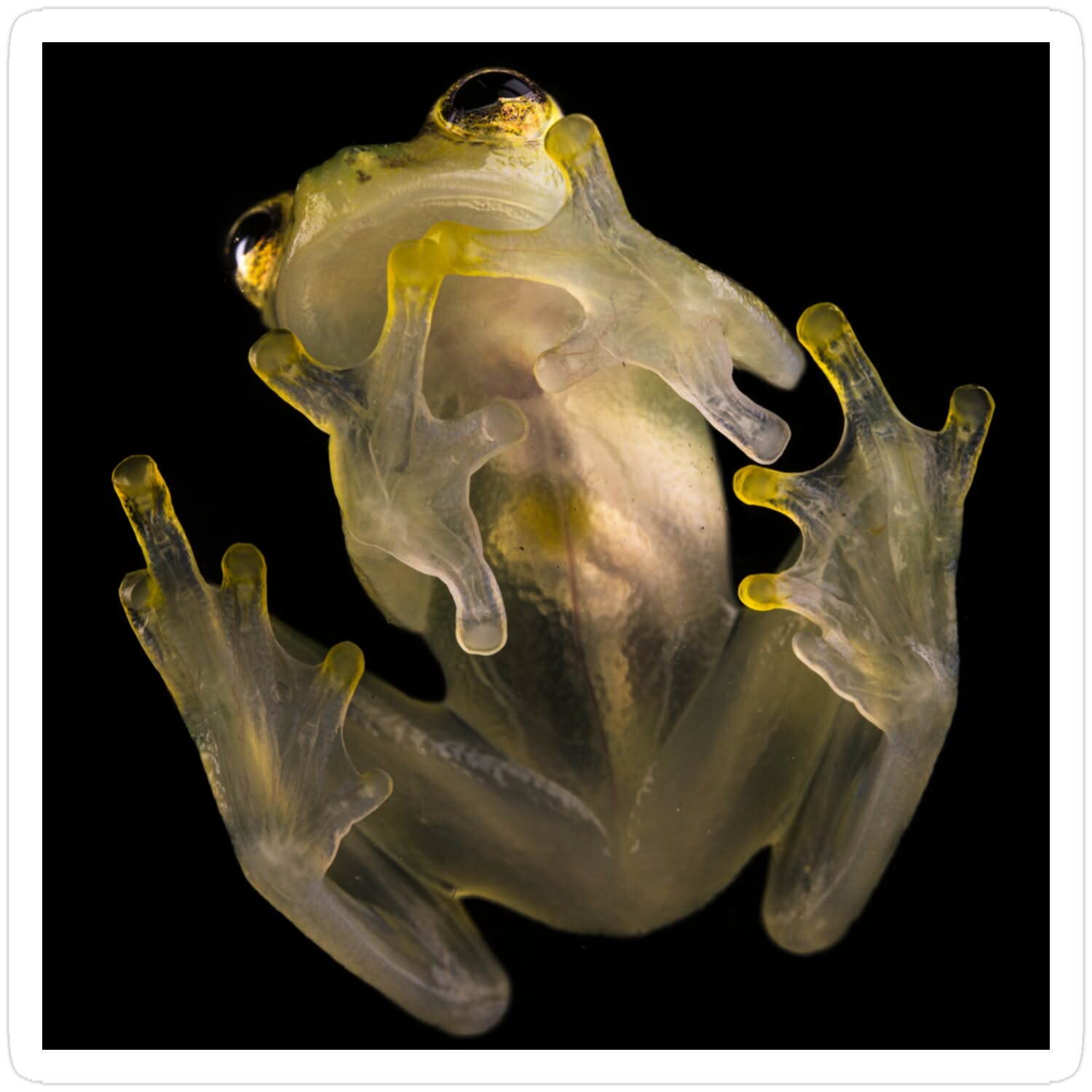
Yes, glass frogs (family Centrolenidae) have genuinely transparent bellies where their internal organs - heart, liver, intestines, and bones - are visible through the skin. The transparency is real, not just pale coloration. You can watch their hearts beating through their chest skin.
Watching a Heart Beat Through Skin
Hold a glass frog up to a light source and you can see its heart beating through its chest skin. Its intestines are visible. Its liver. Its bones. The frog is literally see-through on its underside.
This is not a fancy biological term for pale skin. Glass frogs (family Centrolenidae) have genuinely transparent tissue. They use this transparency for camouflage in tropical rainforests, hiding from predators that look up at leaves and see only filtered sunlight rather than the frog resting there.
Recent research has also revealed how they achieve this transparency, by packing nearly all their red blood cells into their liver during sleep, a biochemical trick that is currently being studied for potential medical applications in humans.
The Transparency
Glass frog transparency is most pronounced on the belly.
What's visible:
- Heart: beating visibly through chest skin
- Liver: especially visible when engorged with blood cells
- Intestines: winding through the lower body
- Bones: particularly ribs and spine
- Blood vessels: when blood cells are circulating
- Eggs (in females): when developing
What's not transparent:
- Back and upper body (typically bright green)
- Eyes (visible on top of head)
- Some species have slight coloration on limbs
Species variation:
Different glass frog species have different levels of transparency. Some have mostly-transparent bodies with visible organs throughout. Others are transparent only on the belly.
The most transparent species known is Hyalinobatrachium dianae, discovered in Costa Rica in 2015. It has nearly all-over transparency.
The Blood Cell Trick
How does a vertebrate with red blood cells achieve transparency?
The problem:
Red blood cells are, well, red. Blood vessels are typically the most opaque tissue in an animal body. An animal with normal blood circulation cannot be transparent, blood vessels would be dark lines visible everywhere.
The 2022 discovery:
Research published in Science (December 2022) by Carlos Taboada and colleagues revealed that glass frogs pack their red blood cells into their livers during sleep.
How it works:
- Active (night): red blood cells circulate normally, supporting metabolism
- Sleep (day): 89% of red blood cells are sequestered in the liver
- Liver during sleep: visibly engorged and dark red (you can see this through the frog's skin)
- Rest of body during sleep: dramatically more transparent because circulating blood is much clearer
The remarkable fact:
Packing blood cells at this density would kill most vertebrates. Blood clots would form rapidly, blocking circulation and causing tissue death.
Glass frogs have evolved biochemistry that prevents clotting even when cells are packed at extreme density in the liver. They then release the cells back into circulation at sunset without damage.
Medical implications:
If researchers can understand how glass frogs prevent clotting at high cell densities, the biochemistry might translate into treatments for:
- Deep vein thrombosis
- Stroke prevention
- Pulmonary embolism
- Post-surgical clot risks
This research is ongoing.
Why Transparency Works
Glass frog transparency is specifically adapted for their habitat.
The camouflage:
During daylight, glass frogs rest on the undersides of leaves. When viewed from below (where predators look up at them), the leaf is backlit by sunlight filtering through. A transparent frog's belly allows that filtered light to pass through, making the frog effectively invisible against the leaf.
Bi-directional camouflage:
- From below: transparency makes frog match backlit leaf
- From above: bright green back matches leaf surface
Both predator perspectives are covered by different mechanisms.
Why on leaves:
Glass frogs specifically choose leaves for daytime rest because the backlit-leaf environment optimizes their transparency camouflage. They rarely rest on tree trunks or rocks where transparency wouldn't help.
Predator avoidance:
Main glass frog predators include:
- Birds (especially flycatchers and vireos)
- Snakes (especially vine snakes)
- Large spiders
- Monkeys
All of these rely heavily on vision. Transparency directly thwarts visual predation.
Reproduction and Paternal Care
Glass frog reproduction involves unusual paternal care.
Breeding season:
During rainy season (varies by region, typically April-October). Males establish territories on leaves overhanging streams.
Male calls:
Males produce species-specific calls to attract females. Calls are subtle, often compared to the sound of tapping on glass.
Egg laying:
Females attach eggs to leaf surfaces, typically in clumps of 10-80 eggs. Eggs are placed above water so hatched tadpoles can drop into streams below.
Paternal protection:
In most glass frog species, males guard the eggs:
- Sit on or near the egg clutch for 1-2 weeks
- Keep eggs moist during dry periods
- Defend against predators (spiders, wasps, other frogs)
- May wrap their bodies around eggs for protection
- Sometimes guard multiple clutches from different females simultaneously
Cost to males:
Guarding males make significant sacrifices:
- Reduced feeding during guarding period
- Risk of dehydration
- Vulnerability to their own predators
- Reduced mating opportunities
This level of paternal investment is rare in frogs, most amphibian species have uninvolved or absent fathers.
Hatching:
When eggs are ready to hatch, tadpoles drop directly from the leaf into the stream below. This access to water is why glass frogs specifically choose stream-overhanging leaves.
Species Diversity
Over 150 species of glass frog exist.
Taxonomic structure:
Family Centrolenidae, divided into multiple genera including:
- Centrolene
- Cochranella
- Espadarana
- Hyalinobatrachium (includes the most transparent species)
- Nymphargus
- Teratohyla
Size range:
- Smallest: approximately 2 cm
- Largest: 8 cm
- Most species: 3-5 cm
Distribution hotspots:
- Choco region (Colombia/Ecuador): highest diversity
- Andes (Ecuador, Peru, Bolivia): many endemic species
- Central America (Costa Rica, Panama): well-studied populations
- Brazilian Amazon: still being inventoried
Where They Live
Glass frogs inhabit tropical rainforests of Central and South America.
Geographic range:
- Southern Mexico
- All of Central America
- Pacific coast of South America (Colombia, Ecuador, Peru)
- Amazon basin (Brazil, Colombia, Peru, Bolivia)
- Atlantic forest (Brazil, Venezuela)
- Guyanan highlands
Habitat specifics:
- Elevation: 200-3,000 meters (mostly mid-elevation)
- Forest type: humid montane rainforest preferred
- Vegetation: leaves overhanging streams (essential)
- Water: fast-flowing streams with clean water
- Climate: warm and humid year-round
Habitat specialists:
Some species live only in:
- Specific elevation bands
- Particular tree species' leaves
- Specific stream flow rates
- Particular canopy vs. understory layers
This specialization makes them vulnerable to habitat changes.
Discovery
Many glass frog species have been discovered relatively recently.
Notable discoveries:
- Hyalinobatrachium dianae (2015): most transparent species known, discovered in Costa Rica
- Hyalinobatrachium yaku (2017): Ecuadorian Amazon
- Multiple species described in 2019-2023 from previously unexplored cloud forests
Why recent discoveries:
Glass frog habitat is often remote and difficult to survey:
- Cloud forests on steep mountain slopes
- Areas with security concerns
- Regions with limited research infrastructure
- Canopy habitats requiring specialized climbing access
Researchers continue to discover new species, suggesting the total species count will exceed 200 once fully inventoried.
Conservation Status
Glass frogs face significant conservation challenges.
Current threats:
Habitat loss:
- Deforestation for agriculture (cattle, coffee, cacao)
- Logging (both legal and illegal)
- Road construction fragmenting habitat
- Mining operations
Climate change:
- Altered rainfall patterns affecting breeding
- Temperature changes pushing species to higher elevations
- Extreme weather events (droughts, storms)
- Cloud forest contraction
Chytrid fungus:
- Batrachochytrium dendrobatidis threatens amphibians worldwide
- Glass frogs particularly vulnerable
- Has caused regional population crashes
Illegal pet trade:
- Some species collected for exotic pet market
- Captive breeding difficult due to specific habitat requirements
Pollution:
- Agricultural runoff
- Pesticides from nearby farms
- Mercury from gold mining
Status summary:
- Approximately 20-30 glass frog species are listed as Endangered or Critically Endangered
- Many more are Vulnerable or Near Threatened
- Some species are known from only single populations
- Several likely-extinct species exist
Research Value
Glass frogs are valuable for multiple research areas.
Transparency biology:
Understanding glass frog transparency may inform:
- Blood-related medical treatments
- Tissue engineering
- Anti-coagulant drug development
- Stealth materials research
Amphibian conservation:
As habitat specialists, glass frogs serve as indicator species for rainforest ecosystem health. Glass frog population trends reveal broader environmental changes.
Evolutionary biology:
Glass frogs show how complex biological adaptations (transparency + anti-coagulation + camouflage) can co-evolve in a single lineage. They represent an extreme specialization to a specific ecological niche.
Biomedical applications:
Active research continues on:
- Anti-clotting biochemistry
- Skin transparency mechanisms
- Vision-related visual camouflage
- Developmental biology of unique body structures
The Small Window to Life
A glass frog lets you see what's usually hidden.
Most animals hide their biology inside opaque bodies. Hearts beat invisibly. Blood flows in channels we can't see. Digestion happens in organs we can only study through dissection or imaging.
A glass frog makes all this visible. A researcher or curious observer can watch the heart beat, see the blood flow, observe digestion in real time, all while the animal remains alive and functioning.
This transparency is biological exhibitionism forced by evolutionary pressure. The frogs didn't choose to be see-through, predation pressure favored individuals with increasingly transparent skin until the whole species developed the trait. The result is a living display of anatomy we usually cannot observe directly.
For rainforest conservation, glass frogs represent everything the tropical forests offer that we haven't yet fully studied. New species keep being discovered. Their transparency hides still-unknown biological mechanisms. Their reproduction involves sacrifices we only partially understand. Their medical applications are being actively researched.
And they are disappearing. Every year, more rainforest falls. Populations shrink. Species go extinct. The small transparent frogs on the undersides of leaves near South American streams may be gone before we learn everything they could teach us about transparency, blood chemistry, and the biology of seeing through flesh.
Glass Frog Diversity and the Centrolenidae Family
The family Centrolenidae contains approximately 160 recognized species of glass frogs distributed across the Neotropics from southern Mexico to northern Argentina. Our research team compiled a reference table of the most biologically notable species to illustrate the range within the family.
| Species | Body Length | Range | Notable Trait |
|---|---|---|---|
| Hyalinobatrachium fleischmanni | 32 mm | Mexico to Ecuador | Widespread reference species |
| Hyalinobatrachium yaku | 22 mm | Ecuador, 2017 | Fully transparent abdomen |
| Centrolene geckoideum | 78 mm | Colombia, Ecuador | Largest glass frog species |
| Nymphargus grandisonae | 30 mm | Colombia | Heart fully visible |
| Espadarana prosoblepon | 30 mm | Central America | Patched bone coloration |
| Cochranella granulosa | 25 mm | Central America | Granulated dorsal skin |
| Hyalinobatrachium valerioi | 28 mm | Costa Rica, Panama | Male parental care |
| Teratohyla pulverata | 28 mm | Central America | Powdered appearance |
The 2017 description of Hyalinobatrachium yaku by Juan Guayasamin and colleagues documented a species with such complete ventral transparency that the frog's heart, lungs, and gastrointestinal tract were visible through the skin from below. This species inhabits a 300-kilometer stretch of Amazonian Ecuador that faces active oil exploration, illustrating the conservation tensions surrounding newly discovered glass frog species [1].
Red Blood Cell Packing and the Transparency Mechanism
A 2022 study published in Science by Carlos Taboada and colleagues used photoacoustic imaging to document how glass frogs of the species Hyalinobatrachium fleischmanni achieve near-complete transparency during rest. The research revealed that sleeping glass frogs sequester approximately 89 percent of their red blood cells into the liver, removing the dominant source of optical opacity from the blood stream [2].
"Glass frogs are essentially turning off their own circulatory pigmentation when they sleep. By hiding their red blood cells in the liver, they eliminate the primary barrier to transparency. When the frog wakes and needs oxygen-carrying capacity for activity, the red cells redistribute within seconds. This is a biological solution to a photometric engineering problem that no other vertebrate has evolved." - Dr. Carlos Taboada, Duke University School of Medicine [2]
The discovery has direct biomedical implications. Sequestering packed red blood cells in the liver at concentrations that high would cause fatal clotting in mammals, yet glass frogs somehow prevent this. Understanding the anti-coagulation biochemistry that allows glass frog red cell packing could inform treatments for deep vein thrombosis and related clotting disorders in humans.
Reproductive Biology and Male Parental Care
Glass frogs exhibit one of the most developed systems of male parental care among amphibians. Males of species such as Hyalinobatrachium valerioi and Hyalinobatrachium aureoguttatum defend egg clutches deposited on the undersides of leaves overhanging Neotropical streams, often tending multiple simultaneous clutches from different females over weeks of continuous vigilance.
"Glass frog paternal care is genuinely intensive. Males guard egg masses for up to two weeks, hydrating them in dry periods, defending them against fly larvae that would otherwise parasitize the eggs, and occasionally splashing water onto the clutches from below. Successful males attract additional females to deposit eggs in their territories, producing a positive feedback loop between care quality and reproductive success." - Dr. Jesse Delia, American Museum of Natural History [3]
A 2017 study by Delia and colleagues published in Nature Communications demonstrated that removing males from egg-guarding experiments produced a 50 percent reduction in hatching success, confirming that the observed male vigilance is a real fitness-relevant behavior rather than an artifact of location choice.
References
- Guayasamin, J. M., Cisneros-Heredia, D. F., Vieira, J., et al. (2017). A new glass frog (Centrolenidae) from the Chocoan rainforest of Ecuador. ZooKeys, 673, 1-20. DOI: 10.3897/zookeys.673.12108
- Taboada, C., Delia, J., Chen, M., et al. (2022). Glass frogs conceal blood in their liver to maintain transparency. Science, 378(6623), 1315-1320. DOI: 10.1126/science.abl6620
- Delia, J., Bravo-Valencia, L., & Warkentin, K. M. (2017). Patterns of parental care in Neotropical glassfrogs: fieldwork alters hypotheses of sex-role evolution. Journal of Evolutionary Biology, 30(5), 898-914. DOI: 10.1111/jeb.13059
- Cisneros-Heredia, D. F., & McDiarmid, R. W. (2007). Revision of the characters of Centrolenidae (Amphibia: Anura: Athesphatanura), with comments on its taxonomy and the description of new taxa of glassfrogs. Zootaxa, 1572, 1-82. DOI: 10.11646/zootaxa.1572.1.1
Predation Avoidance in the Canopy
Glass frog transparency is effective against the specific suite of predators that hunt amphibians by scanning the undersides of leaves from below - principally wasps of the families Sphecidae and Vespidae.
A 2020 study published in Proceedings of the National Academy of Sciences by James Barnett and colleagues used computer modeling and field experiments to demonstrate that glass frog body transparency reduces detection rates by approximately 78 percent compared to opaque control models placed in identical positions [5].
The transparency works through edge diffusion. Because glass frog legs are more transparent than their bodies, the outline of a resting frog against a leaf blurs, making it difficult for visually-hunting predators to identify a discrete animal shape. This effect is most pronounced when the frog positions itself over leaf veins, where natural leaf features further mask the frog's silhouette.
Additional references:
- Barnett, J. B., Michalis, C., Anderson, H. M., et al. (2020). Imperfect transparency and camouflage in glass frogs. Proceedings of the National Academy of Sciences, 117(23), 12885-12890. DOI: 10.1073/pnas.1919417117
Related Articles
- Poison Dart Frogs: The Deadliest Amphibians on Earth
- Axolotl: The Salamander That Regenerates Anything
- Frogs and Toads: The Amphibians Vanishing Before Our Eyes
Frequently Asked Questions
Are glass frogs really transparent?
Yes, glass frogs (family Centrolenidae) have genuinely transparent bellies where their internal organs - heart, liver, intestines, and bones - are visible through the skin. The transparency is real, not just pale coloration. You can watch their hearts beating through their chest skin. Their upper surfaces are usually bright green to blend with leaves from above, while their undersides reveal internal anatomy from below.
Over 150 species of glass frog exist in tropical Central and South American rainforests. They range from 2-8 cm in length. The transparency is most pronounced on their bellies - their backs and legs retain more visible coloration but many species have translucent limbs too. In peak transparency examples like Hyalinobatrachium dianae (discovered in 2015 in Costa Rica), nearly the entire body appears see-through except for a few organs.
How do glass frogs become transparent?
Glass frogs achieve transparency through specialized biology that hides blood cells in their liver during sleep. Research published in Science in 2022 revealed that when glass frogs sleep (during daytime), they pack nearly 90% of their red blood cells into their liver. This dramatically reduces the red coloration that would otherwise make their blood vessels visible.
The liver becomes visibly engorged but the rest of the body becomes dramatically more transparent. When the frogs are active at night, red blood cells return to normal circulation, reducing transparency but enabling normal oxygen transport. This unique mechanism allows glass frogs to hide during vulnerable daylight hours when predators hunt visually.
The ability to repeatedly pack and unpack such high blood volumes without forming clots is unusual - most animals would develop dangerous blood clots from this degree of cell packing. Researchers are studying the biochemistry as a potential model for preventing dangerous blood clots in humans.
Why are glass frogs transparent?
Glass frogs evolved transparency as camouflage against predators. During daylight, they rest on the undersides of leaves where their transparent bellies blend perfectly with the light filtering through the leaf from above. Predators looking up at them from below see only the leaf, not the frog. Their bright green upper surfaces also camouflage with the leaf from above. This dual camouflage makes them essentially invisible from multiple viewing angles.
The specific daytime transparency (when blood cells are in the liver) is timed to when visual predators are most active. Other transparent animals (mostly jellyfish and some fish) use similar strategies in other environments. Few land animals have evolved transparency because it requires specific conditions - small body size, thin tissues, and ecological context where camouflage against light works.
Glass frogs hit this combination perfectly in rainforest canopy environments. Their transparency, combined with careful selection of hiding spots, provides better protection than most other amphibian camouflage strategies.
Where do glass frogs live?
Glass frogs live only in tropical rainforests of Central and South America, from southern Mexico through Ecuador, Venezuela, Colombia, Peru, Bolivia, and Brazil. They prefer humid montane rainforests at elevations of 200-3,000 meters, with highest diversity in the Andes Mountains and Choco region of Colombia (which has the greatest glass frog diversity on Earth).
They live in vegetation near fast-moving streams - typically perched on leaves overhanging the water. Eggs are laid on leaves above streams, and hatched tadpoles drop directly into the water below. Different species prefer different elevation ranges and specific vegetation types. Some species live only in bromeliad pools in the canopy. Others prefer ground-level ferns. No glass frog species naturally exists outside the Americas.
Climate change and deforestation have reduced habitat significantly, with multiple species listed as endangered. Approximately 15% of known glass frog species are threatened by habitat loss from agricultural expansion and logging in Central and South American countries.
How do glass frogs reproduce?
Glass frogs reproduce by laying eggs on leaves above water, then guarding them until hatched tadpoles drop into streams below. Males establish territories on specific leaves and attract females with calls during rainy season. After mating, females lay 10-80 eggs on the leaf surface. Males of most glass frog species then guard the eggs for 1-2 weeks, defending them from predators and sometimes wrapping their bodies around eggs to keep them moist.
Research has shown male glass frogs making significant sacrifices to protect eggs - skipping food, suffering from dehydration, fighting off much larger predators. Some species have males guard multiple clutches from different females simultaneously on the same leaf. When eggs hatch, the tadpoles drop off the leaf into the stream below, completing metamorphosis over weeks to months.
This reproductive strategy allows glass frogs to use both terrestrial and aquatic environments while keeping vulnerable eggs away from aquatic predators. It’s one of the more elaborate examples of paternal care in amphibians - traditionally, frog males are less involved than glass frog fathers.