
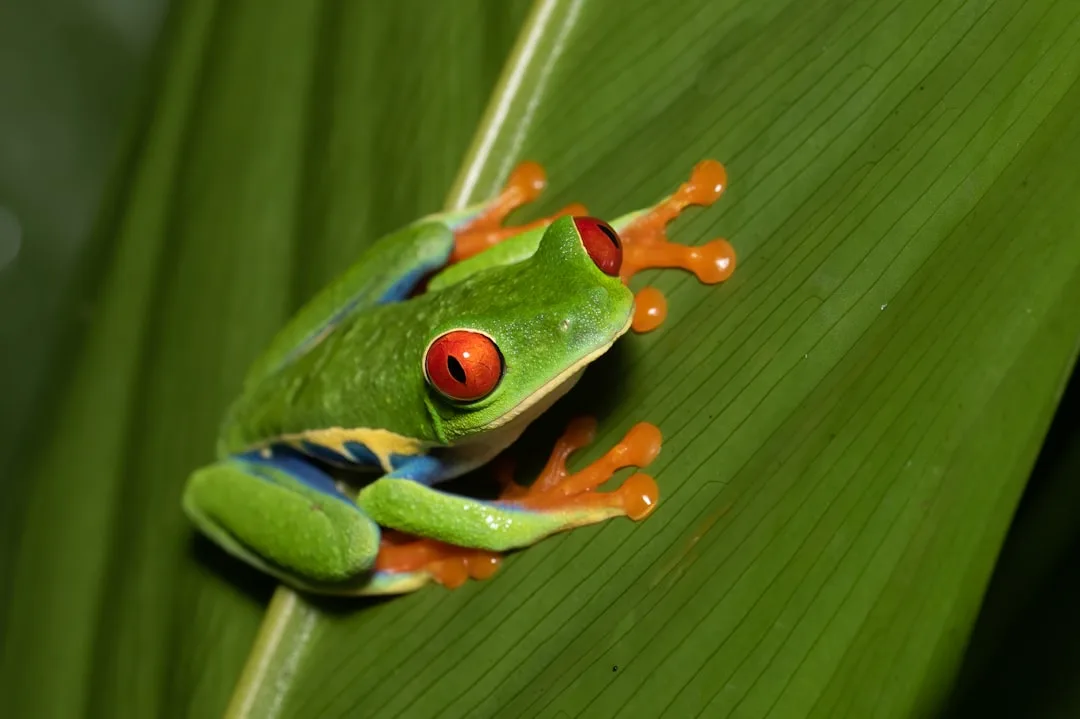
The red-eyed tree frog is one of the most instantly recognisable amphibians alive. Its lime-green body, brilliant red eyes, orange feet, and barred blue-and-yellow flanks have made it a visual shorthand for the Neotropical rainforest - splashed across postcards, textbooks, and conservation posters for decades.
But the species Agalychnis callidryas is more biologically interesting than its poster-child reputation suggests. It is a sleeping specialist, a climber with genuinely remarkable toe pads, a frog whose embryos can decide when to hatch, and a master of a defensive trick scientists call the aposematic flash.
This guide covers every aspect of red-eyed tree frog biology: taxonomy, size, colouration, habitat, sleeping behaviour, startle display, reproduction, the famous plastic hatching work of Karen Warkentin, diet, predators, conservation status, and the relationship between this species and the humans who find it so photogenic. It is a reference entry, not a summary - so expect specifics: centimetres, grams, humidity ranges, and verified behaviours.
Etymology and Classification
The scientific name Agalychnis callidryas combines the Greek roots agan and lychnis - roughly 'very bright lamp' - with kalos dryas, 'beautiful wood nymph'. Put together, the name means something close to 'brilliantly lit beautiful tree spirit', which is a fair description of what the frog looks like when a torch beam catches its red eyes at night in the rainforest canopy.
The species was formally described by Edward Drinker Cope in 1862. For more than a century it sat inside the large tree frog family Hylidae. In 2016 a major revision of amphibian classification moved Agalychnis and its close relatives into a separate family, Phyllomedusidae, the leaf frogs.
This reflects genetic and developmental differences that are significant even though the external appearance resembles that of other tree frogs. Red-eyed tree frogs are therefore no longer hylids in the strict sense, though many older guides still list them there.
Full modern taxonomy runs: Animalia, Chordata, Amphibia, Anura, Phyllomedusidae, Agalychnis, A. callidryas. The genus Agalychnis contains about a dozen recognised leaf frog species, several of them visually similar to the red-eyed tree frog. Closest relatives at the family level include the glass frogs (Centrolenidae), whose translucent bellies reveal the internal organs through the skin - evidence of a shared family experiment with how amphibian integument handles light.
Size and Physical Description
Red-eyed tree frogs are medium-small arboreal frogs with striking sexual dimorphism. Females are larger than males, which is typical of frogs where the male must grip the female's back during amplexus while she carries them both up vegetation to a suitable egg-laying leaf.
Females:
- Snout-vent length: 5-7 cm
- Weight: typically 10-15 g
- Body proportionally broader, abdomen wider when gravid
Males:
- Snout-vent length: 4-5 cm
- Weight: typically 6-10 g
- Darker nuptial pads on the thumbs for gripping during amplexus
- Vocal sac visible as a loose pouch under the throat
Juveniles:
- Metamorphs emerge from water at roughly 1 cm snout-vent length
- Eye colour develops from bronze through orange to red over several weeks
- Full adult size reached at approximately 2 years
The body is slender, with long limbs optimised for climbing and leaping between leaves. The head is broad and rounded, dominated by large protruding eyes set high on the skull. The dorsal surface is a vivid lime to leaf green, sometimes with small white or yellow spots, and this green serves as the frog's primary camouflage while sleeping.
The flanks carry vertical bars of deep blue or purple alternating with cream yellow - a pattern that is structural in origin rather than pigmented, produced by microscopic layers of skin that scatter specific wavelengths. The feet are bright orange with expanded toe discs, and the famous eyes are a saturated crimson red shading toward vermillion at the outer edge of the iris.
Colour, Camouflage, and the Aposematic Flash
The colour combination of the red-eyed tree frog looks, at first glance, like an advertising signal of toxicity - the strategy used by poison dart frogs, fire salamanders, and other chemically defended amphibians. It is not. Agalychnis callidryas carries no significant skin toxins. The colours serve a different purpose, and understanding that purpose is the key to understanding the species.
During the day, the frog sleeps clinging flat to the underside of a leaf. In this sleeping posture every bright colour is hidden. The bright flanks are pressed against the leaf and covered by the legs, which are tucked tightly against the body. The orange feet are folded under the chin and belly. The red eyes are closed, and the translucent lower eyelid draws up over the iris.
The only thing visible from any angle is the green dorsal surface, which matches the leaf so precisely that birds, snakes, and monkeys routinely overlook sleeping frogs centimetres from their faces.
If a predator does detect the sleeping frog, the red-eyed tree frog executes a rehearsed escape. It snaps its eyes open, flashes the red iris, kicks out its orange feet, and exposes the blue-and-yellow flanks in a single coordinated movement. The predator's search image - which had been calibrated to 'plain green leaf' - is suddenly flooded with vivid, high-contrast colour.
Scientists call this an aposematic flash or startle display. It is not a true warning signal because there is no toxin to back up the colour. It is a bluff that exploits the fraction of a second a predator needs to re-process what it is looking at. In that window the frog leaps.
The trick is energetically cheap, does not require constant vigilance, and appears to have evolved early in the leaf frog family: close relatives use similar flashes. It works especially well against visual predators that hunt by scanning leaves at close range.
Sleeping Behaviour and Eyelid Anatomy
The red-eyed tree frog is aggressively nocturnal. Adults spend roughly twelve daylight hours sleeping on leaves, and the quality of that sleeping camouflage depends on the frog's ability to hide every bright patch of skin at the same time as retaining some basic awareness of the environment.
The lower eyelid has evolved a specialised solution to this problem. Instead of a solid opaque cover, the lower lid is threaded with a fine gold reticulated pattern that partially transmits light. When a sleeping frog closes its eyes, the reticulated lid filters incoming light enough to dim the iris and hide the red from a casual observer, but not so much that the frog loses all visual information.
Motion through the lid is detectable. A shadow passing close triggers a partial opening. A leaf shifting with a predator's weight triggers a full flash.
The sleeping posture has its own anatomy. The legs are tucked so tightly against the body that the thin skin along the legs creates an almost perfect seal against the flanks, hiding the blue and yellow. The chin is pressed down against the leaf to cover the orange feet. Breathing continues through flared nostrils without disturbing the posture. In laboratory studies, sleeping frogs have been measured maintaining the same position on a single leaf for eight to ten hours at a time.
Climbing and the Physics of Toe Pads
Red-eyed tree frogs are specialists at moving through rainforest vegetation. Their toes end in expanded discs - toe pads - that combine several adhesion mechanisms into what is effectively a biological suction cup system. A single frog can hang upside down from the underside of a polished leaf for hours, and when startled can leap, land on a vertical surface, and stick instantly.
The toe pads work through a combination of:
- Mucus secretion. Each pad exudes a thin mucus layer that fills microscopic gaps between the pad and the leaf, producing wet adhesion through surface tension.
- Epidermal micro-ridges. The pad surface is divided into micrometre-scale hexagonal cells separated by channels that drain excess fluid and allow the dry contact points between cells to grip like tiny suction cups.
- Soft tissue compliance. The pad deforms to match surface microtopography, maximising the contact area whatever the substrate shape.
- Active muscle control. The frog can peel pads off one toe at a time, breaking adhesion in a controlled way without losing grip with the remaining toes.
The system is strong enough that a single pad can support many times the frog's body weight, which is why red-eyed tree frogs can hang from one leg during escape manoeuvres without slipping. Engineers studying bio-inspired adhesives have modelled synthetic materials on the red-eyed tree frog toe pad.
Reproduction and the Plastic Embryo
Red-eyed tree frogs breed in the rainy season, with peaks that follow heavy tropical downpours. Males gather in chorusing aggregations on vegetation above still or slow-moving water, calling with a distinctive short 'chack' that often synchronises into a wave of sound travelling through the canopy. Females select males, the pair enters amplexus, and the female then carries the male on her back up through the vegetation to a leaf overhanging water.
The female lays a clutch of roughly twenty to fifty translucent green eggs in a gelatinous mass on the upper surface of the leaf. A single female may break the night's eggs into several clutches on several leaves, positioning each one so that hatching tadpoles will drop straight into water below. Males fertilise each clutch externally as it is laid. After egg-laying, the adults leave and the eggs develop on the leaf, relying on the gelatinous mass to retain moisture.
Under normal conditions, embryos develop over six to seven days and hatch on a reasonably fixed schedule. What makes red-eyed tree frogs famous in developmental biology is that this schedule is not rigid.
If the clutch is attacked by a cat-eyed snake (Leptodeira species) or by parasitic wasps, embryos can detect the vibration pattern of the attack through the gelatinous matrix and hatch on the spot - sometimes within seconds, and sometimes up to two days ahead of the normal schedule.
Early hatchlings burst from their eggs as under-developed tadpoles and drop into the water below, where they begin their larval lives immediately.
This phenomenon, called hatching plasticity, was documented in detail by biologist Karen Warkentin beginning in the 1990s. Her work showed that embryos can distinguish between vibration patterns produced by predators, by rainstorms, and by harmless disturbance. Responsive hatching begins at around developmental day four. Before that, the embryos cannot survive outside the egg and so do not respond.
Warkentin's research opened a still-active field on how embryos across many species sense and respond to environmental cues during development.
After hatching, tadpoles live for roughly two to three months in still water pools, feeding on algae, detritus, and microorganisms. They metamorphose into small froglets at around one centimetre snout-vent length and climb onto surrounding vegetation to begin an arboreal life.
Diet and Feeding
Adult red-eyed tree frogs are generalist nocturnal insectivores. They hunt sit-and-wait style, positioned on leaves in the understory or lower canopy, and strike prey that passes within range using a rapid tongue protrusion.
Primary adult prey:
- Crickets and other orthopterans
- Moths and other nocturnal lepidopterans
- Flies and mosquitoes
- Small beetles
- Spiders
- Small grasshoppers
Occasional prey:
- Very small frogs of other species - only by the largest females
- Small winged termites during mass flights
Tadpoles are fundamentally different feeders. They are largely herbivorous and detritivorous, grazing on algae, decomposing leaf litter, and microorganisms suspended in pool water. The digestive tract reorganises during metamorphosis as the animal shifts from plant-based to animal-based food.
Prey is detected primarily by sight and to a lesser extent by vibration. The frog lunges, captures the item with a sticky tongue, and uses the front limbs to push larger prey into the mouth. Red-eyed tree frogs can handle prey up to roughly one-third of their own length.
Predators and Defensive Layering
Predation pressure on red-eyed tree frogs is substantial at every life stage, and the species has evolved a layered defence that uses different strategies against different threats.
Embryos are targeted by:
- Cat-eyed snakes (Leptodeira species)
- Parasitic wasps
- Fungal infections
- Drying of the egg mass in prolonged dry spells
Tadpoles are targeted by:
- Fish in permanent pools
- Predatory insect larvae including dragonfly nymphs
- Other larger tadpoles
- Shrimp and aquatic spiders
Adults are targeted by:
- Snakes including parrot snakes and eyelash vipers
- Birds, especially motmots and some owls
- Bats, including the fringe-lipped bat which listens for frog calls
- Monkeys and coatimundis in some regions
- Larger frogs
The defensive sequence runs: camouflage, then startle, then leap-and-stick, then drop into water if all else fails. Adults can also inflate the body slightly to look larger and occasionally produce mild skin secretions when severely stressed, though these secretions are not significantly toxic.
Habitat and Distribution
Red-eyed tree frogs occupy lowland and premontane rainforests from southern Mexico through Belize, Guatemala, Honduras, Nicaragua, Costa Rica, and Panama, extending into the extreme northwest corner of Colombia. They require high humidity - generally above 80% - and stable warm temperatures between roughly 24 and 29 degrees Celsius. Sudden drops below 18 degrees stress the species and prolonged exposure can be lethal.
Required habitat features:
- Dense broadleaf canopy providing shaded sleeping leaves
- Still or slow-moving surface water such as pools, swamps, or stream margins
- Vegetation overhanging water suitable for egg deposition
- High nocturnal insect density for foraging
- Protection from prolonged dry periods
Regional colour variation is substantial enough that experienced field biologists can often identify where a frog came from just by looking at the flanks. Panamanian populations tend toward purple vertical bars. Costa Rican populations often have crisp blue bars. Mexican and Belizean populations tend toward turquoise.
These differences have led to occasional proposals to split Agalychnis callidryas into subspecies or cryptic species, though most taxonomists currently treat it as a single variable species.
Conservation Status and Threats
The IUCN Red List classifies red-eyed tree frogs as Least Concern, meaning the species has a broad range and generally stable or locally abundant populations. This places it among the less threatened members of its family at a time when amphibians globally are in the middle of what many biologists describe as an extinction crisis.
Even so, the species is not secure everywhere.
Primary threats:
- Deforestation and habitat fragmentation. Rainforest conversion to agriculture, ranching, and palm oil plantations removes the continuous canopy and clean overhanging leaves the species depends on. Fragmented forests support smaller, less genetically connected populations.
- Chytrid fungus. Batrachochytrium dendrobatidis - the chytrid fungus implicated in catastrophic amphibian declines across the Americas - affects red-eyed tree frogs in some regions. Population-level impacts appear milder than in many Neotropical frogs but are not absent.
- Climate change. Rising temperatures, shifting rainfall patterns, and more intense dry seasons threaten the humid micro-habitat the species requires. Breeding is tied tightly to predictable rainfall, and disrupted rain cycles can reduce recruitment.
- Pesticide runoff. Agricultural chemicals in runoff water contaminate the still pools tadpoles develop in and have been linked to developmental abnormalities in several Neotropical frogs.
- Pet trade collection. The species is popular in the amphibian pet trade. Most animals sold internationally are now captive-bred, but illegal wild collection continues in some areas.
Protected areas across Central America - especially in Costa Rica, Panama, and southern Mexico - cover meaningful portions of red-eyed tree frog habitat, and community-led ecotourism often centres on this species as a visible conservation ambassador.
Red-Eyed Tree Frogs and Humans
Few amphibians have had a more successful public relations career than Agalychnis callidryas. The species appears on travel posters, shampoo bottles, biology textbook covers, and thousands of nature documentaries. For many people outside the tropics it is the mental image of 'rainforest frog' in general.
This visibility has had genuine conservation benefits. Ecotourism operators across Costa Rica and Panama run night walks in which guides show visitors sleeping red-eyed tree frogs and explain the regional ecology. Revenue supports forest protection and provides alternatives to destructive land use.
In captivity, red-eyed tree frogs are widely bred and kept by serious amphibian hobbyists. They require specific conditions - high humidity, live plants, a range of climbing branches, cycled temperature and rainfall to trigger breeding - but under good care they live more than ten years and breed reliably. Ethical keepers rely on captive-bred stock and avoid wild-collected animals.
Scientifically, the species is now a model organism for embryonic plasticity. Karen Warkentin's work on hatching decisions has spawned a research field that extends to fish, reptiles, and other amphibians. The red-eyed tree frog is one of very few vertebrates in which biologists can watch a developmental decision being made in real time and relate it to a specific environmental cue.
Related Reading
- Frogs and Toads: The Amphibians Vanishing Before Our Eyes
- Glass Frogs: Transparent Bodies in the Rainforest
- Poison Dart Frog: The Deadliest Amphibian on Earth
- Poison Dart Frogs: Deadliest Amphibians
References
Relevant peer-reviewed and monographic sources consulted for this entry include Warkentin's foundational papers on hatching plasticity in Animal Behaviour and Proceedings of the National Academy of Sciences, the Amphibian Species of the World taxonomic database maintained by the American Museum of Natural History, IUCN Red List assessments for Agalychnis callidryas, Savage's The Amphibians and Reptiles of Costa Rica, and published research in Journal of Experimental Biology, Herpetologica, and Copeia.
Specific developmental timings and hatching response thresholds reflect the consolidated experimental record as of the most recent reviews on embryonic behavioural plasticity.
Frequently Asked Questions
How big do red-eyed tree frogs get?
Red-eyed tree frogs (Agalychnis callidryas) are a medium-small arboreal frog. Adult females measure 5-7 centimetres from snout to vent and generally sit near the top of that range. Males are noticeably smaller at 4-5 centimetres, a size difference biologists call sexual dimorphism and which is typical of tree frogs where males must cling to larger females during amplexus. Body mass ranges from roughly 6 to 15 grams.
Newly metamorphosed froglets emerging from the water are barely a centimetre long and take around two years to reach adult size in the wild.
Where do red-eyed tree frogs live?
Red-eyed tree frogs are Neotropical specialists found from southern Mexico down through Belize, Guatemala, Honduras, Nicaragua, Costa Rica, and Panama, extending into the extreme northwest of Colombia. Their core habitat is humid lowland and premontane rainforest, particularly the canopy and upper understory near slow-moving water such as forest pools, swamps, and still stream margins.
They depend on high humidity and warm temperatures between roughly 24 and 29 degrees Celsius. They are rarely seen on the forest floor - almost all activity happens in vegetation between one and fifteen metres above the ground.
Are red-eyed tree frogs poisonous?
No. Despite their dazzling colours, red-eyed tree frogs are not toxic in any biologically meaningful sense. Their bright appearance is sometimes mistaken for aposematic warning colouration of the kind used by poison dart frogs, but the red eyes and painted flanks of Agalychnis callidryas serve a different function.
The colours stay hidden while the frog sleeps camouflaged green against a leaf, and are only revealed as a startle display when a predator is already close. Scientists call this the ‘aposematic flash’ - a bluff rather than a chemical warning. The frog relies on camouflage first, startle second, and leap-and-escape third.
How do red-eyed tree frog embryos hatch early?
Red-eyed tree frog eggs are laid on leaves above water and normally hatch after about six to seven days. If the clutch is attacked - for example by a cat-eyed snake or a parasitic wasp - embryos can detect the distinctive vibration pattern of the attack and hatch within seconds, dropping into the water below as tadpoles.
Biologist Karen Warkentin documented this in the 1990s and showed that embryos discriminate between predator vibrations, rainstorm vibrations, and harmless movement. The window of plasticity runs from about day four of development onward, and early-hatched tadpoles are smaller and slightly less developed but dramatically more likely to survive.
What do red-eyed tree frogs eat?
Adult red-eyed tree frogs are opportunistic insectivores. Their diet is dominated by crickets, moths, flies, small grasshoppers, and other arboreal arthropods they catch at night using a quick tongue strike. Occasional prey includes spiders and, for the largest females, the smallest tree frogs of other species.
Tadpoles are very different - they are largely herbivorous and detritivorous, grazing on algae, decomposing leaf matter, and microorganisms in the still pools they hatch into. Metamorphosis takes roughly two to three months, during which the diet shifts from plants to animals as the digestive tract reorganises.
How long do red-eyed tree frogs live?
In the wild, red-eyed tree frogs typically live around five years, though a combination of predation, dehydration, parasites, and storm damage to habitat means many never reach that age. In captivity, with controlled humidity, consistent food, and no predators, they often reach ten years or more, and individual zoo animals have been documented past twelve. Females generally outlive males slightly. Sexual maturity is reached at around two years of age.
Wild survival depends heavily on the density of predators such as snakes, bats, birds, and larger frogs, all of which take adults from rainforest vegetation at night.
Are red-eyed tree frogs endangered?
The IUCN lists Agalychnis callidryas as Least Concern, with a range that is relatively large and populations that remain locally abundant where suitable rainforest persists. This makes them one of the less threatened members of their family at a time when amphibians globally face catastrophic declines. Even so, the species is not immune.
Habitat loss through deforestation and agricultural conversion is the main long-term pressure, and the chytrid fungus Batrachochytrium dendrobatidis has caused localised crashes in some populations. Because their life cycle depends on leaves hanging above clean water, any change that fragments that specific micro-habitat reduces local numbers quickly.
Why are red-eyed tree frog eyes so red?
The red iris is produced by pigment cells called pteridinophores concentrated in the outer layers of the eye. Biologists believe the extreme colour evolved as a startle signal rather than an advertising signal. When a predator gets close enough to detect the sleeping frog as prey, the frog pops its eyes open, flashes the red iris, kicks out its orange feet, and exposes the blue-and-yellow striped flanks.
The sudden change from plain green leaf to explosion of colour is thought to confuse the predator’s search image for the critical fraction of a second the frog needs to leap to safety. The same trick appears in several other Phyllomedusidae species, suggesting it evolved early in the family.