
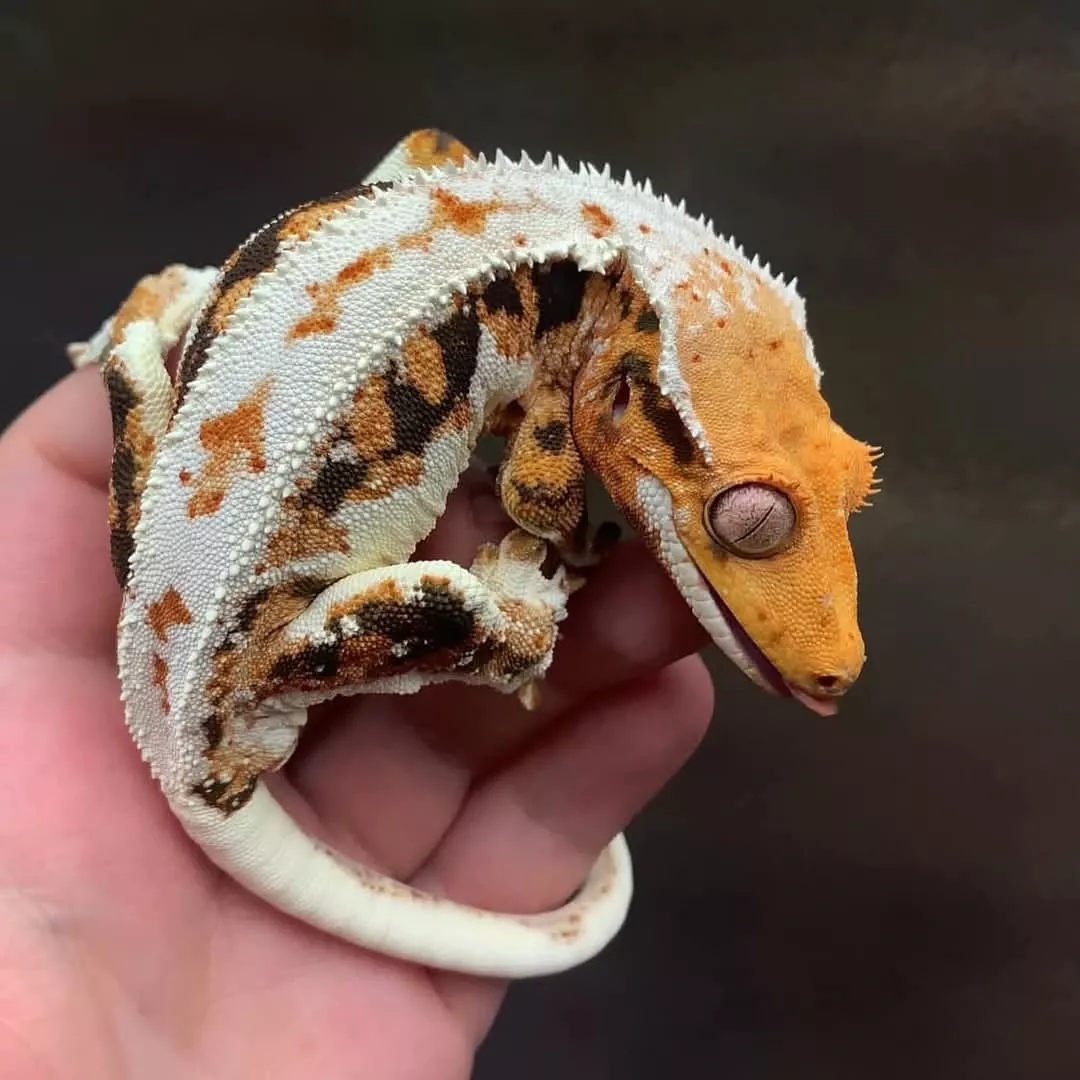
The crested gecko is a medium-sized, nocturnal, arboreal gecko from the rainforests of southern New Caledonia.
It is one of the most remarkable "lost and found" animals in modern zoology: formally described in 1866, then missing from science for more than a hundred and twenty years, then dramatically rediscovered in 1994 on the Isle of Pines after a tropical storm knocked enough leaves off the canopy to make the species visible again.
Within two decades of that rediscovery, Correlophus ciliatus went from being presumed extinct to being the second most popular pet gecko on Earth after the leopard gecko.
This guide covers the biology, ecology, and cultural story of the crested gecko in depth: size, habitat, diet, climbing adaptations, the curious inability to regrow a lost tail, the crest of scales that earned it the nickname "eyelash gecko", its evolutionary isolation on New Caledonia, and its complicated position as a Vulnerable wild species that is simultaneously captive-bred by the hundreds of thousands.
As with every hub entry on this site, specifics are preferred over summary - expect grams, millimetres, years, temperatures, and dates.
Name, Classification, and Rediscovery
The species was first described in 1866 by the French herpetologist Alphonse Guichenot, who named it Correlophus ciliatus. The genus name comes from Greek korre (crest) and lophos (tuft), referring to the prominent row of spiny scales above each eye and along the head. The species name ciliatus comes from Latin for "fringed" or "eyelashed", referring to the same crest.
For most of the twentieth century the species was reclassified into the genus Rhacodactylus, which is why many older books, websites, and even pet-trade labels list the animal as Rhacodactylus ciliatus. A 2012 revision of the New Caledonian giant geckos, based on molecular data, moved the crested gecko back into its original genus Correlophus. The currently accepted scientific name is Correlophus ciliatus.
Taxonomic position:
- Kingdom: Animalia
- Phylum: Chordata
- Class: Reptilia
- Order: Squamata
- Family: Diplodactylidae
- Genus: Correlophus
- Species: C. ciliatus
After Guichenot's 1866 description the species essentially dropped out of the scientific record. For over a century no living specimens reached museum collections, and by the 1980s many herpetologists privately assumed the animal was extinct - another small endemic lost to colonial-era habitat change on a remote Pacific island.
Then in 1994 a German-led expedition surveying New Caledonian reptiles, led by Robert Seipp and Wilhelm Henkel, found living crested geckos on the Isle of Pines shortly after a tropical storm. A very small number of animals were exported legally under permit, sent to breeders in Europe and the United States, and became the founding stock of what is now one of the largest captive reptile populations in the world.
This is why the phrase "lost for a hundred years, rediscovered after a hurricane" follows the crested gecko everywhere. It is not hype - it is the actual species history.
Size and Physical Description
Crested geckos are small to medium geckos. Full adult length is 15-25 cm including the tail, with a snout-to-vent length of roughly 11-12 cm. Adult weight is 35-60 g, with well-fed captive females reaching around 65-70 g and males staying slightly leaner. Hatchlings emerge at around 2.5-3 g and 5-6 cm long.
Four features dominate the crested gecko's physical identity:
The crest. A row of enlarged, spiky scales rises above each eye, runs back over the top of the head, and continues along the neck in two parallel ridges down onto the shoulders. In some morphs the crest continues in reduced form all the way down the flanks. The scales are firm but flexible. They are not feathers, not true eyelashes, and not horns - they are modified scales that give the animal its "eyelash gecko" nickname.
The head. The head is triangular, wide at the base, with very large forward-facing eyes. The eyes are disproportionately big for the skull because the species is nocturnal and depends on low-light vision. The pupils are vertical slits in bright light and expand to near-circular in darkness.
The toe pads and tail. Each toe ends in a broadly expanded adhesive pad covered in microscopic setae - hair-like structures that produce van der Waals adhesion against smooth surfaces. The tip of the tail carries a smaller adhesive pad of its own, and the tail is prehensile. This combination allows a crested gecko to climb polished glass at full speed and to anchor itself by the tail with all four feet free.
The overall build. The body is compact and slightly flattened, suited to squeezing between leaves and branches. The limbs are short and strong. The skin is soft, almost velvety, and comes in an enormous range of colours depending on lineage and mood - from olive-grey through brick-red, chocolate, orange, cream, and near-white.
In wild populations most adults are relatively drab - muted browns, greys, and olive greens that blend into rainforest bark and leaves. In captivity selective breeding has produced dozens of high-contrast morphs (harlequin, pinstripe, dalmatian, lily white, axanthic, reverse pinstripe, and many others) that essentially do not occur in the wild.
Habitat and Range
The crested gecko is endemic to New Caledonia, a French overseas territory in the southwestern Pacific. Within New Caledonia it is restricted to two areas:
- The southern end of Grande Terre, the main island.
- The Isle of Pines, a smaller island off the southern coast.
Its total natural range is only a few hundred square kilometres, making it one of the most geographically restricted reptile species in the international pet trade. Within that range it occupies humid lowland and mid-elevation rainforest, typically below 600 metres elevation, where annual rainfall exceeds 1,500 mm and relative humidity averages 70-90 per cent.
Crested geckos live in the mid-canopy and shrub layer. They are strictly arboreal, spending their entire lives in trees, vines, and dense vegetation. By day they sleep tucked against bark, inside rolled leaves, or in hollow stems, relying on camouflage to avoid detection. At night they emerge to forage.
The species' small geographic range is a double-edged sword. On one hand, the animals are locally fairly abundant in suitable habitat. On the other, any large-scale disturbance to southern New Caledonian rainforest - logging, nickel mining, wildfire, cyclonic damage - affects a disproportionately large share of the total global population.
Evolutionary Isolation
Crested geckos are part of the family Diplodactylidae, a group of geckos whose distribution tells a story of deep geological history. Diplodactylidae is found almost exclusively in Australia, New Zealand, and New Caledonia - the three landmasses that formed from the breakup of eastern Gondwana.
The New Caledonian geckos split from their closest relatives roughly 55 million years ago, when New Caledonia broke off as a fragment of continental crust and drifted into long isolation in the Pacific.
With no large mammalian predators and limited competition, the island's few founder gecko lineages diversified into a remarkable radiation: the Rhacodactylus giants (including the largest living gecko species, the New Caledonian giant gecko), the Mniarogekko, and the Correlophus lineage that contains the crested gecko.
This isolation is why the crested gecko's biology reads as "familiar but wrong" to anyone used to geckos elsewhere. It is nocturnal (like many geckos) but omnivorous (like few). It has adhesive toe pads (like most arboreal geckos) but cannot regrow its tail (like almost none). It has no eyelids (standard for most geckos) but has an elaborate crest of scales above the eye (almost unique).
Diet and Feeding
Most geckos are strict insectivores. The crested gecko is not. Its wild diet is genuinely omnivorous and includes, in rough order of importance:
- Ripe and overripe fruit, including native figs and other fleshy fruit
- Nectar from flowers
- Pollen
- Tree sap where available
- Soft-bodied invertebrates - moths, crickets, small spiders, caterpillars, flies
The fruit-and-nectar component is not a minor supplement. Stomach-content work on captive-raised animals with access to natural foods, combined with field observation of wild animals, shows that a substantial fraction of the diet is plant-based.
This has practical consequences: crested geckos can be kept healthy in captivity on a commercially formulated powdered diet ("crested gecko diet" or CGD) that mixes fruit, protein, and micronutrients. The diet is rehydrated with water into a thick paste. Insects are offered several times per week as enrichment and additional protein, but are not strictly required weekly.
This is unusual. Almost no other popular pet gecko can be kept long-term on a dry powdered food, and this single fact - combined with the rediscovery timing - is why the crested gecko became a pet-trade phenomenon so quickly. Leopard geckos need live insects. Tokay geckos need live prey and often a fight. Crested geckos need a spoon of fruit paste twice a week.
Climbing, Movement, and the Prehensile Tail
Crested geckos are superb climbers. Their toe pads carry thousands of microscopic setae, each of which branches into hundreds of smaller spatulae. Each spatula forms a temporary, weak bond with the surface through van der Waals forces. Multiplied across the entire surface of all four feet, the adhesive force is strong enough to hold the animal's full body weight from a polished pane of glass, upside down, with several feet in the air.
The tail is prehensile and carries a smaller adhesive pad at its tip. A crested gecko routinely anchors itself by the tail while reaching with the front limbs, or uses the tail as a fifth contact point when traversing thin branches. This is unusual among geckos - most gecko tails are used for fat storage (as in leopard geckos), for defence (tail drop), or for signalling, but not for active climbing.
Movement data:
| Metric | Value |
|---|---|
| Top sprint speed | roughly 1.5 m/s on vertical surfaces |
| Vertical jump | up to 20-30 cm from a standing position |
| Typical foraging range at night | tens of metres within a small home range |
| Activity period | 1-2 hours after dusk, resting bouts overnight |
Crested geckos are not long-distance movers. A single individual's effective home range in the wild is a small cluster of a few trees connected by lianas and branches. Most of the animal's "movement" is vertical - up, down, and around within that cluster.
Eyes, Eyelashes, and Licking
The crest of scales above the eye is the single most distinctive feature of the species. The name ciliatus (Latin for "eyelashed") refers directly to it, and "eyelash gecko" is one of the standard English common names. But the crest is not a functional eyelid.
Like almost all geckos other than the eublepharid family (which includes leopard geckos), crested geckos have no movable eyelids. The eye is covered by a transparent scale called the spectacle or brille, which is shed along with the rest of the skin each time the animal moults. Because there are no eyelids, the eye cannot be blinked clean.
Instead, the crested gecko cleans its eyes by licking them with its long, flat, slightly sticky tongue. A single gecko may lick each eye dozens of times per day, especially after dusty movement, moulting, or drinking. This is one of the classic gecko behaviours that people keeping a leopard gecko for the first time notice is missing - leopard geckos have working eyelids and never lick their eyes.
The crest of scales sitting above the eye is therefore structural and ornamental rather than functional for vision protection. It may assist with camouflage by breaking up the outline of the head, and it certainly plays a role in intraspecific signalling, but it does not shade the eye, shield it, or replace an eyelid.
Tail Autotomy and the "One Tail Only" Rule
Like most geckos, crested geckos can drop their tails as a defence. When grabbed, stressed, or attacked, the animal voluntarily releases the tail along a fracture plane between two vertebrae. The detached tail wriggles independently for up to several minutes, distracting the predator while the gecko escapes.
Unlike almost every other gecko in the pet trade, the crested gecko cannot regenerate its lost tail. Once the tail is dropped it is gone for life. The stump heals into a small rounded nub.
The ecological consequence is striking: field surveys of wild adults on the Isle of Pines show that around 80 per cent of adults are tailless. Losing the tail is not a rare emergency event; it is a normal adult condition. Wild crested geckos evidently function well without tails - they continue to climb, forage, mate, and lay eggs - which is consistent with the observation that the adhesive tail-tip pad, while useful, is not critical.
This pattern (the ability to drop a tail but not to regrow it) is shared with a handful of other Diplodactylidae species and is considered a reduction rather than a loss of the underlying regenerative machinery. The exact physiological reason crested geckos cannot regrow their tails is still an active research question.
Reproduction
Crested geckos are prolific breeders compared with many other geckos. In the wild, breeding peaks during the warm, wet months of the austral summer, roughly October to April.
Reproductive cycle:
- Sexual maturity: 15-18 months of age, at around 35 g body weight
- Clutch size: 2 eggs per clutch, almost always
- Clutch frequency: every 3-5 weeks during an active season
- Clutches per season: 8-10, occasionally more in captivity
- Incubation: 60-90 days at 22-27 degrees Celsius
- Hatchling size: 2.5-3 g, 5-6 cm
Eggs are buried in moist leaf litter or loose substrate. Crested geckos do not exhibit strict temperature-dependent sex determination in the rigid sense seen in some turtles - sex ratios skew with temperature, but the relationship is weaker and more variable than in, for example, many turtles and crocodilians.
Hatchlings emerge fully formed and self-sufficient. They absorb the remaining yolk in their first 24-48 hours and typically do not need to eat for several days after hatching - an adaptation that spaces out the first feeding to match the microclimatic windows of the rainforest.
Conservation Status
The IUCN lists Correlophus ciliatus as Vulnerable, with a decreasing population trend. The species faces three principal wild threats:
- Habitat loss. Southern New Caledonia is heavily affected by nickel mining (New Caledonia is one of the largest nickel producers on Earth), logging of native forest, wildfire, and conversion for development. Crested gecko habitat is a narrow band, and every lost square kilometre removes a meaningful fraction of global habitat.
- Invasive species. The little fire ant, Wasmannia auropunctata, is the most serious biotic threat. It attacks eggs and hatchlings, can kill adult geckos in sufficient numbers, and is expanding across New Caledonia. Feral cats and introduced rats also take adults and eggs.
- Collection. Wild collection for the pet trade was a concern in the mid-1990s, immediately after rediscovery. It is now tightly restricted, and the vast majority of animals sold globally are captive bred.
Captive populations number in the hundreds of thousands globally and include virtually every registered pet reptile breeder's inventory on several continents. This provides a genetic reservoir and a commercial disincentive for illegal wild collection, but it does not substitute for protecting wild habitat. Most of the global captive population descends from a small founder group collected in the mid-1990s, which means captive genetic diversity is narrower than wild diversity.
New Caledonia's government and various NGOs run conservation programmes targeting the southern forests that contain crested gecko habitat, with emphasis on fire prevention, controlled access to mining areas, and invasive ant control. The species is listed on CITES Appendix II, which regulates but does not prohibit international commercial trade.
The Crested Gecko in the Pet Trade
Within about a decade of its 1994 rediscovery, the crested gecko became one of the most widely kept reptiles in the world. Several factors combined to drive this:
- Captive breeding was straightforward. Females produce 2 eggs every few weeks across a long season, eggs incubate at room temperature, and hatchlings are hardy.
- The species tolerates a wide range of temperatures (18-27 degrees Celsius is comfortable), meaning no special heating equipment is usually required.
- The formulated "crested gecko diet" - a powdered fruit-and-protein paste mixed with water - removed the need for constant live insect feeding.
- The species is small, quiet, and tolerant of gentle handling once acclimated.
- Selective breeding produced visually striking colour morphs that command premium prices and sustain an enthusiast community.
Today the crested gecko is commonly cited as the second most popular pet gecko after the leopard gecko, and in some markets it is the single most common pet lizard overall. This popularity has both conservation value (captive populations are secure and wild collection is minimal) and conservation cost (a focus on a small, highly adapted captive line can distract public attention from the still-at-risk wild populations in New Caledonia).
Related Reading
- Geckos: Wall-Climbing Marvels of the Reptile World
- How Geckos Stick to Walls
- Leopard Gecko
- Tokay Gecko
References
Relevant peer-reviewed and governmental sources consulted for this entry include the IUCN Red List assessment of Correlophus ciliatus, the 2012 taxonomic revision of the New Caledonian Diplodactylidae by Bauer and colleagues in Zootaxa, New Caledonia's Direction de l'Environnement provincial survey reports for southern Grande Terre and the Isle of Pines, and published observations on rediscovery history and captive biology in Herpetological Review, the Journal of Herpetology, and Gekko.
Rediscovery details follow the 1994 expedition records of Seipp and Henkel. Captive-diet formulations, clutch frequency, and hatchling metrics follow published data from long-running breeder groups and peer-reviewed captive-biology reports.
Frequently Asked Questions
How big do crested geckos get?
Adult crested geckos (Correlophus ciliatus) reach a total length of 15-25 cm including the tail, with a snout-to-vent length of roughly 11-12 cm. Adult weight ranges from 35-60 g, with well-fed captive females sometimes touching 65-70 g. Hatchlings are tiny - around 2.5-3 g and 6 cm long. The species reaches adult size at 12-18 months depending on feeding intensity and temperature.
Males and females are similar in overall length, though mature males develop a visible hemipenal bulge at the base of the tail and females often carry slightly more mass when gravid.
Where do crested geckos live in the wild?
Crested geckos are endemic to the southern end of Grande Terre and the Isle of Pines in New Caledonia, a French overseas territory in the southwestern Pacific. The species is restricted to humid lowland and mid-elevation rainforest, typically below 600 metres, where it lives in the mid-canopy and shrub layer. It favours dense vegetation near watercourses and areas with heavy leaf litter.
Because its entire natural range is confined to a few hundred square kilometres on a single island group, the crested gecko is considered one of the most geographically restricted reptile species in the international pet trade.
Why can't crested geckos regrow their tails?
Crested geckos can voluntarily drop their tails as a defence - a behaviour called caudal autotomy - but unlike leopard geckos, tokay geckos, and most other gecko species, they cannot regenerate the lost tail afterwards. The tail stump heals into a rounded nub and stays that way for life.
Field studies of wild populations have found that around 80 per cent of adult crested geckos are missing their tails, which suggests that adults function perfectly well without them. The inability to regrow is a trait shared with a few other Diplodactylidae species and is considered a reduced regenerative capacity rather than a total loss of regeneration machinery.
What do crested geckos eat?
Crested geckos are omnivores, which is unusual for a gecko. Their wild diet is a mixture of ripe, overripe, and fermenting fruit, flower nectar, pollen, tree sap, and soft-bodied invertebrates including moths, crickets, small spiders, and caterpillars. Captive animals are commonly fed a commercially formulated powdered diet (often called a meal-replacement powder or CGD) mixed with water, supplemented with live insects a few times per week.
This powdered-diet approach - invented after the 1994 rediscovery - is one of the main reasons the species became so widely kept, because it removed the need to source live food daily.
How long do crested geckos live?
In well-managed captivity crested geckos routinely live 15-20 years, with some verified individuals exceeding 20. Wild lifespan is harder to measure because the species has only been accessible to researchers since 1994, but field estimates suggest 10-15 years is typical for wild adults, limited by predation from introduced mammals, parasitism, and habitat stress. Sexual maturity is reached at about 15-18 months and 35 g of body weight.
Females can continue laying fertile eggs for most of their adult life, though breeders typically rest females from breeding after several years to protect long-term body condition.
Are crested geckos endangered?
The IUCN lists Correlophus ciliatus as Vulnerable with a decreasing wild population trend. The two main threats are habitat loss from nickel mining, logging, and wildfire in southern New Caledonia, and predation by invasive species - particularly the little fire ant (Wasmannia auropunctata), which attacks hatchlings and incubating eggs, and feral cats and rats, which take adults.
Paradoxically, the species is one of the most numerous captive geckos in the world, with hundreds of thousands held in private and commercial collections. Captive populations provide a genetic reservoir but do not substitute for protecting wild habitat, because most captive animals descend from a small founder group collected in the mid-1990s.
How did the crested gecko get 'lost' for a hundred years?
The species was formally described by French naturalist Alphonse Guichenot in 1866 from specimens collected in New Caledonia. After that initial description it essentially vanished from scientific records. No verified live specimens were reported for more than 120 years, and many herpetologists assumed the species was extinct.
In 1994 an expedition led by Robert Seipp and Wilhelm Henkel rediscovered living crested geckos on the Isle of Pines shortly after a tropical storm disturbed vegetation and made the nocturnal, canopy-dwelling lizards briefly visible. A small number of specimens were legally exported under permit, and captive breeding from those animals founded essentially the entire global pet population.
The rediscovery is one of the most celebrated ‘lost species’ stories in modern herpetology.
Can crested geckos climb glass?
Yes, easily. Crested geckos have expanded toe pads covered in microscopic hair-like structures called setae, which produce adhesion through van der Waals forces - the same mechanism used by most wall-climbing geckos. They can walk up polished glass at full speed and hang upside down from enclosure lids for long periods.
Unusually, the tip of the prehensile tail also carries a small adhesive pad, so a crested gecko can anchor itself by the tail alone and hang with all four feet free. This combination of sticky feet and a sticky tail tip is part of why the species is so at home in the dense, vertical rainforest canopy of New Caledonia.