
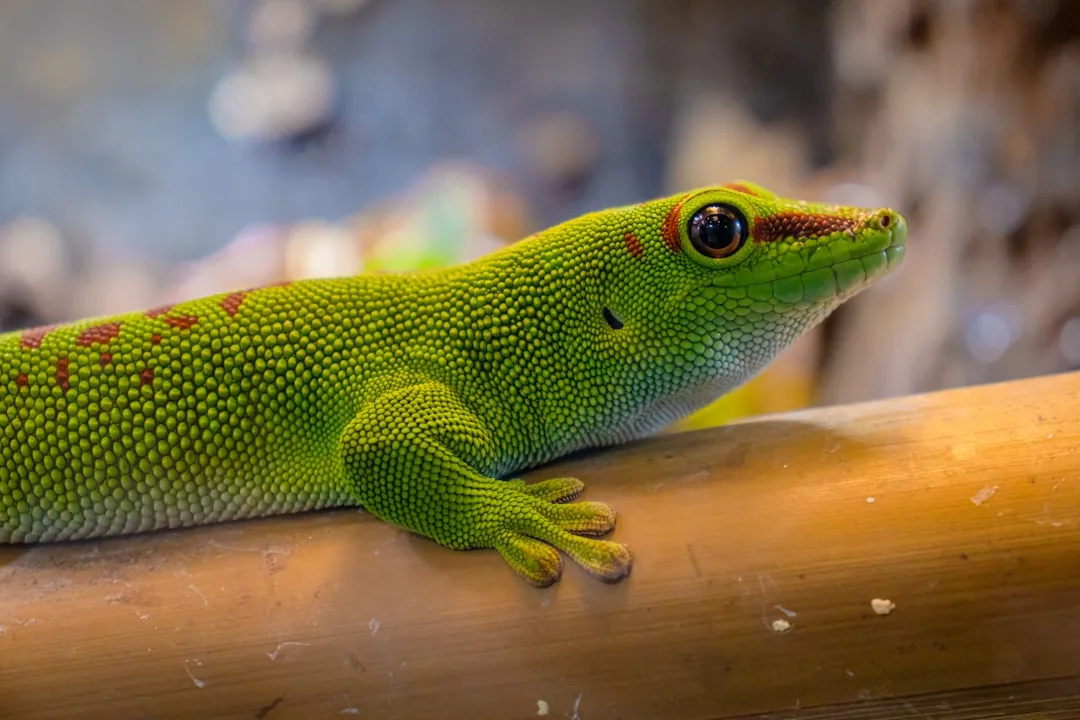
The Madagascar giant day gecko is one of the strangest animals in its family. Of roughly fifteen hundred known gecko species alive today, the overwhelming majority are nocturnal - small, secretive, slit-pupilled, hunting insects on bark and walls after sunset. Phelsuma grandis broke that mould. It is fully diurnal. It basks in bright tropical sun.
It drinks nectar from flowers, eats ripe fruit from palms, and displays its brilliant lime-green skin and scarlet markings as signals rather than camouflage. It is also the species most casual observers would recognise without realising they know its name, because its face shaped the GEICO Gecko mascot that has appeared in American advertising since 1999.
This guide covers every angle of Phelsuma grandis biology and ecology: taxonomy, size, the physics of its adhesive toe pads, its unusual sugar-heavy diet, its endemic Madagascar home, the pet trade pressure it lives under, and the strange facts that make day geckos a reference case for island evolution, tropical pollination, and the biomechanics of climbing in the rain.
Expect specifics - grams, centimetres, numbers of species, trade volumes, and the verified records that make day geckos such a useful test case for what geckos can be.
Etymology and Classification
The genus name Phelsuma was established in 1825 by French zoologist Rene Primevere Lesson, who named it in honour of Dutch physician Murk van Phelsum. The species epithet grandis means simply "large" in Latin - an accurate description, since Phelsuma grandis is the biggest species in the genus. Common names in English include Madagascar giant day gecko, Madagascar day gecko, and sometimes simply giant day gecko.
The species was described by Gray in 1870 but spent more than a century classified as a subspecies - Phelsuma madagascariensis grandis - of the closely related Madagascar day gecko.
Morphological and molecular work published in 2007 by Raxworthy and colleagues confirmed that grandis was a full species rather than a subspecies, based on consistent size differences, scalation patterns, and mitochondrial DNA divergence. Older literature, field guides printed before 2010, and much of the pet trade still use the older subspecies name.
Day geckos as a group - genus Phelsuma - contain roughly fifty recognised species distributed across Madagascar, the Mascarene Islands, the Seychelles, the Andaman Islands, and parts of coastal East Africa. About twenty-eight of those species are endemic to Madagascar alone. The genus is the clearest single example in the reptile world of island-driven adaptive radiation outside of the Galapagos finches and Hawaiian honeycreepers.
Size and Physical Description
Madagascar giant day geckos are the largest members of their genus. Sexual dimorphism is moderate: males are somewhat larger and more heavily built than females, with broader heads and more pronounced red markings.
Males:
- Total length: 28-30 cm (snout to tail tip)
- Snout-vent length: 12-14 cm
- Weight: 70-90 g
- Head: broad, rounded, noticeably wider than the neck
- Preanal and femoral pores visible on the underside of the thighs
Females:
- Total length: 25-28 cm
- Snout-vent length: 11-13 cm
- Weight: 60-75 g
- Head: narrower, more triangular
- Calcium sacs visible as white patches on the sides of the neck during the breeding season
Hatchlings:
- Total length: 5-7 cm
- Weight: 1-2 g
- Colour intensity lower than adults; red markings develop over the first few months
The species is built for life on vertical surfaces. The body is slender but heavy-chested, the limbs are long and muscular, and the tail - usually slightly longer than the body - acts as a counterweight when the animal runs down a vertical palm trunk or leaps between fronds. Unlike the fat, pantry-like tail of a leopard gecko, a day gecko's tail is slim and tapered, built for balance rather than fat storage.
The feet are the signature anatomical feature. Each toe ends in a broad adhesive pad covered in microscopic hair-like setae, plus a small claw. The pads are symmetrical on all four feet and allow the animal to cling equally well to bark, palm frond, painted wall, rain-slick glass, or an inverted ceiling.
The skin is the reason day geckos are famous. The base colour is brilliant lime to emerald green, produced partly by pigment and partly by layers of reflective iridophore cells that refract incoming light. The back is decorated with red bars, stripes, or spots, typically running from the shoulders to the rump. A rust-red stripe usually runs from the nostril through the eye. The belly is cream to pale yellow.
Individual spot patterns are distinctive enough that researchers and experienced keepers can identify individual animals from photographs, much the way researchers identify whale sharks.
Brilliant Green for a Reason
The green and red colour scheme of Phelsuma grandis is not camouflage in the conventional sense. A bright green gecko on the brown bark of a palm is highly visible. On the underside of a green leaf it is invisible. The colour is both a partial camouflage - specifically against fresh foliage - and a social signal used in territorial display, courtship, and thermoregulation.
The brilliance of the green depends on mood and temperature. A cool animal, one in the shade in early morning, appears dull grey-green. A warm, display-ready animal in direct sun looks almost fluorescent. Stressed animals fade rapidly toward grey. The red markings intensify when a male is courting or defending territory from a rival, and can almost disappear when the animal is submissive or hiding.
Iridophores - reflective platelets inside skin cells - produce the near-metallic sheen visible on close inspection. The colour is partly structural rather than purely pigmented, which is why photographs rarely capture it faithfully and why the cartoon GEICO Gecko appears less luminous than the real animal.
Diurnal Life on an Island
Day geckos evolved on Madagascar and nearby islands from nocturnal ancestors. On the mainland of Africa or Asia, gecko niches are dense with competition; moving into the daytime would mean facing lizards, birds, and mammals. On Madagascar, which separated from mainland Africa around 150 million years ago and from India around 90 million years ago, many of those competitors never arrived. Day geckos slid into an empty daytime niche that did not exist anywhere else.
Diurnal activity brought several consequences. Round pupils replaced slit pupils, because bright daylight does not require the extreme aperture control a nocturnal animal needs. Colour vision improved, supporting the use of vivid green and red for social signals.
Basking became possible, lifting body temperature higher and faster than ambient air alone could, which in turn supported more active foraging and faster growth. Vocal communication, common in nocturnal geckos, is reduced in day geckos; visual displays replace most of its function.
Day geckos are strongly territorial. Males maintain linear territories on a single tree or wall and patrol them aggressively, head-bobbing, arching the back, and flaring the red markings at intruders. Fights between evenly matched males can last for minutes and produce visible scars, tail breaks, and bite injuries on the head and shoulders.
Diet: Sugar, Nectar, and Insects
Most geckos are obligate insectivores. Phelsuma grandis is not. It is a true omnivore, and its preference for sugar is among the strongest of any reptile.
Major dietary components:
- Insects: crickets, moths, roaches, beetles, flies
- Fruit: ripe mango, papaya, banana, guava, fallen figs
- Nectar: from native Madagascar palms, traveller's tree (Ravenala), pandans (Pandanus), bananas
- Pollen: licked from flower surfaces during nectar feeding
- Tree sap: opportunistic, where wounds or cuts on bark produce exudates
- Small vertebrates: occasional small tree frogs, juvenile geckos of smaller species
Wild day geckos spend considerable foraging effort on flowering and fruiting plants. In the Sambirano region of northern Madagascar, seasonal fruiting of introduced banana and mango plantations has shifted population distributions, drawing day geckos into cultivated areas where they coexist easily with human activity. Captive studies show that when offered both live insects and sugary fruit gels, Phelsuma grandis consistently chooses the sugar first and ignores insects until the gel is gone.
This sugar preference is ecologically meaningful. Day geckos act as pollinators. When a gecko pushes its head and shoulders into a flower to lap nectar, pollen dusts its snout and scales and is transferred to the next flower it visits. A handful of endemic Madagascar plants are now known to depend partly on day gecko pollination, including some palms and pandans whose flowers are shaped in ways inconsistent with insect or bird pollination alone.
A single captive day gecko in good condition may eat five to ten insects per week alongside two to three feedings of fruit gel. In the wild the ratio leans more heavily toward fruit and nectar during fruiting seasons.
Drinking Off Leaves
Day geckos almost never drink from standing water. Instead, they lick droplets from leaves, branches, and palm fronds after rain or morning dew. Captive animals typically ignore water dishes entirely and depend on daily misting of the enclosure. A keeper unfamiliar with the species often misreads this as the animal refusing to drink, when in fact it is waiting for droplets to form on the surfaces around it.
This drinking style is common across arboreal gecko families but especially pronounced in Phelsuma. It drives specific husbandry practice: day gecko terrariums are misted once or twice daily, and the glass and foliage are designed to hold water droplets long enough for the animal to reach them.
Sticky Pads That Work in Rain
Madagascar giant day geckos live in a humid, tropical climate where rain is frequent. Their adhesive system has to function on wet surfaces as routinely as it does on dry ones, and it does.
Each toe bears a broad adhesive pad made of rows of lamellae - thin overlapping plates. Each lamella is covered in millions of hair-like setae, each about 100 micrometres long. Each seta splits at its tip into hundreds of even smaller branches called spatulae, about 200 nanometres across.
When the toe presses down, the spatulae flatten against the surface and exploit van der Waals forces - the same weak atomic-scale attractions that hold gecko tape and some adhesive films together. No glue is secreted. No suction is involved.
Water does not defeat van der Waals adhesion the way it defeats the tarsal adhesion of insects. A wet leaf is not noticeably harder for a day gecko to climb than a dry one. This is why day geckos can scamper across rain-slick palm fronds in tropical downpours without falling - a useful trait in an environment where surfaces are wet for a third of the year or more.
Engineers studying dry adhesives have used Phelsuma feet, alongside the feet of tokay geckos and anoles, as reference systems for developing climbing robots and residue-free tapes.
Reproduction
Day geckos reach sexual maturity between one and two years of age. Breeding is seasonal in wild Madagascar - tied to the wet season - but captive animals under stable lighting and temperature can breed year round.
Reproductive cycle:
- Courtship: male approaches female with head-bobbing and body flattening; red markings brighten
- Mating: brief, with the male gripping the female's neck
- Egg development: 3-4 weeks between mating and laying
- Clutch size: 2 eggs, almost always
- Annual clutches: up to 6 per female under optimal conditions
- Egg attachment: eggs are glued to bark, leaves, or enclosure walls
- Incubation: 55-75 days depending on temperature
- Hatchling size: 5-7 cm, self-sufficient immediately
Eggs are hard-shelled, unlike the soft eggs of most reptiles, and are glued in pairs to a hidden surface where they harden in place. In captivity keepers often have to cut eggs free of glass to move them, and the surface they stick to can be damaged in the process. In the wild, eggs laid inside palm crowns, beneath loose bark, or inside hollow bamboo are almost impossible to locate without watching the female lay them.
Some Phelsuma species show temperature-dependent sex determination similar to that of crocodiles and many turtles, though the details vary by species and are less cleanly studied in grandis than in leopard geckos.
Lifespan
Wild Phelsuma grandis typically live five to ten years. Many do not reach the upper end of that range. Predation by birds, tree snakes, introduced rats, feral cats, and larger invasive gecko species drives most mortality, alongside injury from territorial fights and exposure during cyclones.
In captivity, with stable temperatures, UV lighting, controlled humidity, a varied diet, and no predators, animals regularly reach fifteen to twenty years. The oldest documented captive Phelsuma grandis exceeded twenty years. This gap between wild and captive lifespan is larger than in most reptiles and reflects both how stressful life on a Madagascar palm trunk actually is and how gently designed modern day gecko husbandry can be.
Range, Habitat, and Introduced Populations
Native range covers the humid forests and coastal lowlands of northern Madagascar, including the Sambirano region, the Nosy Be archipelago, and the northwestern tip of the island. The species prefers tropical rainforest, palm groves, banana plantations, and the walls of human dwellings; it is strongly arboreal and avoids dense ground cover.
Introduced populations exist on Reunion and Mauritius in the Mascarene Islands, where the species has naturalised enough to compete with native (and often more threatened) endemic day geckos. A feral population has established itself in southern Florida since the 1990s after pet trade escapes, and smaller colonies exist in Hawaii. In some of these introduced ranges, Phelsuma grandis has become a successful invasive species, displacing or outcompeting local geckos.
Conservation
The IUCN Red List classifies Phelsuma grandis as Least Concern. The species' adaptability to disturbed habitats, wide native range, and established introduced populations make extinction risk low in the short to medium term.
The situation on the ground is more complicated. Phelsuma grandis is listed on CITES Appendix II, which regulates international trade. Madagascar sets annual legal quotas for wild-caught specimens, and enforcement is uneven. Tens of thousands of animals enter the global pet trade each year, a mix of legally exported wild-caught stock, captive-bred animals, and illegally smuggled specimens. The GEICO-era increase in public recognition of day geckos measurably increased hobbyist demand.
Deforestation across Madagascar is the longer-term concern. Roughly ninety per cent of the island's original forest cover has been lost. Phelsuma grandis tolerates plantations and gardens better than many Madagascar endemics, but the broader forest ecosystem that supports its native populations is under severe pressure.
Several other day gecko species endemic to Madagascar - especially small-island endemics - are listed in higher IUCN threat categories, and at least one Mascarene species (Phelsuma gigas) is already extinct.
Day Geckos and Humans
Day geckos have a longer and closer relationship with humans than most wild reptiles. In Madagascar villages, Phelsuma grandis frequently lives on the outside walls of houses, eating insects attracted to light and drinking from garden misting. Local attitudes toward them are generally tolerant or positive; they are not eaten, rarely killed, and often regarded as benign.
Internationally, the species is best known through two channels. The first is the pet trade, where day geckos are among the most popular arboreal lizards kept by reptile hobbyists. The second is advertising.
The GEICO Gecko, introduced in 1999 by the Martin Agency, draws its visual design directly from day geckos - the round pupils, broad adhesive toe pads, blunt snout, and brilliant green skin are all day gecko features rather than generic "gecko" features. The campaign has run for over two decades and made the silhouette of a day gecko one of the most recognisable animal images in American advertising history.
The mascot has had mixed consequences for the real animals. Awareness of the group grew, as did demand for captive specimens. Conservation organisations occasionally use the familiar mascot as an entry point for discussing the very different situation facing wild Phelsuma populations on Madagascar.
Related Reading
- Geckos: Wall-Climbing Marvels of the Reptile World
- How Geckos Stick to Walls
- Tokay Gecko: The Loudest Gecko on Earth
- Leopard Gecko: The World's Most Popular Reptile Pet
- Crested Gecko: The Rediscovered Species
References
Relevant peer-reviewed and governmental sources consulted for this entry include IUCN Red List assessments for Phelsuma grandis, CITES trade statistics for the genus Phelsuma, the 2007 taxonomic revision by Raxworthy and colleagues in Zoological Journal of the Linnean Society, adhesion research published in Nature and the Journal of Experimental Biology, and field reports from Malagasy herpetological surveys published through the Durrell Wildlife Conservation Trust and the Madagascar Fauna and Flora Group.
Frequently Asked Questions
How big do Madagascar giant day geckos get?
Adult Madagascar giant day geckos (Phelsuma grandis) reach 25-30 centimetres in total length, with the tail accounting for slightly over half the body. Typical adult weight is 60-90 grams. Males are generally larger and more robust than females, with broader heads and more pronounced red markings. The species is the largest member of the genus Phelsuma and one of the largest fully diurnal geckos alive today.
Hatchlings emerge at 5-7 centimetres and around 1-2 grams, doubling in length during their first year.
Where do day geckos live in the wild?
Phelsuma grandis is endemic to the humid forests and coastal lowlands of northern Madagascar, particularly the Sambirano region. They inhabit tropical and subtropical rainforest, palm groves, banana plantations, and the walls of human dwellings. They are strongly arboreal, spending almost their entire lives on vertical surfaces - tree trunks, palm fronds, and painted walls - and rarely descend to the ground.
Introduced populations have established themselves on nearby islands including Reunion and Mauritius, and smaller feral colonies exist in southern Florida and Hawaii after pet escapes.
Why are day geckos active in the daytime when most geckos are nocturnal?
Of roughly 1,500 gecko species, only a small number - including all members of the genus Phelsuma - are fully diurnal. The shift to daytime activity likely evolved on isolated islands such as Madagascar where competition with nocturnal gecko species was low and daytime foraging opportunities, particularly fruit and nectar, were abundant.
Day geckos have round pupils rather than the slit pupils typical of nocturnal geckos, reflecting eye optimisation for bright light. They also bask to raise body temperature rather than relying on ambient heat at night, which allows more active foraging and territorial display than nocturnal species can sustain.
Is the GEICO Gecko based on a real species?
The GEICO Gecko, introduced in a 1999 advertising campaign, is a stylised animated character rather than a portrait of a single species, but its visual design is clearly based on day geckos - particularly Phelsuma grandis and closely related Phelsuma species. The mascot’s brilliant green skin, round pupils, broad toe pads, and blunt snout all match day gecko anatomy rather than the sharper faces and vertical pupils of most gecko families.
Wildlife biologists have noted that the campaign dramatically increased public awareness and pet trade demand for day geckos, which placed additional pressure on wild Madagascar populations.
What do day geckos eat?
Madagascar giant day geckos are true omnivores, which is unusual for reptiles. Their diet in the wild includes insects such as crickets, moths, and flies, but also ripe fruit pulp, floral nectar, pollen, tree sap, and occasionally small vertebrates like tree frogs or smaller geckos. Nectar and fruit can make up 30-50 per cent of the diet, especially in the wet season when palms and pandans are flowering.
Captive animals thrive on a mixed diet of dusted insects and commercial fruit gels with added vitamins. Their reliance on sugar makes them particularly vulnerable to metabolic disorders when fed insects alone.
How long do day geckos live?
Wild day geckos typically live 5-10 years, though many do not reach the high end of that range. Predation by birds, snakes, introduced cats and rats, and competition with invasive gecko species such as the common house gecko drive wild mortality. In captivity, with steady temperatures, UV lighting, controlled humidity, and consistent diet, they regularly reach 15-20 years.
Captive females that are bred hard - producing up to six clutches per year - tend to live shorter lives than non-breeding animals. The oldest documented captive Phelsuma grandis exceeded 20 years.
Are Madagascar day geckos endangered?
The IUCN lists Phelsuma grandis as Least Concern, reflecting the species’ adaptability to disturbed habitats including gardens and plantations, its wide native range in northern Madagascar, and introduced populations abroad. However, the species is listed on CITES Appendix II, which regulates international trade. Legal and illegal wild collection for the pet trade is the principal conservation concern, alongside ongoing deforestation in Madagascar.
Several of the roughly 28 day gecko species native to Madagascar are far more threatened than Phelsuma grandis, and some island endemics such as Phelsuma gigas are already extinct.
How do day geckos stick to walls and leaves?
Day geckos use the same adhesive system as other climbing geckos. Each toe pad bears millions of microscopic hair-like structures called setae, each of which splits into hundreds of even smaller branches called spatulae. When pressed against a surface, the spatulae exploit van der Waals forces - weak atomic-scale attractions - to generate adhesion without any glue or suction.
The system works on smooth glass, wet leaves, painted ceilings, and polished stone. Day geckos spend most of their lives clinging to vertical surfaces and rarely touch the ground, using the adhesive system constantly rather than as a last resort.