
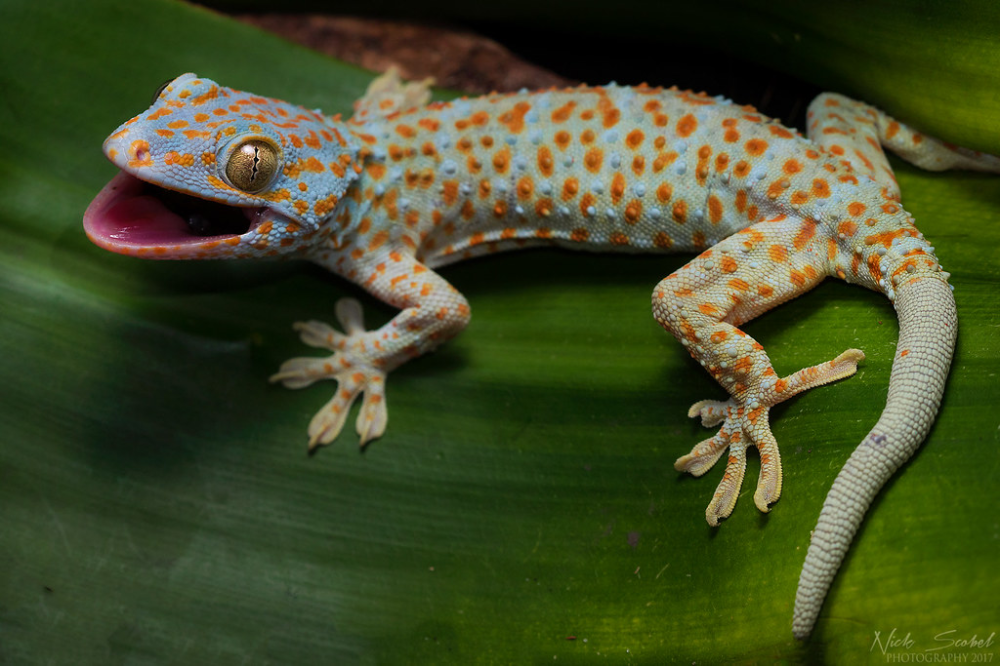
The tokay gecko is the loudest, most aggressive, and arguably the most biomechanically remarkable gecko on Earth. It is the second-largest gecko species alive, dwarfed only by the New Caledonian giant, and it hunts by night across the rainforests, limestone karsts, and rooftops of South and Southeast Asia. Its bluish-grey skin with orange and red spots is not camouflage but a warning.
Its call is a resonant bark that repeats its own name. Its feet can hold two hundred times its body weight on polished glass, wet or dry, by exploiting an atomic force that most biologists ignored until the year 2000.
This guide covers every angle of Gekko gecko biology and ecology: size and coloration, the physics of adhesion, vocal repertoire, hunting, reproduction, the pet and medicine trades, conservation, and the engineering research the species has inspired. Expect specifics - grams, centimetres, newtons per square millimetre, and the strange facts that make the tokay a reference animal for biologists, materials scientists, and roboticists alike.
Etymology and Classification
The name Gekko gecko is a double hit of onomatopoeia. Both the genus and the species epithet derive from the animal's own call, heard across Southeast Asia every night of the year. In Malay and Indonesian the word is tokek or tokay, a direct phonetic copy of the two-syllable mating bark. Thai speakers hear it as tuk-kae. English borrowed the word "gecko" from Malay via seventeenth-century Dutch traders, who adopted it precisely because the animal seemed to announce its own name.
Swedish naturalist Carl Linnaeus formally described the species in 1758, placing it originally in Lacerta. It was later moved into its own genus, Gekko, which now contains more than seventy species across Asia. Tokay geckos are the type species of both the genus Gekko and the family Gekkonidae - meaning they are the reference animal against which other members of both groups are defined.
Two subspecies are generally recognised:
- Gekko gecko gecko - the widespread "red-spotted" form across mainland Southeast Asia
- Gekko gecko azhari - a "black-spotted" form from parts of Bangladesh and the Indonesian archipelago
Genetic work in the 2010s suggested that the species as currently defined may actually contain several cryptic species. Taxonomic revision is ongoing.
Size and Physical Description
Tokay geckos are the second largest geckos alive today. Sexual dimorphism is pronounced: males are larger and more heavily built than females.
Males:
- Total length: 30-35 cm (snout to tail tip)
- Snout-vent length: 16-19 cm
- Weight: 200-300 g
- Head: broad, muscular, visibly wider than the neck
Females:
- Total length: 25-30 cm
- Snout-vent length: 14-17 cm
- Weight: 150-220 g
- Head: narrower, less pronounced jaw musculature
Hatchlings:
- Total length: 7-10 cm
- Weight: 3-5 g
- Coloration: similar to adults within days of hatching
The body is laterally flattened - a useful shape for squeezing behind bark, into rock crevices, and under roof tiles. The head is large and triangular, set on a thick neck with powerful jaw adductor muscles that give the species its notorious bite strength. The eyes are enormous, occupying nearly a third of the head when measured front to back, and they lack movable eyelids.
A transparent scale called the spectacle or brille covers each eye, and the gecko licks this scale clean with its broad tongue.
The skin carries the species' most recognisable feature: a pattern of bluish-grey or slate background colour dotted with bright orange, red, or rust-coloured spots that run along the body and onto the legs and tail. Unlike many lizards, the tokay can actively shift the intensity of this coloration.
A calm, well-fed gecko at night shows vivid contrast; a stressed or cold one goes pale and dusty. The pattern functions partly as aposematic signalling - a visible warning that the animal will fight rather than flee.
The tail is thick, muscular, and segmented along clear fracture planes. Tokays can shed their tail at will through autotomy, sacrificing it to a predator and regrowing a shorter, paler replacement over several months.
Toe Pads and the Physics of Adhesion
No feature of the tokay gecko has attracted more scientific attention than its feet. The species' ability to climb smooth vertical surfaces - including polished glass, wet tile, and the underside of overhangs - puzzled naturalists for centuries and has shaped modern adhesive engineering.
The mechanism is not suction, not glue, not micro-hooks, and not capillary tension. It is van der Waals forces: the weak intermolecular attraction that exists between any two atoms brought close enough together. Individually a van der Waals interaction is trivial. Multiplied by billions of simultaneous contacts, the force becomes enormous.
Adhesion anatomy, from largest to smallest:
- Toe pads (lamellae): broad, scale-like ridges on the underside of each toe, typically 15-20 per digit
- Setae: hair-like structures rooted in each lamella, roughly one million per foot
- Spatulae: tip structures where each seta splits into 100-1,000 nanofibres about 200 nanometres wide
Measured performance:
| Metric | Value |
|---|---|
| Force per single seta | ~20 microNewtons |
| Setae per foot | ~1,000,000 |
| Theoretical maximum grip (all feet) | ~130 Newtons (about 200x body weight) |
| Detachment angle | ~30 degrees (toe curled backward) |
| Works on | glass, metal, stone, leaf, wet, dry |
The detachment mechanism is as important as the adhesion itself. A permanent adhesive would trap the gecko. Instead, curling the toe backward past roughly thirty degrees peels the setae off one row at a time, a process that takes milliseconds and costs almost no energy. This peel-and-plant cycle is how a tokay can run up a wall at full speed without losing its grip.
Biologists at Lewis and Clark College and the University of California Berkeley measured these values in landmark studies by Kellar Autumn and colleagues beginning in 2000. Engineers have since produced dry adhesive materials - generically "gecko tape" - that copy the fibrillar structure. Climbing robots using gecko-inspired pads have scaled office building windows, satellite panels, and submerged surfaces.
Vocalisation
Few lizards anywhere rival the tokay gecko for vocal complexity. Most lizard species are essentially mute; the tokay maintains a repertoire of more than fifty distinguishable calls.
Signature territorial call: a loud, rhythmic two-syllable bark repeated six to twelve times. Renderings vary by language - "to-kay", "GECK-O", "tuk-kae" - but the acoustic structure is the same: a rising click followed by a falling grunt, separated by a brief pause. Sound-pressure measurements place the call above 100 decibels at close range, loud enough to be heard through walls at several tens of metres.
The signature call is produced almost exclusively by adult males and serves two purposes: it advertises territory to rival males and attracts receptive females. Rivals either answer from a distance, establishing acoustic boundaries without confrontation, or move in to fight. Serious fights involve biting, tail-lashing, and long jaw-locked contests that can end with broken toes or lost tails.
Other documented calls include:
- Short alarm barks given when a predator is detected
- Soft "clicks" during close courtship
- Deep throaty grunts during defensive threat displays
- Hissing exhalations, mouth gaped open
- Juvenile distress squeaks, higher pitched
The tokay's vocal range appears to support genuine individual recognition. Playback experiments show that geckos react differently to calls from neighbours versus unfamiliar males, suggesting they track the identities of regional rivals acoustically.
Habitat and Range
The native range of the tokay gecko stretches across roughly a quarter of the world's rainforest belt. Core distribution:
- South Asia: northeast India, Nepal, Bhutan, Bangladesh
- Mainland Southeast Asia: Myanmar, Thailand, Laos, Cambodia, Vietnam, southern China
- Maritime Southeast Asia: Malaysia, Indonesia, Philippines, Brunei, Timor-Leste
- Oceania fringe: western New Guinea
Introduced populations exist in Florida, Hawaii, Martinique, Belize, and scattered other locations where escaped or released pets have established breeding colonies.
The preferred natural habitat is primary or mature secondary lowland rainforest, where tokays live in tree hollows, behind loose bark, and inside cavities in limestone karst formations. They also occupy drier forest, bamboo stands, mangrove edges, and rocky slopes up to about 1,500 m elevation.
What sets the tokay apart from most rainforest reptiles is its success alongside humans. Across most of its range, tokays live inside buildings - temples, warehouses, village houses, stilt homes over water - sheltering in roof cavities during the day and hunting insects around lights at night. They tolerate, and apparently prefer, older wooden structures with plenty of crevices.
A single household may support a breeding pair and several juveniles in the rafters for years. In parts of rural Indonesia and Thailand, a resident tokay is considered beneficial and its loud call is associated with luck.
Diet and Hunting
Tokay geckos are opportunistic ambush carnivores with a broad prey base. They are ectothermic, so their daily food requirement is modest - roughly one to three large insects per day for a healthy adult - but they will take substantial vertebrate prey when available.
Primary prey:
- Large insects: crickets, cockroaches, grasshoppers, katydids, beetles, moths
- Arachnids: spiders up to tarantula size, scorpions
- Centipedes, including large scolopendrids
Secondary and opportunistic prey:
- Other lizards: smaller geckos, skinks, anoles
- Small snakes and snake hatchlings
- Nestling birds taken from tree cavities
- Small rodents such as juvenile rats and mice
- Frogs, especially tree frogs around water sources
Hunting methods:
- Stationary ambush. The tokay waits motionless on a vertical surface near a light source, predictable insect flyway, or fruiting tree. Prey that passes within strike range triggers a rapid lunge.
- Short pursuit. If initial strike fails, the tokay may chase across walls or branches for a metre or two before giving up.
- Lair raid. Tokays investigate tree cavities, roof voids, and rock crevices looking for nesting birds, rodent young, and smaller reptiles.
The bite is the weapon. Jaw musculature is massive in proportion to the head, and the teeth are small but serrated. A large tokay can clamp down with force measured in several kilograms - enough to crush the chitin of a rhinoceros beetle or the skull of a mouse. Once engaged, the bite holds on. In laboratory and field observations, tokays have been documented refusing to release prey or attackers for more than an hour.
Reproduction and Eggs
Tokay gecko reproduction is tied to warm wet seasons but can continue year-round in equatorial parts of the range. Males establish and defend territories that overlap the home ranges of one or more females. Courtship is short: a male approaches a receptive female using soft clicks, and mating follows within minutes.
Reproductive cycle:
- Incubation: 60-200 days, highly temperature-dependent
- Clutch size: 1-2 eggs (almost always two)
- Clutches per year: 2-6 under good conditions
- Egg size: roughly 2.5-3 cm long, 2 cm wide
- Egg shell: hard calcium carbonate, glued to substrate
The most distinctive feature of tokay reproduction is the eggs themselves. Unlike most reptile eggs, which are soft and leathery, tokay eggs have a fully calcified hard shell similar in texture to a small bird egg. The female secretes a fast-setting adhesive from the oviduct at the moment of laying, bonding each egg firmly to a vertical or overhanging surface.
Once set, the eggs cannot be removed without breaking the shell. Favoured laying sites include the inside of tree hollows, rock overhangs, cave ceilings, and the undersides of roof beams in human buildings.
Multiple females often deposit eggs at the same favoured site over successive seasons, producing communal egg masses of thirty or more eggs at different stages of development. The female does not guard the clutch after laying, but the site itself offers considerable protection - the hard shell resists ant predation and humidity swings, and a vertical or inverted orientation keeps eggs away from most ground predators.
Hatchlings emerge fully formed, equipped with functional toe pads, eyes, and teeth. They receive no parental care and disperse within hours.
Life Cycle and Longevity
Hatchling tokays grow rapidly in their first year, reaching sexual maturity between 12 and 18 months of age. Adult size is typically attained by year two. From there, under stable conditions, a tokay can live a remarkably long life for a lizard of its size.
Typical longevity:
| Life stage | Wild | Captive (well-managed) |
|---|---|---|
| Egg to hatchling | 60-200 days | 90-120 days |
| Hatchling to maturity | 12-18 months | 10-14 months |
| Average adult lifespan | 7-10 years | 15-20 years |
| Maximum recorded | ~20 years | 24+ years |
Wild longevity is limited by predation - snakes, raptors, civets, and larger lizards all take tokays - and by the increasing pressure of collection for the pet and medicinal trades. In well-managed captivity the species regularly exceeds twenty years, making it one of the longer-lived smaller lizards kept by private keepers.
Sensory and Behavioural Biology
Tokay geckos are primarily nocturnal, with peak activity from dusk through the first half of the night and a secondary burst before dawn. Their sensory system is optimised for this schedule.
Vision. The eyes are disproportionately large, with vertically slit pupils that can dilate enormously in dim light. The retina is rod-dominated and includes specialised multifocal lenses that allow colour vision even at illumination levels where most vertebrates see only in monochrome. Behavioural tests indicate tokays can distinguish colours at light levels 350 times dimmer than the human threshold.
Tongue-based eye cleaning. Because they have no movable eyelids, tokays cannot blink. Instead, they lick the transparent spectacle covering each eye with a broad, wet tongue. A single eye-clean takes under a second and occurs dozens of times per hour in captive animals.
Hearing. Tympanic membranes are visible as dark oval discs behind each eye. The species hears a wide range of frequencies relevant to its own vocal output and to the footfalls of prey.
Chemoreception. Tokays have a functional Jacobson's (vomeronasal) organ and flick the tongue against surfaces to sample scent trails, though less frequently than snakes.
Socially, tokays are territorial but not solitary. Males defend territories vocally and through display. Females occupy smaller, overlapping ranges. Juveniles disperse and attempt to establish territories on unoccupied walls, rocks, or trees. Population density in good habitat can reach several adults per hectare.
Conservation Status and Threats
The IUCN Red List lists Gekko gecko as Least Concern at the global scale, reflecting its broad range and adaptability. However, the conservation picture is more complicated than that category suggests. Regional declines have been documented across Thailand, Indonesia, the Philippines, Vietnam, and southern China, and some national assessments list the species as Near Threatened or Vulnerable locally.
Primary threats:
- Collection for the pet trade. Millions of wild tokays are exported annually for the international reptile trade, most of them wild-caught rather than captive-bred. Collection targets breeding adults and reduces reproductive output in affected populations.
- Traditional Chinese Medicine demand. Dried tokays are sold in TCM markets for unsubstantiated treatments of asthma, diabetes, impotence, cancer, and - most damagingly - HIV/AIDS. The "tokay AIDS cure" rumour spread rapidly through Southeast Asia in the late 2000s and briefly pushed market prices to thousands of US dollars per large specimen. The claim has no scientific support whatsoever. Peer-reviewed studies have found no antiviral activity in tokay tissue or saliva against HIV.
- Habitat loss. Conversion of lowland rainforest to oil palm, rubber, and rice cultivation removes breeding habitat across the species' core range.
- Persecution. Despite cultural tolerance in many areas, tokays are killed in some communities where their loud nocturnal calls are considered a nuisance or a bad omen.
In 2019, CITES added Gekko gecko to Appendix II, requiring export permits and monitoring of international trade. Enforcement varies widely. Sustainable captive breeding programmes exist but have not yet met global demand, and the economics of wild collection still favour the black market in most source countries.
Biomimicry and Research Applications
The tokay gecko is a minor celebrity in materials science. Since Kellar Autumn's team published the first direct measurements of setal adhesion in Nature in 2000, research into gecko-inspired materials has grown into a multi-institution field.
Research areas inspired by the tokay:
- Dry adhesives. Synthetic materials copying the fibrillar structure of setae, with applications ranging from reusable tapes to medical dressings.
- Climbing robots. Several prototypes (Stickybot, Tankbot, and successors) use gecko-inspired pads to scale glass and metal surfaces without suction or magnets.
- Space and satellite grippers. NASA and ESA have tested gecko-inspired grippers for capturing debris and docking in vacuum, where suction cups fail.
- Surgical adhesives. Nanopatterned dry adhesives are being tested as alternatives to sutures for closing internal tissues.
- Underwater adhesion. Because tokay adhesion works submerged, its principles are studied for ship-hull inspection robots and underwater medical devices.
The tokay's biology has also informed studies of animal colour vision in low light, reptilian vocalisation, and the evolution of egg-shell calcification.
Tokay Geckos and Humans
The relationship between tokay geckos and humans is older than written record in Southeast Asia. Rural communities across Indonesia, Malaysia, Thailand, and Vietnam have historically treated a resident tokay as an auspicious household presence.
The gecko reduces mosquito, cockroach, and moth populations; its call is believed in several traditions to signal coming rain, good fortune, or the presence of ancestral spirits. In Bali, tokay calls are counted for divination: an odd total brings one outcome, an even total another.
Western attention to the species has followed three phases. Nineteenth-century naturalists documented it as an unusually large, loud lizard. Twentieth-century herpetoculture brought tokays into the international pet trade, where they earned a reputation as inexpensive but ferocious captives - beautiful to observe, nearly impossible to handle. Twenty-first-century biology revealed the physical basis of their adhesion and turned the animal into a reference organism for adhesive engineering.
The darker side of human attention is the medicinal trade. Since roughly 2009, rumours across Southeast Asia have claimed that tokay tissue cures HIV or cancer. The claims are false, but the resulting market has driven heavy collection in source countries.
Regional conservation organisations have campaigned to counter the rumours with scientific information, and the CITES Appendix II listing in 2019 was a direct response to trade data showing millions of individuals leaving source countries each year.
For the casual observer, the tokay remains what it has always been: a large, brightly spotted, ferociously vocal lizard that scales walls as easily as it crosses floors, eats its weight in pests every month, and announces itself every evening with a loud shout of its own name.
Related Reading
- Common House Gecko: Small Lizard, Huge Range
- Leopard Gecko: The Beginner's Reptile
- How Geckos Climb Walls
- Geckos of the World: Adhesion, Voice, and Night Vision
References
Peer-reviewed and governmental sources consulted for this entry include Autumn et al. 2000 and 2002 in Nature and PNAS on setal adhesion, the IUCN Red List assessment for Gekko gecko, CITES CoP18 Appendix II listing documentation (2019), TRAFFIC Southeast Asia reports on the tokay trade, published research in Herpetologica, Zootaxa, Journal of Experimental Biology, and Biological Conservation, and regional field guides including Grismer's Lizards of Peninsular Malaysia, Singapore and their Adjacent Archipelagos.
Population and trade figures reflect the most recent consolidated estimates as of 2024.
Frequently Asked Questions
How big does a tokay gecko get?
Adult tokay geckos (Gekko gecko) typically reach 25-35 cm from snout to tail tip, with males larger and more heavily built than females. Weight ranges from about 150 to 300 g. This makes the tokay the second largest gecko species alive, behind only the New Caledonian giant gecko (Rhacodactylus leachianus). Hatchlings emerge from the egg at roughly 7-10 cm and reach full adult size in 1-2 years under good conditions.
Males are identifiable by broader heads, thicker tail bases, and prominent pre-anal pores.
How does a tokay gecko stick to walls?
Tokay geckos climb using dry adhesion generated by van der Waals forces - the same subtle intermolecular attraction that holds nitrogen molecules together in air. The underside of each toe carries rows of hair-like structures called setae, roughly a million per foot. Each seta splits at the tip into hundreds of even finer projections called spatulae, measured in nanometres.
When a gecko presses its toe against any surface, those spatulae come close enough that atomic-scale attraction holds them in place. The adhesion works on glass, metal, wet leaves, and even underwater. To release, the gecko simply curls its toe backward, peeling the setae off one row at a time.
Where do tokay geckos live?
The native range of the tokay gecko stretches across South and Southeast Asia: northeast India, Nepal, Bangladesh, Bhutan, Myanmar, Thailand, Laos, Cambodia, Vietnam, southern China, the Malay Peninsula, Indonesia, the Philippines, and New Guinea. They have also established introduced populations in Florida, Hawaii, Martinique, and Belize. In the wild they prefer rainforest, forest edge, rocky outcrops, and hollow trees.
They are also strongly commensal with humans, living in the rafters, walls, and roof cavities of houses, temples, and outbuildings where insect prey is abundant and few natural predators can follow.
Is a tokay gecko dangerous? Does its bite hurt?
Tokay geckos are not venomous and pose no danger to human life, but they are one of the most aggressive lizards kept in captivity and their bite is genuinely painful. A large adult can exert several kilograms of clamping force with serrated jaws, easily breaking skin on a finger or palm. Once engaged, a tokay often holds on for 30-60 minutes and sometimes longer, refusing to let go even when submerged in cold water or pried at the jaw.
Experienced keepers handle them only with thick leather gloves or do not handle them at all. The species is best observed rather than touched, especially for beginners.
What do tokay geckos eat?
Tokay geckos are opportunistic ambush carnivores. The bulk of their diet consists of large insects and arthropods - crickets, cockroaches, katydids, moths, beetles, spiders, and centipedes. Adults routinely tackle vertebrate prey as well: small lizards including other geckos, juvenile snakes, nestling birds, small rodents, and frogs.
In human dwellings they are valued because a single tokay can reduce the population of household pests dramatically over a season. They hunt at night from a stationary position, often near a light source where flying insects gather, striking with a rapid lunge and a powerful bite.
How long do tokay geckos live?
Wild tokay geckos typically live 10-20 years given favourable conditions, though predation, habitat loss, and collection for trade reduce the average substantially in many regions. In well-managed captivity they regularly exceed 20 years, and individual records approach 25. Longevity depends on stable temperatures (26-32 degrees Celsius), adequate humidity (60-80 per cent), a varied diet, and freedom from parasites.
Females that are bred too frequently tend to have shorter lifespans due to the calcium drain of producing hard-shelled eggs year after year.
Are tokay geckos endangered?
The IUCN Red List currently classifies Gekko gecko as Least Concern because the species remains widespread across a large geographic range and adapts well to disturbed habitats including human buildings. However, local populations in Thailand, Indonesia, the Philippines, and parts of China are declining rapidly.
Two pressures drive the decline: the international pet trade, which exports millions of wild-caught tokays annually, and the Traditional Chinese Medicine market, which values dried tokays for unsubstantiated claims about curing HIV, asthma, diabetes, and cancer. CITES added the species to Appendix II in 2019 to regulate international trade.
Why does the tokay gecko shout its own name?
The signature ‘to-kay, to-kay’ or ‘GECK-O’ call is a territorial and mating advertisement produced almost exclusively by adult males. The call begins with a series of rapid clicking grunts, then settles into a rhythmic two-syllable pattern that can repeat dozens of times and carry more than 100 metres through dense forest. Rival males answer or retreat; receptive females move toward the caller.
The word ‘gecko’ in English and ‘tokay’ in Malay are both direct imitations of this sound, making Gekko gecko one of the few vertebrates whose common name is a human transcription of its own voice. The species produces more than fifty other calls for alarm, defence, and close-range communication.