
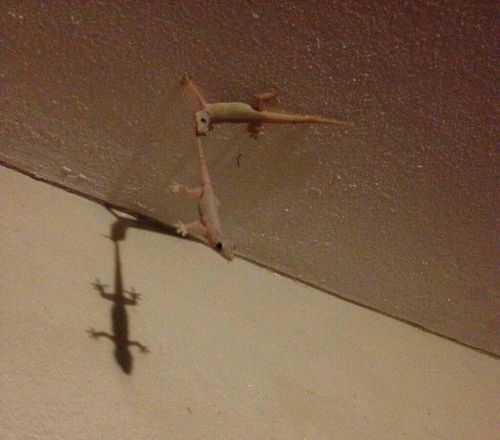
How do geckos stick to walls?
Geckos and wall climbing come down to millions of microscopic hair-like structures called setae on the bottoms of their feet. Each seta is about 100 micrometers long and splits at the tip into hundreds of even smaller branches called spatulae. A single gecko foot has approximately 500,000 setae, producing roughly 1 billion spatulae per gecko.
Walking on Glass
A tokay gecko weighs roughly 300 grams. Place it on a vertical pane of polished glass and it walks up the surface without slowing down. Flip the glass upside down and the gecko walks across the underside as if gravity were a suggestion rather than a law.
This is not magic and not suction. It is not glue, not claws, not some hidden biological adhesive the gecko secretes. The mechanism that lets geckos climb smooth vertical glass is quantum mechanical - the same physics that determines how atoms interact with other atoms at the scale of billionths of a meter.
Understanding how geckos stick to walls is one of the stranger discoveries in biology. The answer turns out to be that gecko feet exploit physical forces so fundamental that they act on every surface in the universe, just too weakly to matter unless you have about a billion contact points to work with.
The Problem to Solve
Climbing vertical surfaces requires solving several physics challenges:
Friction is not enough. Smooth glass offers almost no friction. Claws cannot grip it. The surface has no irregularities for hooks or pads to catch on.
Suction is limited. Vacuum suction cups work on non-porous surfaces but require a sealed edge and air-pressure differential. They fail on porous, textured, or dusty surfaces - and anyway, geckos do not form suction seals.
Adhesives are permanent. Chemical adhesives like glue bond surfaces together but must be removed actively. A gecko that glued itself to a wall could not walk.
The solution geckos evolved works on virtually any solid surface, activates and deactivates instantly with foot movement, produces no residue, and requires no external energy to maintain.
Setae: The Microscopic Hairs
Under a microscope, a gecko's foot reveals structure invisible to the naked eye.
The hierarchy:
- Toe pads (lamellae): Flat, broad pads on the underside of each toe, visible to the naked eye
- Setae: Microscopic hair-like structures densely packed across each lamella. Each seta is about 100 micrometers long and 5 micrometers wide
- Spatulae: Microscopic branches at the tip of each seta. Each seta splits into hundreds of spatulae. Each spatula is 200 nanometers across - close to the wavelength of visible light
The numbers:
- Setae per gecko foot: approximately 500,000
- Spatulae per seta: approximately 1,000
- Total spatulae per gecko: roughly 1 billion
This extraordinary density of contact points is the key to the whole mechanism.
Material:
Setae are made of beta-keratin, the same protein as hair, feathers, and fingernails. They are stiff but flexible - like tiny hairs that can bend against a surface without breaking.
Van der Waals Forces
The physical force that holds geckos to walls is called the van der Waals interaction.
What it is:
Van der Waals forces are weak electromagnetic attractions between any two molecules. They arise because electrons orbiting atoms create brief, fluctuating charge distributions. A momentary positive charge on one atom induces a momentary negative charge on a nearby atom, producing a brief attraction.
These fluctuations happen on every atom, all the time. Every object attracts every other object through van der Waals forces. Usually we do not notice because the forces are vanishingly small at the scale of everyday life.
Why they matter for geckos:
Van der Waals attraction strength increases dramatically as atoms get closer. The force operates at distances measured in nanometers - one-billionth of a meter.
A gecko's spatulae are small enough to get within van der Waals range of surface molecules. When billions of spatulae simultaneously approach to within a few nanometers of a wall's surface, the cumulative attraction becomes enormous.
The calculation:
Each spatula individually produces only a tiny adhesion force. But with 1 billion spatulae per gecko, the total force is staggering.
Measured values:
- Maximum adhesion force per foot: approximately 20 Newtons
- Maximum load a single gecko foot can support: up to 130 kg
- Body weight of a tokay gecko: 0.3 kg
A single gecko foot can theoretically support a load 400 times the gecko's body weight. Real-world climbing uses only a fraction of this capability, providing a huge safety margin.
How the Foot Activates
Gecko adhesion is not constant - it activates only when the foot is pressed correctly.
The pressing phase:
When a gecko places a foot on a surface, it does not slam it flat. Instead, setae press against the surface at a shallow angle (roughly 30 degrees). This shallow pressing ensures spatulae come into maximum contact with surface irregularities.
Once pressed, the gecko applies a slight backward shear force - pulling the toe slightly backward. This shear motion forces spatulae to fully engage with the surface, maximizing van der Waals contact.
The holding phase:
While the foot is holding, adhesion is automatic. Van der Waals forces do not require active energy to maintain. The gecko can relax its muscles and the foot stays stuck.
The release phase:
To detach, the gecko changes the angle between setae and surface. When setae rotate past approximately 30 degrees, spatulae peel away from the surface and van der Waals contact breaks almost instantly.
This is why geckos curl their toes upward when lifting a foot. The curling motion rolls setae off the surface at the critical release angle, breaking adhesion smoothly.
Timing:
A gecko can step forward in under 20 milliseconds. Adhesion activates and releases essentially in real time with foot movement. This is why geckos can run up walls at speeds over 1 meter per second without any slowing at the transition from horizontal to vertical.
What Surfaces Work
Gecko adhesion works on almost any solid surface.
Works well:
- Glass (polished or frosted)
- Painted walls
- Polished stone
- Wood
- Tree bark
- Leaves
- Metal
- Plastic (most kinds)
Works poorly:
- Teflon (molecular structure produces very weak van der Waals interaction)
- Dusty surfaces (dust blocks setae contact)
- Oily surfaces (oil film prevents direct contact)
- Ice (constantly shedding water layer)
Mixed results:
- Wet surfaces (depends on surface type)
- Underwater (some geckos can still stick)
The fact that Teflon specifically defeats gecko adhesion was an important clue in the 2000 Stanford study that confirmed van der Waals forces as the mechanism. Teflon's unique molecular structure produces minimal van der Waals attraction - exactly what happens when you rely on those forces for adhesion.
Self-Cleaning Feet
Gecko feet maintain their adhesive performance despite living in dusty environments - a property that has puzzled engineers trying to copy the mechanism.
The self-cleaning discovery:
In 2005, researchers at Lewis & Clark College published a study showing that gecko setae clean themselves through walking.
The mechanism:
When dust or dirt sticks to setae, the particles are held by van der Waals forces between dirt and seta. When the gecko places its foot on a surface, dirt particles come into contact with that surface.
Van der Waals attraction between the dirt and the larger surface is often stronger than attraction between the dirt and the seta. When the foot lifts, dirt stays on the surface, and the seta comes away cleaner than before.
Implications:
Geckos do not need to groom their feet. They do not lick them, wash them, or clean them in any active way. Walking itself cleans the feet automatically.
This is one of the most elegant properties of gecko adhesion and one of the hardest to replicate in engineering. Synthetic gecko tape loses performance rapidly when contaminated because no equivalent self-cleaning mechanism has been successfully engineered.
Biomimicry and Technology
Gecko adhesion has inspired decades of engineering research.
Gecko-inspired tape:
Multiple research groups have produced synthetic materials that mimic gecko setae structure:
- Pillars of polymer material with sizes and spacing similar to gecko setae
- Arrays of carbon nanotubes functioning as artificial setae
- Layered polymer films with micro- and nano-structures
The best synthetic gecko tape can hold 45 kg per square centimeter - comparable to or exceeding real gecko feet in raw strength. But synthetic versions generally:
- Lose performance after repeated use (real setae last years)
- Lack self-cleaning properties
- Perform poorly in contaminated conditions
- Work only within narrower temperature ranges
Climbing robots:
Stanford and DARPA have funded robotic systems that use gecko-inspired adhesion:
- Stickybot: a robot that climbs glass walls using gecko-inspired toe pads
- Z-Man program: human climbing aids using gecko-style adhesion
- Space debris grippers: robotic systems for capturing tumbling objects in orbit
Medical applications:
Gecko-inspired adhesives have potential for medical use:
- Wound closure without sutures or staples
- Internal bandages that bond to wet tissue
- Drug delivery patches that conform to body surfaces
- Surgical grippers that hold delicate tissue without crushing
The medical appeal is that van der Waals adhesion works on wet surfaces and leaves no chemical residue - key advantages over traditional adhesives for biological tissue.
Evolution of Gecko Feet
Not all lizards have gecko feet. The structure evolved specifically in geckos and a few other climbing lizard groups.
Phylogenetics:
Setae-based adhesion evolved independently multiple times in geckos. Different gecko species have slightly different seta structures, suggesting convergent evolution toward similar solutions.
Some gecko species have lost adhesive pads entirely - typically ground-dwelling geckos that do not need to climb. This loss has happened repeatedly across gecko lineages.
Other climbers:
A few non-gecko lizards have independently evolved similar adhesive structures:
- Anoles (genus Anolis) in the Americas
- Some skinks in Australia
- Some arboreal iguanas
In each case, the microstructural details differ, but the principle - massive numbers of tiny hairs generating van der Waals adhesion - is similar. This is a classic example of convergent evolution, where unrelated species arrive at similar solutions to similar problems.
Why insects are different:
Many insects can also climb walls, but they use different mechanisms. Flies use adhesive pads with sticky fluid secretions. Beetles often use setae similar to geckos but with different chemistry. Spiders use both van der Waals adhesion and mechanical interlocking with surface irregularities.
The Physics of Billions
The ultimate lesson of gecko adhesion is about the power of small forces multiplied.
Van der Waals forces act between every pair of molecules in the universe. They are real, they are universal, and they are almost always too weak to notice. A single atom cannot hold itself to a surface through van der Waals attraction alone - the force is vanishingly small.
But geckos demonstrate that with enough contact points, even the weakest fundamental forces become powerful. One billion spatulae, each generating a tiny attraction, produce enough total force to hang a gecko from smooth ceiling indefinitely.
This principle - strength through multiplication - appears throughout biology. Muscles generate macroscopic force through billions of molecular contractions. Blood oxygen transport works through billions of hemoglobin molecules each carrying a few oxygen atoms. Digestion breaks food apart through trillions of enzyme interactions.
Gecko feet are biology discovering, through evolution, that you can exploit even the weakest universal force if you organize enough contact points to use it. The fundamental physics is not mysterious. The remarkable thing is that a lizard with a brain smaller than a pea evolved to solve problems using quantum-level phenomena that humans only began to understand in the 20th century.
Gecko Adhesion Performance by Species
Van der Waals adhesion performance varies dramatically across gecko species, with the tokay gecko and the day geckos of Madagascar producing the strongest documented adhesion. Our research team compiled adhesion performance data from published peer-reviewed studies.
| Species | Setal Density (per mm2) | Max Pad Shear Stress (kPa) | Body Mass (g) | Safety Factor |
|---|---|---|---|---|
| Gekko gecko (tokay) | 14,400 | 578 | 230 | 16x body weight |
| Phelsuma (day geckos) | 12,000 | 450 | 25 | 21x body weight |
| Hemidactylus (house geckos) | 8,500 | 320 | 6 | 11x body weight |
| Pachydactylus (thick-toed) | 7,200 | 280 | 12 | 9x body weight |
| Eublepharis (leopard geckos) | 0 (no setae) | - | 65 | Cannot climb smooth |
The tokay gecko (Gekko gecko) produces the highest absolute adhesive force of any measured gecko species - a single tokay toe can support approximately 20 Newtons of pulling force, meaning the animal could theoretically support 200 times its own weight from a single toe if all setae engaged simultaneously.
Biomimetic Gecko Tape and Industrial Applications
A 2014 study published in the Journal of the Royal Society Interface by researchers at Stanford University documented the first synthetic dry adhesive capable of supporting an adult human against a vertical glass wall - a 16-pad pair of gecko-inspired mushroom-tipped pillars that mimicked the setal branching of natural gecko feet [1].
"Gecko-inspired adhesives are fundamentally different from conventional tape. They do not use chemical glue. They rely on intimate contact between microscale features and the target surface, which means they can be used and reused thousands of times, work underwater, adhere to glass, plastic, metal, and rough surfaces, and leave no residue. The potential industrial applications are enormous." - Dr. Mark Cutkosky, Stanford Biomimetics and Dexterous Manipulation Laboratory [1]
Commercial applications of gecko-inspired adhesives have emerged in several sectors. Surgical wound closure bandages using mushroom-tip adhesive designs have entered regulatory approval processes. Robotic grippers for delicate component manufacturing, climbing robots for infrastructure inspection, and reusable mounting systems for satellites are all active development targets.
The Evolution of Adhesive Pads
A 2012 phylogenetic analysis by Aaron Bauer and colleagues published in Proceedings of the Royal Society B demonstrated that adhesive toe pads evolved and were subsequently lost multiple times within the gecko family, with at least 9 independent gains and 11 independent losses across the 2,000 gecko species examined [2].
"The gecko adhesive pad is one of the most evolutionarily labile structures we have studied in any vertebrate lineage. It appears and disappears repeatedly across the gecko phylogeny, suggesting that the genetic machinery for building it is preserved but only deployed when ecological pressures favor arboreal climbing. Ground-dwelling geckos consistently lose the ability within a few million years of transitioning to terrestrial habitats." - Dr. Aaron Bauer, Villanova University [2]
This evolutionary pattern suggests that the core genetic program for gecko adhesion can be selectively turned on or off through regulatory changes, without the need to reconstruct the underlying developmental machinery. The finding has implications for understanding how complex biological structures can be retained in a latent state across evolutionary time.
References
- Hawkes, E. W., Eason, E. V., Christensen, D. L., & Cutkosky, M. R. (2015). Human climbing with efficiently scaled gecko-inspired dry adhesives. Journal of the Royal Society Interface, 12(102), 20140675. DOI: 10.1098/rsif.2014.0675
- Gamble, T., Greenbaum, E., Jackman, T. R., et al. (2012). Repeated origin and loss of adhesive toepads in geckos. PLOS ONE, 7(6), e39429. DOI: 10.1371/journal.pone.0039429
- Autumn, K., Liang, Y. A., Hsieh, S. T., et al. (2000). Adhesive force of a single gecko foot-hair. Nature, 405(6787), 681-685. DOI: 10.1038/35015073
- Autumn, K., Sitti, M., Liang, Y. A., et al. (2002). Evidence for van der Waals adhesion in gecko setae. Proceedings of the National Academy of Sciences, 99(19), 12252-12256. DOI: 10.1073/pnas.192252799
Related Articles
- Chameleon Vision: How They See Two Directions at Once
- Spider Silk: Stronger Than Steel by Weight
- How Flies Walk on Ceilings
Frequently Asked Questions
How do geckos stick to walls?
Geckos stick to walls using millions of microscopic hair-like structures called setae on the bottoms of their feet. Each seta is about 100 micrometers long and splits at the tip into hundreds of even smaller branches called spatulae. A single gecko foot has approximately 500,000 setae, producing roughly 1 billion spatulae per gecko.
These structures get close enough to surface molecules that weak electromagnetic forces called van der Waals interactions hold the foot in place. Van der Waals forces are individually tiny but collectively enormous when distributed across billions of contact points. A tokay gecko can support up to 130 kg of weight using a single foot - far more than its own body weight of 0.3 kg.
The adhesion works on virtually any surface, including smooth glass, Teflon (with limitations), and even underwater surfaces.
Can geckos stick to any surface?
Geckos can stick to almost any surface, with a few notable exceptions. They stick easily to glass, polished stone, painted walls, tree bark, leaves, and most building materials. They can even hang from smooth glass by a single toe. However, geckos struggle with certain surfaces. Teflon (polytetrafluoroethylene) is the main surface that defeats gecko adhesion because its molecular structure produces very weak van der Waals interactions.
Dusty or oily surfaces reduce adhesion because contaminants block direct contact between setae and the surface. Water presents mixed results - geckos can stick to wet glass but perform poorly on hydrophobic (water-repelling) wet surfaces. Ice and snow reduce grip because the smooth frozen surface layer is constantly shedding water molecules.
Overall, however, gecko adhesion is remarkably universal compared to other biological or engineered sticking mechanisms.
Why don't geckos get stuck permanently?
Geckos detach from surfaces by changing the angle between their setae and the surface. When the setae are pressed flat against a surface at a shallow angle, van der Waals forces hold firmly. When the gecko peels its foot starting from the back (toes lifting first), the angle changes and the setae disengage almost instantly.
This directional peeling is why geckos curl their toes upward when lifting a foot - they are breaking adhesion at the seta tips rather than pulling straight away from the surface. The mechanism works like Velcro in reverse: easy to release when peeled properly, extremely strong when pressed flat. A gecko can step forward in under 20 milliseconds because adhesion activates and releases almost instantly with foot movement.
This allows geckos to climb smooth vertical walls at speeds over 1 meter per second.
What are gecko feet used for in technology?
Gecko-inspired adhesion technology is an active research area called biomimicry. Engineers have developed reusable tape that mimics gecko setae, climbing robots that scale smooth walls, medical devices for attaching to tissue without chemicals, and industrial grippers for handling delicate objects. The US military DARPA program has funded human climbing aids based on gecko adhesion.
Companies have produced gecko-inspired tape that can hold 45 kg per square centimeter. NASA has tested gecko-like grippers for grabbing space debris and securing astronauts to spacecraft surfaces. Medical adhesives inspired by gecko feet can bond to wet tissue inside the body without inflammation.
Despite significant progress, synthetic gecko adhesive still underperforms real gecko feet in key ways - real setae self-clean, last for years, and work across temperature ranges that synthetic versions cannot match.
How do geckos keep their feet clean?
Gecko feet are self-cleaning - a remarkable property that engineers have struggled to replicate. When dust or dirt particles stick to gecko setae, the act of walking and detaching the foot from surfaces removes most contaminants. Each detachment cycle leaves dirt behind on the previous surface because van der Waals adhesion between the dirt and the surface is often stronger than between the dirt and the setae.
This self-cleaning mechanism was discovered in 2005 by researchers at Lewis & Clark College. It allows geckos to maintain adhesive performance despite living in dusty environments without grooming their feet like cats or dogs do. Setae also resist contamination because they are hydrophobic (water-repelling), preventing many chemical contaminants from bonding.
Synthetic gecko tape loses adhesion quickly when contaminated, which is one of the main unsolved problems in gecko-inspired adhesion technology.