
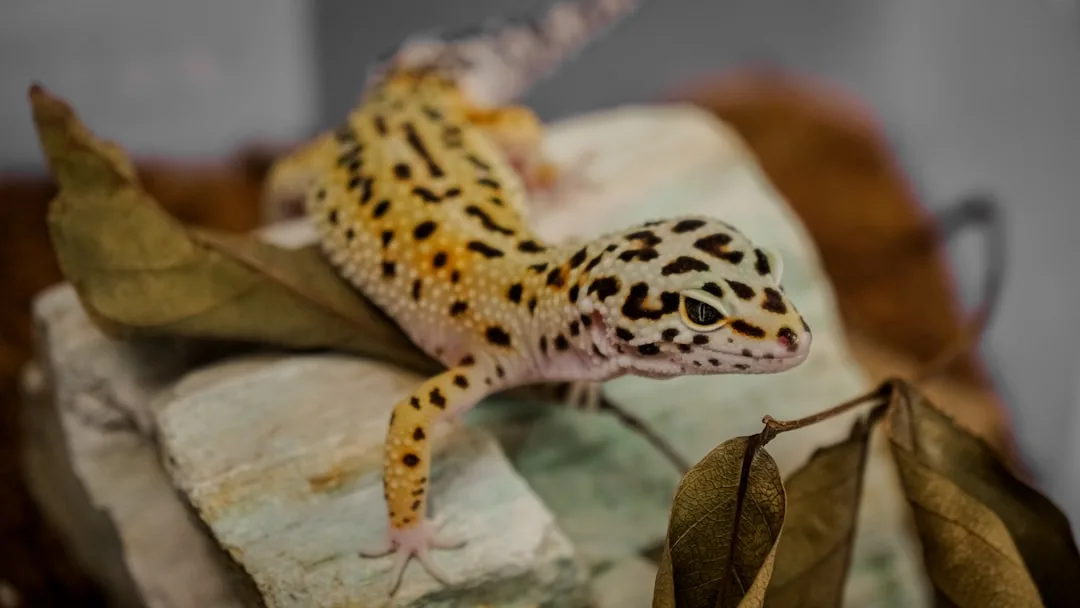
The leopard gecko is one of the strangest reptiles many people never realise they are looking at. It is a gecko that cannot climb walls. It is a gecko with eyelids. It stores fat in its tail, drops that tail when frightened, regrows it in a cheaper form, and has been bred in captivity for so long and through so many generations that it is now the most common reptile pet on Earth.
It was also the first reptile to have its entire genome sequenced and assembled at chromosome resolution, a milestone that makes it a quiet celebrity of modern comparative genomics.
This guide covers every aspect of Eublepharis macularius: taxonomy, anatomy, ecology across its native range in central and south Asia, hunting and diet, reproduction with its temperature-driven sex determination, the extraordinary defensive mechanism of tail autotomy, conservation status, and the roughly three decades of intensive captive breeding that have produced the morphs seen in pet shops today.
It is a reference entry, not a pet-care brochure, so expect specifics: centimetres, grams, temperatures, incubation durations, and generational counts.
Etymology and Classification
The genus name Eublepharis is Greek for 'true eyelid', a reference to the feature that separates this family from almost every other gecko on the planet. The species epithet macularius comes from Latin macula, meaning 'spot' or 'blemish', referring to the black spots scattered across the adult's yellow ground colour. Combined, the scientific name translates roughly to 'spotted true-eyelid'.
The species sits in the family Eublepharidae, which contains about thirty species across Asia, Africa, and Central America. All members of this family share two features almost absent elsewhere in the gecko lineage: functional eyelids and a complete lack of adhesive toe pads.
In evolutionary terms Eublepharidae represents an early branch of gecko diversification that retained the ancestral reptile eyelid rather than losing it, and never acquired the setae-covered feet that gave other geckos their famous wall-climbing ability.
Five subspecies of Eublepharis macularius are typically recognised based on geographic variation in colour and pattern: E. m. macularius, E. m. fasciolatus, E. m. afghanicus, E. m. montanus, and E. m. smithi. Most captive leopard geckos trace to E. m. macularius from Pakistan, with intermittent genetic contributions from the other forms.
Size and Physical Description
Leopard geckos are small but stocky lizards. Their build is unusual among geckos: robust body, short strong legs, a broad triangular head, and a conspicuous tail that is often almost as wide as the body itself in healthy adults.
Adults:
- Length: 18-28 cm total, with tail making up roughly 40 per cent
- Weight: 45-80 g typical, 90-110 g in selectively bred giant morphs
- Head length: 3-4 cm
- Lifespan: 6-8 years wild, 10-20 years captive
Hatchlings:
- Length: 7-9 cm
- Weight: 2-4 g
- Colour: strongly banded yellow and dark brown - the leopard spotting develops during juvenile growth
The classic wild-type coloration is a pale to bright yellow ground covered in irregular black spots, fading to a white underside. Juveniles hatch with bold transverse bands of brown or black on yellow, a pattern that breaks up into the adult spotted form during the first year of life. This ontogenetic pattern shift is thought to function as camouflage: banded juveniles resemble the striped pebble shadows of rocky terrain, while spotted adults match dappled lichen-covered stones.
Their eyes are large and expressive, with vertical pupils that dilate to wide ovals in low light. The iris varies from pale silver to deep amber, and movable eyelids cover the eye when closed. No other widely kept pet gecko possesses functional eyelids.
Built for Rocky Semi-Arid Life
Leopard geckos are native to a narrow band of rocky, semi-arid terrain running from eastern Iran through Afghanistan, across Pakistan, and into the northwestern states of India. This is not the rolling dune desert of popular imagination - it is hardpan, gravel, scattered scrub, broken rock, and low grasses, with seasonal extremes from roughly minus 5 degrees Celsius in winter to over 40 degrees Celsius in summer.
Key habitat features:
- Loose stones and rocky crevices for daytime shelter
- Sparse low vegetation for cover
- Firm ground rather than shifting sand
- Seasonal temperature swing of 40+ degrees Celsius
- Moderate rainfall (150-400 mm annually)
Leopard geckos are strictly terrestrial. They cannot climb smooth surfaces because they lack the setae - the microscopic hair-like branching structures - that give most other geckos their adhesive ability. Their feet carry five clawed toes adapted for running across sand, gravel, and rock. This single anatomical difference shapes almost every aspect of their behaviour.
They shelter in ground-level crevices rather than on tree trunks. They hunt low to the ground rather than on walls. They are caught by ground-dwelling predators rather than arboreal ones.
During the hottest hours leopard geckos retreat into rock crevices, beneath stones, or into burrows abandoned by small mammals. They emerge at dusk and hunt through the night, returning to shelter at dawn. In the coldest months (November to February across most of the range) they brumate - a reptile form of dormancy - deep in crevices below the frost line. During brumation body temperature, metabolism, and heart rate all drop sharply, and the gecko survives on fat reserves stored in its tail.
The Eyelid Question
It is worth spending some time on the eyelids, because they genuinely are remarkable among geckos.
Most geckos have a transparent scale called a spectacle or brille fused over the eye, just as most snakes do. They cannot blink. Because they cannot blink, they cannot wipe the eye clean mechanically, and they solve this problem by periodically licking the eye surface with their tongue. You see it often in tokays, crested geckos, and day geckos.
Leopard geckos do not need to lick their eyes clean because they have eyelids that close fully and open cleanly. They blink, squint, wink, and shut their eyes to sleep. When sand blows or dust settles, they close their eyes. When they are threatened, they can stare intensely with both eyes wide, or close their eyes in a display that appears to function as submission.
The evolutionary trade-off is instructive. Spectacle scales protect the eye from scratches and drying but require cleaning. Eyelids offer active protection and automatic lubrication but add moving parts and a slightly more complex embryology. Each solution suits a different ecological niche. Spectacles suit arboreal species that squeeze through bark and leaves. Eyelids suit ground-dwellers that encounter wind-blown sand and debris.
Hunting and Diet
Leopard geckos are obligate insectivores. They eat live invertebrates exclusively in the wild, and their digestive system is not equipped to process plant matter, fruit, or vertebrate flesh in meaningful quantities.
Natural prey:
- Crickets, grasshoppers, and locusts
- Beetles and beetle larvae
- Spiders and scorpions (including some venomous species)
- Centipedes and millipedes
- Moths and caterpillars
- Occasional smaller geckos and newly hatched rodents
They hunt by a combination of sight and scent. Large eyes provide excellent low-light vision, and the tongue-flicking vomeronasal system detects scent trails along the ground. When prey is located, the gecko approaches slowly, fixes the target with both eyes (producing a characteristic binocular stare), and launches a short lunge that ends with jaws snapping shut across the prey. Larger prey is shaken aggressively or slammed against a rock before being swallowed whole.
Leopard geckos are among the few lizards known to show caudal luring in juveniles: the banded juvenile tail is waved slowly above the substrate to attract the attention of predators and rivals. Adults do not use this behaviour regularly, but the banded pattern of the juvenile tail is thought to be part of the lure mimicry.
Tooth replacement is continuous. Leopard geckos shed and regrow individual teeth on a rolling schedule roughly every three to four months, producing perhaps a hundred full sets of teeth over a long captive lifespan. Compare this with the two sets most mammals receive.
Tail Autotomy and Regeneration
Few features of the leopard gecko capture imagination like its tail.
The tail is not a simple appendage. It is a dedicated fat storage organ, a locomotor counterweight, a defensive decoy, and a signalling device. A healthy leopard gecko carries a tail that is visibly wider than the base of its hips. In lean times - drought, brumation, captive fasting - the tail thins noticeably as fat is metabolised, and a 'pencil-thin' tail is a reliable warning sign of illness or starvation.
When a leopard gecko is grabbed by the tail, or experiences sufficient stress such as a predator strike, it can voluntarily sever the tail at one of several fracture planes in the caudal vertebrae. This is called caudal autotomy, and it works like this:
- Specialised muscles at the fracture planes contract sharply.
- The tail separates with almost no bleeding, thanks to pre-configured blood vessel sphincters.
- The detached tail continues to wriggle for up to 30 minutes, driven by residual nerve activity and reflex circuits.
- The gecko escapes while the predator is distracted.
Regeneration begins almost immediately but is never perfect. The replacement tail lacks the original vertebrae; instead, it grows around a rod of cartilage. It is typically shorter, often stubbier, and its scale pattern rarely matches the original. Regrown tails take several weeks to reach their final length, and the gecko must invest significant metabolic resources to rebuild the fat store. Regeneration is also noticeably less efficient after a third or fourth autotomy event.
The autotomy response is so strong that leopard geckos should never be picked up by the tail. Even healthy captive animals will shed tails under surprisingly mild stress.
Reproduction and Temperature-Dependent Sex
Leopard gecko reproduction is governed by a biological feature that fascinates embryologists: temperature-dependent sex determination (TSD). The gecko does not have sex chromosomes in the same sense as mammals. Instead, the temperature at which an egg is incubated during a critical window in the first third of development determines the hatchling's sex.
Incubation temperature outcomes:
| Temperature | Sex ratio outcome |
|---|---|
| 26 degrees Celsius | Nearly 100% female |
| 28 degrees Celsius | Mostly female |
| 30 degrees Celsius | Mixed ratio, trending slightly female |
| 32 degrees Celsius | Mostly male |
| 33-34 degrees Celsius | Nearly 100% 'hot female' (aggressive, infertile) |
The 'hot female' phenomenon is particularly interesting. Eggs incubated at the upper end of the viable range produce phenotypic females that look like ordinary females externally but tend to behave aggressively, defend territory like males, and often fail to reproduce. In a warming climate, populations that rely on TSD can be pushed toward single-sex outcomes, a concern flagged by researchers studying crocodilians, turtles, and leopard geckos alike.
Reproductive cycle:
- Mating season: February to September in captivity, broadly similar in the wild
- Clutch size: 2 eggs per clutch
- Clutches per season: 4-8 from a healthy female
- Incubation duration: 35-89 days depending on temperature
- Female sexual maturity: 9-12 months in captivity, typically 18-24 months in the wild
Females store sperm internally and can produce fertile clutches for months after a single mating. They dig shallow nests in loose substrate, lay two elongated eggs, and abandon them - no parental care follows. Eggs are leathery rather than hard-shelled and highly sensitive to moisture as well as temperature.
Communication and Senses
Leopard geckos are often described as silent but they vocalise more than most pet reptiles.
Known vocalisations:
- Barks: Short loud calls used by males during courtship and territorial display.
- Squeaks: High-pitched calls from juveniles when startled or grabbed.
- Chirps: Quieter calls, often in hunting contexts or from females to males.
- Hisses: Defensive sounds, mouth open, often accompanied by tail waving.
Hearing is good enough to detect insect movement on substrate at short range, and vision is strongly adapted to low light. The vertical pupil dilates to near-circular in full dark and closes to a thin slit in bright light. Olfaction, mediated through the tongue and Jacobson's organ, drives prey detection, mate finding, and recognition of familiar conspecifics.
Conservation Status
The IUCN Red List classifies Eublepharis macularius as Least Concern. The species is widespread across its native range, tolerates a broad range of habitats within that range, and is not subject to major population-level threats in the wild. The captive-bred supply of leopard geckos is so enormous that wild collection pressure is essentially negligible in the pet trade, unlike many other reptile species.
Regional concerns:
- Habitat loss in parts of Pakistan and Afghanistan due to agricultural expansion
- Localised pesticide exposure reducing insect prey
- Small-scale illegal wild collection in some areas
- Climate change potentially shifting sex ratios through TSD
Compared with most reptiles in the pet trade, the leopard gecko is a conservation success story. Three decades of captive breeding have removed almost all economic pressure from wild populations. This is an argument sometimes made in favour of well-run captive breeding programmes more generally.
Captive Breeding History and Morphs
Leopard geckos have been kept as pets in Europe and North America since the 1960s, but the species was considered an exotic oddity through the 1970s. Serious captive breeding began in the 1980s, when a handful of specialist breeders established the first reliable colony-based programmes. The decisive shift came in the 1990s, when Ron Tremper and other breeders isolated the first co-dominant and recessive colour morphs and began a steady pipeline of selectively bred variants.
Key morphs:
| Morph name | Key trait |
|---|---|
| Normal / Wild-type | Yellow with black leopard spots |
| High Yellow | Reduced spotting, deeper yellow saturation |
| Tangerine | Strong orange ground colour |
| Albino (three lines: Tremper, Bell, Rainwater) | No black pigment, red eyes |
| Blizzard | Solid white or yellow with no pattern |
| Enigma | Irregular pattern, often with neurological syndrome |
| Black Night | Near-solid black melanistic form |
| Eclipse | Solid-coloured eyes |
| Giant / Super Giant | Selectively bred for large size (up to 110 g) |
Many morphs are combined to produce compound phenotypes - the 'Super Snow Tremper Albino Eclipse' is a real designation used in reptile expos. This degree of selective breeding places the leopard gecko well along the path toward true domestication. Captive generations are short enough (one year to breeding maturity) that dozens of generations have now accumulated, and behavioural differences between captive-bred and wild-caught individuals are measurable.
In 2022, a team led by researchers in China published the first full chromosome-level genome assembly for Eublepharis macularius, making it the first reptile to have its genome fully decoded at that resolution. The reference genome has opened a new chapter in comparative herpetology and has already produced findings about the genetic basis of colour morphs, tail regeneration, and TSD.
Leopard Geckos and Humans
Among reptiles, the leopard gecko has an unusually benign relationship with humans. It is not venomous. It does not bite hard enough to break adult skin. It does not carry significant zoonotic disease beyond the ordinary salmonella precautions that apply to any reptile. It tolerates handling in ways that most reptiles do not. A leopard gecko kept in good conditions from hatchling stage often becomes calm enough to perch on a hand without signs of distress.
For many reptile keepers, it is the gateway species - the first reptile they own, the one that taught them husbandry, and often the one that sparked a lifelong interest. This role is reflected in the species' ubiquity: it is stocked by almost every general pet store in the Western world, featured in countless beginner care guides, and bred at scale by commercial and hobbyist operations alike.
Responsible keeping still matters. Leopard geckos require consistent heat gradients, UVB lighting (despite older literature claiming otherwise), appropriate substrates, and a varied invertebrate diet with calcium and vitamin D3 supplementation. They live long enough - up to two decades - that impulse purchases commonly end badly for animals that outlive their owner's enthusiasm.
Related Reading
- Geckos: Wall-Climbing Marvels of the Reptile World
- How Geckos Stick to Walls
- Tokay Gecko: The Loud Neighbourhood Giant
References
Peer-reviewed and technical sources consulted for this entry include the IUCN Red List assessment for Eublepharis macularius, the 2022 chromosome-level genome assembly published in Scientific Data, foundational work on temperature-dependent sex determination in Eublepharidae published in the Journal of Experimental Zoology, breeder documentation from Ron Tremper and Phillipe de Vosjoli, and field survey data published in Herpetological Review and Zootaxa on the subspecies and range distribution of E. macularius across Afghanistan, Pakistan, and northwest India.
Frequently Asked Questions
How big do leopard geckos get?
Adult leopard geckos (Eublepharis macularius) reach 18-28 centimetres in total length, including the tail, which accounts for roughly 40 per cent of their body. Typical adult weight is 45-80 grams, with females generally smaller than males. Selectively bred ‘giant’ and ‘super giant’ morphs can exceed 100 grams and reach 30 centimetres, though these sizes are artefacts of captive breeding and unknown in wild populations.
Hatchlings emerge at just 7-9 centimetres and around 3 grams, growing steadily for the first 18 months before reaching sexual maturity.
Where do leopard geckos live in the wild?
Wild leopard geckos inhabit rocky, semi-arid grasslands, scrubland, and hardpan desert across Afghanistan, Pakistan, northwest India, and parts of eastern Iran. They avoid pure sand deserts because they cannot climb and rely on crevices, loose stones, and abandoned burrows for shelter.
Daytime temperatures in their range can reach 40 degrees Celsius in summer, falling to near freezing in winter, and the species brumates - a reptile form of dormancy - underground during the coldest months. Unlike most geckos, they are ground-dwelling and spend almost no time in trees or on vertical surfaces.
Why do leopard geckos have eyelids when other geckos don't?
Leopard geckos belong to the family Eublepharidae, whose name literally means ‘true eyelid’. This family retains a feature lost in most other gecko lineages: functional, movable eyelids that allow them to blink and close their eyes. The trade-off is that they cannot use the lick-clean method that eyelid-less geckos rely on to keep their eye surface moist and free of debris.
Eyelids provide better protection against sand and desert grit, which fits their ground-dwelling habitat, whereas most geckos evolved to live on bark, leaves, and walls where dust is less of an issue.
Can leopard geckos climb walls like other geckos?
No. Leopard geckos lack the setae-covered toe pads that allow species like tokay geckos or house geckos to cling to vertical surfaces. Their feet carry claws instead, optimised for running across sand, gravel, and rocky terrain. This is one of the reasons they became such popular pets - a simple open-topped terrarium is sufficient to house them, and escapes up the glass are physically impossible.
In the wild they climb low rocks and into crevices, but they cannot ascend smooth or vertical surfaces.
How long do leopard geckos live?
In captivity leopard geckos routinely live 10-20 years with good husbandry, and the oldest documented captive specimen reached 27 years. Wild lifespans are much shorter at 6-8 years on average due to predation, parasites, and harsh seasonal conditions. The enormous gap between wild and captive longevity reflects how low-stress captive life can be for a species that evolved to handle drought, temperature extremes, and constant predator pressure.
Females that are bred hard every season tend to live shorter lives than those kept as non-breeding pets.
How is the sex of a leopard gecko determined?
Leopard geckos use temperature-dependent sex determination (TSD), like crocodiles and many turtles. Eggs incubated at around 26 degrees Celsius produce almost all females. Eggs incubated at 30 degrees Celsius produce a mixed ratio. Eggs incubated at 32-33 degrees Celsius produce mostly males. Eggs incubated at 34 degrees Celsius produce a population of unusually aggressive, infertile ‘hot females’.
This biological fact has profound implications in a warming climate and is a major reason the species is studied in reproductive research.
Why is the leopard gecko's tail so fat?
The thick tail is a dedicated fat storage organ. In the wild, leopard geckos experience long fasting periods during brumation and during dry summer months when insect prey is scarce. Fat stored in the tail sustains the gecko through these stretches. A plump, well-proportioned tail indicates a healthy animal, while a thin, wrinkled tail signals poor condition.
When a leopard gecko drops its tail as a defensive reflex, it loses a significant portion of its energy reserves and must rebuild them through weeks or months of heavy feeding.
Are leopard geckos really domesticated?
Many herpetologists argue yes. Leopard geckos have been bred in captivity for roughly thirty to forty generations since intensive commercial breeding began in the 1970s and accelerated in the 1990s. Dozens of colour and pattern morphs - albino, blizzard, enigma, tangerine, black night, and many hybrids - exist only in captivity.
Captive leopard geckos show tamer temperaments, wider colour variation, and reduced flight responses compared to wild-caught animals. While they fall short of the genetic and behavioural overhaul seen in dogs, they are among the most domesticated reptile species on Earth.