
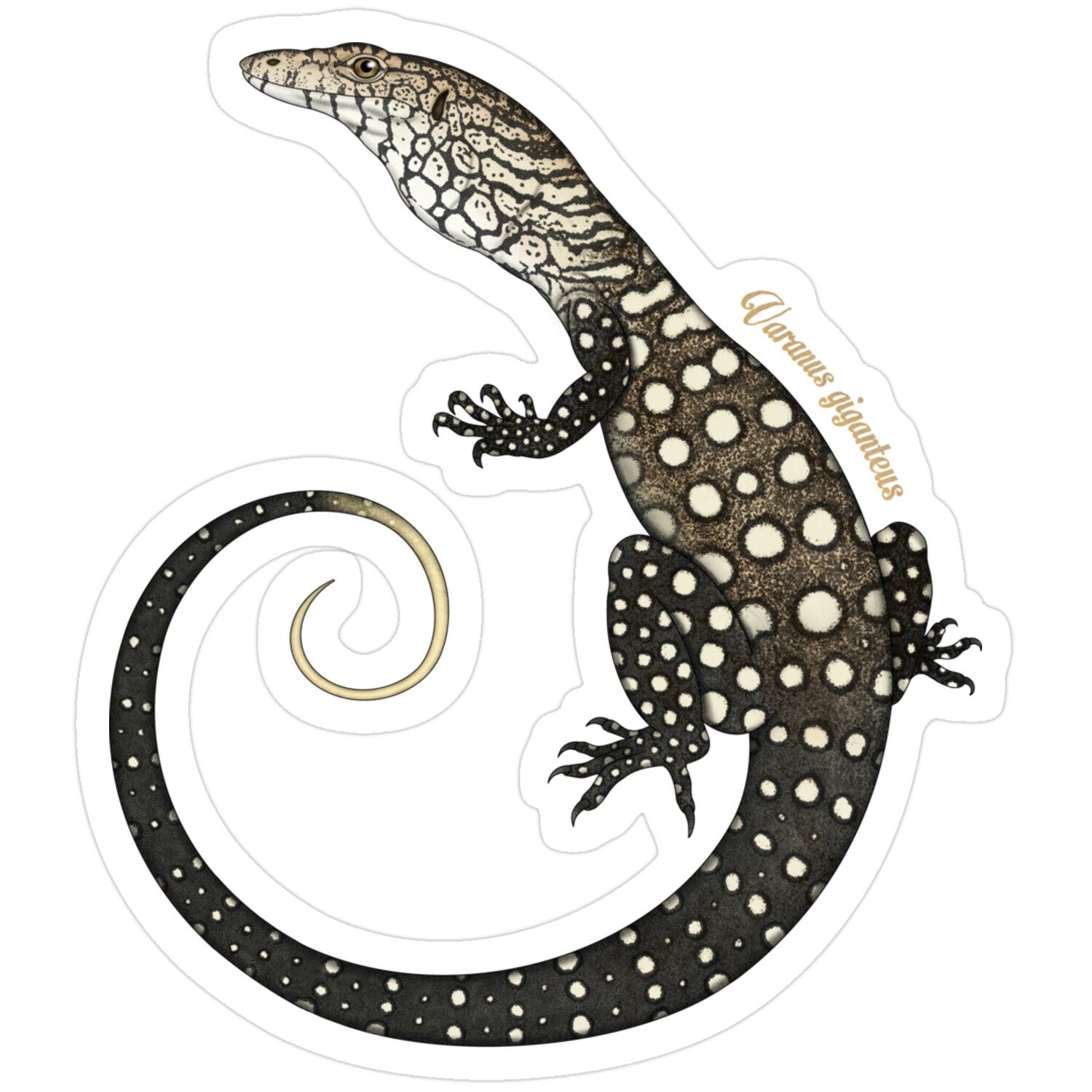
The perentie is the largest lizard in Australia and the fourth-largest living lizard on Earth, surpassed in length and mass only by the Komodo dragon of Indonesia, the Asian water monitor, and the crocodile monitor of New Guinea.
Varanus giganteus is a desert-country apex predator, a Gondwanan relic, a venom-producing reptile, and one of the most culturally significant animals in the Aboriginal Dreamtime traditions of Central Australia. For a species this large, this long-lived, and this ecologically important, the perentie remains surprisingly little known outside its arid homeland.
This guide covers every major aspect of perentie biology: taxonomy and evolution, size and anatomy, hunting strategies, venom, reproduction, behaviour, range and habitat, cultural meaning, and conservation. It is a reference entry rather than a summary - so expect specifics: metres, kilograms, burrow depths, tooth counts, and verified records.
Etymology and Classification
The scientific name Varanus giganteus was assigned by the English zoologist John Edward Gray in 1845, working from specimens collected in the Australian interior by early colonial expeditions. Varanus derives from the Arabic waran, the root word for monitor lizards across much of the Old World, and giganteus is Latin for "gigantic" - an apt epithet for the largest member of an already oversized genus on the Australian continent.
The common name "perentie" is adapted from Aboriginal languages of Central Australia. The Pitjantjatjara and Yankunytjatjara peoples of the Western Desert call the animal Ngintaka. Other language groups use names such as Pirinti, Warrana, and Bungarra in different regions. The anglicised spelling "perentie" was in common use by pastoralists and naturalists by the 1860s.
Within Varanidae, the perentie belongs to a deep Australian radiation of monitors. Molecular phylogenies place the Australian Varanus species in a single clade that originated on the continent when Australia was still joined to the rest of Gondwana, and diversified into the huge range of living forms - from thumb-sized dwarf monitors to the giant perentie - as the continent drifted north and dried.
The closest living relatives of the perentie are other large Australian monitors such as the lace monitor (V. varius) and the sand monitor (V. gouldii), but morphological and ecological divergence from these species is substantial.
Size and Physical Description
Perenties are large, long, heavily muscled lizards built for sprinting, digging, and wrestling prey. Size differences between males and females are modest - males tend to be slightly larger and carry thicker necks - but the variation within each sex is wide.
Adults:
- Total length: 2.0-2.5 metres (largest verified approach 2.5 m; 19th century museum records claim up to 2.8 m)
- Body mass: 15-20 kg, with large males and well-fed females occasionally exceeding 20 kg
- Tail length: roughly equal to body length, acting as counterbalance and defensive weapon
- Claw length: up to 4 cm on the forelimbs, curved and non-retractable
Hatchlings:
- Snout-to-vent length at emergence: 10-12 cm
- Total length at emergence: 22-25 cm
- Mass at emergence: 30-50 grams
The perentie's body is powerful and elongate, supported on comparatively long limbs that lift the belly clear of the hot desert substrate during locomotion. The head is triangular and narrow at the snout, widening to strong jaw muscles behind the eye.
The skin is covered in small, tightly packed scales that form a network of cream-to-yellow rosettes on a rich brown or reddish-brown background, producing a mottled pattern that is strikingly effective camouflage against red desert gravel and spinifex.
The tongue is deeply forked, and the forked tip is flicked constantly during active foraging. Chemical particles collected on the tongue are transferred to the paired openings of the vomeronasal (Jacobson's) organ in the roof of the mouth, giving the perentie an extraordinarily sensitive stereochemical sense. Laboratory trials indicate perenties can discriminate between individual prey species by scent alone and can follow a wounded rabbit's blood trail across several kilometres of desert.
Built for the Red Centre
Perenties live at the limits of what any large animal can tolerate. Summer ground temperatures in the Gibson, Great Sandy, and Great Victoria Deserts routinely exceed 60 degrees Celsius at midday, while winter nights fall below freezing. Rainfall is unreliable, often less than 200 mm a year, and surface water is scarce for months at a time.
Thermoregulation strategies:
- Basking in the early morning to raise body temperature from overnight lows of 15-18 degrees Celsius to an active range of 34-38 degrees Celsius
- Shuttling between sun and shade throughout the day, using spinifex clumps, rocks, and shrub cover
- Retreating to deep burrows when substrate temperatures exceed 45 degrees Celsius
- Adopting a stilt-walking posture to lift the belly clear of hot ground during midday travel
- Reducing activity to near-zero during extreme heatwaves, with some individuals staying underground for a week or more
Perenties dig their own burrows when they have to, but they prefer to modify existing rabbit warrens, wombat burrows, or erosion cavities under boulders. A well-established perentie burrow can extend three metres or more into sandy substrate and remain five to ten degrees cooler than the surface even during the hottest months. Individual burrows are used repeatedly across years and sometimes across decades, with generations of perenties occupying favoured shelters in succession.
Water requirements are low. Perenties obtain most of their moisture from prey tissue and opportunistic drinking at waterholes and cattle troughs. Studies tracking radio-collared animals in the Gibson Desert recorded periods of more than three weeks without any observed drinking.
The Tripod Stance
One of the most distinctive behaviours of Varanus giganteus is the tripod stance: the lizard rears up on its hind legs and braces on its tail, lifting its head as much as 1.5 metres clear of the ground. This posture is used to see over spinifex hummocks, survey for rivals or predators, assess distant movement, and occasionally to intimidate other perenties.
Only a handful of lizards worldwide regularly adopt a true tripod stance. Most goannas and monitors will occasionally rear, but the perentie performs the posture with unusual ease thanks to its long, muscular tail and its relatively upright pelvic geometry. Field observers in Central Australia routinely report perenties standing motionless on their hind legs for a minute or more, turning the head slowly like a periscope, before dropping back to all fours and continuing about their business.
The tripod stance is not only a survey behaviour. Male perenties will rear and grapple chest-to-chest in ritualised combat during the breeding season, each lizard attempting to push the other off-balance while biting and clawing. These contests can last ten to thirty minutes and sometimes end with one animal suffering serious injury.
Hunting and Diet
Perenties are opportunistic apex predators. Diet studies from stomach-content analysis and scat sampling across central Australia show a remarkably broad menu that includes almost any animal small enough to be subdued.
Primary prey:
- European rabbits - introduced in 1859 and now a major food source across much of the perentie's range
- Small kangaroos, wallabies, and juvenile euros
- Feral cats and occasionally small foxes
- Other monitor lizards, goannas, and large skinks
- Snakes, including venomous elapids such as mulga snakes
- Nesting birds, fledglings, and eggs
- Carrion from road-kill and natural deaths, including kangaroos and camels
Juvenile prey:
- Insects, particularly large grasshoppers, scorpions, and beetles
- Small skinks, geckos, and dragons
- Nestling birds and eggs
- Small mammals including dunnarts and rodents
Hunting techniques:
- Active foraging. The perentie walks widely across its home range, flicking its tongue constantly to sample scent. When a promising trail is detected, the lizard follows it to burrows, nests, or carcasses.
- Ambush near water. Perenties take advantage of animals concentrating at remote waterholes by waiting in cover downwind of approach trails and sprinting out at close range.
- Burrow excavation. Strong claws and powerful forelimbs let the perentie tear open rabbit warrens and small mammal burrows, reaching prey that cannot be caught in the open.
- Scavenging. Road-killed kangaroos and natural carcasses attract perenties from long distances; several individuals may feed on a single carcass in rough hierarchical order determined by body size.
Success rates and hunting frequency have been quantified in several radio-telemetry studies. A large adult perentie eats one substantial meal every seven to fourteen days on average, with intake weighted heavily toward rabbits in rabbit-dense country and toward reptiles and birds where rabbits are sparse. Large meals can represent more than 25 per cent of the lizard's body mass at a single sitting.
Venom
Until 2005, monitor lizards were generally considered non-venomous. Their occasional role in fatal bites - particularly bites by Komodo dragons - was attributed to septic infection from bacteria in the mouth. Work by Bryan Fry and colleagues at the University of Melbourne, published from 2006 through 2009, demonstrated conclusively that large varanids including the perentie possess paired mandibular venom glands and secrete genuine toxins.
Confirmed venom effects:
- Lowered prey blood pressure through vasodilation
- Anticoagulation - wounds bleed profusely and do not clot normally
- Muscle paralysis at higher doses
- Localised swelling and inflammation
The venom is delivered through grooves along the perentie's recurved teeth rather than through specialised fangs. Envenomation is probabilistic: small bites may inject little venom, while deeper wounds on major prey introduce significant doses. The ecological role is to exhaust and disable prey that escape the initial strike, giving the lizard time to relocate and finish the kill.
In practical terms for humans, a perentie bite causes deep puncture wounds, prolonged bleeding, and significant pain, but envenomation is not medically serious for healthy adults.
This discovery had major implications beyond monitor biology. It fed into a broader reassessment of reptile venom evolution, including the theory that a single ancestral toxicofera clade gave rise to snake, lizard, and some archaic reptile venoms.
Reproduction and Life Cycle
Perentie reproduction is tied to the brief, unpredictable productivity pulses that follow major rainfall events in arid Australia. Courtship and mating typically occur in the early summer wet season. Males locate females through scent trails and engage in ritualised wrestling contests for access.
Nesting:
After copulation, the female carries developing eggs for roughly four to six weeks. Clutches of 6-13 large, leathery eggs are laid deep inside active termite mounds. The female uses her forelimbs and snout to excavate a chamber through the hard termite-built structure; after laying, the termites seal the breach, inadvertently providing near-perfect incubation conditions.
Termite mound interiors maintain a stable temperature of roughly 30 degrees Celsius and controlled humidity throughout the year, regardless of external desert extremes.
Incubation lasts approximately eight months. Hatchlings emerge at the start of the following warm season by clawing their way out of the mound, a process that can take several days.
Juvenile survival and growth:
Hatchlings are immediately independent. They disperse into loose cover and feed on insects and small lizards. Mortality during the first year is high and driven by predation from raptors, dingoes, foxes, feral cats, and cannibalism by adult perenties. Growth is rapid: body length roughly doubles in the first year.
Sexual maturity is reached at approximately four years of age. Females typically produce one clutch every one to two years when conditions allow, with reproductive output strongly tied to rainfall and prey availability.
Range, Habitat, and Home Ranges
Perenties occupy a vast but discontinuous range across the Australian interior. The core of their distribution covers the central and western deserts, including the Pilbara, the Great Sandy Desert, the Gibson Desert, the Great Victoria Desert, the Simpson Desert fringe, and parts of the MacDonnell and Musgrave Ranges.
Habitat preferences:
| Habitat feature | Role in perentie ecology |
|---|---|
| Rocky outcrops | Shelter, nesting, basking, predator avoidance |
| Deep sandy substrates | Burrowing, thermoregulation, egg chambers indirectly |
| Spinifex grasslands | Cover while hunting, lizard and small-mammal prey habitat |
| Termite mounds | Egg incubation sites |
| Desert waterholes | Drinking, ambush opportunities on visiting prey |
Home range data:
| Metric | Value |
|---|---|
| Adult home range (central Australia) | 0.5-6 km^2 |
| Adult home range (low prey density) | Up to 10+ km^2 |
| Daily movement (foraging days) | 1-4 km |
| Typical burrow depth | 1-3 m |
| Maximum recorded swim distance | ~100 m, multiple observations |
Perenties are absent from the fertile coastal fringes, tropical wetlands, dense eucalypt forest, and alpine regions. Their distribution ends sharply at the edges of the arid zone, reflecting both thermal preferences and prey community structure.
Behaviour, Climbing, and Swimming
Although built for running, perenties are surprisingly versatile. Large adults climb rocky outcrops, scree slopes, and occasionally trees when pursuing prey or escaping threats. Climbing ability at this body size is unusual - most monitor lizards over two metres in length are ground specialists - and reflects the fragmented, vertical structure of perentie habitat across central Australian ranges.
Swimming is another unexpected ability. Despite inhabiting the driest country on the continent, perenties readily enter water when necessary. Field observations across the Kimberley and Pilbara document individuals crossing waterholes, billabongs, and seasonal rivers up to 100 metres across. The lizard holds its head clear of the water and propels itself with side-to-side flexion of the body and tail, using the limbs as stabilisers.
Defensive behaviour is graded by the severity of the threat. A perentie that detects a predator at long range will freeze, then slip quietly into cover. At medium range it runs - reaching bursts of roughly 40 km/h over flat ground - toward a known burrow or rock crevice. At close range it rears onto its hind legs, inflates the throat, and hisses loudly.
Cornered animals bite, claw, and lash the tail, and the combination of venom, serrated teeth, and sharp claws makes a defensive perentie genuinely dangerous to dogs, feral cats, and unwary humans.
Cultural Significance
The perentie holds a central place in the Dreamtime traditions of many Aboriginal peoples of Central Australia. In Pitjantjatjara and Yankunytjatjara oral traditions, Ngintaka is a creator being - a giant perentie who journeyed across vast stretches of the desert, whose actions shaped waterholes, rocky ranges, and landmarks that remain sacred places today.
The Ngintaka Tjukurpa is one of the long song-cycles that record and transmit this story, and it anchors land rights, ceremonial obligations, and detailed geographical knowledge across generations.
The perentie is also a traditional food species. Large individuals were taken by experienced hunters, pit-roasted whole in hot coals, and shared according to customary rules of distribution. The fat in the tail and around the viscera is particularly valued, offering one of the richest concentrated energy sources available in the pre-contact desert diet.
Contemporary Aboriginal artists continue to depict the perentie and Ngintaka in painting, carving, and ceremony. Several major works by Pitjantjatjara and Anangu artists can be found in the collections of the National Gallery of Australia, the Art Gallery of South Australia, and regional art centres across the APY Lands.
Conservation Status and Threats
The IUCN Red List classifies the perentie as Least Concern, reflecting the species' broad distribution, its tolerance of disturbed pastoral landscapes, and the low human density across most of its range. Australian federal and state legislation provides blanket protection - perenties cannot be taken, killed, or exported without permits - and Indigenous co-management agreements across large tracts of the range provide additional on-ground protection.
Current threats:
- Feral predators. Foxes and feral cats take juvenile perenties and deplete shared prey. Rabbit collapses following biological control releases also reduce food availability for large adults.
- Habitat modification. Pastoral grazing alters spinifex structure and reduces small mammal diversity, affecting prey options for perenties across grazed country.
- Road mortality. Remote highways cross key perentie habitat. Large adults basking on warm bitumen are often killed by road trains and tourist vehicles.
- Wildfire regimes. Changing fire regimes in spinifex country, particularly larger and more intense fires following long droughts, can eliminate cover and concentrate prey in ways that affect lizard populations at the landscape scale.
- Illegal collection. The perentie is prized in the underground reptile trade. Large individuals with good markings are sometimes poached for illegal export to Europe, the United States, and parts of Asia.
- Climate change. Projections for Central Australia include more frequent heatwaves, compressed activity windows, and longer droughts between rainfall pulses. The long-term impact on perentie populations is uncertain but probably negative.
No subpopulations of Varanus giganteus are currently listed as threatened under Australian legislation, though population trend data outside long-term research sites remains sparse. Several Indigenous ranger programs across the Western Desert actively monitor perentie populations as part of broader biodiversity assessments on Aboriginal-managed land.
Perenties and Humans
Human encounters with perenties fall into three main categories: scientific, cultural, and incidental. Research programs based at universities in Perth, Adelaide, and Darwin have tracked individually marked animals across decades using radio telemetry, camera trapping, and genetic sampling, producing most of what modern science knows about the species.
Aboriginal ranger groups across the APY Lands, Ngaanyatjarra country, the Kimberley, and the Pilbara contribute on-ground observations, traditional knowledge, and co-authored publications that integrate Indigenous and scientific understanding.
Incidental encounters are common. Tourists driving the Great Central Road, the Tanami Track, or the Gunbarrel Highway often see perenties basking on road edges or crossing in front of vehicles. Outback campsites occasionally attract bold individuals, especially near bins or butchered carcasses. Responsible behaviour is the same as with any large wild predator: do not approach, do not feed, store food and waste securely, and give the animal a clear escape route.
Related Reading
- Monitor Lizards: The Intelligent Giants of the Reptile World
- Komodo Dragon: Facts and Deadly Venom
- Nile Monitor
- Water Monitor
References
Relevant peer-reviewed and governmental sources consulted for this entry include the IUCN Red List assessment for Varanus giganteus, the Australian Government Department of Climate Change, Energy, the Environment and Water species profile, Fry et al.
(2006, 2009) on monitor venom systems published in Nature and the Proceedings of the National Academy of Sciences, Pianka and King (2004) Varanoid Lizards of the World, and long-term field studies published in the Australian Journal of Zoology, Herpetologica, and Wildlife Research.
Cultural material is drawn from published accounts of the Ngintaka Tjukurpa prepared with and by Pitjantjatjara and Yankunytjatjara knowledge holders, including works held by the South Australian Museum and Ara Irititja.
Frequently Asked Questions
How big is a perentie?
Adult perenties (Varanus giganteus) reach a total length of 2.0 to 2.5 metres from snout to tail tip, with the longest verified specimens approaching 2.5 m and anecdotal reports - including museum records from the late 19th century - claiming up to 2.8 m. Body mass typically falls between 15 and 20 kg in healthy wild adults, though exceptional animals have exceeded 20 kg.
The tail accounts for roughly half of total length and acts as a counterbalance, prop, and defensive whip. Hatchlings emerge from the egg at 22-25 cm and grow rapidly in their first three years, reaching sexual maturity around age four.
Where do perenties live?
Perenties inhabit the arid and semi-arid interior of Australia, from the western deserts of Western Australia through the Northern Territory and into parts of South Australia, western Queensland, and far north-western New South Wales. They favour rocky outcrops, gibber plains, sandy desert with deep burrow-friendly soil, and spinifex grasslands.
Perenties are notably absent from true coastal regions, tropical wetlands, and dense eucalypt forests - they are specialists of the red centre. Home ranges of individual adults can exceed several square kilometres, centred on reliable shelter sites such as rock piles, abandoned warrens, or self-dug burrows up to three metres deep.
What do perenties eat?
Perenties are opportunistic apex carnivores that consume almost any animal small enough to swallow or dismember. Diet studies across central Australia list rabbits, small kangaroos and wallabies, feral cats, goannas and smaller monitors, snakes including venomous species, nesting birds and their eggs, large insects, and carrion from road-killed livestock.
They are effective ambush predators around water points, and scavenge aggressively on kangaroo and camel carcasses when available. Juveniles focus on insects, small skinks, and nestling birds. Large adults are capable of killing prey up to a third of their own body weight and can fast for weeks between substantial meals thanks to a slow reptilian metabolism.
Is a perentie venomous?
Yes, though the venom is not medically significant for healthy humans. In 2009 a research team led by Bryan Fry at the University of Melbourne demonstrated that perenties, along with Komodo dragons and other large monitors, possess paired mandibular venom glands that secrete anticoagulant and hypotensive compounds through grooves along the teeth. The venom lowers blood pressure, prevents clotting, and likely contributes to prey exhaustion after a bite.
This overturned the older ‘dirty mouth’ model which attributed monitor bite fatalities to septic bacterial infection. In practical terms, a perentie bite causes painful puncture wounds, prolonged bleeding, and localised swelling, but no recorded human deaths have been attributed directly to envenomation.
How long do perenties live?
Wild perenties typically live at least 20 years, with repeat-sighting studies of individually recognisable animals in the Gibson and Great Victoria deserts suggesting that some specimens approach or exceed 25 years. Captive perenties at Australian zoos have reached comparable ages under veterinary care, though the species is notoriously difficult to keep because of its size, intelligence, and environmental requirements.
Growth is rapid in the first three to four years, after which body length plateaus and mass accrues more slowly. Mortality is highest in hatchlings and juveniles, which face predation from raptors, dingoes, feral cats, and cannibalistic adult perenties.
Why is the perentie sacred to Aboriginal peoples?
The perentie, known as Ngintaka in Pitjantjatjara and under other names across Anangu, Yankunytjatjara, and Arrernte country, is a principal ancestral being in Central Australian Dreamtime traditions. The Ngintaka Tjukurpa describes the creator-perentie’s theft of a sacred grindstone and his epic journey across what is now the Central Desert, a path that created waterholes, ranges, and landmarks still known today.
For many families the perentie is a totem animal, carrying hunting rights and restrictions passed down the generational line. The species is also a traditional food source - large, slow-roasted perentie tail fat is a prized protein and one of the richest fat sources available in the arid zone.
Are perenties dangerous to humans?
Perenties are not considered dangerous to adults under normal circumstances. They are wary, fast-fleeing animals that will almost always retreat into a burrow or up a rock pile long before a person gets close. If cornered, a large perentie can deliver serious injuries through bite, tail whip, and claw raking - grown adults wield claws comparable in size to a large dog’s.
The slightly venomous bite causes significant bleeding but is not lethal to healthy humans. Small children, pets, and injured or cornered perenties are the contexts where serious incidents have occurred, and tourists at outback campsites are occasionally startled when a habituated perentie raids food stores.
What is the perentie's conservation status?
The IUCN Red List classifies the perentie as Least Concern, reflecting its wide distribution across the Australian interior and the low density of human populations across most of its range. The species is protected under Australian federal wildlife law and by every state and territory within its range.
Principal threats are habitat modification from cattle grazing, competition and prey depletion caused by feral cats and foxes, road mortality along remote highways, and poaching for the illegal reptile trade.
Climate projections for Central Australia - hotter summers, longer droughts, more intense fires in spinifex country - may compress perentie activity windows and reduce reproductive output in coming decades, though current population trends are considered stable.