
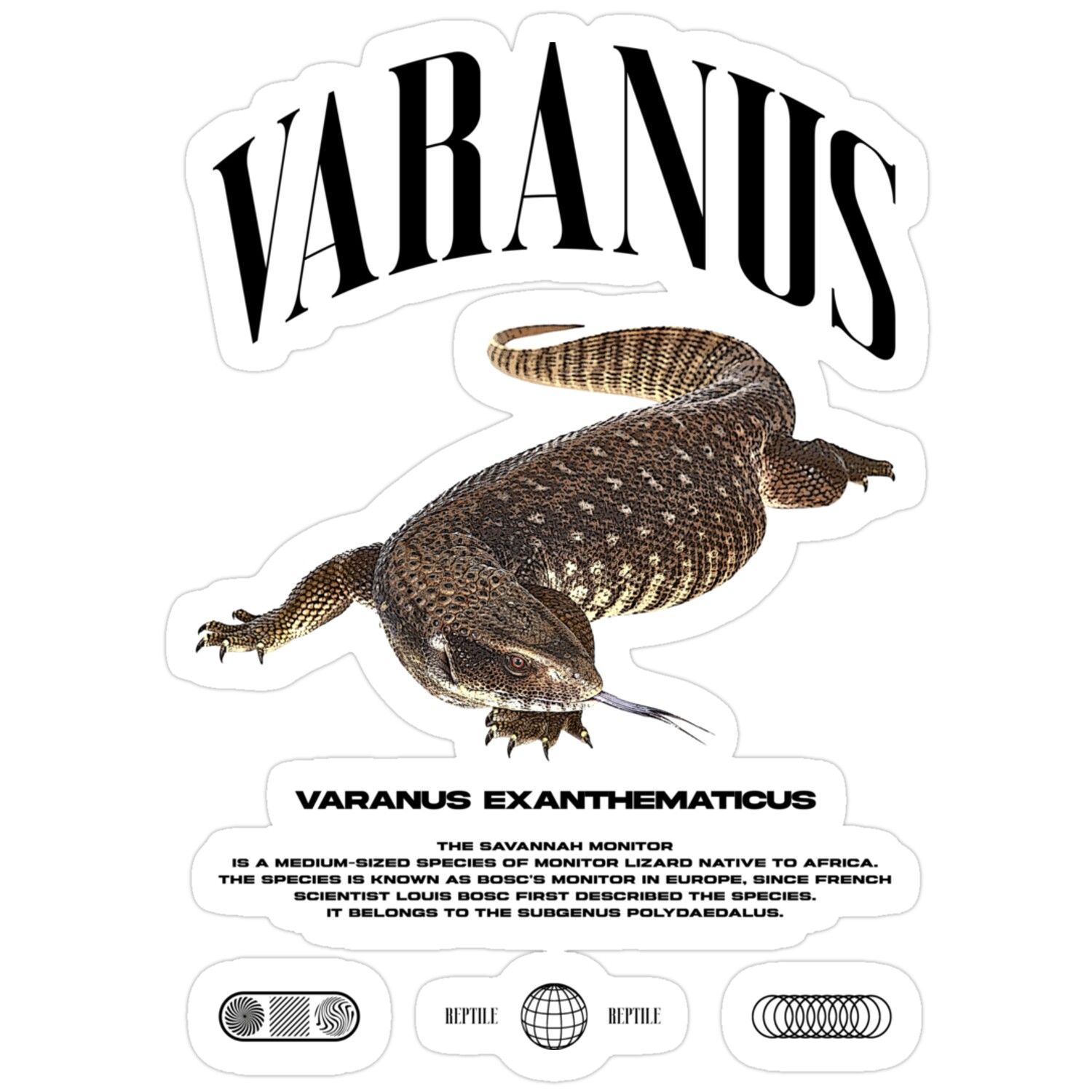
The savannah monitor is the stocky, ground-dwelling cousin of Africa's better-known water and Nile monitors. Unlike those long-bodied swimmers, Varanus exanthematicus is built low and broad, digs deep burrows, spends months of the year sealed underground in aestivation, and makes most of its living on insects, snails, and scorpions rather than fish or mammals.
It is also one of the most heavily traded reptiles on Earth, exported in the tens of thousands every year as a so-called beginner pet, with welfare outcomes that range from excellent to catastrophic depending on the keeper.
This guide covers every aspect of savannah monitor biology and ecology: taxonomy and relatives, size and body plan, the savanna environment that shaped it, its unusual invertebrate-heavy diet, the burrowing and aestivation cycle that defines its year, reproduction, intelligence, the international pet trade, and the conservation picture around farmed populations.
It is a reference entry, not a summary - so expect specifics: kilograms, centimetres, temperatures, export figures, and husbandry realities.
Etymology and Classification
The scientific name Varanus exanthematicus combines the Arabic-derived genus name Varanus, from waran meaning 'monitor' or 'warning lizard', with the Greek exanthema meaning 'eruption' or 'pustule' - a reference to the round, raised scales scattered across the lizard's neck and back, which gave early taxonomists the impression of a skin eruption.
The species was described by Bosc in 1792 based on West African specimens. In English-language herpetology the common name is spelled both 'savannah monitor' and 'savanna monitor', with the double-n form dominant in the pet trade and the single-n form more common in ecological literature.
Within Varanidae, the savannah monitor sits in the African clade alongside the white-throated monitor (V. albigularis), the Nile monitor (V. niloticus), and the short-limbed monitor (V. yemenensis). The closest relative is the white-throated monitor, which was long considered a subspecies of V. exanthematicus before molecular work separated the two.
Together they represent the dry-country African branch of the monitor family tree; their wetter cousins, the Nile and mangrove-associated species, took a very different ecological path.
Genetically the genus Varanus is extremely old and has occupied Africa for tens of millions of years. The savannah monitor lineage reflects that long residency, with body-plan features - heavy skull, short limbs, thick tail base - that converge with unrelated burrowing lizards elsewhere in the world.
Size and Physical Description
Savannah monitors are the smallest and stockiest of what biologists sometimes call the 'true monitors' - large terrestrial varanids built for an active predatory lifestyle rather than miniaturised forms like the dwarf monitors of Australia.
Adults:
- Total length: 80-100 cm typical, record 1.2 m
- Weight: 5-11 kg in wild adults, heavier in obese captives
- Tail length: slightly longer than the snout-to-vent length
- Snout-to-vent length: around 40-50 cm in typical adults
Juveniles:
- Hatchling length: roughly 10-12 cm
- Hatchling weight: around 25-40 grams
- Growth: rapid in first two years if food is available
Compared with a Nile monitor of the same mass, a savannah monitor looks almost dwarfed - it is shorter, rounder, and heavier-limbed, with a disproportionately large triangular head. The neck is shorter and thicker, the chest deeper, the belly broader. This barrel-shaped body makes the animal poor at climbing but excellent at shouldering through dense dry-country shrub. Among monitors it is the most visibly terrestrial in build, the ecological equivalent of a badger compared to a ferret.
The base colouration is a mottled grey-brown to sandy tan, with lighter circular ocelli arranged in rough bands across the back. Scattered across the neck and anterior back are the raised pustular scales that gave the species its name. The belly is paler cream or pale grey. Juveniles are often more vividly marked and can look almost golden in sunlight; adults dull with age. The tail is laterally compressed only weakly - unlike the paddle-tailed Nile monitor - because it is not used for swimming.
The skull is built for crushing rather than slicing. Jaw muscles are heavy and attach to a broad, box-shaped cranium. Teeth are conical and slightly recurved, optimised for gripping hard-shelled prey and holding struggling invertebrates. This contrasts with the long, blade-like teeth of the Komodo dragon or the serrated teeth of larger predatory monitors.
Range and Habitat
Savannah monitors occupy a wide east-west band across sub-Saharan Africa, north of the equatorial rainforest and south of the Sahara. Known range states include Senegal, Mauritania, Mali, Burkina Faso, Cote d'Ivoire, Ghana, Togo, Benin, Nigeria, Niger, Chad, Cameroon, Central African Republic, Sudan, South Sudan, Ethiopia, Eritrea, and northern parts of Uganda and the Democratic Republic of the Congo. This makes the species one of the most widely distributed large lizards in Africa.
Preferred habitats:
- Open savanna with scattered acacia or thornbush
- Dry grassland with loose sandy-loam soil
- Degraded scrub and the edges of cultivated land
- Rocky outcrops and termite-mound fields
- Seasonal wetlands (only during the rains)
Avoided habitats:
- Dense tropical rainforest
- True desert with minimal vegetation
- Permanent large river systems (used instead by Nile monitors)
- High mountain elevations above roughly 1,500 m
Within these habitats the animal's distribution is tightly linked to two resources: prey-rich soil-dwelling invertebrates and diggable substrate for burrows. Areas with compacted stony ground, saturated clay, or heavy flooding are avoided. During the wet season the lizards spread widely across the landscape; during the long dry season they concentrate near burrow sites and can be almost invisible from the surface for months at a time.
The ecological overlap with Nile monitors is real but limited. Where the two species co-occur, they partition habitat by water - Nile monitors near rivers, savannah monitors in drier uplands - and by diet.
Burrowing and Aestivation
The burrow is the single most important feature of savannah monitor ecology. Nothing else about the species makes sense without it.
The savanna environment is brutally seasonal. In the wet season, rainfall can exceed several hundred millimetres over a few months, insect populations explode, and the surface world is liveable. In the dry season, daytime surface temperatures climb above 40 degrees Celsius, soil moisture disappears, and prey densities collapse. A medium-sized ground-dwelling reptile cannot sustain itself on the surface through this period. The savannah monitor's answer is to dig down and wait.
Burrow structure:
- Depth: typically 0.5-2 m
- Length: often 1-3 m with a sharp downward angle
- Terminal chamber: widened for the lizard to turn
- Reuse: frequently extensions of abandoned rodent or warthog burrows
Burrows provide an extraordinarily stable microclimate. While surface temperatures swing from 15 degrees Celsius at night to 45 degrees at midday, burrow-chamber temperatures stay within a narrow band, often 25-30 degrees Celsius year-round. Humidity stays high enough to prevent desiccation even during months of zero rainfall.
During the dry season, adults seal themselves inside and enter aestivation. This is a reptilian form of torpor, physiologically similar to hibernation but triggered by heat and drought rather than cold. Metabolic rate drops sharply, breathing slows, digestive activity stops, and the lizard lives off stored fat reserves. Adults can remain sealed for six to eight months without eating or drinking.
Body condition at the start of the dry season therefore determines survival: a fat lizard in November is a living lizard in June; a lean one may not emerge at all.
Aestivation is not a fringe behaviour in this species. It is the central annual event, and most of the lizard's feeding, fighting, mating, and nesting activity is compressed into the three to four months per year when the burrow is open.
Diet and Feeding
Savannah monitors are hypercarnivores, but their prey base is distinctive among large varanids: it is dominated by invertebrates.
Primary prey:
- Millipedes (often the single largest dietary item by volume)
- Beetles and beetle larvae
- Grasshoppers, crickets, and other orthopterans
- Scorpions (including venomous species)
- Giant land snails (Achatina spp.)
Secondary prey:
- Small lizards and geckos
- Small snakes, including venomous species
- Amphibians during the wet season
- Bird eggs and nestlings
- Small rodents, shrews, and mammalian young
- Carrion occasionally
Juveniles are essentially pure insectivores. They emerge from the egg weighing a few tens of grams and can only tackle prey smaller than their head. As they grow, the prey size increases but the taxonomic range only widens gradually. Even adult savannah monitors remain fundamentally invertebrate specialists, which sets them apart from Nile monitors (fish and bird eggs) and water monitors (fish, rodents, and carrion).
The jaw is purpose-built for crushing hard prey. A millipede's exoskeleton, a beetle's elytra, or a scorpion's carapace will shatter under the bite force produced by the massive temporal muscles. Prey is generally swallowed whole after a short period of manipulation; large snails are sometimes cracked against rocks or held in the jaws while the foot is extracted.
Venomous prey poses a special challenge. Savannah monitors routinely take scorpions and small venomous snakes without visible distress. Their tolerance is not fully understood but appears to involve both thick skin around the mouth and a degree of biochemical resistance common across the Varanidae. This is the same family that contains the Komodo dragon, whose own oral biochemistry is well studied.
In the wet season, well-fed adults can double their fat reserves in a matter of weeks, building the subcutaneous and visceral fat stores that they will draw down during aestivation. In captivity this tendency is a liability: a savannah monitor fed ad libitum on high-fat rodent prey year-round, with no seasonal fast, rapidly becomes obese and develops fatty liver disease.
Life Cycle and Reproduction
Savannah monitor reproduction is keyed to the savanna rain cycle. Mating occurs at the end of the dry season or the start of the wet season, when adults have emerged from aestivation and food is becoming abundant.
Reproductive timeline (generalised):
- Emergence: early wet season
- Courtship and mating: over several weeks after emergence
- Egg laying: mid to late wet season
- Incubation: 5-6 months, often overlapping with the dry season
- Hatching: usually at the start of the next wet season
Males compete for females with ritualised bipedal wrestling matches, rearing up on hind legs and pushing against each other in bouts that can last many minutes. Serious injuries are uncommon; the contests function mainly to establish size dominance. Successful males follow receptive females for days, tongue-flicking along the flanks and tail.
Clutches typically contain 10-50 eggs laid in a burrow or self-dug nest chamber. Unlike Nile monitors, savannah monitors rarely nest in termite mounds, though they will reuse existing holes. The eggs are leathery and white, roughly 25-30 mm long, and weigh a few tens of grams. The female covers the nest and departs; parental care ends there.
Incubation temperature strongly influences development rate and, in some varanid species, sex ratio. Hatchlings emerge 5-6 months later, measuring 10-12 cm and weighing 25-40 grams. They are fully independent at hatching and immediately begin hunting insects. Juvenile mortality is severe: hatchlings are taken by birds of prey, snakes, carnivorous mammals, and even adult conspecifics.
Sexual maturity is reached at around two years in well-fed captives and somewhat later in the wild. Wild lifespan is estimated at 10-15 years, compressed by predation, drought-year aestivation mortality, and the energetic cost of reproducing in a harsh environment. Captive lifespan under good husbandry can extend to 15-20 years.
Intelligence and Behaviour
Monitors in general are regarded as the most intelligent lizards on Earth, and savannah monitors fit the pattern despite their reputation for being slower and less active than their aquatic relatives. Experimental work on captive animals has shown problem-solving, counting-like discrimination between quantities, individual recognition of keepers, and operant learning from food rewards.
Under natural conditions this intelligence shows up in:
- Spatial memory of burrow locations across a home range
- Seasonal timing of aestivation and emergence
- Cautious approach to large or defended prey
- Flexible responses to novel objects and sudden disturbance
Social structure is loose. Adults are largely solitary outside of mating, but home ranges overlap and individuals recognise neighbours. Confrontations between resident adults are usually resolved by posture and body inflation rather than by combat. Juveniles and subadults disperse away from areas of high adult density.
Defensive behaviour is graded. A lightly threatened savannah monitor inflates its body, hisses loudly, and lashes with the tail. A cornered one will bite and claw vigorously. Tail strikes are painful but not medically dangerous; bites can tear skin and carry bacterial load. Unlike some larger monitors, savannah monitors almost never climb to escape; they retreat into burrows instead.
Home Range and Movement
Savannah monitors have modest home ranges compared to other large varanids, reflecting their sedentary ground-dwelling lifestyle.
| Metric | Value |
|---|---|
| Typical adult home range | 5-25 hectares in productive habitat |
| Daily active distance | Usually under 1 km |
| Aestivation duration | 6-8 months sealed in burrow |
| Active season | ~3-4 months per year, mainly wet-season |
| Maximum recorded age | ~20 years in captivity |
Home range size varies strongly with habitat quality. In prey-rich wet-season conditions an animal may cover only a few hectares per week; in degraded or marginal habitat it may range much further. Movement is almost entirely on the ground. Juveniles occasionally climb low shrubs; mature adults rarely do.
Swimming is not a normal part of the species' behaviour, though they can cross water when necessary. They are slow, buoyant swimmers compared with Nile or water monitors. Crossing a river is an emergency manoeuvre, not a lifestyle.
Conservation Status and the Pet Trade
The IUCN Red List classifies Varanus exanthematicus as Least Concern on the basis of its wide range and continued presence across much of sub-Saharan Africa. The classification tells only part of the story. CITES Appendix II listing regulates international trade, and for decades the savannah monitor has been one of the most heavily traded reptiles in the world.
Trade pressure:
- Peak exports from Ghana alone reached roughly 30,000 animals per year
- Combined West African exports historically ran well into the hundreds of thousands annually
- Most animals are marked as 'ranched' or 'captive bred' in trade records
- Welfare during shipping is poor; mortality in transit can be high
'Ranching' in the varanid trade typically means that gravid wild females are collected, kept briefly while they lay eggs, and those eggs or hatchlings are then exported as captive-produced stock. True multi-generational captive breeding of savannah monitors is uncommon because wild-caught imports are cheaper and faster to supply.
The result is that the pet trade effectively functions as a continuous drain on wild populations, channelled through farms and dealers that obscure the underlying source.
Local ecological impact is real even where species-level classification remains stable. In areas of heavy collection, adult savannah monitor densities have fallen measurably, juveniles are over-represented, and cascading effects on invertebrate populations - particularly on giant land snails and millipedes - have been suggested though not fully quantified.
Additional pressures include:
- Habitat loss and conversion for agriculture
- Altered burn regimes in managed savanna
- Vehicle strikes along expanding road networks
- Persecution near settlements as suspected poultry predators
- Secondary poisoning from rodent-control campaigns
The species is not in imminent danger of extinction, but regional depletion is documented, and 'Least Concern' should not be read as 'unaffected'.
Savannah Monitors in Captivity
Savannah monitors have been marketed as entry-level monitor lizards since the 1980s on the strength of their small size, calm temperament, and low purchase price. Experienced keepers increasingly push back against this framing.
Genuine requirements for a healthy captive adult:
- Enclosure size: minimum 2.4 x 1.2 m floor area for a single adult, larger preferred
- Substrate: deep diggable topsoil-sand mix, 40-60 cm minimum
- Thermal gradient: basking surface 55-65 degrees Celsius, cool end 24-26 degrees Celsius
- Humidity: moderate, with humid hide for shedding
- Diet: predominantly whole prey invertebrates, not rodents
- Seasonal cycling: a cooler, drier, lower-food period to approximate aestivation
Failures against these requirements produce the pattern that dominates the captive population: undersized enclosures, rodent-heavy diets, insufficient heat, no burrowing opportunity, and short lifespans. The most common causes of captive death are obesity, fatty liver disease (hepatic lipidosis), respiratory infection from chronic dehydration, and gout from poor kidney function. A well-kept savannah monitor can live 15-20 years; a poorly kept one often does not reach its second birthday.
Welfare organisations and responsible breeders increasingly argue that the species should be treated as a specialist keeper's animal, not a beginner reptile, and that wild-caught imports should be phased out in favour of genuine captive breeding. That shift has not happened at commercial scale.
Related Reading
- Monitor Lizards: The Intelligent Giants of the Reptile World
- Nile Monitor
- Water Monitor
- Perentie
- Komodo Dragon: Facts and Deadly Venom
References
Relevant peer-reviewed and governmental sources consulted for this entry include the IUCN Red List assessment for Varanus exanthematicus, CITES trade database exports for West African range states, published ecological work in Journal of Herpetology, African Journal of Ecology, and Biological Conservation, and long-standing captive-husbandry literature from the reptile-keeping community.
Export figures reflect peak-decade CITES records from the primary source countries, especially Ghana, Togo, and Benin.
Frequently Asked Questions
How big do savannah monitors get?
Wild savannah monitors (Varanus exanthematicus) typically reach 80-100 cm in total length from snout to tail tip, with the tail making up slightly more than half of that. Exceptional adults can stretch to about 1.2 m, which is the usually cited record for the species. Healthy adult weight ranges from about 5 kg in lean wild animals to 11 kg in well-fed specimens, and obese captive individuals can exceed that.
Compared with Nile monitors or water monitors, savannah monitors are noticeably shorter but far stockier - broad-chested, heavy-limbed, and built for pushing through shrub rather than climbing or swimming.
Where do savannah monitors live?
Savannah monitors inhabit a broad band of sub-Saharan Africa stretching from Senegal and Mauritania in the west across Mali, Burkina Faso, Ghana, Nigeria, Chad, and Sudan into parts of Ethiopia and northern Uganda. They prefer open savanna, dry scrub, and grassland with scattered trees, and avoid dense rainforest and true desert. Within that zone they occupy rocky outcrops, termite-mound fields, and areas with loose soil suitable for burrowing.
They are almost entirely terrestrial and only rarely approach permanent water, which distinguishes them clearly from the water-loving Nile monitor that overlaps much of their range.
What do savannah monitors eat?
Savannah monitors are unusual among large varanids in being essentially insectivorous. Wild stomach-content studies show that millipedes, beetles, orthopterans, scorpions, and giant land snails together make up the majority of their diet. They also take smaller vertebrate prey opportunistically - lizards, small snakes (including venomous species), amphibians, bird eggs, nestlings, and the occasional rodent.
They do not hunt large mammals, fish, or carrion to the extent that Nile or water monitors do. Prey is generally swallowed whole after a crushing bite, and the lizard’s jaw musculature is specialised for hard-shelled invertebrates rather than slicing flesh.
Why do savannah monitors dig burrows?
The burrow is the single most important feature of savannah monitor ecology. African savannas swing between a short wet season with heavy rain and insect blooms, and a long dry season of heat, drought, and prey scarcity. Savannah monitors respond by excavating or extending deep burrows, sometimes exceeding two metres in length, where temperature and humidity remain stable while the surface bakes above 40 degrees Celsius.
During the dry season they retreat underground, seal the entrance, and enter aestivation - a metabolic torpor similar to hibernation but triggered by heat and drought rather than cold. Adults can remain sealed in the burrow for six to eight months without feeding, living entirely off fat reserves built up during the wet season.
Are savannah monitors endangered?
The IUCN currently lists Varanus exanthematicus as Least Concern, with a wide African range and no evidence of catastrophic population collapse at the species level. Local depletion is nevertheless severe in the main export regions - Ghana, Togo, Benin, and Nigeria - where tens of thousands of wild animals have been taken for the pet and leather trades each year over decades. Peak exports reached roughly 30,000 animals per year from Ghana alone.
CITES Appendix II listing regulates international trade but does not stop collection; many shipments are declared as ‘captive bred’ or ‘ranched’ despite the strong probability that most are wild-caught. Habitat conversion for agriculture and bushfire-driven changes to savanna structure add secondary pressure.
How long do savannah monitors live?
Wild savannah monitors are thought to live about 10 to 15 years on average, shorter than several larger varanids because of high predation on juveniles and the energetic cost of annual aestivation cycles. In well-managed captivity they can reach 15 to 20 years, with the longest documented captive individuals living slightly past 20.
Captive lifespan is heavily dependent on husbandry: the species is commonly killed by obesity, fatty liver disease, respiratory infection, and parasite loads associated with poor enclosure conditions. Many pet savannah monitors die within their first 12 months in a private home, usually from a combination of chronic overfeeding on rodents and insufficient heat.
Do savannah monitors make good pets?
Savannah monitors have a reputation as ‘beginner monitors’ because they are relatively small by varanid standards and often behave calmly when handled. That reputation is misleading. They require a large, heated, deeply substrated enclosure to express their natural burrowing behaviour, a varied invertebrate-heavy diet, and careful management of body condition to avoid fatty liver disease.
The overwhelming majority of animals sold are wild-caught or ‘ranched’ imports that arrive dehydrated and parasitised. Welfare organisations and experienced keepers increasingly argue against casual ownership. A properly kept adult is a rewarding, intelligent captive; a poorly kept one is a short-lived, suffering one.
How do savannah monitors differ from Nile and water monitors?
All three belong to the genus Varanus, but they occupy very different ecological niches. The Nile monitor (V. niloticus) is semi-aquatic, long-bodied, and a generalist predator of fish, frogs, eggs, birds, and mammals. The water monitor (V. salvator) is Asian, even more aquatic, and one of the largest lizards on Earth. The savannah monitor is smaller, dry-country, terrestrial, stocky, and specialised for invertebrates.
Where Nile and water monitors are fast, excellent swimmers and active hunters over wide ranges, savannah monitors are slower, home-body burrowers that spend large parts of the year underground. Shared features include forked tongues used for chemical sensing, high reptilian intelligence, and laid clutches of eggs.