
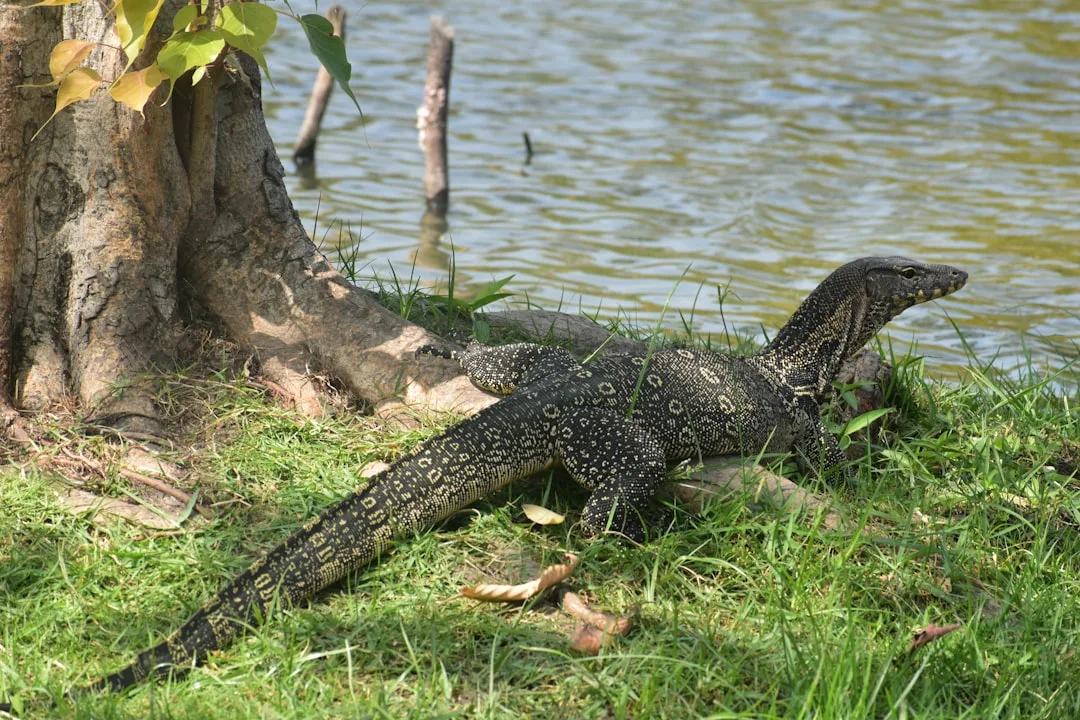
The Asian water monitor is one of the most successful large reptiles on the planet. Stretching from the rivers of Sri Lanka to the swamps of Indonesia, Varanus salvator is the second-longest lizard alive today - outranked only by the Komodo dragon, and occasionally surpassed in raw length by exceptionally slim individuals.
It swims open sea channels, climbs tall trees, hunts fish, scavenges carrion, and somehow also thrives in the middle of one of the world's busiest capital cities. Few large predators adapt to human landscapes as gracefully as this reptile does.
This guide covers every aspect of water monitor biology and ecology: size and anatomy, aquatic adaptations, diet and hunting, reproduction, intelligence, urban life, the skin trade, and the monitor's surprising evolutionary connection to the extinct Australian giant Megalania. It is a reference entry, not a summary - so expect specifics: measurements in metres, kilograms, years, and verified records.
Etymology and Classification
The scientific name Varanus salvator was coined in 1768 from the Arabic word waral meaning monitor lizard and the Latin salvator meaning 'saviour' - a reference to the monitor's supposed warning behaviour around crocodiles, which early European naturalists interpreted as the lizard alerting villagers to danger.
The species is known by dozens of regional names: biawak in Malay and Indonesian, hia or tua ngern tua thong in Thai, kabaragoya in Sinhala, bayawak in Filipino, and simply water monitor across the English-speaking world.
Taxonomic relationships within Varanidae are complex. V. salvator sits in the subgenus Soterosaurus together with several closely related species: V. cumingi (Philippine water monitor), V. marmoratus, V. nuchalis, V. togianus, and V. palawanensis. Several forms once treated as subspecies of V. salvator are now recognised as separate species thanks to genetic and morphological evidence.
The genus Varanus as a whole originated in Asia, spread across the Old World, and radiated spectacularly in Australia, where it produced both today's goannas and the extinct giant Megalania (Varanus priscus), which may have reached five to seven metres long during the Pleistocene.
Water monitors are therefore not only the second-largest lizards alive - they are close cousins of the largest lizards that ever lived.
Size and Physical Description
Asian water monitors are long, powerful, semi-aquatic lizards built for life in and around water. Size varies enormously between populations, sexes, and individuals.
Typical adults:
- Total length: 1.5-2.0 metres from snout to tail tip
- Weight: 15-25 kilograms
- Tail length: roughly equal to snout-to-vent length
Large males:
- Total length: up to 2.5 metres regularly, 3 metres occasionally
- Weight: 40-50 kilograms in obese captive specimens
- Record specimen: 3.2 metres (Sri Lanka, historical)
Hatchlings:
- Total length: 25-30 centimetres
- Weight: 40-70 grams
- Bright black-and-yellow banding; colour fades with age
The body is long and laterally compressed, ending in a powerful tail that functions as a swimming paddle and a whip-like defensive weapon. The neck is long and flexible, the head is elongated with strong jaw muscles, and the skull bears a battery of sharp recurved teeth well-suited to gripping slippery prey.
Nostrils sit high on the snout, close to the eyes, which allows the monitor to breathe while nearly submerged - a trait shared with crocodiles and, not coincidentally, one of the reasons water monitors are so often mistaken for crocodilians in Southeast Asia.
Adult colouration ranges from olive-green to nearly black across the back, broken by rows of yellow or cream spots that fade with age. The underside is paler, often banded in dark brown or grey. The tongue is deeply forked and usually dark blue, flicked rapidly during scent tracking. Claws are long, strongly curved, and used equally for climbing trees, digging burrows, and tearing prey.
Built for Water
Unlike most other large monitors, Varanus salvator is a true semi-aquatic reptile. Every major feature of its biology serves one of two goals: hunt effectively in water, or use water as an escape from danger.
Aquatic adaptations:
- Laterally compressed tail that functions as a paddle
- Valved nostrils that close underwater
- High-set nostrils and eyes allowing partial submersion
- Salt tolerance permitting travel through estuaries and coastal seas
- Long sustained breath-hold of roughly thirty minutes
Behavioural adaptations:
- Routine swimming in fast-flowing rivers and tidal creeks
- Long-distance sea crossings between islands
- Diving from overhanging branches into deep water to escape threats
- Foraging along reef flats for stranded fish and crustaceans
Water monitors swim with the body and tail undulating sideways in a smooth serpentine motion, while the limbs fold back tight against the flanks to reduce drag. The tail alone generates most of the thrust. In fast currents they can hold position behind submerged rocks and wait for prey. In open water they swim in long, slow arcs, surfacing only briefly to breathe.
Their sustained dive capability is extraordinary for a reptile of this size. Thirty minutes underwater gives a threatened monitor time to swim across a wide river, take refuge in a submerged root ball, or simply wait out a predator patrolling the bank.
Hunting and Diet
Water monitors are generalist carnivores with a strong scavenging streak. Their diet shifts with age, habitat, and opportunity.
Primary prey categories:
- Fish (catfish, carp, tilapia, freshwater eels)
- Crustaceans (freshwater crabs, shrimps, mangrove crabs)
- Amphibians (frogs, toads, their eggs and tadpoles)
- Reptile eggs (turtle clutches, crocodile nests, lizard clutches)
- Ground-nesting birds and their eggs
- Small to mid-sized mammals (rats, squirrels, young civets)
- Carrion of all kinds, including livestock and human corpses after floods
Urban food sources:
- Rats and mice in drains and markets
- Fish waste from wet markets and ports
- Discarded food scraps, particularly cooked meat
- Stray kittens and puppies in extreme cases
- Chicken and duck from unguarded coops
Hunting techniques are flexible. In water, monitors stalk slowly and strike with a sideways sweep of the head. On land, they locate prey almost entirely by scent, flicking the forked tongue rapidly and reading the chemical map delivered to the Jacobson's organ in the roof of the mouth. Turtle and crocodile nests are a particularly reliable seasonal bonanza - monitors excavate entire clutches in a single session, sometimes consuming more than a kilogram of eggs at a time.
At large carcasses, several monitors may feed together in a rough dominance hierarchy. The largest animal eats first, whipping smaller rivals with its tail and gaping its jaws as a threat display. Smaller monitors wait their turn, then strip the remaining flesh and gnaw the bones. Like crocodilians, water monitors use a death roll to dismember prey too large to swallow whole - gripping a limb or section of flesh in the jaws and rotating the body along its long axis until the piece tears free.
Life Cycle and Reproduction
Water monitors follow a classic reptilian reproductive pattern with several interesting quirks. Breeding is timed to the wet season in most of the range, synchronised with rising water levels, increased prey availability, and soft mud suitable for nesting.
Reproductive schedule:
- Mating: wet season, varies by latitude
- Nesting: 3-6 weeks after mating
- Incubation: 180-320 days depending on temperature
- Hatching: coincides with the following wet season, usually
Females dig nest burrows in riverbanks, mud mounds, and occasionally active termite mounds. Termite nests are prized because the insects maintain a stable internal temperature and humidity, which incubates the eggs reliably. Clutch size is 10 to 40 eggs. The female may guard the burrow for a short period but does not provide extended parental care.
Hatchlings are miniature versions of adults with bright black-and-yellow banding, and they spend their first year in trees and dense undergrowth to avoid adult monitors, snakes, birds of prey, and predatory fish. They feed heavily on insects, small frogs, and small fish, then gradually move toward the water's edge as they grow. Sexual maturity arrives at about two years and one metre of length in females, slightly later in males.
Lifespan in the wild averages 15 to 20 years. Captive animals with consistent food and veterinary care can exceed 20 and occasionally approach 30. Adult mortality is driven by pythons, saltwater crocodiles, poaching for the skin trade, road traffic in urban areas, and persecution by poultry farmers.
Range and Habitat
Water monitors occupy one of the largest geographic ranges of any large reptile. They are found across almost the whole of South and Southeast Asia, with populations on hundreds of islands.
Core range:
| Region | Status |
|---|---|
| Sri Lanka | Widespread; abundant in temple ponds and paddy fields |
| Eastern India | Coastal and northeastern wetlands |
| Bangladesh | Sundarbans mangroves and inland rivers |
| Myanmar | Widespread along river systems |
| Thailand | Extremely abundant, including urban Bangkok |
| Malaysia | Widespread in peninsular and Borneo populations |
| Singapore | Common in parks, canals, and reservoirs |
| Indonesia | Widespread across Sumatra, Java, Borneo, Sulawesi |
| Philippines | Replaced by related species in most islands |
Habitat requirements are simple: permanent or seasonal water, some tree or bank cover, and a reliable prey base. Within those limits, water monitors thrive in rainforests, mangroves, swamps, rice paddies, garbage dumps, harbours, storm drains, and city parks. Their altitudinal range extends from sea level to around 1,800 metres, though most populations are lowland.
Urban Life
Few large predators adapt to cities the way water monitors do. Bangkok's Lumpini Park is the most famous example, home to several hundred wild monitors that bask on lawns, swim in ornamental lakes, and cross busy footpaths in full view of joggers and tourists. Occasionally the city authorities remove large individuals for public safety, but the population rebounds quickly from the surrounding canal network.
Similar urban populations exist in Sri Lankan temple grounds, Malaysian drainage systems, Singaporean reservoirs, and Indonesian harbour districts.
The reasons for this urban success are straightforward. Cities offer abundant rats, abundant food waste, warm microclimates, few natural predators, and extensive canal networks that function as highways. Cultural tolerance in parts of the range - monitors considered inedible in Sri Lanka, tolerated as rat controllers in Thailand - reduces direct persecution.
Water monitors are also cognitively flexible enough to learn human patterns quickly, avoiding peak traffic times and identifying reliable food sources.
Problems arise when monitors raid chicken coops, attack pets, or grow bold enough to approach tourists for food. Most Southeast Asian municipalities now run monitor management programmes that translocate nuisance animals rather than killing them, recognising that the species provides free pest control and holds cultural value.
Intelligence
Monitors as a group are unusually intelligent for reptiles, and Varanus salvator is no exception. Captive water monitors have:
- Counted quantities up to six in experimental feeding trials
- Learned to open complex puzzle feeders
- Recognised individual human keepers by face and voice
- Displayed play behaviour with objects and with other monitors
- Shown spatial memory of burrow and territory layout
Their brains have proportionally larger forebrain regions than most lizards, with neural structures considered convergent with those of birds. Research on the closely related Nile monitor and Komodo dragon has found similar cognitive performance, suggesting that the Varanidae as a family evolved bird-like intelligence long before corvids did.
This intelligence may underlie their urban success. A monitor that can learn routes through a canal network, remember which market stalls discard fish at which times, and recognise individual humans as threats or neutral has an enormous advantage over a more rigid hunter.
The Skin Trade
Water monitors are among the most heavily traded reptiles in the world. Their skins are durable, finely textured, and take dye well, making them highly valued for:
- Luxury watch straps
- Wallets and handbags
- Traditional drum heads in Southeast Asian music
- Belts, shoes, and other leather goods
The species is listed on CITES Appendix II, which requires export permits and nominal quotas, but enforcement varies widely across the range. Annual international trade is estimated at between 500,000 and 1.5 million skins, with additional poaching for the domestic market in major producing countries. Indonesia is the largest exporter.
Despite these enormous offtake numbers, the IUCN still classifies V. salvator as Least Concern because the species breeds rapidly, tolerates habitat modification, and occupies an enormous range. Local populations can be seriously depleted by skin hunters, however, and several island subspecies are much more vulnerable than the mainland form. Conservationists argue that better monitoring and enforcement of CITES quotas are essential even though the species is not globally endangered.
Conservation Status and Threats
The Asian water monitor is listed as Least Concern on the IUCN Red List and on CITES Appendix II. The global population is presumed stable but has never been comprehensively surveyed.
Primary threats:
- Skin trade. Over a million animals killed annually for luxury leather.
- Habitat loss. Drainage of wetlands for agriculture, aquaculture, and development.
- Pollution. Urban waterways carry heavy metals, pesticides, and microplastics that accumulate in apex predators.
- Persecution. Poultry farmers kill monitors that raid coops; crocodile farms consider them competitors.
- Road mortality. Urban populations suffer heavy losses to vehicles.
- Confusion with crocodiles. Some populations are killed out of misplaced fear of crocodile attack.
- Invasive pressure. Escaped pet monitors have established breeding populations in Florida and a few other warm regions, where they threaten native wildlife - creating a conservation irony where the species is hunted in its native range and persecuted as an invader elsewhere.
Conservation measures include CITES quotas, protected area coverage across much of the range, and urban tolerance programmes in major cities. The species' sheer adaptability is its best defence. Few large reptiles can survive in a freeway drainage canal, a mangrove creek, and a temple pond with equal success.
Water Monitors and Humans
Relationships between water monitors and humans vary widely across the range. In parts of Sri Lanka and Thailand the species is considered sacred, unclean, or simply inedible, which effectively protects it from hunting for meat. In other regions it is hunted for the skin trade, persecuted by farmers, and killed on sight out of fear.
Modern urban populations enjoy a kind of uneasy coexistence: Bangkok residents joke about the giant lizards crossing their streets, Singaporean park-goers photograph them, and Sri Lankan temple keepers feed them leftovers.
Myth and folklore portray water monitors in contradictory roles. Some traditions blame them for spreading disease or raiding graves, while others credit them with warning villagers of crocodile attacks - the supposed origin of the species name salvator. Neither claim is accurate; monitors do scavenge carrion but carry no more disease than any other urban scavenger, and they certainly do not issue alarms about crocodiles.
Water monitors are occasionally kept as pets, though their adult size, sharp claws, powerful tail, and strong bite make them unsuitable for most keepers. Responsible captive care requires a large enclosure, a deep pool, high humidity, climbing structures, and a varied diet of whole-prey items.
Many captive monitors end up released or surrendered when they outgrow their owners' ability to house them, which is how small breeding populations have established in Florida, where the species is now considered invasive.
Related Reading
- Nile Monitor: Africa's Largest Lizard
- Komodo Dragon: Facts and Deadly Venom
- Monitor Lizards: The Intelligent Giants of the Reptile World
References
Relevant peer-reviewed and governmental sources consulted for this entry include IUCN Red List assessments for Varanus salvator, CITES trade data on monitor skin exports, published research in Biawak (the journal of the International Varanid Interest Group), Herpetological Review, Zootaxa papers on Soterosaurus taxonomy, and ecological studies of urban monitor populations in Bangkok, Singapore, and Sri Lanka.
Specific trade figures reflect recent CITES trade database summaries for live animals and skin exports.
Frequently Asked Questions
How big are Asian water monitors?
Adult Asian water monitors (Varanus salvator) typically measure 1.5 to 2.0 metres from snout to tail tip and weigh between 15 and 25 kilograms. Large males can reach 2.5 metres and 50 kilograms. The longest reliably measured specimen was a 3.2-metre individual from Sri Lanka, which makes Varanus salvator the second-longest lizard species alive today after the Komodo dragon. Roughly half of total length is tail.
Hatchlings emerge at 25-30 centimetres and grow rapidly in their first two years under good conditions.
Where do Asian water monitors live?
Asian water monitors occupy a vast range across South and Southeast Asia, from Sri Lanka and eastern India through Bangladesh, Myanmar, Thailand, Cambodia, Vietnam, peninsular Malaysia, Singapore, Indonesia, and the Philippines. They favour freshwater wetlands, river banks, mangrove swamps, tidal creeks, and coastal estuaries but tolerate brackish and fully marine conditions for short periods.
The species has adapted spectacularly to urban environments - Bangkok canals, Sri Lankan temple ponds, and Malaysian drainage systems all support thriving populations. They dig burrows, shelter in tree hollows, and bask on banks or overhanging branches close to water.
What do water monitors eat?
Water monitors are opportunistic carnivores and scavengers. Wild diet includes fish, crabs, frogs, turtles and their eggs, snakes, rodents, ground-nesting birds and their eggs, and carrion of all kinds. In cities they scavenge refuse, raid chicken coops, eat rats, and feed on fish market discards. Monitors are known to work cooperatively at large carcasses, with dominant individuals feeding first.
They swallow prey whole when possible using flexible jaw joints, and tear larger food by gripping with the teeth and rotating the body - a behaviour called the death roll, also seen in crocodilians.
Are water monitors dangerous to humans?
Asian water monitors are not generally dangerous to healthy adults. They are shy around people and almost always flee toward water when approached. However, large individuals can deliver serious bites with their long recurved teeth, whip powerful tail strikes, and inflict deep scratches with their claws. Their saliva contains mild venom-like proteins typical of monitor lizards and carries a significant bacterial load, so bites require medical attention.
Attacks on humans are rare and typically involve cornered animals, improperly handled pets, or bites near feeding sites. There are isolated reports of monitors feeding on human corpses in flood disasters.
How long do water monitors live?
Asian water monitors live approximately 15 to 20 years in the wild. Captive individuals with good veterinary care and stable diets can reach 20 to 25 years, and a few exceptional records approach 30. Juvenile mortality is extremely high - most hatchlings are taken by birds, snakes, fish, and adult monitors within the first year. Females reach sexual maturity at around two years and a length of one metre.
Adult monitors have few natural predators apart from large pythons, saltwater crocodiles, big cats along the edge of their range, and humans.
Are water monitors related to the Komodo dragon?
Yes. Both species belong to the genus Varanus in the family Varanidae. The Asian water monitor is in the subgenus Soterosaurus, while the Komodo dragon (Varanus komodoensis) sits in a different lineage that diverged from Australian monitors millions of years ago. Water monitors are also close relatives of the extinct giant Megalania (Varanus priscus) from Pleistocene Australia, which may have reached 5 to 7 metres.
Despite their evolutionary distance, Komodo dragons and water monitors share many traits: forked tongues, loose jaw joints, venom-producing oral glands, high intelligence for reptiles, and a scavenging-predatory lifestyle.
Are Asian water monitors endangered?
The IUCN lists Varanus salvator as Least Concern due to its enormous range and adaptability. However, the species is listed on CITES Appendix II and faces intense regional pressure from the skin trade, which kills more than a million animals annually for luxury leather products. Habitat loss, pollution of wetlands, and persecution by poultry farmers also reduce local populations. Several island subspecies are more vulnerable than the mainland form.
Water monitors benefit from cultural tolerance in parts of their range - in Sri Lanka and parts of Thailand they are considered inedible or sacred, which shields them from direct hunting for food.
Can Asian water monitors swim in the ocean?
Yes. Water monitors are exceptional swimmers and regularly move through brackish mangroves, tidal estuaries, and open seawater. They use the laterally compressed tail as a paddle, tuck their limbs against the body, and glide in a snake-like motion. They have been filmed crossing sea channels between Indonesian islands and foraging on coral reef flats for crabs and stranded fish.
Adult monitors can hold their breath for around thirty minutes during dives, long enough to escape predators or stalk aquatic prey. This saltwater tolerance is one reason the species colonised so many isolated islands across the Indo-Malay archipelago.