
Among the birds of prey, evolution has produced a creature that hunts on foot, covers 30 kilometres of African savanna daily in a measured deliberate stride, and dispatches venomous snakes with a kick force of 195 Newtons delivered in 15 milliseconds, too fast for the snake to redirect a strike, and powerful enough to break a cobra’s spine.
Sagittarius serpentarius, the secretary bird, is the only living member of the family Sagittariidae and the only raptor on Earth that has abandoned aerial hunting entirely in favour of working the grassland on long, stork-like legs.
The secretary bird stands 1.2 metres tall, spreads wings of over 2 metres, and uses them not primarily for flight but as a shield and balancing pole when administering the stamping blows that kill its prey.
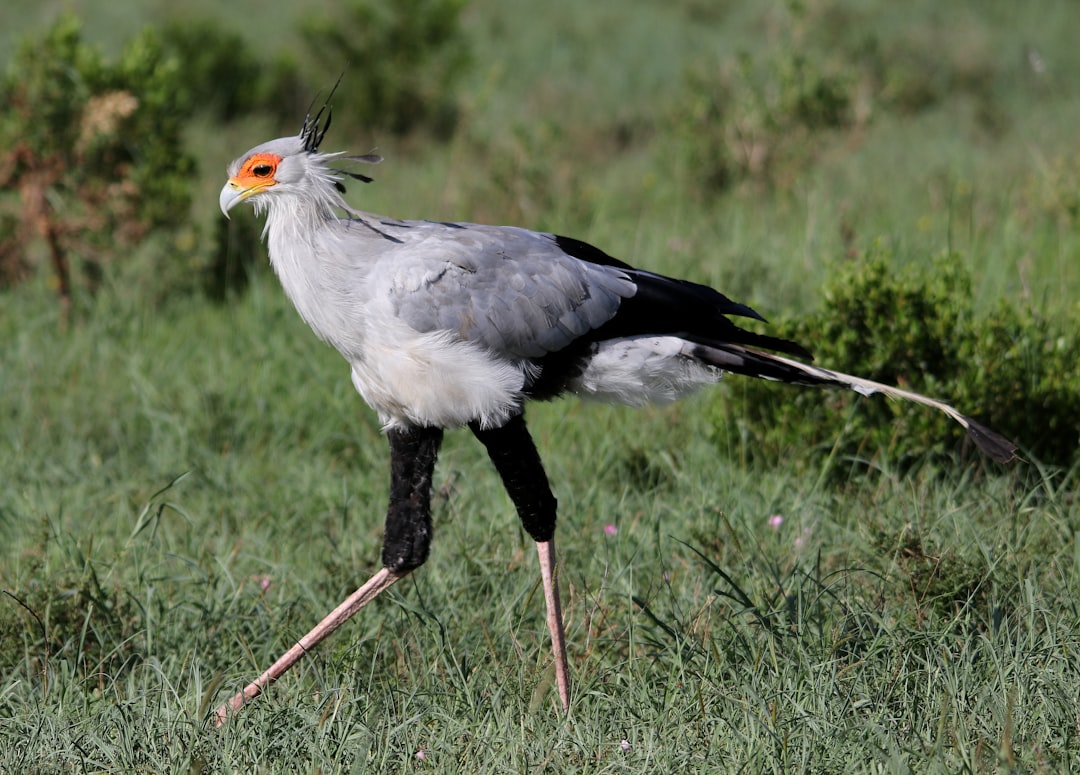
It is monumental in appearance, upright posture, black thighs like breeches, a crest of long quill-like feathers radiating behind the head, an eagle’s hooked beak set above a bare orange face, and its movement through the grassland is correspondingly unhurried and purposeful.
Pairs cover their home ranges methodically, flushing rodents, insects, lizards, and snakes from grass with the feet, then dispatching each with the appropriate technique for its size and danger.
This is a species appearing on the national emblems of two African nations, monitored by wildlife agencies across the continent, and now classified as Vulnerable on the IUCN Red List after decades of grassland habitat loss have reduced its population substantially.
The secretary bird’s biology combines the structural adaptations of a ground bird with the predatory toolkit of a raptor, and its hunting biomechanics have become a subject of serious experimental analysis, because a kick delivered in 15 milliseconds against a reactive venomous snake is an engineering problem whose solution took millions of years to optimise.
Etymology and Classification
The family Sagittariidae contains a single genus, Sagittarius, and a single species, S. serpentarius. The generic name means “archer” in Latin, a reference, most likely, to the long, arrow-like central tail feathers rather than to any archery-like behaviour. The species name serpentarius translates directly as “of the serpents” or “serpent-hunter,” an unambiguous reference to the animal’s most famous prey. Both names were assigned by Miller in 1779.
The common name “secretary bird” has been debated since the nineteenth century. The most frequently cited explanation refers to the long crest feathers extending behind the head, which early European observers compared to the quill pens that office secretaries of the period tucked behind their ears.
Alternative explanations include a derivation from the French ‘secrétaire’ (secretary), itself potentially derived from the Arabic ‘saqr-et-tair’ meaning hunting-bird, transmitted through colonial contact in North Africa. A proposed Afrikaans etymology from ‘seker vogel’ (certain bird, in reference to its hunting precision) has also been advanced. The quill-pen explanation dominates modern usage despite lacking documentary proof.
Phylogenetically, the secretary bird belongs to the order Accipitriformes alongside hawks, eagles, harriers, kites, and Old World vultures. Despite its dramatic morphological divergence from these relatives, molecular analyses consistently place Sagittarius serpentarius within this order, as the sister lineage to the Accipitridae (the hawk-eagle family).
The osprey (Pandion haliaetus) and the New World vultures (Cathartidae) are the next most closely related groups. This placement indicates that the secretary bird’s terrestrial, long-legged body plan evolved from an aerial raptor ancestor, a transition that must have involved substantial modification of both the locomotory skeleton and the prey-capture apparatus.
Physical Description
The secretary bird is one of the largest flying birds in Africa and the tallest raptor in the world by standing height. Adults stand 1.2 to 1.3 metres at the crown, with total body length (beak tip to tail end) of 112 to 150 cm, the variation driven largely by the length of the elongated central tail feathers which can extend 30 cm beyond the other tail feathers. Wingspan ranges from 191 to 220 cm. Weight is 2.3 to 4.3 kg, with females slightly smaller than males on average.
The overall colour is pale grey on the mantle, back, and wing coverts, with black flight feathers, black thighs (giving the appearance of wearing dark breeches), and a white belly and underwing. The bare facial skin is bright orange-red. The crest consists of 6 to 20 long, black-tipped grey feathers that project backward from the occiput and can be raised or lowered. These crest feathers are not static adornments but are actively used in display, raised during courtship and threat interactions.
The bill is aquiline, strongly hooked at the tip, resembling the bill of a hawk or eagle and used for tearing prey after it is subdued. The eyes are large and yellow-ochre, positioned to provide broad binocular overlap in front, consistent with a predator that needs accurate depth perception for striking at ground-level prey.
The legs are extremely long for a raptor, grey-white, and scaled with broad scutes on the front surface that provide protection from snake bites. The toes are short and blunt, with only slightly curved claws compared with the long, strongly curved talons of aerial raptors, an adaptation for running and stamping rather than gripping.
The wing structure, while providing a large surface area, is not highly specialised for either soaring or high-speed aerial hunting. The wings serve primarily as balancing and shielding structures during ground-level combat with prey, and for the daily commute between roost tree and hunting ground.
Habitat and Range
The secretary bird is endemic to sub-Saharan Africa, occurring from Senegal and Gambia in the west, across the Sahel and savanna zone, through East Africa, and south to South Africa and Namibia. It is absent from dense forest, the Sahara, and the humid lowland forests of the Congo Basin. The species is most abundant in the open grassland and savanna habitats of the East African plains and the South African highveld.
Habitat requirements are specific: the secretary bird needs open ground with short to medium grass height that allows unobstructed walking and prey detection, combined with scattered trees, typically Acacia, Commiphora, or Terminalia, for nesting and roosting. Very short, heavily grazed grassland supports fewer prey species and offers less hunting cover; very tall, dense grass impedes walking and prey detection.
The species responds positively to fire management that maintains a heterogeneous mosaic of grass heights, a feature of traditional pastoral management that is being lost in many areas as land use changes.
Home ranges are large, typically 20 to 30 square kilometres for a breeding pair, and pairs use their entire range systematically over the course of weeks. GPS tracking studies in South Africa have documented individual daily movements of 20 to 32 km within these ranges. Pairs are largely territorial with respect to other secretary bird pairs during the breeding season but may tolerate overlap in non-breeding periods.
Altitude range extends from sea level to approximately 3,000 metres in East African highland grasslands. The species is resident (non-migratory) across its range, though individual birds may make local movements of hundreds of kilometres in response to drought or grassland burning.
Diet and Feeding Behaviour
The secretary bird’s diet reflects the diversity of the savanna fauna it encounters during its daily walking circuits. Systematic analysis of prey items from stomach contents, pellet analysis, and direct observation reveals a diet dominated by:
- Rodents (particularly multimammate rats, vlei rats, and mice)
- Snakes (including highly venomous species such as puff adders, cobras, and mambas)
- Lizards (skinks, geckos, agamas, and small monitors)
- Large insects, particularly locusts and grasshoppers during outbreak events
- Small birds and their eggs
- Frogs and small tortoises
Snakes are prominent in the diet and constitute the prey most associated with the species in popular accounts, but rodents may form the numerical majority of prey items across much of the range. During locust or grasshopper irruptions, the bird may concentrate its foraging on insects almost exclusively for extended periods.
Hunting technique varies with prey type. For rodents and lizards, the bird typically walks through grass, using its feet to kick at vegetation and flush prey, then seizes the startled animal with the beak or pins it with a foot before biting. For large venomous snakes, the approach is more deliberate and choreographed.
The bird positions itself to one side and slightly in front of the snake, spreads its wings partly to create a visual barrier and protection against lateral strikes, and then delivers a rapid series of downward stamps with both feet. Each stomp targets the snake’s head or anterior body. Studies by Busby et al.
(2019) measured the peak force of these kicks at approximately 195 Newtons, with a contact duration of approximately 15 milliseconds, both figures that exceed the snake’s neurological reaction time, preventing a defensive bite during the kick sequence.
The wing-spread posture serves multiple functions: balance during the kick, visual obscuration of the bird’s legs from the snake’s perspective, and protection of the body from forward strikes if the snake is not fully pinned. Large or vigorous snakes may require many kicks before being incapacitated. Once prey is subdued, the bird may carry it into the air and drop it from height, further disabling it, before consuming it.
Reproduction and Life Cycle
The secretary bird breeds throughout the year in equatorial regions where conditions allow, and seasonally in more temperate parts of southern Africa, with most breeding occurring in the drier months when grass is shorter and prey more visible.
Pair bonds appear to be long-term and possibly life-long. Courtship involves aerial displays in which both members of a pair soar together, periodically dipping and undulating, and may include display walking with wings spread and crest raised on the ground. Nesting occurs in trees, with the nest platform built at the canopy of flat-topped Acacia or Commiphora trees typically 3 to 8 metres above ground.
The nest is a large flat structure of sticks, up to 2.5 m in diameter when repeatedly reused, lined with grass, leaves, and occasionally fur or feather material.
Clutch size is 1 to 3 eggs, with 2 being most common. Eggs are pale green-blue to white, incubated for approximately 45 days. Incubation is shared but dominated by the female. Both parents provision the chicks, regurgitating partially digested food. At hatching, chicks are covered in white down and are altricial. The eyes open within a few days. Growth is rapid; first feathers appear at approximately 40 days. Fledging occurs at 65 to 106 days of age.
The post-fledging period is long, with juveniles remaining in the natal territory for 60 or more days, during which they continue to be fed by the parents and gradually learn hunting technique by following the adults on their daily foraging circuits. Full independence occurs at approximately 3 to 4 months post-fledging. Age at first breeding is typically 2 to 3 years. Wild lifespan is estimated at 10 to 15 years; the maximum recorded captive longevity is approximately 19 years.
Conservation Status
Sagittarius serpentarius was reclassified from Least Concern to Vulnerable on the IUCN Red List in 2020 following analyses suggesting a population decline exceeding 60% over three generations (approximately 52 years). The global population is estimated at fewer than 30,000 individuals, with a declining trend across most of the range.
The principal driver of decline is the loss and degradation of native grassland and savanna. Agricultural conversion, particularly the transformation of native grassland to crop land or improved pasture, eliminates the complex grass-shrub mosaic the species requires. Overgrazing by domestic livestock reduces grass structure and prey diversity.
Changes in fire management, particularly fire suppression or poorly timed burning, alter grass height and composition in ways that reduce the suitability of large areas of savanna for secretary birds.
Secondary threats include nest disturbance by humans in some areas, persecution based on the false belief that secretary birds threaten domestic poultry, and collisions with power lines. In South Africa, the construction of new power line infrastructure across secretary bird habitat has been identified as a significant cause of mortality, and efforts to mark or insulate high-risk lines are ongoing.
Protected area networks across sub-Saharan Africa provide the most effective conservation tool. The species occurs in most major African national parks and game reserves and is relatively well protected within these areas. Outside protected areas, conservation depends on engaging private landowners and pastoral communities in grassland management practices that maintain suitable habitat.
Related Reading
- Fastest Birds in the World: Peregrine Falcon Dive
- Shoebill (Balaeniceps rex)
- Saltwater Crocodile: Largest Reptile Alive
- Most Venomous Snakes Ranked by LD50
References
Busby, N. J. T., Llorente, J., Koster, R., & Tanaka, H. (2019). Secretary bird (Sagittarius serpentarius) foraging strikes at small prey. Journal of Experimental Biology, 222(22), jeb199875. https://doi.org/10.1242/jeb.199875
Ferguson-Lees, J., & Christie, D. A. (2001). Raptors of the World. Houghton Mifflin. ISBN: 9780618127627
Boshoff, A. F., & Anderson, M. D. (1998). Secretary bird Sagittarius serpentarius nest site selection in two contrasting landscapes in South Africa. Ostrich, 69(3–4), 339–344. https://doi.org/10.1080/00306525.1998.9639741
Jenkins, A. R., Smallie, J. J., & Diamond, M. (2010). Avian collisions with power lines: a global review of causes and mitigation with a South African perspective. Bird Conservation International, 20(3), 263–278. https://doi.org/10.1017/S0959270910000122
Thiollay, J. M. (1998). Long-term changes in raptor populations in northern West Africa. Journal of Raptor Research, 32(1), 35–45.
Kemp, A. C., & Kemp, M. I. (1978). Sagittarius serpentarius: a review of its biology with comments on its hunting methods. Annals of the Transvaal Museum, 31(11), 171–192.
Frequently Asked Questions
How does the secretary bird kill snakes?
The secretary bird kills snakes primarily through rapid, powerful stomping. When it encounters a snake, it spreads its wings partly open, both for balance and as a visual barrier against counter-strikes, and delivers a rapid series of downward stamps with the blunt, scaled feet. Each kick delivers approximately 195 N of peak force in approximately 15 milliseconds.
This force is sufficient to break a snake’s spine or crush its skull, and the speed prevents most venomous species from redirecting a defensive bite to the attacking foot before the foot withdraws. The bird’s scaled legs and wing-shield posture provide substantial protection against the strikes it does not avoid. Not all prey is killed this way; smaller animals are often picked up in the beak and battered against the ground.
Why is it called a secretary bird?
The most widely accepted explanation is that the long dark crest feathers radiating from the back of the head resemble the quill pens that Victorian-era office secretaries kept tucked behind their ears. Alternative etymologies have been proposed: some researchers suggest the name derives from the Arabic phrase ‘saqr-et-tair’ (hunter-bird) transmitted through colonial French as ‘secrétaire,’ while others propose an Afrikaans or Dutch origin.
The quill-pen explanation remains the most frequently cited in ornithological literature, and the bird’s upright posture and deliberate walking gait are often fancifully compared to a busy clerical worker. The scientific name serpentarius straightforwardly means ‘of the serpents,’ a reference to the bird’s most famous prey.
Is the secretary bird endangered?
Yes. The secretary bird was uplisted from Least Concern to Vulnerable on the IUCN Red List in 2020, following analyses that suggested the global population had declined by more than 60% over three generations. The principal driver is the loss and degradation of native grassland and savanna habitat through conversion to agriculture, overgrazing by domestic livestock, and inappropriate fire management.
The species requires extensive tracts of open grassland and cannot persist in fragmented or heavily modified habitats. It occurs across sub-Saharan Africa but is now absent or very sparse from areas where it was common in the mid-twentieth century.
Does the secretary bird fly?
Yes. Despite spending most of its time on the ground, the secretary bird is a capable flier with a wingspan of 191 to 220 cm. It uses flight primarily to reach its nest, which is built at the top of Acacia or Commiphora trees, 3 to 8 m above the ground, and to move between distant foraging areas. The species also performs aerial courtship displays, with pairs soaring together and occasionally diving in undulating patterns.
In flight, the long legs trail behind the body and the elongated central tail feathers stream backward, giving a distinctive silhouette. The bird is not a soaring specialist in the manner of vultures and eagles but is capable of sustained flapping and gliding flight.
What does the secretary bird eat besides snakes?
Snakes are a famous and important prey item, but the secretary bird’s diet is more varied than its common name implies. Systematic dietary studies show that rodents, lizards, large insects (particularly grasshoppers and locusts), small tortoises, frogs, bird eggs and nestlings, and small mammals form a substantial part of the diet in many populations.
In areas with high locust or grasshopper abundances, these insects may dominate the diet for extended periods. The bird hunts by walking systematically through grassland, flushing prey with its feet and stamping or pecking at any animal that emerges. Snake capture is more episodic and requires specific behaviours not used for insect or rodent capture.
How does the secretary bird nest?
Secretary birds nest in the canopy of flat-topped Acacia trees, typically 3 to 8 metres above ground. The nest is a large, flat platform of sticks, lined with grass and leaves, and can reach up to 2.5 metres across if reused and added to over multiple seasons. The same nest may be used for many consecutive years. Clutch size is typically 2 to 3 eggs, laid at intervals of several days.
Incubation lasts approximately 45 days and is performed primarily by the female. Chicks hatch altricial (helpless) and are brooded for several weeks; fledging occurs at approximately 65 to 106 days. The post-fledging dependency period is long, with juveniles remaining near the nest territory for 60 or more days before dispersing.
How far does the secretary bird walk each day?
Secretary birds are among the most mobile terrestrial raptors, typically covering 20 to 30 kilometres of grassland per day on foot. This extensive walking is necessary to cover the large home ranges, typically 20 to 30 square kilometres per pair, at the low prey densities characteristic of open savanna.
GPS tracking studies of individuals in South Africa have confirmed daily movement ranges of this magnitude, with birds departing their roost tree soon after sunrise and returning in the late afternoon. The walking pace is steady and deliberate, with the bird scanning the grass ahead and kicking at vegetation to flush prey. Multiple pairs in an area may share overlapping home ranges without significant territorial conflict.
How does the secretary bird compare to other raptors?
The secretary bird is unique among living raptors in being exclusively terrestrial in its hunting strategy. No other raptor regularly hunts on foot across open terrain, stamping prey to death. Most raptors use aerial speed and powerful talons to seize prey, and their foot anatomy reflects this: long curved talons for gripping. The secretary bird’s feet are short, blunt, and partially webbed, adapted for running and stomping rather than grasping.
Its legs are long, rivalling those of storks and cranes rather than other raptors. Despite its ecological divergence, molecular phylogenetics firmly places it within the order Accipitriformes, sister to all other hawk-eagle-harrier lineages, a position suggesting it evolved its terrestrial hunting from a conventionally aerial raptor ancestor.