
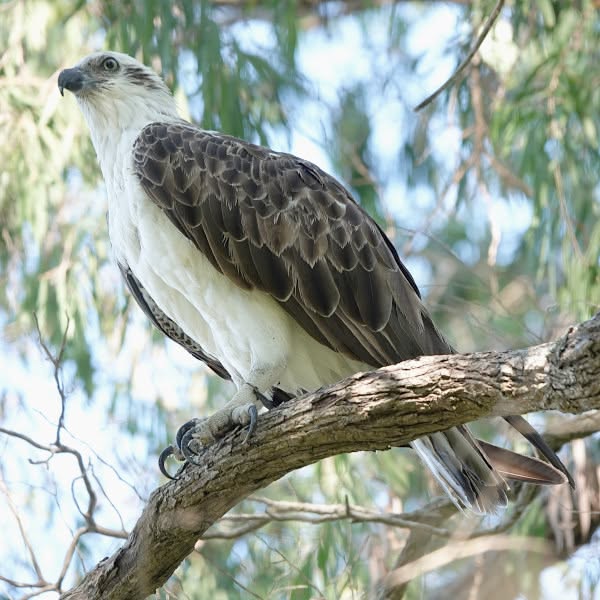
The osprey is the only raptor on Earth whose entire lineage has been shaped around a single prey item: live fish. Unlike eagles, hawks, falcons, or kites - which are generalist predators that happen to catch fish when convenient - Pandion haliaetus has specialised so completely that it no longer fits inside the family tree of any other bird of prey.
The osprey is the sole living member of its family, Pandionidae, and the only raptor found on every continent except Antarctica. Fish make up roughly 99% of its diet, and its feet, wings, nostrils, eyelids, and feathers have all been remodelled to pull slippery, thrashing prey out of open water.
This guide covers every aspect of osprey biology and ecology: size and structure, fishing behaviour, migration, reproduction, nest construction, conservation history, and the unusual anatomy that makes this bird unlike anything else in the sky. It is a reference entry, not a summary - so expect specifics: centimetres, kilograms, dive heights, migration distances, and verified records.
Etymology and Classification
The scientific name Pandion haliaetus combines two Greek elements. Pandion was a mythical king of Athens whose daughters were transformed into birds in Ovid's Metamorphoses; 18th-century naturalists liked to attach classical names to newly described genera.
Haliaetus means 'sea eagle' in Greek (hali- for sea, aetus for eagle), and the same root appears in the generic name of the bald eagle, Haliaeetus leucocephalus. The osprey has been called the fish hawk, sea hawk, river hawk, and fish eagle across English-speaking regions, and equivalents of 'fish eagle' appear in almost every language inside its enormous range.
Taxonomically, the osprey sits in its own family, Pandionidae, within the order Accipitriformes. It is the only living member of that family. Every other raptor species on Earth shares a family with at least a handful of close relatives - eagles, hawks, harriers, and kites are clustered together in Accipitridae, falcons in Falconidae, and so on.
The osprey branches off on its own and has done so for roughly 30 million years according to molecular clocks, which is long enough for its fishing-specialist anatomy to diverge deeply from every other bird of prey.
Four subspecies are currently recognised:
- P. h. haliaetus - Eurasia, northwest Africa, and migrating populations wintering in sub-Saharan Africa
- P. h. carolinensis - North America and the Caribbean, long-distance migrant to Central and South America
- P. h. ridgwayi - Caribbean resident (Bahamas, Cuba, Belize), largely non-migratory, with a distinctive pale head
- P. h. cristatus - Australia, Indonesia, and parts of the southwestern Pacific, smaller and sedentary
Genetic studies consistently show low variation between the subspecies compared to what is seen in other wide-ranging raptors. This is consistent with frequent long-distance gene flow during annual migrations, as well as a recent global expansion.
Size and Physical Description
Ospreys are medium-large raptors - smaller than most true eagles but larger than most hawks. The species shows reversed sexual dimorphism: females are 15-20% heavier than males and carry slightly longer wings, a pattern common across raptors whose females handle incubation and nest defence while males do most of the hunting during the breeding season.
Body measurements:
- Length: 50-66 cm from bill tip to tail tip
- Wingspan: 1.27-1.80 metres
- Weight: 1.2-2.1 kg (males typically 1.2-1.6 kg, females 1.6-2.1 kg)
- Tail length: 19-25 cm
- Wing chord: 38-52 cm
Plumage and structural features:
- Crown and underparts: white
- Upperparts: dark brown to near-black
- Eye stripe: bold dark band running from bill through eye to nape
- Iris: yellow in adults, orange-red in juveniles
- Legs and feet: pale blue-grey, heavily scaled
- Underside of wings at the 'wrist': distinctive dark patch used for identification
Osprey wings are long, narrow, and sharply angled at the wrist - closer in shape to a large gull than a hawk. In flight the wing shows a characteristic M-bend when the bird soars, with the primaries drooping slightly below the plane of the rest of the wing.
This wing shape generates the lift needed to haul a heavy fish clear of the water surface, which is one of the hardest mechanical tasks in the entire raptor world. The plumage is unusually dense and oily, treated with copious preen gland secretion that waterproofs the feathers against repeated plunge-diving - a property other raptors lack because they don't routinely submerge.
Built for Fishing
Almost every major feature of osprey anatomy is an adaptation for catching live fish. Together they make Pandion haliaetus the most highly specialised piscivorous raptor in the world.
The reversible outer toe. In the vast majority of birds of prey, the outer toe (digit IV) is fixed in a forward-facing position. Three toes point forward, one (the hallux, or 'big toe') points back. This is called an anisodactyl foot. The osprey is the only diurnal raptor that can rotate its outer toe backward at will, so the foot grips with two toes in front and two toes behind - a configuration called zygodactyl.
This arrangement distributes clamping force more evenly around a cylindrical target like a fish, preventing the prey from twisting free. Only a handful of other birds share this trick; owls do it all the time, and most parrots and cuckoos are permanently zygodactyl. Among hawks, eagles, falcons, and kites, the osprey stands alone.
Spiny footpads. The underside of each toe is covered in dense rows of small, sharp, keratinised spines called spicules. These work like the barbs on a fish hook or the teeth of a cheese grater - they bite into fish scales and lock the prey into the grip. Even when a fish thrashes violently, the spicules prevent it from slipping free.
Long curved talons. Osprey talons are unusually long relative to body size and are more strongly curved than those of similarly sized hawks. They punch cleanly into fish muscle and hold without needing to crush the prey the way an eagle would.
Closable nostrils. The osprey's nostrils can be actively closed shut during the plunge, preventing water from being forced into the airways on impact.
Nictitating membrane. Like most birds, ospreys have a third eyelid that sweeps across the eye from the inner corner. In ospreys this membrane is particularly thick and transparent, and it closes at the moment of water impact, acting as built-in swim goggles that protect the eye while preserving vision underwater.
Oily, waterproof plumage. Ospreys produce copious preen oil from an enlarged uropygial gland and spread it across their feathers with a vigorous preening routine after every hunt. This keeps the plumage from soaking through during repeated dives.
Together these features allow the osprey to do something no other raptor can: enter the water fully, grip a living fish underwater, and fly back out with the prey still alive in its grip.
Hunting and Diet
The osprey is a piscivore, and the fraction of fish in its diet is among the highest of any large bird: roughly 99% across most populations. The remaining 1% consists of opportunistic prey - small birds, rodents, snakes, squirrels, amphibians - taken when open water is frozen over or when storms make fishing impossible.
Primary prey categories:
- Surface-feeding freshwater fish (mullet, carp, tilapia, shad, suckers)
- Mid-water fish in lakes and estuaries (perch, pike, walleye, trout)
- Coastal marine fish (menhaden, flounder, mullet, herring)
- Slow-moving reservoir species (bass, bream, catfish) where legally present
Preferred prey size is 150-300 grams, though ospreys can lift fish up to about 2 kg under ideal conditions. A classic hunting fatality occurs when a bird's talons lock into a fish larger than it can lift - the spicules and reversible toe hold so well that the bird is sometimes pulled underwater and drowned by a fish too heavy to release.
Hunting technique, step by step:
- Search flight or hover. The osprey flies over open water at 10-40 metres altitude or hovers on beating wings when winds allow. Flat, wind-still water gives the best visibility into the depths.
- Target acquisition. The bird spots a fish within about a metre of the surface, adjusts heading, and fixes its gaze on the target.
- Plunge dive. The osprey folds its wings partly, rotates its body so the feet are leading, and drops feet-first in a controlled steep plunge.
- Impact and submersion. The bird hits the water feet-first, nictitating membranes closed, nostrils sealed, and can submerge up to a metre below the surface.
- Grip. The outer toe rotates backward; spicules and talons bite into the fish; both feet clamp.
- Lift-off. The osprey beats its wings powerfully to break free of surface tension and gain altitude.
- Shake-off. In mid-air, the bird shakes its plumage violently to shed water while still flying forward - a manoeuvre unique to ospreys.
- Transport. The fish is rotated in the feet so its head faces forward, reducing aerodynamic drag during the flight back to a perch or nest.
Hunt success rates are among the highest of any raptor. Field studies report per-dive success between 24% and 75%, with most populations averaging 30-40%. Success depends heavily on water clarity, surface chop, prey density, and the bird's experience. First-year birds often fail repeatedly before figuring out the correct dive angle and depth.
Life Cycle and Reproduction
Osprey reproduction is closely tied to the availability of open water and suitable nesting structures. In most populations breeding begins in April or May in the northern hemisphere and August to October in the southern hemisphere.
Courtship and pairing. Ospreys typically pair for life. When birds return to breeding grounds after migration, males perform a 'sky dance' display - a series of undulating flights at great height while carrying a fish or nest material and calling loudly. Successful courtship results in the male delivering fish directly to the female throughout the breeding season. Food delivery rates are a key signal of male fitness; females that are poorly provisioned sometimes abandon the pair bond.
Nest construction. Ospreys build bulky stick nests on tall exposed structures with commanding views. Natural sites include the tops of dead trees, rocky sea stacks, and cliff ledges. Artificial sites include utility poles, channel markers, purpose-built platforms, cell towers, and even stadium lights. Pairs reuse the same nest year after year and add material every season.
After several decades an active osprey nest can grow to 2 metres across, 2 metres deep, and weigh hundreds of kilograms. Some platforms in the eastern United States and Scotland have been continuously occupied and expanded for more than 50 years.
Egg laying and incubation. A typical clutch is 2-4 eggs (most often 3), laid at intervals of 1-2 days. Eggs are cream-coloured with heavy reddish-brown blotching. Incubation lasts 36-42 days and is shared, though the female does roughly 70-80% of the work while the male delivers food.
Chicks and fledging. Hatching is asynchronous - the first chick may be 3-5 days older than the last, which creates a size hierarchy in the nest. In good seasons all chicks survive; in lean seasons the smallest starves. Chicks fledge at 50-55 days, one of the faster fledging schedules among large raptors.
For several weeks after fledging, young ospreys continue to return to the nest for fish deliveries while they learn to hunt on their own. Juveniles leave the natal area before their first migration, usually a few weeks after the parents depart.
Females typically produce one brood per year and continue breeding annually into their twenties if they survive. Reproductive output is strongly correlated with fish availability; local collapses in fish populations quickly translate into smaller clutches and fewer fledged young.
Migration
Most osprey populations are long-distance migrants, with the exception of the Caribbean (P. h. ridgwayi) and Australian (P. h. cristatus) subspecies, which are largely sedentary.
Routes and distances:
| Population | Breeding range | Wintering range | One-way distance |
|---|---|---|---|
| North American (carolinensis) | Canada, US lower 48 | Central America, South America | 3,500-8,000 km |
| Western European | UK, Scandinavia, Iberia | West and Central Africa | 4,000-6,000 km |
| Central European | Germany, Poland, Baltics | West and Central Africa | 5,000-7,500 km |
| Russian (Siberian) | Siberia | South and Southeast Asia, Africa | 5,000-9,000 km |
| Australian (cristatus) | Australia, Indonesia | Same range - largely resident | 0-500 km |
Navigation and pace. Juvenile ospreys undertake their first migration alone, without parental escort, guided by inherited navigation. Satellite telemetry has shown that individual adults return to the same wintering site year after year, sometimes to the exact same tree. Average migration speeds are 250-400 km per day on good days, with birds exploiting thermals over land and switching to flapping flight over water.
Notable ocean and desert crossings include the Atlantic between Spain/West Africa (up to 2,500 km non-stop), the Gulf of Mexico, and the Sahara.
Mortality on migration. First-year ospreys have the highest mortality of any life stage, and most deaths occur during or immediately after the first southbound migration. Common causes include exhaustion over large water crossings, starvation in unfamiliar wintering areas, shooting in some Mediterranean countries, and collisions with power lines at stopover sites.
Global Range and Populations
The osprey's geographic range is extraordinary. It breeds or winters on every continent except Antarctica, making it the most widely distributed raptor on Earth. No other bird of prey comes close.
Distribution by region:
| Region | Status | Notes |
|---|---|---|
| North America | Breeding + migrating | ~30,000 breeding pairs, concentrated on coasts |
| Central/South America | Wintering + Caribbean residents | ridgwayi subspecies year-round in Caribbean |
| Europe | Breeding + migrating | Recovered strongly after 20th-century crash |
| Africa | Wintering + localised breeding | Major non-breeding grounds in sub-Sahara |
| Asia | Breeding + migrating | Siberia, China, Japan, Middle East, India |
| Australia/Oceania | Resident | cristatus subspecies, non-migratory |
The global population is estimated at 500,000+ mature individuals and rising. Density is highest along productive coastlines, large rivers, and reservoirs with tall nesting structures.
Conservation Status and Recovery
The IUCN Red List classifies the osprey as Least Concern with a stable or increasing global trend. The current status masks a dramatic 20th-century population crash and one of the clearer recovery stories in modern raptor conservation.
The DDT era. From the late 1940s through the 1960s, ospreys across North America and Europe collapsed along with bald eagles, peregrine falcons, and brown pelicans. The cause was DDT and its breakdown product DDE, which concentrated in fish and caused eggshell thinning in fish-eating birds. Eggs broke under the weight of the incubating parent.
Breeding success dropped to near zero in some regions. Long Island, the Chesapeake Bay, Scotland, and parts of the Baltic lost more than 90% of their breeding pairs.
The recovery. DDT was banned in the United States in 1972, in Canada in 1985, and across most of Europe during the 1970s and 1980s. Volunteer networks and conservation organisations installed thousands of artificial nesting platforms - utility pole cross-arms, wooden T-platforms, and channel markers - giving the returning birds safe, easily defended nest sites away from ground predators and human disturbance.
Reintroduction projects helped repopulate areas where ospreys had been completely wiped out, including Rutland Water in England (1996-2001) and parts of New England.
Current threats. Though populations are healthy at the global scale, several pressures persist:
- Fishing line entanglement. Nesting ospreys readily collect discarded monofilament line, which wraps around chicks in the nest and causes amputation or death. Nest surveys in some urban bays find line in more than half of nests.
- Mercury and persistent pollutants. Ospreys remain valuable sentinel species for industrial mercury contamination in freshwater systems.
- Collisions with power lines and wind turbines. Large wingspan and slow take-off from water make them vulnerable at poorly sited infrastructure.
- Habitat loss on tropical wintering grounds. West African wetlands and South American estuaries face development pressure that reduces fish availability.
- Illegal shooting on migration. Still a problem in parts of the Mediterranean and Middle East.
Because most osprey populations now nest on artificial platforms, the species is unusually responsive to active management. Cleaning line from nests, maintaining platforms, and leaving water bodies undisturbed during breeding all have measurable effects on local productivity.
Ospreys and Humans
Ospreys have a long cultural history. They appear in classical Greek mythology (the myth of Nisos and Pandion that gave the genus its name), in medieval European falconry writings - usually dismissed as unsuitable for falconry because of their single-minded focus on fish - and as symbols of coastal and river ecosystems in Indigenous cultures across the Americas, Australia, and Polynesia.
The species is the national bird of Sweden's Sodermanland province and appears on several Caribbean and Polynesian postage stamps.
Unlike bald eagles or some hawks, ospreys are not aggressive toward humans and tolerate close approach to active nests far better than most raptors. This tolerance has made them ideal subjects for nest-cam live-streams, which reach millions of viewers every breeding season and have become a major gateway into backyard wildlife watching.
Ospreys also routinely lose fish to kleptoparasitic bald eagles. Field observations in the Chesapeake Bay and along the Columbia River document bald eagles chasing ospreys until the smaller bird drops its catch, which the eagle then retrieves. This relationship is so consistent that Benjamin Franklin invoked it when arguing against adopting the bald eagle as the US national bird, noting that the eagle 'does not get his living honestly' because it routinely robs the hard-working fish hawk.
Related Reading
- Osprey: The Fish Eagle That Dives for Dinner
- Bald Eagle (Haliaeetus leucocephalus)
- Raptors: The Apex Predators of the Sky
- Eagle Vision - Eight Times Better Than Ours
References
Relevant peer-reviewed and governmental sources consulted for this entry include BirdLife International's species factsheet on Pandion haliaetus, the IUCN Red List assessment, the Cornell Lab of Ornithology Birds of the World osprey account, satellite telemetry studies published in Journal of Avian Biology and Ibis, and long-term nesting surveys from the Rutland Osprey Project (UK), the Chesapeake Bay Program (US), and the Australian Wildlife Conservancy.
Population figures reflect the most recent consolidated estimates available at the time of writing.
Frequently Asked Questions
How big is an osprey?
Adult ospreys (Pandion haliaetus) measure 50-66 cm from head to tail and carry a wingspan of 1.27-1.80 metres. Body weight ranges from 1.2 to 2.1 kg, with females typically 15-20% heavier and slightly longer-winged than males - a pattern called reversed sexual dimorphism common among raptors.
Northern temperate birds run larger than tropical subspecies; an Australian eastern osprey (P. h. cristatus) is often 20% smaller than a North American one (P. h. carolinensis). Chicks hatch at about 50 grams and reach adult size in 50-55 days, one of the faster growth rates among large raptors.
What do ospreys eat?
Ospreys are near-obligate piscivores - roughly 99% of their diet is live fish. Surveys of prey remains in different populations consistently show fish species dominating, with typical targets including mullet, menhaden, flounder, carp, trout, pike, perch, and tilapia depending on region. Ospreys tend to take fish 150-300 grams in weight, though they can lift prey up to 2 kg under ideal conditions.
The remaining 1% of the diet includes opportunistic items such as small birds, rodents, snakes, squirrels, and amphibians, usually taken only when fishing is impossible due to ice cover or storms. An adult osprey needs roughly 300-400 grams of fish per day, which translates to 1-3 catches depending on prey size.
How does an osprey catch a fish?
An osprey hunts by flying or hovering 10-40 metres above open water, scanning for fish near the surface. When it spots prey, it folds its wings partly and dives feet-first in a controlled plunge that ends with full submersion, sometimes up to a metre underwater. At the moment of impact the nictitating membrane closes across the eyes, and the reversible outer toe swings backward so the fish is gripped with two toes in front and two behind.
Spiny footpads called spicules lock onto the fish’s scales. The osprey then beats its wings to lift clear of the water, shakes off excess weight in mid-air, and flies to a perch to eat - always carrying the fish head-first to reduce drag. Hunt success rates are among the highest of any raptor, reported between 24% and 75% depending on water clarity, wind, and prey density.
Where do ospreys live?
Ospreys have one of the widest geographic distributions of any bird on Earth and are the only raptor found on every continent except Antarctica. They breed across North America, Europe, northern and central Asia, and parts of Australia, and overwinter in the Caribbean, Central and South America, sub-Saharan Africa, South and Southeast Asia, and coastal Australia.
Four subspecies are recognised: P. h. haliaetus (Eurasia), P. h. carolinensis (North America and Caribbean), P. h. ridgwayi (Caribbean resident, non-migratory), and P. h. cristatus (Australia and Indonesia). Osprey habitat is defined by access to shallow, fish-rich open water - coasts, estuaries, large rivers, lakes, reservoirs, and wetlands - with tall nesting structures nearby.
They readily use artificial platforms, utility poles, and channel markers, which has helped populations rebound in heavily developed regions.
How do ospreys migrate?
Most osprey populations are long-distance migrants, though the Caribbean and Australian subspecies are largely sedentary. North American ospreys winter as far south as Argentina and Chile, while European breeders cross the Mediterranean and the Sahara to reach sub-Saharan Africa, often covering 6,000-8,000 km each way. Satellite tagging has shown that individual birds return to the same wintering site year after year, sometimes to the exact same tree.
Juveniles undertake their first migration alone, without parents, guided by inherited navigation. Average migration speeds are 250-400 km per day on good days, with birds using thermals over land and flapping-powered flight over water. Atlantic Ocean crossings of 2,500+ km are documented and occasionally fatal.
What makes osprey feet different from other raptors?
Osprey feet are the most specialised fish-catching tools in the raptor world and differ from every other hawk or eagle in two ways. First, the outer toe is reversible - it can rotate backward so the bird grips prey with two toes in front and two behind (a zygodactyl configuration), spreading force evenly around a slippery fish. Most raptors have a fixed three-forward-one-back (anisodactyl) foot and cannot do this.
Second, the underside of each toe is covered in small sharp spiny scales called spicules, which act as one-way hooks that bite into fish scales. Together these adaptations allow ospreys to hold a fish firmly even as it thrashes. The talons are also unusually long and strongly curved for a bird of their size. This combination is so specialised that it has independently evolved nowhere else among birds of prey.
How long do ospreys live and how often do they breed?
Wild ospreys typically live 7-10 years, with roughly half of juveniles failing to survive their first migration. Adults that reach breeding age have high annual survival (around 85-90%) and can live much longer - the oldest confirmed wild osprey was a Finnish-tagged female recorded at 30 years old. In captivity, with consistent food and veterinary support, ospreys have exceeded 25 years and in rare cases reached 32.
Ospreys typically pair for life and reuse the same nest every year, adding sticks until the platform grows several metres across. Clutches are 2-4 eggs, incubated for 36-42 days mostly by the female. Chicks fledge at around 50-55 days but depend on parental fish deliveries for several more weeks. Most pairs produce 1-3 fledglings per successful breeding season.
Are ospreys endangered?
No. The IUCN currently lists the osprey as Least Concern with a stable or increasing global population estimated at over 500,000 mature individuals. This is a conservation success story closely linked to the bald eagle’s recovery. In the 1950s and 1960s ospreys collapsed across eastern North America and much of Europe as DDT contaminated fish stocks and caused eggshell thinning. Some local populations declined by more than 90%.
After DDT was banned (1972 in the United States, later elsewhere) and artificial nesting platforms were widely installed by volunteers and conservation groups, ospreys rebuilt rapidly - a human-assisted comeback that paralleled the bald eagle’s. Remaining threats include entanglement in fishing line at nest sites, collisions with power lines, habitat loss around tropical wintering grounds, and chronic pollution of freshwater and coastal fish stocks.