
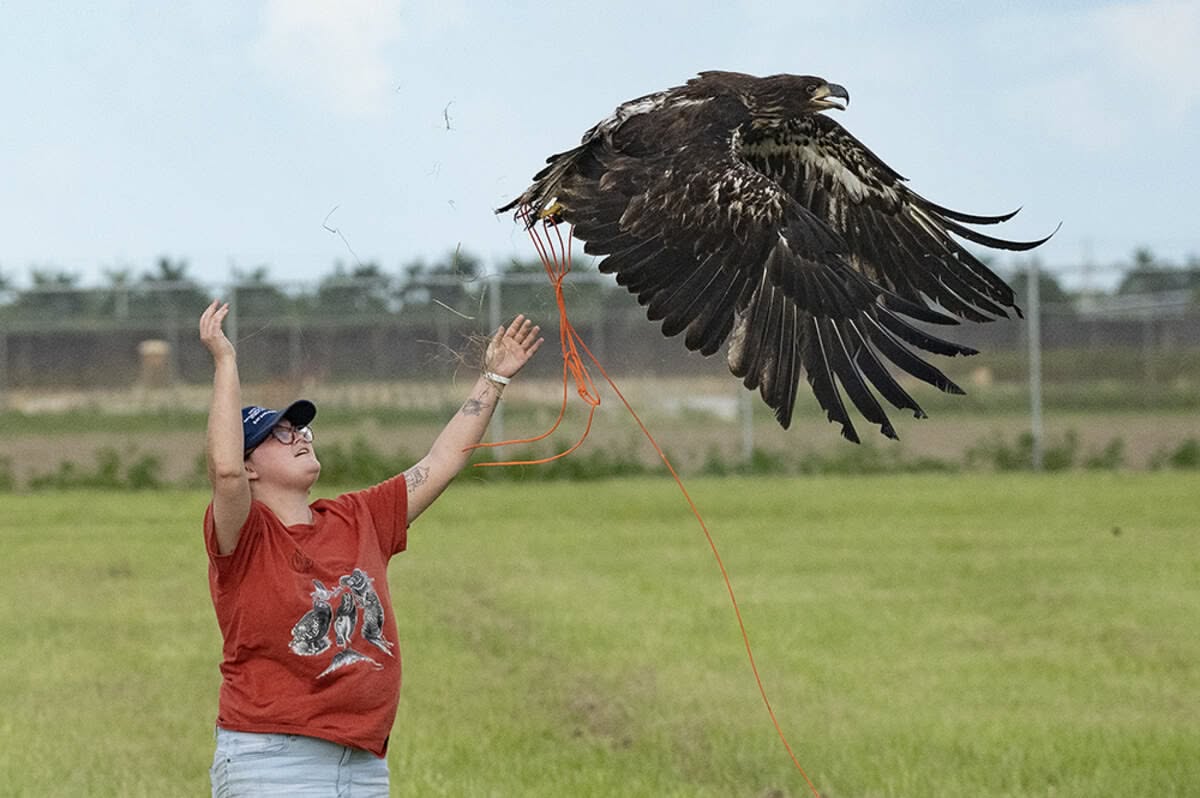
The bald eagle is the national bird of the United States, a large sea eagle native to North America, and one of the most thoroughly studied raptors in the world. Despite its name, Haliaeetus leucocephalus is not actually bald.
The head and tail feathers of an adult are pure white, and the word "bald" in the species' English name comes from the Old English "balde," meaning "white" or "shining." Everything else about the bird is dark chocolate brown, which makes the contrast striking at distance and has kept the species at the centre of American iconography for more than two centuries.
This entry covers the species in full: taxonomy, anatomy, vision, flight, hunting, diet, reproduction, nest structure, lifespan, conservation history, and the long list of strange details that separate the real bird from its national-symbol mythology. It is a reference article, not a summary, so expect specifics: wingspans, dive speeds, nest weights, population counts, dates, and records.
Etymology and Classification
The scientific name Haliaeetus leucocephalus was given to the species by Carl Linnaeus in 1766. It combines Greek roots: hali (sea), aetos (eagle), leukos (white), and kephale (head). The literal translation is "white-headed sea eagle," which is exactly what the bird is.
Linnaeus placed the bald eagle in the genus Haliaeetus alongside the white-tailed eagle of Eurasia and several related species, and molecular work has confirmed the grouping. The bald eagle's closest living relative is the white-tailed eagle (Haliaeetus albicilla); the two species diverged an estimated one million to four million years ago and occasionally hybridise in captivity.
There are two recognised subspecies separated by latitude rather than by major genetic differences:
- Haliaeetus leucocephalus leucocephalus - the southern subspecies, breeding south of roughly 40 degrees north.
- Haliaeetus leucocephalus washingtoniensis - the northern subspecies, larger-bodied, breeding from Alaska and Canada south to around 40 degrees north.
The bald eagle was adopted as the national emblem of the United States on 20 June 1782, when the Second Continental Congress approved the design of the Great Seal. The bird appears on the seal, on the presidential flag, on military insignia, and on US currency including the one-dollar bill and the quarter.
Benjamin Franklin objected to the choice in a well-known 1784 letter to his daughter, arguing that the bald eagle was "a bird of bad moral character" because it scavenges carrion and steals fish from ospreys. Franklin preferred the wild turkey. He was outvoted.
Size and Physical Description
The bald eagle is a large raptor but not the largest. Its body measures 70-102 cm from beak to tail. Wingspan ranges from 1.8 to 2.3 metres, with exceptional Alaskan females reaching 2.4 metres. Weight varies from 3 to 6.3 kg and tracks latitude: Alaskan and Canadian birds are roughly 30% heavier than Floridian birds of the same sex. Females are about 25% larger than males, a pattern called reversed sexual dimorphism that is standard among hawks, eagles, and falcons.
Males:
- Length: 70-90 cm
- Wingspan: 1.8-2.1 m
- Weight: 3.0-4.5 kg
Females:
- Length: 80-102 cm
- Wingspan: 2.0-2.3 m
- Weight: 4.0-6.3 kg
Chicks at hatching:
- Weight: roughly 85 grams
- Covered in pale grey down that darkens to brown over the first month
- Reach near-adult size in 10-14 weeks, before first flight
Adult plumage is unmistakable: chocolate brown body and wings, white head, white tail, bright yellow beak, yellow legs, and yellow feet with black talons. The iris is pale yellow. Juveniles, however, look nothing like the adults.
For the first four to five years of life they wear a mottled brown and white plumage with a dark head, which causes constant confusion with golden eagles and with other large Haliaeetus species. Full adult plumage appears on the fifth moult, which coincides with sexual maturity.
The beak is proportionally massive - a curved yellow hook used for tearing flesh rather than for killing. The killing work is done by the talons. Bald eagle grip strength is roughly ten times that of an adult human hand, with closing pressure estimated at around 400 psi. The rear talon (hallux) is especially long and is driven into prey to pin it down while the front talons hold.
Vision and Sensory World
Bald eagle vision is the sharpest well-studied example of raptor eyesight. Published estimates place it at four to eight times the resolving power of average human vision, depending on the measurement method. A perched eagle can spot a rabbit from close to three kilometres and track small fish moving just below the surface of a lake from hundreds of metres up.
Several anatomical features drive this performance:
- Two foveae per eye. The fovea is the retinal region of highest visual acuity. Humans have one per eye. Bald eagles have two - a central fovea for straight-ahead detail and a temporal fovea angled forward and downward. The temporal fovea functions like a built-in telephoto lens, giving the bird the ability to track a distant object even while cruising across a wide field of view.
- Dense photoreceptors. Eagle retinas pack roughly five times as many cones per square millimetre as human retinas, which boosts resolving power and colour discrimination.
- Ultraviolet sensitivity. Bald eagles can see into the near-ultraviolet spectrum. This lets them detect urine trails left by small mammals across grassland - rodent urine reflects UV strongly - and improves contrast against vegetation in ways invisible to humans.
- Binocular overlap of about 30 degrees. Enough for depth judgement during high-speed dives.
The total field of view per eye is about 280 degrees, which combined with an agile neck gives the bird an effectively full-sphere awareness of its surroundings.
Bald eagles hear roughly in the human range, with no exceptional adaptation for extreme frequencies. Smell is limited and plays almost no role in hunting, which is an important distinction from vultures and some other carrion-eating birds.
Flight and Dive Performance
Bald eagles are soaring birds. In level flight they cruise at 50-65 km/h with minimal wingbeats, riding thermals and ridge lift for hours. They can push to roughly 120 km/h in pursuit flight. During a stoop - the steep dive used for striking prey - bald eagles partially fold their wings and reach about 160 km/h. This is slower than a peregrine falcon's stoop but faster than most prey can react.
Flight data:
| Metric | Value |
|---|---|
| Level cruising speed | 50-65 km/h |
| Pursuit speed | up to 120 km/h |
| Stoop / dive speed | ~160 km/h |
| Typical foraging altitude | 100-300 m |
| Maximum observed soaring alt. | ~3,000 m above ground level |
| Daily range (territorial) | 5-50 km from nest during breeding season |
Wings are broad and long with deeply slotted primary feathers - the "fingers" at the tip - which give the bird fine control during slow flight and reduce induced drag at low speed. The broad wing plan favours efficiency in soaring over raw speed, which is why bald eagles spend most of their active hours on thermal updrafts along coastlines, ridgelines, and river valleys.
One behaviour unique among large raptors: a bald eagle that hooks a fish too heavy to lift from the water will lay its wings flat on the surface and row toward shore, using the wings as oars. Birds have drowned doing this when the fish was genuinely too heavy, but healthy eagles can row fish weighing more than they can carry aloft to the bank and feed there.
Hunting and Diet
Bald eagles are opportunistic carnivores with a strong preference for fish. Fish make up 80-90% of the diet across most populations, with the exact proportion varying by season, region, and local prey abundance. Salmon-run rivers in Alaska and the Pacific Northwest support the densest breeding populations in the world precisely because salmon supply predictable, concentrated, high-calorie food.
Primary prey:
- Fish. Salmon, trout, herring, shad, catfish, carp, and smaller species. Taken live from water surface or scavenged from spawning die-offs.
- Waterfowl. Ducks, geese, coots, gulls. Eagles target sick or injured individuals, ambush rafts of ducks at dawn, or snatch chicks from the water.
- Small mammals. Rabbits, muskrats, prairie dogs, ground squirrels, and occasionally young of larger mammals.
- Reptiles. Turtles and snakes in warmer latitudes.
- Carrion. Road-killed deer, livestock carcasses, beached fish, and washed-up marine mammals.
Hunting techniques:
- Perch-and-wait. The bird sits on a tall tree or cliff near water and watches. When a fish or small bird moves into striking range, the eagle drops into a stoop and snatches the prey in its talons at the end of the dive. This is the dominant hunting method during breeding season because it is energy-cheap.
- Low soaring. The eagle cruises at 20-100 metres over open water, watching for fish near the surface. When it spots prey it banks into a shallow dive and extends its feet to snatch the fish, often without fully submerging.
- Wading. Eagles walk into shallow water during salmon runs and pick out weakened fish from the current. This looks ungraceful but is highly effective during peak runs.
- Kleptoparasitism. Bald eagles are unusually willing to steal food from other birds. Ospreys are the most common victims - an osprey returning to its nest with a fish is a frequent target. The eagle harasses the osprey in mid-air until the smaller bird drops the fish, then catches the fish before it hits the water. Gulls and other eagles are also robbed.
- Cooperative harassment. Paired eagles sometimes hunt waterfowl together, with one bird driving prey while the other strikes. This is less common than solo hunting.
A mature bald eagle eats roughly 250-550 grams of food per day, equivalent to a medium fish or half a duck. Healthy adults can fast for several days between meals and can swallow enough at a single sitting to store food in the crop for slow digestion over 12-24 hours.
Success rates vary by method and prey. Direct strikes on fish succeed about 20-30% of the time. Kleptoparasitic attempts on ospreys succeed roughly half the time. Hunting waterfowl is the hardest discipline, with success rates often below 10%.
Life Cycle and Reproduction
Bald eagles pair for life, with divorce occurring mainly after repeated breeding failure. Pair bonding is reinforced with spectacular aerial displays. The best known is the cartwheel display: the pair flies high, locks talons mid-air, and falls toward the ground in a tumbling cartwheel, breaking apart only seconds before impact. The display appears during courtship and is also used to resolve territorial disputes between rival birds.
Breeding cycle (varies by latitude):
- Courtship and pair reunion: late autumn to midwinter in the south, early spring in the north
- Nest building or refurbishment: 1-3 months before egg laying
- Egg laying: typically 1-3 eggs, most commonly 2
- Incubation: about 35 days
- Nestling period: 8-14 weeks from hatch to first flight
- Post-fledging dependence: 4-10 weeks after first flight
- Juvenile independence: late summer to autumn
Eggs are dull white, about 7 cm long, and roughly 125 grams each. Both parents incubate, but the female does the larger share. Hatching is asynchronous, which means the first chick is several days older and larger than the second. In lean years the older chick may kill the younger - a pattern known as siblicide common among eagles.
Chicks develop quickly on a diet of fish and small mammals delivered by both parents. They reach adult size before first flight but retain juvenile plumage. After fledging, young birds depend on their parents for several more weeks while they learn to hunt. Many young eagles fail in their first winter - first-year mortality is roughly 50% - with starvation, collisions, and electrocution as the main killers.
Sexual maturity arrives at age 4 or 5, when the white head and tail appear. Most bald eagles do not successfully breed until age 5 or 6 even though they are physiologically capable earlier.
The Largest Tree Nests in the World
The bald eagle builds the largest tree nests of any bird on Earth. A typical nest is 1.5-2 metres across and 1-2 metres deep, weighing several hundred kilograms when fresh and considerably more once wet. Pairs return to the same nest year after year, adding fresh sticks, grass, moss, and softer material for lining. Over decades the structure grows into an enormous platform that can dominate its host tree.
Nest records and averages:
| Metric | Value |
|---|---|
| Typical diameter | 1.5-2 m |
| Typical depth | 1-2 m |
| Typical weight | 200-1,000 kg |
| Largest verified (diameter) | 3 m |
| Largest verified (depth) | 6 m |
| Largest verified (weight) | ~2,700 kg |
| Location of record nest | St Petersburg, Florida (1963 record) |
| Typical host tree | Tall live conifer, cottonwood, or oak |
Nest trees are chosen for height, structural strength, and visibility. Bald eagles prefer the tallest tree in the area with an unobstructed approach and good sightlines. In treeless regions they will nest on cliff ledges, on tall man-made structures, or - rarely - on the ground. Excessive nest weight eventually causes structural failure: some storied nests have collapsed their host trees during storms, and birds build a replacement nearby.
Territories around active nests span roughly 2-8 square kilometres and are defended against other eagles. Territorial disputes are noisy and can include the cartwheel display, chases, and occasional talon-locked fights to exhaustion.
Distribution, Populations, and Migration
Bald eagles are native only to North America. Their range extends from northern Alaska and much of Canada south through every US state except Hawaii, and into the northern states of Mexico. They are always tied to open water: coastlines, large rivers, reservoirs, and productive wetlands. The densest populations occur along salmon-bearing rivers in Alaska and the Pacific Northwest, along the Chesapeake Bay, along the Mississippi and Missouri river systems, and in the Great Lakes.
Population by region (approximate):
| Region | Approximate adult population |
|---|---|
| Alaska | 30,000+ breeding birds |
| Contiguous United States | ~316,000 total (2020 USFWS estimate) |
| Canada | 20,000-80,000 depending on province |
| Northern Mexico | Small, localised |
Migration patterns depend on latitude and ice. Northern populations move south when lakes and rivers freeze, because open water is required for fishing. Alaskan and Canadian birds may winter in the northwestern states or along the Pacific coast. Southern populations are year-round residents and may even move north during summer for cooler conditions.
Migrating eagles follow ridgelines, coastlines, and river valleys using thermal and ridge lift to minimise flapping. Concentrations of 1,000 or more birds appear at winter roosts near reliable open water, such as the Squamish River in British Columbia or the Skagit River in Washington State.
Conservation History and Current Status
The bald eagle's conservation history is one of the most-cited recovery stories in modern wildlife management. In 1782, when the species was adopted as the national emblem, there were probably 100,000 or more bald eagles across North America. By the mid-twentieth century the population had collapsed.
Causes of the decline:
- DDT. The pesticide dichloro-diphenyl-trichloroethane came into heavy agricultural use after 1945. DDT and its metabolite DDE accumulate in fish and are concentrated in the tissues of fish-eating predators. DDE disrupts calcium metabolism in female birds, which causes eggshells to thin. Bald eagle eggs broke under the weight of the incubating female, and reproductive success collapsed.
- Shooting. Bald eagles were shot as perceived competitors for game fish and waterfowl, and for bounty in some states until the mid-twentieth century.
- Habitat loss. Logging of tall shoreline trees destroyed nesting habitat. Damming changed river ecology and fish availability.
- Lead poisoning. Eagles that scavenge gut piles from hunters ingest lead fragments from rifle ammunition. Lead poisoning continues to kill bald eagles today and is one of the few remaining significant mortality causes.
By 1963 the breeding population in the contiguous 48 states had fallen to roughly 417 pairs. The species was on the verge of extinction in the lower 48. A series of interventions followed:
- 1940: Bald and Golden Eagle Protection Act prohibits killing or possession of the species in the United States.
- 1963: Low point of roughly 417 breeding pairs in the lower 48.
- 1972: DDT banned for most agricultural uses in the United States.
- 1973: Endangered Species Act signed into US law.
- 1978: Bald eagle listed as Endangered across most of the lower 48 and Threatened in a few states.
- 1995: Status downgraded from Endangered to Threatened across the lower 48.
- 2007: Bald eagle removed from the US Endangered Species Act list after reaching recovery targets.
- 2020: US Fish and Wildlife Service announces a population of more than 316,000 individuals including roughly 71,000 breeding pairs in the lower 48.
The IUCN Red List classifies the bald eagle as Least Concern with an increasing population trend. The species is still protected under the Bald and Golden Eagle Protection Act, the Migratory Bird Treaty Act, and comparable Canadian and Mexican laws. Possession of any part of a bald eagle - including feathers found on the ground - is illegal in the United States without specific federal permits, and penalties for shooting or poisoning a bald eagle can reach years in prison.
Current threats include lead poisoning, collisions with wind turbines, electrocution on power lines, vehicle strikes, illegal shooting, and localised habitat loss. None of these threats approach the historical scale of DDT, but several are being monitored as potential risks if unchecked.
Bald Eagles and Humans
The bald eagle has held central symbolic importance in many Indigenous North American cultures for thousands of years - longer, by orders of magnitude, than it has been a US national symbol. Eagle feathers are sacred in many nations and are used in ceremonies, regalia, and spiritual practice.
The US National Eagle Repository, established in the 1970s, distributes feathers and parts from naturally deceased birds to enrolled members of federally recognised tribes for ceremonial use, which is the legal channel that reconciles federal protection law with Indigenous religious rights.
Benjamin Franklin's 1784 letter to his daughter Sarah complained that the bald eagle was "a bird of bad moral character" because it scavenges and steals. Modern biology confirms Franklin's observations while rejecting his moral framing: bald eagles are opportunistic carnivores that scavenge heavily and kleptoparasitise smaller birds whenever opportunity allows.
These behaviours are energy-efficient and entirely appropriate for a large soaring raptor. Franklin preferred the wild turkey, calling it "a much more respectable bird," but he was overruled by the committee that designed the Great Seal.
Bald eagle tourism now generates meaningful revenue in places like Homer, Alaska; Squamish, British Columbia; and the upper Mississippi River during winter. Controlled viewing sites let visitors observe concentrations of eagles without disturbing birds. Livestreamed nest cameras at sites such as the Decorah, Iowa and Hanover, Pennsylvania nests have drawn millions of viewers and have become a significant public-engagement tool for conservation.
Human-eagle conflict exists but is limited. Bald eagles occasionally take domestic fowl, small lambs, and pet-sized animals, which provokes complaints in rural areas. Fatal attacks on humans are essentially unknown - no confirmed cases exist in the scientific literature - though eagles will defend nests aggressively against people who climb too close.
Related Reading
- Golden Eagle: North America's Other Great Raptor
- Osprey: The Fish Hawk
- Peregrine Falcon: The Fastest Animal on Earth
- Raptors of North America: Eagles, Hawks, and Falcons
References
Relevant peer-reviewed and governmental sources consulted for this entry include US Fish and Wildlife Service Bald Eagle Population Size updates (2016, 2020), IUCN Red List species assessments, the Birds of the World account for Haliaeetus leucocephalus published by the Cornell Lab of Ornithology, and research published in The Auk, Journal of Raptor Research, Ecological Applications, and The Condor.
Population figures reflect the most recent consolidated US estimates as of the 2020 USFWS assessment. Historical recovery data follow the US Endangered Species Act record and the Bald and Golden Eagle Protection Act amendments.
Frequently Asked Questions
How big is a bald eagle?
Adult bald eagles (Haliaeetus leucocephalus) measure 70-102 cm from head to tail and carry a wingspan of 1.8-2.3 metres. Body weight ranges from 3 to 6.3 kg, with females typically 25% larger than males - a pattern called reversed sexual dimorphism common among raptors. Alaskan and Canadian birds run larger than those in Florida or Texas, a north-south size gradient known as Bergmann’s rule.
A large female from the northern range can approach 7 kg, while a small southern male may weigh under 3 kg. Chicks hatch weighing about 85 grams and reach adult size within roughly 10-14 weeks.
What do bald eagles eat?
Bald eagles are opportunistic carnivores whose diet is dominated by fish, which make up 80-90% of prey in most populations. Salmon, trout, catfish, herring, and shad are common targets depending on region and season. They also take waterfowl such as ducks, geese, and coots; small mammals including rabbits, muskrats, and prairie dogs; reptiles; and carrion of all sizes from roadkill to whale carcasses washed ashore.
Bald eagles are notorious kleptoparasites - they chase ospreys, other eagles, and even gulls to force them to drop captured prey. Adults eat roughly 250-550 grams of food per day and can fast for several days when food is scarce.
Where do bald eagles live?
Bald eagles are native to North America and occur almost exclusively on this continent. Their range stretches from northern Alaska and most of Canada south through every US state except Hawaii, and into northern Mexico. They are strongly tied to open water and are usually found within a few kilometres of a coast, lake, river, or large wetland where fish are available.
Alaska supports the highest density, with an estimated 30,000+ breeding birds concentrated along salmon-rich rivers. Northern populations migrate south in winter when lakes and rivers freeze; southern populations are year-round residents. Birds concentrate in enormous numbers at winter roosts near open water or predictable food sources.
How fast and how well do bald eagles see?
Bald eagle vision is 4 to 8 times sharper than human vision. A perched eagle can spot a rabbit from nearly 3 km away and resolve details at distances that would require high-powered binoculars for humans. Their eyes contain a second fovea angled forward and downward, effectively giving them both a wide-angle and a telephoto mode simultaneously.
They see into the near-ultraviolet spectrum, which allows them to detect urine trails left by small mammals across grassland. Bald eagles can cruise at 50-65 km/h in level flight, accelerate to roughly 120 km/h in a chase, and dive at around 160 km/h when striking prey from height.
How big are bald eagle nests?
Bald eagles build the largest tree nests of any bird in the world. A typical nest is 1.5-2 metres wide and 1-2 metres deep, weighing hundreds of kilograms. Pairs reuse and expand the same nest year after year, so structures grow over decades into enormous platforms of sticks, grass, and moss. The largest verified bald eagle nest, recorded in St Petersburg, Florida in 1963, measured 3 metres across and 6 metres deep and weighed an estimated 2,700 kg.
Some nests become heavy enough to collapse their host tree during storms. Eagles prefer the tallest live trees near water, typically conifers or cottonwoods, with good visibility in multiple directions.
Are bald eagles endangered?
No. The IUCN currently lists the bald eagle as Least Concern with an increasing population trend. This is a significant recovery story. In 1963, after decades of DDT exposure thinned their eggshells and caused reproductive collapse, only about 417 breeding pairs survived in the lower 48 United States.
DDT was banned in 1972, the Endangered Species Act added the bald eagle to its original list in 1978, and active management - captive breeding, nest protection, prosecution of poachers - allowed the species to rebuild. The US Fish and Wildlife Service delisted the bald eagle in 2007, and by 2020 the population had reached more than 316,000 individuals including roughly 71,000 breeding pairs in the contiguous states.
How long do bald eagles live?
Wild bald eagles typically live 20-30 years, with mortality concentrated in the first year. Roughly half of juveniles do not survive to their first birthday; causes include starvation, electrocution on power lines, lead poisoning from ingested ammunition fragments, collisions with vehicles or wind turbines, and predation on young chicks. Adult survival rates are high - over 90% per year once a bird reaches breeding age.
The oldest known wild bald eagle, banded in New York, was confirmed at 38 years old. In captivity, with consistent food and veterinary care, bald eagles have exceeded 50 years. Breeding begins around age 4 or 5 when the iconic white head and tail feathers appear.
Why did Benjamin Franklin dislike the bald eagle?
In a 1784 letter to his daughter Sarah, Benjamin Franklin wrote that the bald eagle was ‘a bird of bad moral character’ because ‘he does not get his living honestly’ - referring to its habit of stealing fish from ospreys and scavenging carrion. Franklin argued that the wild turkey, though ‘vain and silly,’ was a more respectable symbol of American character.
His objection was aesthetic and moralistic rather than biological, and the bald eagle had already been adopted as the national symbol in 1782 on the Great Seal. Modern biology confirms Franklin’s observation: bald eagles are heavy scavengers and frequent kleptoparasites, taking food by force from smaller birds whenever opportunity allows.