
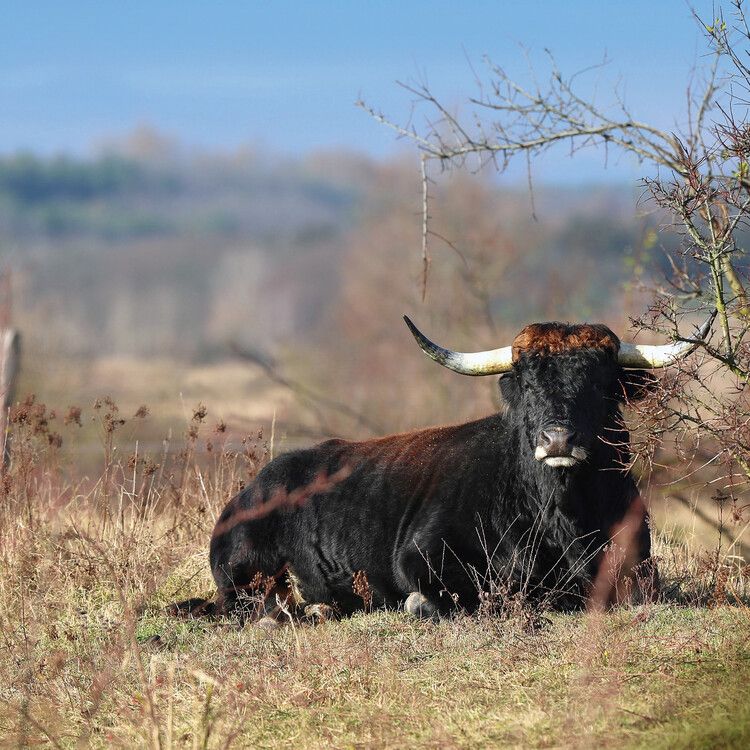
The aurochs is the wild ancestor of every domestic cow on Earth. It was the largest land mammal in Europe for most of the Holocene, a 1,500-kilogram bovid with forward-curving horns and a temperament that Julius Caesar described as fearful of nothing.
It was painted on the walls of Lascaux and Chauvet, hunted by Mesopotamian kings, worshipped as Apis in Egypt, and finally hunted and fenced into oblivion in a single small Polish forest. The last known individual died in 1627 in the Jaktorow Forest of Mazovia, making the aurochs one of only a handful of extinct species whose final death can be assigned to a specific year.
This guide is a wiki-style reference entry on the aurochs: taxonomy, anatomy, range, domestication, cultural weight, extinction, and the modern back-breeding and rewilding programs trying to reassemble an aurochs-like grazer from primitive cattle lines. It prioritises specifics - centimetres, kilograms, dates, specimens, and locations - over general description.
Etymology and Classification
The German word auerochs (pronounced roughly "our-oaks") combines the prefix ur-, meaning primitive or original, with ochs, meaning ox. The English "aurochs" is borrowed directly from German and functions as both singular and plural. The scientific name Bos primigenius was formalised by the Lithuanian-German anatomist Ludwig Bojanus in 1827, built from the Latin bos (ox) and primigenius (firstborn or original), reflecting its status as the ancestral ox.
The aurochs belongs to the family Bovidae - the hollow-horned ruminants that also includes antelopes, gazelles, sheep, goats, and wild cattle - and specifically to the genus Bos, which contains the yak, the gaur, the banteng, and domestic cattle.
Genetic and morphological work recognises three geographic subspecies of Bos primigenius: the European-North African subspecies B. p. primigenius, the Indian subspecies B. p. namadicus, and the North African subspecies B. p. africanus.
The two domesticated cattle species - taurine (Bos taurus) and zebu (Bos indicus) - are sometimes treated as subspecies of Bos primigenius rather than separate species, reflecting their direct descent from the aurochs.
The aurochs diverged from other Bos species roughly 2 million years ago during the Early Pleistocene. Fossils attributed to the lineage appear across Eurasia and North Africa from that point onward, with the species reaching essentially modern form by the Middle Pleistocene around 700,000 years ago.
Domestication of the taurine line in the upper Euphrates around 10,500 years ago, and of the zebu line in the Indus Valley around 8,000 years ago, split the species into wild and domestic populations that continued to exchange genes through backcrossing for thousands of years.
Taxonomy at a Glance
- Kingdom: Animalia
- Phylum: Chordata
- Class: Mammalia
- Order: Artiodactyla
- Family: Bovidae
- Subfamily: Bovinae
- Tribe: Bovini
- Genus: Bos
- Species: B. primigenius
- Subspecies: B. p. primigenius (Eurasian), B. p. namadicus (Indian), B. p. africanus (North African)
Size and Physical Description
The aurochs was significantly larger than any living cattle breed and substantially more athletic in build. The dimensions below refer to fully grown Eurasian aurochs. The Indian and North African subspecies were slightly smaller but comparable in proportions.
Body dimensions:
- Shoulder height: up to 180 centimetres (bulls), 150 centimetres (cows)
- Body length: approximately 250-310 centimetres from nose to tail base
- Estimated mass: 700-1,500 kilograms (bulls), 500-900 kilograms (cows)
- Skull length: 55-70 centimetres
- Horn length: up to 80 centimetres along the outer curve
- Horn base diameter: 10-20 centimetres
Proportions and build:
- Long-legged, deep-chested, with a pronounced shoulder hump in bulls
- Narrow hindquarters compared to modern beef cattle
- Tail long, reaching below the hocks, with a dark tuft
- Coat short and coarse in summer, dense and curly in winter
Colouration:
Contemporary descriptions and cave art agree on a sex-dimorphic colour scheme. Bulls were black or very dark brown overall, with a paler dorsal stripe called the eel stripe running along the spine, a lighter muzzle ring, and sometimes lighter fur inside the ears. Cows and juveniles were reddish brown with similar pale markings. Calves were born reddish and darkened with age in males.
This pattern is consistent across Sigismund von Herberstein's 1556 description, the 1827 Augsburg painting of a living aurochs, and Paleolithic cave art from southern France.
Horns:
Aurochs horns were forward-pointing, lyre-shaped, and significantly larger than those of any modern cattle. They grew outward from the skull at roughly 60 degrees, then curved forward and inward in a gentle arc. Horns on mounted specimens in the State Darwin Museum in Moscow and the Natural History Museum of Denmark reach 80 centimetres along the curve.
Germanic and Polish aristocrats tipped aurochs horns with silver bands and used them as drinking vessels, a practice documented from Caesar's De Bello Gallico through to the 17th century Polish-Lithuanian Commonwealth.
Range and Habitat
At its peak during the Early and Middle Holocene, the aurochs ranged across almost the entire Old World north of the Sahara and south of the boreal forest. Confirmed Holocene fossils and subfossils have been recovered from Portugal to Korea and from Denmark to the Nile Delta. Three geographic populations with distinct morphology occupied this range:
| Subspecies | Range | Notes |
|---|---|---|
| B. p. primigenius | Europe, Near East, Siberia | Ancestor of taurine cattle |
| B. p. namadicus | Indian subcontinent | Ancestor of zebu cattle |
| B. p. africanus | North Africa, Nile Valley, Sahara fringe | Smaller, disputed as separate subspecies |
Habitat preference:
Aurochs were animals of open woodland, forest edges, river valleys, marshes, and grass-scrub mosaics rather than closed forest or open steppe.
Pollen analysis of deposits associated with aurochs fossils in the Netherlands, Britain, and Poland indicates a preference for a wood-pasture landscape - patches of forest interspersed with grassland, wetland, and scrub - similar to the structured mosaic maintained today by European bison and free-roaming primitive cattle in rewilding reserves.
River corridors appear to have been particularly important, both for water and for the mixed vegetation that grew along flood plains.
In Britain aurochs disappeared from upland areas first and persisted longest in lowland river systems such as the Thames valley and East Anglian fens. In continental Europe they retreated into large forested estates controlled by aristocracy, which became the last refuges because hunting access was restricted. The final Polish population lived in the Jaktorow Forest, a mixed broadleaf forest with marshy clearings west of Warsaw that still exists today as a protected landscape.
Diet and Feeding Behaviour
Aurochs were mixed feeders, shifting between grazing and browsing depending on season and habitat. Stable isotope analyses of tooth enamel from Neolithic and Bronze Age aurochs bones indicate a diet dominated by C3 grasses and herbaceous plants through spring and summer, with a strong shift toward browse - leaves, twigs, acorns, and beech mast - in autumn and winter. This flexibility likely allowed them to persist in landscapes where strict grazers could not.
Primary foods:
- Grasses and sedges (spring and summer grazing)
- Leaves and shoots of oak, ash, elm, and hazel
- Acorns and beech mast in autumn
- Aquatic plants in marshes and flood plains
- Bark and twigs in winter when snow covers grass
Aurochs skulls show deep, well-developed cheek-tooth rows with high-crowned molars capable of grinding both tough grasses and fibrous browse. The rumen of a 1,500-kilogram bull would have processed enormous quantities of vegetation - estimates based on similar-sized wild bovids suggest 50-70 kilograms of forage daily.
This grazing and browsing pressure almost certainly shaped European vegetation during the Holocene, maintaining the open wood-pasture mosaics that many European plant and insect species evolved to inhabit.
Social Structure and Behaviour
Contemporary accounts and comparison with close living relatives indicate that aurochs lived in small mixed herds outside the breeding season and that bulls were largely solitary. Herd size recorded in the Polish royal inventories of Jaktorow - 38 animals in 1564, 24 by 1602, 4 by 1620 - gives some sense of the final population but not of original group sizes.
Ethological comparison with the gaur of South Asia and the banteng of Southeast Asia, the aurochs's closest wild relatives, suggests typical herd sizes of 10-30 in undisturbed conditions, composed mostly of cows, calves, and subadults, with mature bulls joining during the rut.
The rut took place in late summer and early autumn. Bulls fought by clashing horns and by parallel display walking, similar to extant wild bovids. Gestation lasted approximately 9 months, with calves born in spring. Cows gave birth to a single calf, rarely twins, and nursed for 7-12 months.
Caesar, Herberstein, and Polish estate records agree that aurochs were aggressive when cornered or wounded and that hunting them was dangerous. Caesar in De Bello Gallico describes young Germanic men proving manhood by killing an aurochs and presenting the horns as evidence. Herberstein in 1556 warned that a mature bull could disembowel a horse and rider with a single upward thrust.
Polish royal hunts reserved aurochs kills for the king or direct members of the royal family, reflecting both prestige and risk.
Domestication
The aurochs was domesticated at least twice, in different regions, at different times, from genetically distinct source populations.
Taurine cattle (Bos taurus):
Domesticated approximately 10,500 years ago in the upper Euphrates region of what is now southeast Turkey and northern Syria. Genetic analysis of both ancient and modern DNA consistently points to a very small founder population - estimates range from 80 to a few hundred animals - from which all modern taurine cattle descend.
Spread from this origin was rapid by prehistoric standards: domestic cattle appear in the archaeological record of southeast Europe by 6,400 BCE, in central Europe by 5,500 BCE, and in Britain and Scandinavia by 4,000 BCE. Cattle arrived in sub-Saharan Africa around 5,000 BCE.
Zebu cattle (Bos indicus):
Domesticated approximately 8,000 years ago in the Indus Valley region of what is now Pakistan and northwestern India, from the local aurochs subspecies Bos primigenius namadicus. Zebu are morphologically distinct from taurine cattle, with a pronounced shoulder hump, drooping ears, a large dewlap, and significantly higher heat and drought tolerance.
Zebu spread westward into the Near East and across North Africa during the Bronze and Iron Ages, and in many regions hybridised with taurine cattle to form intermediate populations.
Proposed African domestication:
Some researchers have argued for a third independent domestication event of aurochs in North Africa around 9,000 years ago, based on cattle remains from the Nabta Playa site in Egypt and genetic signals in modern African cattle. This remains contested. The more conservative interpretation is that African cattle descend from imported Near Eastern taurine cattle that later admixed with zebu imports.
Domestic cattle continued to interbreed with wild aurochs for thousands of years wherever the two populations overlapped. Ancient genome sequencing has repeatedly recovered evidence of introgression in both directions, and the genetic legacy of European and African aurochs populations survives in modern cattle breeds in ways that are still being mapped.
The Final Centuries: Decline and Extinction
The aurochs disappeared from its range in a gradient from west to east over roughly five thousand years. The pattern tracks closely with the intensity of agriculture, the spread of domestic cattle, and the clearing of woodland.
Timeline of disappearance:
| Region | Last confirmed records |
|---|---|
| North Africa | ~3rd century CE |
| Southern Britain | ~1300 BCE |
| Scotland | ~1st century CE |
| Central Europe | ~1000 CE |
| France | ~13th century CE |
| Hungary | ~16th century CE |
| East Prussia | ~1618 |
| Poland (Jaktorow) | 1627 |
Pressures on the species:
- Habitat loss: progressive clearing of open woodland for agriculture and pasture
- Direct hunting: prestige game for aristocracy, meat and hide value for commoners
- Competition: free-ranging domestic cattle outcompeted aurochs for winter grazing
- Disease: rinderpest and anthrax transmitted from domestic herds
- Inbreeding: small isolated populations lost genetic diversity and fertility
- Climate stress: bad winters repeatedly killed vulnerable animals
The final population in the Jaktorow Forest of Mazovia was a royal preserve. Polish kings from the 15th century onward issued decrees protecting the herd: only the king could hunt them, poaching was punishable by death, and dedicated gamekeepers were paid in grain to provide hay through hard winters. This is one of the earliest formal species conservation programs anywhere in the world.
Detailed royal inventories survive:
- 1564: 38 aurochs counted
- 1566: 24 animals
- 1602: 4 aurochs (3 bulls and 1 cow)
- 1620: 1 cow
- 1627: the last cow died of natural causes
The skull of the last aurochs was reportedly taken by Swedish forces during the invasion of Poland in 1655 and is believed to survive in the collection of the Livrustkammaren in Stockholm, although identification has been debated.
Cultural Significance
The aurochs was among the most symbolically powerful animals in early Eurasian civilization. Its size, power, and difficulty to hunt made it a paragon of masculine authority, royal legitimacy, and divine strength across many cultures.
Paleolithic cave art:
Aurochs appear in the earliest known representational art. Chauvet Cave in the Ardeche region of France contains aurochs paintings dated to more than 35,000 years ago. Lascaux, painted roughly 17,000 years ago, includes the Hall of the Bulls in which individual aurochs figures reach more than five metres long - the largest animal images in Paleolithic art.
The paintings are accurate enough in proportion and colour that they provided the first reliable reference for the appearance of living aurochs when the art was rediscovered in the 20th century.
Ancient Near East:
Mesopotamian, Sumerian, and Assyrian iconography is saturated with bull imagery that almost certainly refers to aurochs rather than domestic cattle. The Bull of Heaven in the Epic of Gilgamesh is best read as an aurochs. Assyrian kings from Ashurnasirpal II onward commissioned palace reliefs depicting royal aurochs hunts, which served as visual propaganda of the king's strength.
Egypt:
The sacred bull Apis, associated with fertility and kingship, and the cow-goddess Hathor derive their iconography from the North African aurochs. Aurochs hunts appear on temple walls at Medinet Habu and elsewhere as demonstrations of the pharaoh's valour.
Greece and Rome:
Greek myth includes the Cretan Bull, the Minotaur of Knossos, and the white bull into which Zeus transformed himself to abduct Europa - each of these stories is probably rooted in folk memory of the aurochs rather than domestic cattle. The Minoan bull-leaping frescoes at Knossos depict animals with distinctly aurochs-like proportions.
Caesar devoted a passage of De Bello Gallico to aurochs in the Hercynian forest of Germany, describing them as slightly smaller than elephants and untameable even when captured young.
Astronomy and the Taurus zodiac:
The constellation Taurus and its zodiac sign are almost certainly descended from aurochs imagery rather than domestic cattle. The oldest surviving star maps from Mesopotamia depict the constellation as a bull in the act of charging, with horns forward and shoulder hump prominent. The word taurus itself - the Latin name for bull - became the scientific genus name for domestic cattle and derives ultimately from the Proto-Indo-European root for the aurochs.
Germanic and Slavic cultures:
Aurochs horns were polished, banded with precious metals, and used as drinking vessels at noble banquets. Caesar describes the practice among Gaulish and Germanic aristocracy. Polish royal archives record the presentation of silver-mounted aurochs horns to visiting dignitaries as gifts. Several such horns survive in museum collections including the Kunsthistorisches Museum in Vienna and the Royal Castle in Warsaw.
Back-Breeding and Rewilding
The extinction of the aurochs left a biological and ecological gap in European landscapes. Several projects have attempted to fill it.
The Heck cattle project (1920s-1940s):
Lutz Heck and Heinz Heck, directors of Berlin and Munich zoos respectively, began in the 1920s to cross primitive cattle breeds in an attempt to reassemble the aurochs phenotype. Their stock included Spanish fighting bulls, Hungarian Grey, Scottish Highland, Corsican, and several other breeds selected for hardiness and aurochs-like features.
The project received direct patronage from Hermann Goering, who envisioned aurochs-like herds in occupied eastern European forests as part of a Nazi rewilding ideology. Both brothers claimed success within ten years, but comparison with actual aurochs skeletons shows Heck cattle are too small, too stocky, and wrong in horn shape and body proportion.
Heck cattle survive today in several European reserves and form a distinct breed, but no modern biologist considers them a genuine recreation of the aurochs.
The Tauros Programme (2008-present):
Based in the Netherlands and coordinated by the Rewilding Europe foundation, the Tauros Programme uses modern genomic selection. Starting breeds include Maremmana, Pajuna, Sayaguesa, Limia, Boskarin, Podolica, and Highland - primitive southern European cattle that retain particularly high proportions of aurochs-like DNA and morphology.
Breeding is guided by genome comparison to sequenced ancient aurochs DNA, including the 2010 British aurochs genome. The goal is a functional ecological proxy for the aurochs - a large, hardy, self-sufficient grazer capable of restoring wood-pasture ecosystems - rather than a genetic resurrection.
Herds of Tauros cattle are already released in rewilding reserves in the Danube Delta, Croatia's Velebit Mountains, Portugal's Greater Coa Valley, and the Iberian highlands.
The Uruz Project:
Run by the True Nature Foundation and operating in parallel with the Tauros Programme, the Uruz Project uses a partially overlapping set of breeds and a similar genomic selection approach. Both projects share data and stock in some cases and differ mainly in management structure.
Genomic resources:
The 2010 sequencing of a 6,750-year-old aurochs bone from Derbyshire in England produced the first complete nuclear genome of any extinct large mammal. Later sequences from German, Italian, and Balkan aurochs have added regional diversity. These genomes make it possible to check which aurochs alleles survive in which modern cattle breeds and to target those alleles in back-breeding programmes.
Related Reading
- Megafauna: Why the World's Largest Animals Disappeared
- Woolly Mammoth: Ice Age Giant and the Science of De-Extinction
- Giant Ground Sloth (Megatherium americanum)
- Why Mammoths Went Extinct
References
Relevant peer-reviewed and institutional sources consulted for this entry include the 2010 aurochs genome paper by Edwards and colleagues in Proceedings of the Royal Society B, the Tauros Programme annual reports, studies of aurochs morphology published in Journal of Zoology and Quaternary International, Cis van Vuure's 2005 monograph Retracing the Aurochs, the archaeological analyses of Jaktorow Forest records in Polish Academy of Sciences journals, and the ancient DNA studies by Orlando and Bollongino on European and Near Eastern cattle domestication.
Specific extinction dates and final population counts reflect surviving Polish royal inventories from the 16th and 17th centuries preserved in the Central Archives of Historical Records in Warsaw.
Frequently Asked Questions
How big were aurochs compared to modern cattle?
Aurochs (Bos primigenius) were dramatically larger than any modern cattle breed. Adult bulls stood up to 180 centimetres at the shoulder - roughly the same as a tall man standing upright - and weighed between 700 and 1,500 kilograms, with exceptional individuals reaching even higher mass. Cows were smaller at 150 centimetres and 500-900 kilograms.
By comparison, the largest modern cattle breeds such as Chianina bulls reach about 170 centimetres and 1,300 kilograms at absolute peak, and typical dairy or beef cattle rarely exceed 140 centimetres. Aurochs were also leaner, longer-legged, and more athletic than any domestic breed, with proportions closer to a wild bovid like the gaur.
Their forward-pointing lyre-shaped horns reached 80 centimetres along the curve and were thicker at the base than the horns of any living cattle. Cave paintings and the 16th-century Augsburg painting of a living aurochs support these measurements, as do complete skeletons from Danish bogs and German gravel pits.
When and where did aurochs go extinct?
The aurochs went extinct on the morning of an unknown day in 1627, when the last surviving individual - a female - died of natural causes in the Jaktorow Forest of Mazovia, Poland. This makes the aurochs one of only a handful of extinct species whose final date can be pinned to a specific year. The extinction was the end of a long decline.
Aurochs had been continuously contracted in range for centuries: they disappeared from Britain by the Bronze Age, from southern Europe during the Roman period, from France by the 13th century, and from Hungary in the 16th. By 1564 a Polish royal census found only 38 surviving animals, all in the Jaktorow forest.
Polish kings treated the herd as a protected royal resource and employed gamekeepers to feed them through winter, but poaching, inbreeding, habitat fragmentation, and disease transmitted from free-ranging domestic cattle reduced the herd to a handful by 1620 and finally to none in 1627.
Are aurochs really the ancestor of all modern cattle?
Yes, but the relationship is more complicated than a single straight line. Modern domestic cattle descend from at least two separate domestication events of the aurochs. Taurine cattle (Bos taurus) - the type found across Europe, Africa, and the Americas - were domesticated from a small founder population of aurochs in the upper Euphrates valley of what is now southeast Turkey and northern Syria roughly 10,500 years ago.
Genetic evidence points to as few as 80 original founding animals. Zebu cattle (Bos indicus), the humped cattle of South Asia, were domesticated independently from a distinct Indian subspecies of aurochs (Bos primigenius namadicus) in the Indus Valley around 8,000 years ago. A third domestication event in North Africa has been proposed but remains contested.
Modern cattle therefore carry genetic legacies from separate aurochs populations, mixed and recombined over thousands of years of human-directed selection.
What were the Heck brothers trying to do with aurochs?
In the 1920s and 1930s two German zoo directors, Lutz Heck at Berlin Zoo and his brother Heinz Heck at Munich’s Hellabrunn Zoo, independently tried to recreate the extinct aurochs through selective breeding of primitive domestic cattle breeds. The idea was that the ancestral genome was still distributed across surviving cattle and could be reassembled.
The brothers crossed Spanish fighting cattle, Hungarian Grey, Scottish Highland, Corsican, and other hardy breeds, selecting for aurochs-like colour, horn shape, and body proportions. The project received direct patronage from Hermann Goering, who envisioned aurochs-like herds in the occupied forests of eastern Europe as part of a Nazi rewilding ideology.
The resulting Heck cattle survive today and resemble aurochs superficially - dark coat, forward-curving horns, longer legs - but are significantly smaller and proportionally wrong compared to original aurochs skeletons. Modern geneticists consider the Heck project a qualified failure: the breeding stock used was not representative of the closest aurochs-descended lines and the selection criteria were cosmetic rather than genetic.
Can aurochs actually be brought back?
Several active projects are attempting it using modern genomics. The Tauros Programme, based in the Netherlands and running since 2008, selects from primitive southern European breeds - Maremmana, Pajuna, Sayaguesa, Limia, Boskarin - that retain particularly high proportions of aurochs-like genetic material.
By crossing and selecting across generations, the programme aims to produce cattle phenotypically and functionally equivalent to the aurochs within about seven generations. The Uruz Project, run by the True Nature Foundation, takes a similar approach with different breeds. Both programmes use full genome sequencing of ancient aurochs DNA - including the 2010 British aurochs genome - as a reference target.
These projects do not claim to resurrect the aurochs genetically in the way Colossal Biosciences claims for the woolly mammoth. They aim instead for a functional ecological proxy: a large, wild grazer capable of restoring grassland and wood-pasture ecosystems. Animals bred under these programmes are already being released into rewilding projects in the Danube Delta, the Velebit Mountains of Croatia, and the Iberian Peninsula.
What do cave paintings tell us about aurochs?
Paleolithic cave art provides the earliest direct evidence of what living aurochs looked like. The most famous depictions come from Lascaux in southwestern France, painted roughly 17,000 years ago, and from Chauvet in the Ardeche, where some aurochs paintings have been dated to 35,000 years ago or older. The animals are shown in dark charcoal or red ochre, often in profile, with characteristic forward-curving horns, sloping backs, and heavy shoulders.
Cave paintings consistently depict bulls as jet black and cows as reddish brown with lighter bellies - a pattern confirmed centuries later by the German traveler Sigismund von Herberstein, who in 1556 described living aurochs as dark with a pale dorsal stripe and reddish-brown cows. The paintings also capture behaviour: threat displays, herd movement, and interactions between aurochs and hunters.
The Hall of the Bulls at Lascaux contains aurochs figures more than five metres long, which are among the largest single animal images in Paleolithic art.
What role did aurochs play in ancient cultures?
The aurochs was arguably the most symbolically powerful land animal in early European, Near Eastern, and North African civilizations. In ancient Egypt the bull-god Apis and the fertility goddess Hathor both derive their iconography from aurochs rather than domestic cattle. Minoan Crete built its religious and athletic culture around the bull, culminating in the Minotaur myth and the bull-leaping frescoes of Knossos.
Mesopotamian kings from Gilgamesh onward hunted aurochs as a demonstration of royal legitimacy, and bull-hunt reliefs are among the most common motifs in Assyrian palace art. In Greek myth Zeus took the form of a white bull to abduct Europa, and Heracles captured the Cretan Bull as his seventh labour.
The Taurus constellation and associated zodiac sign almost certainly derive from the aurochs, and the word taurus itself became the scientific root for cattle. In Germanic and Slavic cultures aurochs horns were polished, banded with silver, and used as drinking vessels at noble banquets - a practice Caesar described in Gaul and one that continued into the medieval period in Poland and Lithuania.
Why did aurochs go extinct when domestic cattle did not?
The aurochs went extinct because it could not coexist with expanding human civilization in its wild form, while its domesticated descendants thrived precisely because they had been shaped to fit human needs. Several pressures operated together over thousands of years.
Habitat loss was the slowest and most decisive: the open woodland mosaics that aurochs depended on were progressively cleared for agriculture and pasture across Europe from the Neolithic onward. Direct hunting pressure was intense, because aurochs were a prestige prey species and their meat, hide, and horns were valuable. Competition with free-ranging domestic cattle reduced access to good grazing, especially in winter.
Disease transmission from domestic herds, including rinderpest and anthrax, struck vulnerable populations that no longer had large enough numbers to absorb losses. By the final centuries the surviving population in Poland was small, isolated, and genetically depleted. Inbreeding reduced fertility and resilience, and a few bad winters, a poaching incident, or a disease outbreak could finish a herd.
The aurochs is a textbook example of how a single species can go extinct even as its close relatives proliferate under human management.