
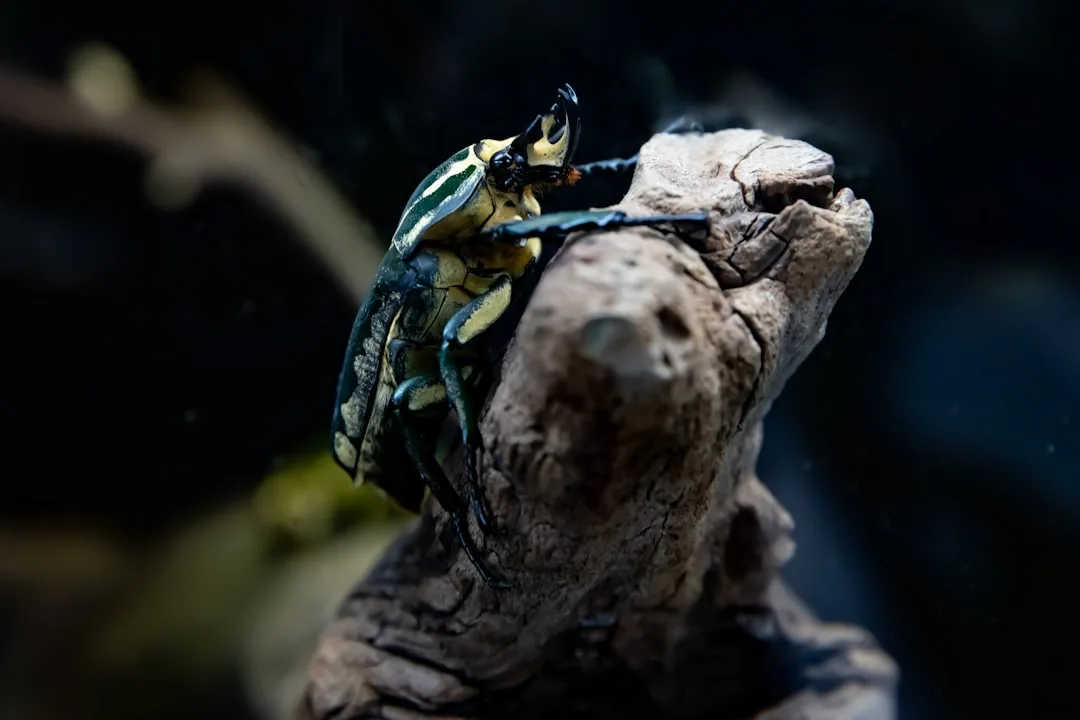
The Goliath beetle is the heaviest known insect on Earth. Adult males of Goliathus goliatus tip the scales at 80 to 100 grams, roughly the weight of a small apple, and their larvae reach an astonishing 150 grams before pupation - more than the body mass of many adult rodents.
In the canopy of equatorial African rainforest, these beetles drink tree sap by the spoonful, lock horns with rivals on trunks dripping with fermenting juice, and fly with a noisy, helicopter-like buzz despite their extraordinary bulk. The species is the flagship member of a genus of just five related African giants and sits at the absolute upper limit of what a terrestrial insect body plan can weigh.
This guide covers every important aspect of Goliath beetle biology and ecology: size and sexual dimorphism, the Y-shaped combat horn, the gigantic larval grubs, the liquid-only adult diet, reproduction, range across the Congo Basin, conservation pressures, and the cultural life the species leads as a prized pet in Japan. It is a reference entry, not a summary - so expect specifics: millimetres, grams, months, ranges, and verified measurements drawn from the entomological literature.
Etymology and Classification
The genus name Goliathus and the species epithet goliatus both refer to Goliath, the biblical giant felled by the shepherd boy David. The comparison is entirely appropriate.
When Swedish entomologists first encountered preserved specimens sent back from central Africa in the eighteenth century, the beetles stood out not for any single dimension but for sheer density - they looked like scarabs, but scaled up and weighted down.
Carl Linnaeus originally described the type species under the name Scarabaeus goliatus in 1771, and the genus Goliathus was erected by Lamarck in 1802 to contain the largest African flower scarabs.
Within the family Scarabaeidae, the Goliath beetle sits in the subfamily Cetoniinae, commonly called flower scarabs or flower chafers. Cetoniinae contains thousands of species worldwide, most of them much smaller than a finger joint, with the Goliath beetles sitting at the absolute top end of the subfamily's size range.
Their closest living relatives are the other four species in the genus: Goliathus regius of West Africa, Goliathus cacicus of the forest-savanna mosaics of Guinea and Cote d'Ivoire, Goliathus orientalis of the eastern Congo Basin, and Goliathus albosignatus of southeastern Africa.
All five species share the same basic silhouette, the same Y-shaped male horn, and the same distinctive black-and-white velvet colouring, though the exact pattern of stripes and blotches differs between species.
Molecular phylogenies place the genus Goliathus deep within the African cetoniine radiation, with an origin likely tied to the expansion of the Central African rainforest block during the Miocene. The restriction of all five species to tropical Africa - with no wild populations on any other continent - reflects this evolutionary history rather than any biological limit on where a Goliath-like beetle could theoretically live.
Size and Physical Description
Goliath beetles are the heaviest beetles on Earth, and by weight the heaviest insects at any life stage. Sexual dimorphism is moderate rather than extreme: males are larger and carry a horn that females lack, but females are still massive by any reasonable standard.
Males:
- Body length: 60-110 mm
- Weight: 80-100 g in the largest specimens
- Horn: Y-shaped, projecting forward from the head
- Elytra: broad, velvety, with bold black and white pattern
Females:
- Body length: 50-80 mm
- Weight: typically 40-60 g
- Head smooth and unhorned, often with a small flat shield for digging
- Elytra patterned similarly to males
Larvae (fully grown):
- Length: up to 130 mm curled, longer stretched
- Weight: up to 150 g
- Colour: cream-white body with a brown head capsule
- Body form: thick C-shaped grub typical of scarabs
The male's two tarsal claws and the broad front tibiae are oversized in proportion to the body, reflecting the need to grip rough bark firmly during combat. The thorax is extraordinarily thick and muscular, housing the flight muscles required to lift the insect into the air. The abdomen is compact but deep.
The elytra, or hardened wing covers, are one of the most distinctive features of the species: thick, convex, and finished in a matte velvet-like texture rather than the glossy sheen of many tropical scarabs. The background colour is a deep chocolate-brown to near-black, overlaid by bold cream or ivory stripes, hooks, and blotches. Together these give the beetles an almost monochrome appearance rare in their region.
Beneath each elytron sits a large membranous hind wing that unfolds for flight. The wings are surprisingly long and broad for the body, and they have to be - a 100-gram flying insect is close to the theoretical upper limit of what muscle-powered flight can lift.
The Y-Shaped Horn and Male Combat
The single most recognisable feature of a male Goliath beetle is the Y-shaped horn rising from the top of the head. Two tines project forward and slightly upward, meeting at the base in a sturdy shaft. The horn is moderately sized compared with the absurd forceps of a Hercules beetle, but it is purpose-built for one function: wrestling.
During the mating season males aggregate at sap flows and fruiting trees. These aggregation sites are hot spots where females come to feed and where males compete for prime positions. A Goliath beetle fight is a wrestling match conducted on the vertical face of a trunk or branch. Two males approach each other, lock horns, plant their thick legs firmly on the bark, and push.
The tines of one horn fit under the tines of the other, giving each male the leverage to pry sideways. The winner levers the loser off the bark and sends him tumbling, usually without injury. Fights rarely last more than a minute. Body size, horn length, and leg grip all predict the outcome, with the larger and better-placed male almost always winning.
Importantly, the horn is not a defensive tool against predators. Females lack horns entirely and do perfectly well, and males almost never attempt to use the horn against birds, mammals, or human handlers. The horn is a male-male weapon, shaped entirely by sexual selection rather than by survival pressure.
Size, Weight, and the Heaviest-Insect Title
Several beetle species are routinely called the world's largest insect, and the exact title depends on which measurement is used.
- The titan beetle (Titanus giganteus) is the longest beetle, with wild specimens reaching up to 167 mm from jaws to elytra tip, but it is slim in build.
- The Hercules beetle (Dynastes hercules) is the longest when horns are included, at up to 175 mm or more, but most of that length is horn rather than body.
- The Elephant beetle (Megasoma elephas) is heavily built but maxes out at around 50 g as an adult.
- The Goliath beetle (Goliathus goliatus) is the heaviest. Adults reach 80-100 g and larvae reach 150 g.
The 150-gram larval weight is the figure that settles the debate for sheer mass. It is heavier than any other verified insect at any life stage, and comfortably heavier than many small vertebrates. A Goliath beetle grub is genuinely a serious piece of biomass. Keepers who pick up a mature Goliathus larva for the first time are almost always surprised at how solid it feels in the hand, and the comparison most often reached for is a bratwurst or a small potato.
Diet and Feeding
Goliath beetles split their culinary life neatly between larva and adult, with almost no overlap in food sources.
Larval diet. After hatching, the grub feeds voraciously on decomposing wood, rotting leaf humus, and the rich microbial mats that develop in the upper layers of forest soil. Goliath larvae are less specialised wood-borers than Hercules beetle larvae - they will happily work through a mixed substrate of crumbling hardwood, leaf litter, and fungal-inoculated loam.
In captivity they are often fed a high-protein substrate supplemented with dog kibble or fish flakes to support their enormous growth, and experienced keepers report that a well-fed Goliath larva can gain weight almost visibly from one week to the next. Over 12 to 24 months the grub grows from a pale body the size of a grain of rice into a heavyweight up to 150 grams, passing through three larval instars.
Adult diet. Once the beetle emerges from the pupa, its mouthparts are completely different from those of the grub. Adults cannot chew solids. Instead they possess brush-like galeae - soft, hairy extensions of the maxillae - used to lap up liquids. Favoured adult foods include:
- Tree sap from wounded trunks, especially from fig, palm, and rainforest hardwoods
- Fermenting fallen fruit - mango, banana, palm fruit, and pineapple are all attractants in their range
- Honeydew left by aphids, scales, and other sap-feeders
- Occasional flower nectar
This dual diet is typical of the largest scarab beetles and is one of the keys to their enormous body size. Larvae do all the structural growth on a high-bulk, low-quality diet of rotting plant material, while adults focus purely on energy and reproduction using a liquid sugar diet that supports brief, intense, flight-heavy adult lives.
Reproduction and Life Cycle
Goliath beetle reproduction is gated by the wet season of equatorial Africa, which varies across the range but generally peaks during the major rains. Males emerge from the soil first, locate sap-flowing trees, and defend feeding positions through the horn-wrestling already described. Females emerge slightly later, visit the same trees, and mate with the resident males. A single female may mate more than once during her adult life.
After mating, the female descends to the forest floor and digs into rich humus or rotting wood. She lays 20 to 50 eggs across several weeks, placing each egg in a small individual chamber of compacted substrate. Eggs are oval, cream-white, and about 4 mm long. They hatch after roughly 2 to 4 weeks depending on temperature and humidity.
The larvae pass through three instars. Growth is rapid - body mass can triple between moults - and by the end of the third instar the grub has reached its final weight. The late-stage larva constructs a pupal chamber from soil and saliva, often incorporating its own cast skin into the walls, then moults into a pupa.
Pupation takes 4 to 8 weeks, during which the internal organs are completely reorganised into the adult body plan. The new adult emerges pale and soft, hardens over several days underground, then digs its way to the surface when conditions are right.
Lifecycle Summary
| Stage | Duration | Key events |
|---|---|---|
| Egg | 2-4 weeks | Laid in humus or rotting wood; develops into L1 larva |
| Larva L1 | 1-2 months | Small grub feeds on decaying plant matter |
| Larva L2 | 3-6 months | Major growth; extensive tunnelling through substrate |
| Larva L3 | 8-18 months | Peak size; can reach 150 g |
| Prepupa | 2-4 weeks | Stops feeding; builds pupal chamber |
| Pupa | 4-8 weeks | Complete internal restructuring |
| Adult | 3-6 months (wild) | Feeds, flies, fights, mates, dies |
More than 80 per cent of a Goliath beetle's life is spent as a larva underground, out of sight. The short, conspicuous adult stage is the tip of a long, slow, hidden developmental iceberg.
Flight and Movement
Goliath beetles fly despite their bulk. Take-off is preceded by a warm-up sequence in which the flight muscles shiver to raise their temperature several degrees above ambient, followed by a rapid opening of the elytra and unfolding of the hind wings. The resulting flight is loud, direct, and laboured - the buzzing hum is audible from well over ten metres away and has been compared to the drone of a small remote-controlled helicopter.
Flight is expensive. A large male Goliath beetle burns through a substantial fraction of his fat reserves on a single long flight, which is why most movement is short-range and targeted. Adults use flight mainly to move between sap trees and to locate mating aggregations by following fermentation-scent trails in the air.
During the day they are mostly inactive, wedged into crevices or under bark to avoid predators and desiccation. Most flight takes place in the warm, humid late afternoon and early evening.
Ground movement is slow and deliberate. A Goliath beetle walks with a wide-legged, low-slung gait that keeps its centre of mass close to the substrate. On smooth surfaces the beetles are clumsy, but on rough bark their tarsal claws grip superbly, which is critical during combat.
Range and Habitat
Goliath beetles of all five species are African. Goliathus goliatus itself ranges across the equatorial rainforest belt from Cameroon and Gabon eastward through the Republic of Congo and the Democratic Republic of the Congo, extending into parts of Uganda and northern Angola. Populations also occur in the forest-savanna mosaics at the edges of the main rainforest block.
Typical habitat is humid primary or mature secondary rainforest with abundant rotting hardwood, sap-flowing trees, and deep humus layers. The beetles will also use the transition zones where forest meets wooded savanna, provided larval substrate remains available.
They do not live in dry savanna, montane grassland, or desert, and they are absent from North Africa, Madagascar, and every continent other than Africa. No self-sustaining wild population of any Goliathus species has been documented outside Africa.
Within its range the species is patchily distributed, with local abundance driven by the availability of fruiting trees during the mating season and mature rotting logs for larval development.
Predators and Defence
Adult Goliath beetles have relatively few natural predators once they reach full size. The dense cuticle and 80 to 100 gram bulk defeat most birds and small mammals, and the velvet-patterned elytra break up the outline against mottled bark. Known predators and likely nest raiders include:
- Large forest birds such as hornbills and turacos
- Mangabeys and other forest primates, which occasionally crush beetles against branches
- Civets, genets, and other medium-sized carnivores
- Large forest lizards
- Army ants, which can overwhelm a settled adult in numbers
The main anti-predator defences are:
- Large size and dense cuticle, which resist pecking and crushing
- Cryptic bark-mimicking colour pattern
- Daytime hiding in crevices and cavities
- Loud stridulation produced by rubbing the abdomen against the elytra when seized
- Fast, disorienting take-off into flight when threatened
Larvae are far more vulnerable than adults. Deep in humus they are exposed to soil predators, parasitoid wasps, large scoliid wasps, predatory beetle larvae, and insectivorous mammals that dig through rotting logs. Hogs, pangolins, and several large rodents are known log-rippers in the species' range. The larva's primary defence is depth - the deeper it burrows and the denser the substrate, the safer it is.
Conservation Status and Threats
The IUCN has not formally assessed Goliathus goliatus or any other Goliathus species. This is typical of large tropical invertebrates; most IUCN effort focuses on vertebrates and commercially important taxa. As a result there is no official Red List category for the species, which in turn means there is no legal protection driven by conservation status alone. African entomologists and field workers consistently report declines across much of the range.
Primary threats:
- Deforestation. Equatorial African rainforest is being cleared at historic rates for logging, cocoa, oil palm, subsistence agriculture, and infrastructure. Larvae depend on old rotting hardwood and deep humus, which disappear from managed and degraded forest within a few years of disturbance.
- Climate change. Rising temperatures and shifting rainfall disrupt the wet-season cycles that drive adult emergence and larval growth. Rainforest loss to drought-linked dieback compounds direct clearance.
- Pesticide drift. Agricultural pesticides used near forest edges reduce insect populations generally and can affect beetles indirectly by damaging the microbial communities that support larval digestion.
- Collection for the pet trade. Compared with habitat loss this is a minor factor, but heavy unregulated collection of wild adults around breeding aggregations can dent local populations. Captive breeding now supplies most of the international trade and reduces pressure on wild stock.
- Bushmeat and subsistence collection. Goliath larvae are eaten as a protein source in parts of Central Africa, which is sustainable at low intensity but less so where collection intensifies.
Several national parks across the Congo Basin and Central African rainforest block provide meaningful protection for interior populations, but enforcement is uneven and the species receives no targeted conservation attention.
Goliath Beetles and Humans
Across much of equatorial Africa the Goliath beetle is a familiar, even iconic, rainforest resident. It is known under dozens of local names and features in folklore as a symbol of strength, bulk, and resilience. Rural collectors have long known where to find adults at sap trees during the wet season, and larvae are harvested as a protein-rich food in some regions.
Outside Africa, Goliath beetles have found a second life as pets and display animals. Japanese beetle-keeping culture, active since at least the 1990s, treats large scarabs as serious hobby animals on a par with tropical fish or reptiles. Department stores stock live rhinoceros and stag beetles, and specialist shops and online breeders supply Goliath beetles of multiple species.
Top-quality captive-bred adult males fetch several hundred US dollars, and record specimens have sold for far more. Captive breeding is now well enough established that most pet Goliath beetles are several generations removed from wild stock, which reduces collection pressure on wild populations.
Captive care is demanding. Larvae require a deep substrate of rotting hardwood mixed with protein supplements, stable warm humid conditions, and patience through a 12 to 24 month development period. Adults need fresh fruit jelly or banana daily and a humid enclosure with room to crawl and fly.
The United States restricts live imports of most foreign Goliath beetles under agricultural biosecurity rules to prevent the accidental establishment of a large non-native scarab in North America, so keepers in the US work mostly with native species instead.
Scientific interest in the species is also strong. Physiologists study Goliath beetle flight as a test case for the upper size limit of muscle-powered insect flight. Materials scientists investigate the dense cuticle and horn microstructure for biomimetic engineering applications. Ecologists use Goliathus presence as an indicator of high-quality rainforest, because a population of 100-gram beetles requires a healthy rotting-wood cycle, stable humidity, and abundant sap-producing trees.
Related Reading
- Hercules Beetle: Giant of the Neotropics
- Rhinoceros Beetle: Armoured Champion of the Tropics
- Stag Beetle: The Forest's Armed Logger
- Beetles: The Most Diverse Order of Life on Earth
References
Relevant peer-reviewed and governmental sources consulted for this entry include taxonomic revisions of Goliathus published in Zootaxa and Coleopterists Bulletin, physiological work on insect flight and scaling published in Journal of Experimental Biology, ecological studies of Central African rainforest invertebrates published in African Journal of Ecology, and cultural-economic analyses of the Japanese pet-beetle industry published in Insect Conservation and Diversity.
Range data follow the Catalogue of the Scarabaeoidea of the Afrotropical Region and the Natural History Museum London's Goliathus reference collection.
Frequently Asked Questions
How big is a Goliath beetle?
The Goliath beetle (Goliathus goliatus) is one of the largest beetles in the world and by weight the heaviest insect ever verified. Adult males measure 60 to 110 millimetres in body length and weigh 80 to 100 grams in the largest specimens, which is comparable to a small apple. Females are smaller at 50 to 80 millimetres and typically weigh 40 to 60 grams.
The full-grown larva is even more astonishing - it can reach around 150 grams, heavier than almost any other insect at any life stage. Only the horns distinguish males from females in silhouette, and those horns make up a relatively small part of the total length compared with Hercules or stag beetles.
Where do Goliath beetles live?
Goliath beetles are restricted to tropical Africa. The genus Goliathus contains five recognised species, all distributed across the equatorial belt from West Africa through the Congo Basin to parts of East Africa. Goliathus goliatus itself is a rainforest specialist of West and Central Africa, with strongholds in Cameroon, Gabon, the Republic of Congo, the Democratic Republic of the Congo, and neighbouring countries.
The beetles favour humid primary rainforest with abundant rotting hardwood and sap-flowing trees, as well as the transition zones where forest meets wooded savanna. Within that habitat adults are most often found on fruiting trees and bleeding sap wounds, while larvae develop underground in leaf litter and decomposing logs.
What do Goliath beetles eat?
Adults and larvae eat completely different diets. Adult Goliath beetles feed almost exclusively on liquids. They drink tree sap from wounds in trunks and branches, lap up juice from fermenting fallen fruit, and visit honeydew deposits left by sap-feeding insects. Their mouthparts are brush-like rather than biting, so solid food is effectively off the menu. Larvae, by contrast, are bulk-feeders.
After hatching they burrow into decomposing wood, leaf litter, and rich humus, chewing through huge volumes of rotten plant material and extracting nutrients with the help of a dense community of gut microbes. This dietary split between wood-eating grub and sap-drinking adult is a classic scarab strategy and is part of why the species can achieve such enormous body size.
Why is the Goliath beetle called the heaviest insect?
Several beetles compete for the title of world’s largest insect, but the Goliath beetle holds the record for heaviest verified weight. The largest males of Goliathus goliatus reach around 100 grams as adults, and mature larvae have been weighed at approximately 150 grams in captivity and the wild. Those numbers put the species ahead of competitors like the Hercules beetle, the Elephant beetle, and the Giant weta of New Zealand on pure mass.
Longer beetles exist - the titan beetle (Titanus giganteus) is longer on average - but they do not carry the sheer bulk of a large Goliathus. Weight is the honest measure here: these beetles are genuinely heavy enough to feel substantial in a human hand, and the larvae often surprise first-time keepers with how much they weigh.
What is the Y-shaped horn for?
Male Goliath beetles carry a Y-shaped horn projecting forward from the top of the head. The two tines point forward and slightly upward and meet the substrate when the beetle bends its head low. During the mating season, males gather at sap flows and fruiting trees where females come to feed, and they fight over prime positions.
A Goliath beetle fight involves two males locking horns, pushing, and trying to pry each other sideways off the bark using the Y-horn as a lever. Fights are brief, almost always non-injurious, and decided by body size, horn length, and grip. Females are entirely hornless, which is typical of horned scarabs and confirms that the horn functions as a male-male combat weapon rather than as a defensive feature against predators.
How long do Goliath beetles live?
A Goliath beetle’s full life cycle runs roughly 18 months to 3 years, depending on species, nutrition, and climate. The vast majority of that life is spent underground as a larva. After hatching from an egg, the grub feeds on decomposing wood and leaf humus for 12 to 24 months, passing through three instars and reaching a weight of up to 150 grams.
Pupation takes several more weeks inside an earthen chamber that the final-instar larva builds from compacted soil and saliva. Once the adult emerges and digs to the surface, it lives just 3 to 6 months - long enough to feed, fly, fight, and reproduce. In captivity, with constant warmth and humidity, some adult males approach a year of life, but wild adults rarely see a second dry season.
Are Goliath beetles kept as pets?
Yes, Goliath beetles are kept as pets by specialist keepers around the world, with Japan leading the hobby. Japanese beetle-keeping is a serious cultural pursuit that has been active since at least the 1990s, and captive-bred Goliathus of various species are stocked by insect shops, department stores, and online breeders.
Top-quality adult males with long horns and clean markings regularly fetch several hundred US dollars, and record specimens have sold for far more. Captive care requires a deep substrate of rotting hardwood and humus for the larvae, stable warm humid conditions, and a fruit-jelly or banana diet for the adults.
Import and export rules vary sharply by country: the United States restricts live imports under agricultural biosecurity rules, while European and Asian keepers generally have easier access through regulated breeders.
Are Goliath beetles endangered?
The Goliath beetle has not been formally assessed by the IUCN Red List, so it has no official global conservation category. In practice, populations across equatorial Africa face significant pressure. The main threat is habitat loss: tropical rainforest in West and Central Africa is being cleared at historic rates for logging, cocoa, oil palm, subsistence agriculture, and infrastructure.
Because larvae depend on mature rotting hardwood and deep humus, degraded and fragmented forest supports far fewer beetles than intact primary forest. Secondary threats include pesticide drift from agriculture, climate-driven shifts in rainfall that disrupt larval development, and collection pressure for the international pet trade - though collection is a much smaller factor than outright habitat loss.
Without a formal listing the species receives little targeted protection, but protected national parks across its range do shelter important populations.