
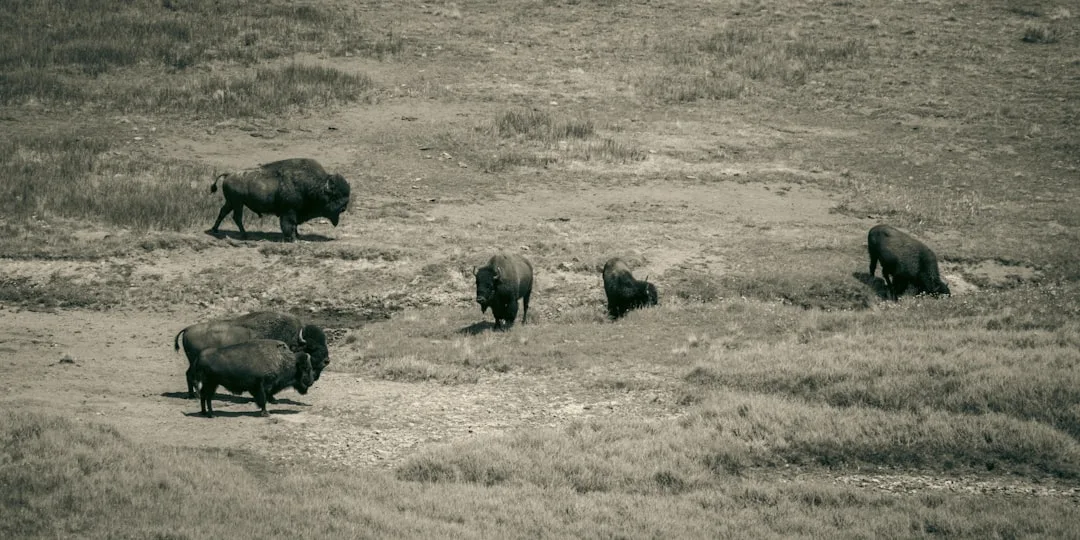
The American bison is the largest land mammal in North America, the national mammal of the United States, and the sole survivor of a group of wild cattle that once dominated the continent's grasslands by the tens of millions.
Bison bison is a creature of extremes: a 1,000-kilogram grazer that can outrun a horse, clear a standard cattle fence from a standing jump, swim across a mountain lake, and shoulder aside a metre of snow to reach the grass beneath it.
It is also a creature whose recent history is one of the starkest near-extinctions in the record of large mammals - a crash from an estimated 30 to 60 million animals to just 1,091 individuals in a single human lifetime, followed by a slow recovery that is still underway.
This guide covers the biology, ecology, and human history of the American bison: taxonomy, the plains and wood subspecies, body plan and physiology, feeding and behaviour, reproduction and life cycle, movement and range, the collapse and recovery, and the animal's central cultural position among Plains Indigenous nations. It is a reference entry rather than a summary, so expect specifics - kilograms, kilometres, dates, and verified figures.
Etymology and Classification
The scientific name Bison bison was established by Carl Linnaeus in 1758. The genus name derives from the Greek bison and the Latin bison, both referring to a wild ox of northern Europe.
In common English the animal is often called a "buffalo", a term that is zoologically incorrect - true buffalo belong to the genera Bubalus (Asian water buffalo) and Syncerus (African buffalo) - but that is deeply embedded in North American usage, place names, Indigenous English translations, and federal and state law. Both "American bison" and "American buffalo" remain in official use.
The taxonomy is straightforward at higher levels: Animalia, Chordata, Mammalia, Artiodactyla (even-toed ungulates), Bovidae (hollow-horned ruminants), genus Bison. Within the species, two subspecies are currently recognised:
- Plains bison (Bison bison bison) - temperate grasslands of the central and western United States and southern Canada.
- Wood bison (Bison bison athabascae) - boreal forests, aspen parkland, and sedge meadows of northern Canada and Alaska.
The only other living bison species is the European bison or wisent (Bison bonasus), which shares a recent common ancestor with the American species and can produce fertile hybrids with it. Molecular data indicate the two lineages diverged during the Pleistocene, with North American bison evolving from Bison priscus - the steppe bison that crossed the Bering land bridge during the last ice ages - rather than from modern European stock.
Plains Bison and Wood Bison
Although the two American subspecies look superficially identical to casual observers, they differ consistently enough that Canadian conservation law treats them as separate management units, and some taxonomists continue to argue for full species status.
| Feature | Plains bison (B. b. bison) | Wood bison (B. b. athabascae) |
|---|---|---|
| Adult bull weight | 540-900 kg | 800-1,000+ kg |
| Shoulder height | 1.7-1.9 m | 1.8-2.0 m |
| Hump shape | Rounded, centred | Squared, set well forward |
| Beard and neck chaps | Heavy, long | Lighter, shorter |
| Hair "bonnet" on forehead | Prominent | Reduced |
| Habitat | Grasslands, sagebrush | Boreal meadows, parkland |
| Historic low | 1,091 (1889) | ~250 (1900) |
Wood bison were functionally unknown to Euro-American science until the late 19th century and were long assumed to be simply larger plains bison in a different climate. Genetic analysis in the 1990s and 2000s confirmed meaningful divergence, with some gene flow where the two ranges met historically. The northernmost wood bison herds today occupy Wood Buffalo National Park, which straddles Alberta and the Northwest Territories and is the largest national park in Canada.
Size, Strength, and the Shoulder Hump
American bison display pronounced sexual dimorphism. Mature bulls are dramatically larger than cows, carry a much more pronounced head-and-shoulder hump, a heavier beard, and thicker head fur. This pattern is typical of polygynous bovids, where males compete physically for access to breeding females.
Bulls (adult males):
- Length: 3.0-3.5 metres head to tail
- Shoulder height: 1.7-2.0 metres
- Weight: 540-900 kg typical, 1,000+ kg in exceptional individuals
- Horns: upward-curving, up to 60 cm, roughened and worn in older bulls
Cows (adult females):
- Length: 2.1-2.7 metres head to tail
- Shoulder height: 1.5-1.7 metres
- Weight: 360-540 kg
- Horns: slimmer, more sharply curved, less worn
Calves:
- Weight at birth: 15-25 kg
- Coat: bright orange-red (the "red dog" stage), darkening to brown by 3-4 months
The signature feature of a bull bison is the enormous hump rising from the shoulders. It is often assumed to be a fat reserve. It is not. The hump is built on an exaggerated series of vertebral spinous processes that may project more than 30 centimetres above the bony column of the spine, with massive shoulder muscles anchored to them.
These muscles power the head, and their size reflects two daily jobs: swinging the head through deep snow to uncover winter forage, and using the head as a battering ram during the breeding season. In wood bison the hump is even more developed and set further forward, giving the silhouette a distinctive squared-off profile.
Despite all that mass, the bison is far more athletic than it looks. A healthy adult can accelerate from standstill to 55 km/h - roughly 15 metres per second - within a few strides. It can jump 1.8 metres vertically from a standing start, which is why conservation-grade bison fencing is rated for 2.1 metres and reinforced against impact.
It can pivot in its own body length, swim strongly across wide rivers, and maintain a steady lope for several kilometres. Yellowstone park rangers note, with some frustration, that tourists who think they can "outrun a cow with a calf" are the single largest source of bison-related injuries in the United States.
Physiology and Cold Tolerance
Bison are built for continental winters. Their coat is double-layered: a dense, woolly underfur trapping still air against the skin, and long coarse guard hairs shedding wind, rain, and snow. A winter coat can be 13 centimetres thick over the neck and shoulders. Summer sees a dramatic seasonal moult, with huge sheets of old wool peeling off in ragged patches during June.
Skin on the face, especially around the eyes and nostrils, is heavily muscled and thickly haired, allowing bison to bury their faces in snow without apparent discomfort. Their hooves are wide and round, providing traction on grass, ice, and soft boreal ground alike. Counter-current blood flow in the legs reduces heat loss to frozen ground, much as in reindeer and musk oxen.
Internally, bison are typical ruminants with a four-chambered stomach. Their fermentation efficiency is substantially higher than that of domestic cattle on coarse, low-quality prairie forage, which is a major reason they thrive in habitats where cattle need supplemental feed. They can maintain body condition on winter grass that would cause weight loss in cows of comparable size.
Diet and Grazing Behaviour
American bison are obligate grazers. Graminoids - grasses and sedges - make up approximately 90 to 99 per cent of the diet. Forbs, shrubs, and lichens contribute seasonally and vary by subspecies.
Plains bison primary forage:
- Blue grama (Bouteloua gracilis)
- Buffalograss (Bouteloua dactyloides)
- Little bluestem (Schizachyrium scoparium)
- Western wheatgrass (Pascopyrum smithii)
- Needle-and-thread grass (Hesperostipa comata)
Wood bison primary forage:
- Sedges (Carex spp.)
- Reedgrass (Calamagrostis spp.)
- Boreal meadow grasses
A mature bull consumes 11 to 14 kilograms of dry forage per day. Cows eat somewhat less. Bison drink once or twice daily when water is available, and can tolerate several days without surface water by extracting moisture from vegetation.
Foraging behaviour shifts seasonally. In summer, herds drift slowly across grasslands, grazing in the early morning and late afternoon, ruminating and resting in the heat of midday. In winter, they use the massive muscles of the hump to swing their heads side to side and clear away snow.
This "snow-ploughing" allows them to feed on grass buried under a metre of snowpack and distinguishes them sharply from domestic cattle, which starve when forage is covered. Winter bison move less, lose weight steadily, and rely on summer-built fat reserves to survive until spring green-up.
Bison grazing shapes the prairie itself. Unlike cattle, which tend to graze preferred patches into ruin, bison move constantly and graze unevenly, producing a mosaic of heavily grazed and lightly grazed patches that support far greater plant and insect diversity. Their wallows - shallow pits where they roll to dust themselves against biting flies - become microhabitats for specialised grasses and invertebrates.
Their dung feeds insect communities that in turn feed grassland birds. The ecological role of the bison is not replicable by any other species in the Great Plains.
Reproduction and Life Cycle
Bison reproduction runs on a strict seasonal schedule. The breeding season, or rut, occurs from late July to early September. Bulls that have spent most of the year in loose bachelor groups rejoin the mixed herds and begin competing for access to cows in oestrus.
Rut behaviour:
- Roaring: bulls produce deep, loud bellows carried for several kilometres
- Wallowing: bulls dig and roll in dust wallows, often urinating in them and coating themselves in scent
- Head-to-head combat: bulls lock horns and push; serious fights can end in broken horns, skull fractures, or death
- Tending: a dominant bull follows a single cow closely for hours to days, driving off rivals until she accepts mating
A tending bull may lose 10 to 15 per cent of his body mass over a single rut. Subordinate bulls, excluded from breeding, conserve energy and build winter reserves instead.
Gestation and birth:
- Gestation length: 270-285 days
- Birth season: April to June
- Litter size: 1 (twins are exceedingly rare)
- Birth weight: 15-25 kg
- Neonatal coat: bright orange-red, lasting 3-4 months
Calves are precocial. They stand within 10 to 30 minutes of birth, nurse within the first hour, and run with the herd within a few hours. Mothers are fiercely defensive, and a cow with a new calf will charge any perceived threat including bears, wolves, and humans. Calves nurse for about 7 to 8 months and remain with their mothers for a further year.
Cows reach sexual maturity at 2 to 3 years; bulls are physically mature at 3 but typically cannot compete for breeding opportunities until 6 to 9 years, when they have reached peak body mass. Wild bison generally live 15 to 20 years, with captive individuals reaching 25 to 30.
Movement, Speed, and Range
Pre-collapse bison herds moved across the Great Plains in continental-scale seasonal migrations, shifting north in summer and south in winter, tracking rainfall-driven grass growth. Historical eyewitness accounts describe single herds covering hundreds of square kilometres and taking days to pass a given point. These migrations are gone.
Modern conservation herds are confined by fencing and land tenure to ranges of a few hundred to a few thousand square kilometres. Yellowstone bison still undertake genuine seasonal movements inside the park, descending from summer high-elevation meadows to lower winter ranges, but the scale is a shadow of the historical pattern.
Movement and athletic performance:
| Metric | Value |
|---|---|
| Top running speed | 55 km/h |
| Sustained trot | 15-20 km/h for several kilometres |
| Vertical jump | up to 1.8 m from standstill |
| Swimming | strong; crosses large rivers, lakes |
| Daily summer foraging | 2-5 km/day |
| Historic migrations | 300-600+ km seasonally |
Bison swim well. In Yellowstone they have been observed crossing Yellowstone Lake - more than 7 kilometres wide in places - with only their heads and the tops of their humps above the waterline. Their dense guard hair traps enough air to provide buoyancy, and their broad hooves paddle efficiently.
The Collapse: 30 Million to 1,091
Before European contact, conservative estimates place the North American bison population at 30 million. Higher-end historical ecology estimates reach 60 million. Either way, the species formed the largest aggregation of large wild mammals anywhere on Earth.
By 1889, when naturalist William Hornaday published his survey The Extermination of the American Bison, the total surviving wild population was 1,091 individuals. Within a single human lifetime, somewhere between 99.996 and 99.998 per cent of the species was destroyed.
Drivers of the collapse:
- Commercial hide trade. Industrial tanning processes developed in the 1860s and 1870s made bison hides valuable as machine belting leather. Professional hunters - "buffalo runners" - shot thousands of animals per year each, taking only the hide and tongue and leaving the carcasses.
- Railroad expansion. The transcontinental railroads of the late 1860s and 1870s brought hunters into the heart of bison country and carried hides out efficiently.
- Federal policy. Senior US military and political figures explicitly supported bison extermination as a means of destroying the economic base of Plains Indigenous nations and forcing them onto reservations. General Philip Sheridan is widely quoted as endorsing hunters as the army's most effective allies.
- Habitat conversion. Grasslands were rapidly fenced and ploughed for cattle and wheat, removing the ecological base even where bison themselves survived.
- Disease. Introduced cattle brought brucellosis, anthrax, and bovine tuberculosis to remaining bison populations.
Recovery began almost accidentally. A handful of private ranchers - Charles Goodnight in Texas, Michel Pablo and Charles Allard in Montana, Walking Coyote among Salish-Kootenai communities - gathered calves from the dwindling wild herds in the 1870s and 1880s. Yellowstone National Park, established in 1872, preserved a small wild herd in the Lamar Valley.
In 1905 the American Bison Society was founded, and in 1907 the Bronx Zoo shipped 15 bison from New York back to Oklahoma to seed a reintroduced herd - the first deliberate large-mammal reintroduction in North American history. Over the following century, populations were rebuilt from this tiny genetic bottleneck.
Today approximately 500,000 American bison live across the continent. Around 31,000 are in conservation herds managed for wild behaviour and genetic integrity. The rest are on commercial ranches, raised for meat. Many commercial herds carry introgressed cattle genes from early recovery-era hybridisation, making genetically pure wild stock unusually valuable to conservation programmes.
Yellowstone and the Only Continuous Wild Population
Yellowstone National Park occupies a unique position in bison biology. It is the only place in North America - and therefore on Earth - where wild bison have lived continuously since prehistoric times. Every other existing wild or conservation herd traces back to reintroduction from captive stock.
The Yellowstone herd, numbering about 5,000 animals today, descends from an estimated 23 bison that survived the low point inside park boundaries, supplemented by animals brought in from private ranches in 1902.
The park's bison are genetically among the most valuable in the world, being free of detectable cattle introgression in most individuals. They are also the subject of ongoing conflict.
Yellowstone bison carry brucellosis - introduced historically from cattle - and when they leave park boundaries in winter in search of lower-elevation forage, they are controversially culled or hazed back into the park to prevent possible transmission to Montana cattle herds.
The population has been capped at politically negotiated numbers for decades, and the culling programme remains contested among ecologists, ranchers, and tribal nations who seek to receive live transfers of Yellowstone stock to restore tribal herds.
Conservation Status
The IUCN lists the American bison as Near Threatened with the population subdivided into conservation herds and commercial livestock. CITES listing is not applied because domestic commercial herds dominate total numbers, but wild populations remain small, fragmented, and dependent on active management.
Major current threats:
- Habitat fragmentation. No remaining wild range is large enough to support the migratory behaviour of historical populations. Even Yellowstone bison are confined by park boundaries and hazing.
- Disease management. Brucellosis in Yellowstone and bovine tuberculosis in Wood Buffalo National Park complicate range expansion and live transfer.
- Cattle gene introgression. Many commercial and some conservation herds carry cattle DNA from early 20th-century hybrid breeding. Genetically pure bison are concentrated in a handful of herds including Yellowstone, Wind Cave, Elk Island, and the Henry Mountains.
- Political and legal boundaries. Bison cross jurisdictions easily; management agencies do not. Conflicts between federal, state, tribal, and private authorities slow restoration.
- Climate change. Grassland productivity and snow regimes are shifting, particularly at the northern edge of wood bison range.
Indigenous Cultures and the Bison
For more than thirty Plains Indigenous nations, the bison is not a wildlife species. It is a relative, a teacher, and a central spiritual being. Lakota tradition names the animal Tatanka; Blackfoot tradition names it iinii; Cheyenne traditions place the bison at the centre of origin narratives.
Before the collapse, Plains nations derived food, clothing, shelter, tools, fuel, and ceremonial material from the bison, with specialised techniques - buffalo jumps, impoundments, hunts on horseback - refined over thousands of years.
The 19th-century destruction of the bison was not a side effect of settlement. It was targeted policy. Contemporary US military and political correspondence makes clear that eliminating the bison was understood as a means of forcing Plains nations into surrender and onto reservations. For Indigenous peoples, the bison near-extinction was experienced as an attack on their families, their spiritual world, and their economic independence all at once.
Modern restoration is therefore a cultural and political project as well as an ecological one. The Intertribal Buffalo Council, founded in 1992, coordinates bison restoration across nearly 80 tribal nations and manages more than 20,000 animals. The transfer of live Yellowstone bison to tribal ranges - including the Fort Peck and Blackfeet reservations - has become an important and contested conservation practice.
For many Plains communities, the return of bison is inseparable from the return of language, ceremony, and food sovereignty.
National Mammal Designation
On May 9, 2016, President Barack Obama signed the National Bison Legacy Act, designating the American bison as the National Mammal of the United States. The bald eagle remains the national bird and symbol. The bison is the only officially designated national mammal. The designation is ceremonial and does not create additional legal protections, but it reflects the animal's symbolic weight in American history - both the near-extinction and the recovery.
Related Reading
- Bison: From Near Extinction to National Mammal
- Yellowstone Wildlife: A Guide to the Park's Iconic Animals
- Great Plains Ecosystems: Grasslands, Grazers, and Predators
- Wood Bison of the Boreal North
References
Population and conservation figures in this entry draw on IUCN American Bison assessments, the US Fish and Wildlife Service bison conservation initiative, Parks Canada wood bison recovery documentation, and the Intertribal Buffalo Council's annual reporting.
Historical population estimates and collapse chronology follow the established ecological-history literature, including reconstructions published in Conservation Biology, Ecological Applications, and The Journal of Wildlife Management. Cultural content is informed by published work from Lakota, Blackfoot, and Cheyenne scholars and by the Intertribal Buffalo Council's public educational materials.
Subspecies taxonomy follows the American Society of Mammalogists Mammal Diversity Database and Canadian Species at Risk Act listings.
Frequently Asked Questions
How big is the American bison?
The American bison (Bison bison) is the largest land mammal in North America. Adult males (bulls) stand 1.7-2.0 metres at the shoulder, stretch 3.0-3.5 metres head to tail, and typically weigh 540-900 kg, with record individuals exceeding 1,000 kg. Females (cows) are smaller at 1.5-1.7 metres shoulder height and 360-540 kg. The wood bison subspecies is consistently larger than the plains bison, with bulls commonly exceeding 900 kg.
Calves weigh 15-25 kg at birth. The defining feature of both sexes is the muscular shoulder hump, which is more exaggerated and anteriorly placed in bulls. Horns curve upward in both sexes and reach 60 cm in mature males.
What do American bison eat?
American bison are obligate grazers. Roughly 90 to 99 per cent of their diet is graminoids - grasses and sedges - supplemented by small amounts of forbs, shrubs, and lichen depending on season and region. Plains bison favour warm-season prairie grasses such as blue grama, buffalograss, and little bluestem, while wood bison rely more heavily on sedges and boreal meadow grasses. A mature bull consumes 11-14 kg of dry forage per day.
In winter bison use their massive heads as snowploughs, swinging side to side to uncover buried grass, a behaviour that allows them to survive winters that would kill cattle. They drink daily when water is accessible and can go several days without water during dry periods.
How did the American bison almost go extinct?
Before 1800 an estimated 30-60 million bison roamed North America, forming the largest aggregation of large wild mammals on Earth. Systematic commercial slaughter in the middle to late 19th century - driven by the hide trade, railroad expansion, and explicit federal policies aimed at starving Plains Indigenous nations into reservations - collapsed the population to roughly 1,091 individuals by 1889.
A handful of ranchers and the newly established Yellowstone National Park preserved the last wild and captive remnants. Today about 500,000 bison live across the continent, but only around 31,000 are in conservation herds managed for genetic integrity; most of the rest are commercial livestock. Wood bison (B. b. athabascae) were reduced to roughly 250 individuals before their own recovery.
Where do American bison live today?
Wild or semi-wild conservation herds of American bison occur across the United States, Canada, and reintroduction sites in northern Mexico.
Key populations include Yellowstone National Park (the only continuously wild herd, around 5,000 animals), Wind Cave, Badlands, Theodore Roosevelt National Park, the American Prairie Reserve in Montana, Elk Island National Park in Alberta, Wood Buffalo National Park spanning Alberta and Northwest Territories, and tribal herds managed by the Intertribal Buffalo Council across more than 20 Native American nations.
Plains bison inhabit grasslands and sagebrush steppe, while wood bison occupy boreal meadows, aspen parkland, and river valleys in northern Canada and Alaska. Most of the global half-million bison, however, live on private commercial ranches, not in wild ecosystems.
Are plains bison and wood bison different species?
No. Plains bison (Bison bison bison) and wood bison (Bison bison athabascae) are currently classified as two subspecies of the American bison, not separate species, though their status has been debated for more than a century. Wood bison are taller, heavier, and darker, with a more squared hump positioned further forward on the body, a straighter back, and a lighter beard. They occupy boreal Canada while plains bison inhabit temperate grasslands.
Genetic studies confirm meaningful divergence but also confirm interbreeding where ranges overlap. Canadian conservation authorities manage wood bison as a distinct unit under the Species at Risk Act, and the International Union for Conservation of Nature (IUCN) lists them separately. Some taxonomists continue to argue that wood bison warrant full species status.
Are American bison dangerous to humans?
Yes, and more dangerous than their placid appearance suggests. Bison injure more visitors in Yellowstone National Park than any other animal - far more than bears - because tourists routinely underestimate them. A bison can accelerate from standstill to 55 km/h in a few strides, pivot in its own body length, and toss a 90-kg adult several metres into the air with a flick of its head.
Bulls become particularly aggressive during the July-September rut, when they patrol females and tolerate no rivals. Cows with calves are dangerous year-round. The National Park Service recommends staying at least 25 metres from any bison. Non-lethal injuries are common; fatalities do occur but remain rare because most attacks are warnings rather than committed predation, since bison are not predators.
How long do American bison live?
Wild American bison typically live 15 to 20 years, with mortality driven by predation on the very young and old, winter starvation, disease, and injuries sustained during the rut. Bulls often live shorter lives than cows because the energetic cost of the rut, combined with fighting injuries, accumulates rapidly after age 10. In captivity, with reliable food, veterinary care, and no predators, bison commonly reach 25 years and occasionally exceed 30.
Cows produce their first calf at age 2 or 3 and can continue breeding into their late teens, giving birth to one calf per year in favourable conditions. Gestation is 270 to 285 days and calves are precocial - able to stand within 30 minutes and run with the herd within hours.
What is the cultural significance of the American bison?
The American bison is the spiritual, material, and ceremonial centre of more than thirty Plains Indigenous nations, including the Lakota, Dakota, Cheyenne, Arapaho, Blackfoot, Crow, Pawnee, and Comanche. Before the 19th-century collapse, bison provided food, clothing, tools, shelter coverings, and a complete cosmology. The Lakota word Tatanka refers simultaneously to the animal and a sacred being.
The deliberate destruction of the bison by the US government in the 1870s and 1880s was inseparable from the assault on Plains nations themselves, and modern bison restoration is therefore tied to cultural and political restoration as well as ecology. In 2016 the bison was designated the National Mammal of the United States, and tribal herds managed through the Intertribal Buffalo Council now hold more than 20,000 bison across nearly 80 tribes.