
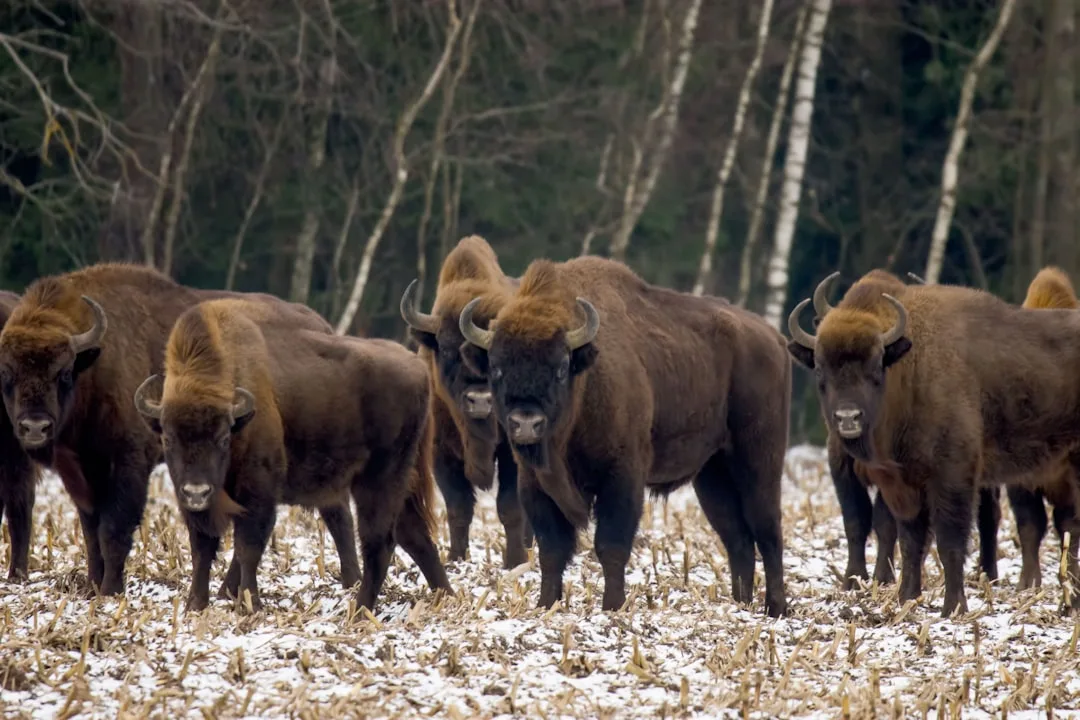
The European bison, or wisent, is the largest land mammal in Europe and the only European large mammal to have been exterminated in the wild and then successfully brought back. Every one of the roughly nine thousand Bison bonasus alive today descends from just twelve captive founders that survived the species' extinction in 1927.
The Bialowieza Forest on the Poland-Belarus border remains the living heart of the population, but wisent now browse woodland in Romania, the Netherlands, Spain, Germany, Denmark, and - since March 2022 - Kent, in the south-east of England.
This guide covers every aspect of European bison biology and ecology: size and build, the crucial differences between wisent and the American bison that most people assume is the same animal, diet and forest behaviour, reproduction, the century-long recovery programme, current rewilding projects across Europe, conservation status, and the strange facts that make this species one of the most important case studies in modern conservation.
It is a reference entry, not a summary - so expect specifics: kilograms, kilometres, dates, population numbers, and verified records.
Etymology and Classification
The scientific name Bison bonasus was formalised by Linnaeus in 1758. Bonasus is a Latinised form of the Greek bonasos, a word used by Aristotle for a large horned beast that is almost certainly the same animal. The common English name wisent comes from the Old High German wisunt, itself related to the modern German Wisent, the Dutch wisent, and the Polish zubr.
Medieval Slavic, Germanic, and Baltic languages all have cognate words, reflecting how widely the animal was once known across the European forest zone.
Taxonomically the European bison belongs to:
- Kingdom: Animalia
- Phylum: Chordata
- Class: Mammalia
- Order: Artiodactyla
- Family: Bovidae
- Genus: Bison
- Species: B. bonasus
Two historical subspecies are usually recognised: the lowland bison (B. bonasus bonasus) from the Bialowieza Forest and the broader European plain, and the Caucasian bison (B. bonasus caucasicus) from the Caucasus Mountains. The Caucasian form went fully extinct in 1927.
A small amount of Caucasian genetic material survived through a single bull that had been crossed with lowland cows, creating the so-called lowland-Caucasian line (B. bonasus montanus, informally) used in mountain reintroductions.
Genetic studies published in the 2010s produced a striking finding: modern European bison appear to be the product of an ancient hybridisation event between the extinct steppe bison (Bison priscus) and the ancestor of modern cattle (Bos primigenius, the aurochs). That would make Bison bonasus one of the few large mammals known to have arisen through species-level hybridisation, and it helps explain why the wisent can interbreed with both American bison and domestic cattle.
The European bison and the American bison (Bison bison) diverged from a common ancestor several hundred thousand years ago and remain close enough to produce fertile hybrids. A 20th-century Polish and Caucasian breeding programme produced such a hybrid deliberately - the zubron - as a candidate meat animal, before the experiment was wound down in favour of protecting the purebred wisent line.
Size and Physical Description
European bison are the largest land mammals native to Europe, outweighing every European bear, moose, and wild boar. Sexual dimorphism is pronounced but less extreme than in American bison.
Males (bulls):
- Length: up to 2.9 m head to rump
- Shoulder height: 1.6-1.9 m
- Weight: typically 600-920 kg, exceptional animals over 1,000 kg
- Horns: short, upward-curving, around 50 cm
Females (cows):
- Length: 2.1-2.6 m
- Shoulder height: 1.5-1.7 m
- Weight: 320-540 kg
- Horns: slightly more slender and more curved than in bulls
Calves at birth:
- Weight: 15-35 kg
- Coat: pale reddish-brown, shed within two to three months for the adult dark brown
The wisent's silhouette is the single clearest identification feature that separates it from its American cousin. European bison are taller at the shoulder, longer in the leg, and shorter in the forequarter mane. The hump that dominates the front half of an American bison is much smaller and more gently rounded in a wisent, and it is placed less far forward on the body.
The head is carried higher, which reflects the species' reliance on browsing leaves and bark from small trees and shrubs rather than grazing with the head low to the ground.
The coat is short on the flanks and hindquarters, longer on the forequarters, chest, and chin, and thickens substantially in winter. Colour is a uniform dark brown to chocolate, sometimes with a slightly greyer tone on the back and a slightly lighter tone on the belly. There is no strong pattern or marking.
Differences from the American Bison
Because the two species are so often confused, a direct comparison is worth laying out clearly.
| Feature | European bison (wisent) | American bison |
|---|---|---|
| Scientific name | Bison bonasus | Bison bison |
| Preferred habitat | Forest and forest-meadow | Open grassland and prairie |
| Shoulder height | 1.6-1.9 m (bulls) | 1.7-2.0 m (bulls) |
| Leg length | Relatively long | Relatively short |
| Forequarter hump | Small, rounded | Large, pronounced, forward-set |
| Head carriage | High | Low |
| Forequarter mane | Short | Long, shaggy |
| Beard | Short | Long and dense |
| Primary feeding | Mixed grazer and browser | Near-obligate grazer |
| Herd size | Typically 8-20 | Historically hundreds to thousands |
| Current population | ~9,000 | ~500,000 (mostly commercial) |
| Historic low | 0 in wild (1927); 12 founders | 1,091 individuals (1889) |
| Conservation status | Near Threatened | Near Threatened |
The behavioural and ecological differences matter as much as the anatomical ones. Wisent form much smaller herds, are substantially more shy of humans, and fill a woodland-herbivore ecological niche closer to moose or red deer than to the plains-roaming American buffalo.
Habitat and Range
Historically the European bison ranged across most of the broadleaf and mixed forest zone of Europe, from France and northern Spain in the west to the Caucasus and the Volga in the east, and from southern Sweden in the north to the Balkans in the south. By 1800 that range had shrunk to isolated refuges in Poland, Lithuania, Belarus, Russia, and the Caucasus. By 1927 it was zero.
Modern free-living wisent occur in:
- Poland - Bialowieza, Knyszyn, Borecka, Augustow, Bieszczady, and western Pomerania
- Belarus - Bialowieza (Belovezhskaya Pushcha), Berezinsky Biosphere Reserve, several forest districts
- Lithuania - Panevezys region
- Russia - Oka Reserve, northern Caucasus reintroductions, Orlovskoye Polesye
- Ukraine - several Carpathian and northern forest reintroductions
- Romania and Slovakia - the Carpathian Mountains, including the Tarcu and Fagaras ranges supported by Rewilding Europe and WWF
- Germany - Rothaargebirge free-roaming herd
- Netherlands - Kraansvlak coastal dunes (since 2007), Maashorst, Veluwe
- Denmark - Bornholm island
- Spain - several fenced and semi-wild sites in the Cantabrian Mountains and central Spain
- Bulgaria, Czech Republic, Azerbaijan - smaller reintroduction projects
- United Kingdom - West Blean Woods, Kent, since March 2022 (the first free-ranging bison in Britain in thousands of years)
The Bialowieza Forest, which straddles the Poland-Belarus border, remains the species' ecological and cultural heart. Protected variously as a royal hunting reserve, a Tsarist reserve, and now a national park and UNESCO World Heritage Site on both sides of the border, Bialowieza preserves the last continuous fragments of the primeval lowland forest that once covered the European plain. Around 1,000 to 1,200 wisent live freely in the wider Bialowieza landscape.
Diet and Forest Ecology
European bison are bulk mixed feeders. Unlike the American bison, which is an almost obligate grazer, the wisent consumes substantial quantities of leaves, shoots, bark, acorns, beechnuts, and twigs alongside grasses and herbaceous plants. A mature animal eats 30-60 kg of fresh vegetation per day.
Seasonal diet shifts:
- Spring - new grass, sedges, herbaceous plants, fresh leaves as they flush
- Summer - grasses and herbs dominate, supplemented by leaves from shrubs and low trees
- Autumn - acorns, beechnuts, fallen fruit, and late herbaceous growth
- Winter - bark, twigs, evergreen browse, rushes, and any exposed shrub layer; in managed herds, provisioned hay
Wisent routinely strip bark from oak, ash, hornbeam, willow, young conifers, and other species, sometimes killing mature trees. This is one of the main points of tension between bison and commercial forestry in Poland and Belarus. From a rewilding perspective, however, the same behaviour is a benefit: bark-stripping and browsing create canopy gaps, deadwood, and structural diversity that support woodpeckers, saproxylic beetles, fungi, and ground-nesting birds.
The species will stand on its hind legs to reach leaves and bark up to about three metres from the ground, a habit rarely observed in American bison. In Bialowieza and many managed reserves, wisent are provisioned with hay during winter. The practice began in the 1920s and 1930s as an emergency measure to keep the fragile recovery herd alive and has since become embedded in the species' winter ecology in central Europe, for better and for worse.
Reproduction and Life Cycle
European bison reproduction follows a clear seasonal pattern.
- Rut: August to September, with peak activity in late August
- Gestation: 264-272 days (roughly nine months)
- Births: May and June
- Litter size: 1 calf (twins extremely rare)
- Weaning: 7-12 months
- Sexual maturity: cows from age 3-4, bulls from age 6-7 (but usually excluded from breeding until at least age 8)
Rutting bulls join small groups of cows, displace younger males, and compete through displays of head-tossing, pawing, snorting, and sometimes direct clashes. Fights are usually ritualised rather than dangerous, though serious injuries and occasional deaths do occur.
Cows give birth away from the herd, in dense cover. The calf can stand within an hour and walks with the mother back to the group within a day. Calves nurse for about a year but begin taking solid food within weeks. Young animals typically remain with their natal group until sexual maturity; young bulls then disperse.
Calf mortality in the first year is estimated at 20-40 per cent depending on winter severity, wolf predation (especially in eastern populations where wolves are common), and inbreeding-related disease. Cows typically produce one calf every one to two years in good conditions and remain reproductive into their late teens.
The Twelve Founders and the Recovery
The near-extinction and recovery of the European bison is one of the most dramatic stories in large-mammal conservation.
The collapse:
- 1800 - already reduced to Bialowieza and Caucasus
- 1900 - perhaps 1,500-2,000 animals total across both refuges
- 1914-1919 - Bialowieza herd destroyed during the First World War and the chaos that followed; the last wild Bialowieza bison was killed by poachers in February 1919
- 1927 - the last wild Caucasian bison is shot
- 1927 - 54 European bison remain alive in zoos and private collections
- 1927 - of those 54, only 12 prove to be genetically effective founders of the recovery line
The rescue:
- 1923 - International Society for the Protection of the European Bison founded in Berlin
- 1929 - breeding centre established at Bialowieza by the Polish state
- 1932 - first volume of the European Bison Pedigree Book (studbook) published in Bialowieza
- 1939-1945 - Second World War threatens the recovery; the studbook survives in duplicate copies
- 1952 - first reintroduction of captive-bred animals to the Polish side of Bialowieza
- 1970s-1990s - further reintroductions in Poland, Belarus, Lithuania, Ukraine, and Russia
- 2004 - Rewilding Europe and partners begin planning Carpathian releases
- 2014 - first Carpathian rewilding release in Romania's Tarcu Mountains
- 2020 - IUCN downlists the species from Vulnerable to Near Threatened
- 2022 - free-ranging wisent released into West Blean Woods, Kent, UK
- 2023 - global population passes roughly 9,000 animals
The studbook is still maintained at Bialowieza National Park in Poland, still printed in Polish, and still tracks every individual European bison alive, captive or wild. It is the oldest continuous pedigree record for any wild mammal.
The cost of the 12-founder bottleneck is real. Every wisent alive today is more closely related to every other wisent than the founders of most modern cattle breeds are to each other. Consequences include reduced sperm quality in some bulls, elevated rates of congenital defects, and unusual vulnerability to infectious diseases such as bovine tuberculosis, foot-and-mouth disease, and balanoposthitis, a male urogenital condition that has caused notable mortality in parts of the Polish population.
Conservation Status
The IUCN Red List currently classifies Bison bonasus as Near Threatened. The species was downlisted from Vulnerable in 2020, an unusual move that reflected steady population growth across multiple range states and the establishment of viable free-ranging herds outside the original Bialowieza stronghold. Even so, the long-term outlook depends on continued management.
Primary threats:
- Genetic bottleneck - 12 effective founders mean unusually low diversity and elevated disease risk
- Habitat fragmentation - much of the European forest zone is divided by roads, settlements, and farmland that limit gene flow between subpopulations
- Disease - bovine tuberculosis, foot-and-mouth disease, and balanoposthitis circulate in some herds
- Poaching - limited but persistent in parts of the eastern range
- Conflict with forestry - bark-stripping damages commercial timber; mitigation is expensive
- Vehicle collisions - increasing as herds expand along forest road networks
- Climate change - shifting composition of European forests may alter food availability on long timescales
The 1923 International Society, later continued by the European Bison Friends Society and by national bison conservation authorities, remains central to species management. Studbook coordination, strategic translocations to maintain genetic diversity, disease monitoring, and carefully planned reintroductions are now standard tools.
Zoos worldwide continue to hold reserve breeding populations that support the studbook and act as an insurance policy against any future crash in the free-ranging herds.
Rewilding and the European Bison
Rewilding organisations have made the wisent a keystone species for a new generation of European conservation projects. Its size, behavioural repertoire, and mixed feeding habits allow it to reshape landscapes in ways smaller herbivores cannot match.
Key rewilding sites:
- Netherlands: Kraansvlak (2007) - first rewilding release in western Europe, in coastal dune forest near Haarlem
- Germany: Rothaargebirge (2013) - first free-roaming herd in Germany in centuries
- Romania: Tarcu and Fagaras Mountains (2014) - largest rewilded population outside Bialowieza, supported by Rewilding Europe and WWF
- Spain: multiple sites (since 2010) - semi-wild herds in Cantabrian Mountains and central Spain
- Denmark: Bornholm (2012) - island rewilding experiment
- United Kingdom: West Blean Woods, Kent (March 2022) - first free-ranging bison in Britain for thousands of years; a national media event and a test case for small-scale British rewilding
Early monitoring data from these projects consistently show positive effects on plant diversity, ground-nesting bird habitat, dung-dependent invertebrate communities, and overall structural heterogeneity of the forest. The Kent release in particular has been studied closely as a model for small, fenced, ecologically significant releases in countries where large-mammal rewilding is politically sensitive.
Cultural Significance
The wisent has deep cultural roots across the European forest zone. In Poland it is a national symbol, appearing on coins, postage stamps, the Zubr beer label, and the Zubrowka bison-grass vodka produced since the 16th century - the vodka is flavoured with Hierochloe odorata, a grass wisent graze in Bialowieza. The Polish word zubr and the Lithuanian stumbras appear in medieval literature, heraldry, and folklore.
Belarus has declared the wisent its national animal; it appears on coins and in the Belovezhskaya Pushcha national park logo.
Further east, the Caucasian peoples had their own names and traditions for the mountain subspecies before it was lost. In Russia the species has long been a focus of scientific and conservation attention, particularly at the Oka Reserve and the Caucasus Biosphere Reserve, where reintroduced animals from the lowland-Caucasian line now carry the only surviving traces of Caucasian ancestry.
For Poles in particular, the story of the wisent - the near-destruction, the 12 founders, the studbook, and the century-long comeback - is a national conservation story on a scale comparable to what the American bison represents for the Indigenous nations of the Great Plains and the modern United States. The species appears in children's books, primary school curricula, and tourism branding across the Polish and Belarusian border forests.
Related Reading
- American Bison: Thunder of the Plains
- Ungulates: The Hoofed Animals That Shaped the World
- Moose: The Largest Deer in the World
- Wild Boar: Europe's Most Adaptable Mammal
References
Relevant peer-reviewed and governmental sources consulted for this entry include the IUCN Red List assessment for Bison bonasus (Plumb et al., 2020), the European Bison Pedigree Book published annually by Bialowieza National Park, the European Bison Conservation Newsletter, Rewilding Europe's Carpathian progress reports, and published research in Biological Conservation, Mammal Review, Acta Theriologica, and Molecular Ecology.
Population figures and rewilding milestone dates reflect the most recent consolidated data as of the 2023 assessment cycle.
Frequently Asked Questions
How big is a European bison?
The European bison (Bison bonasus) is the largest living land mammal in Europe. Mature bulls measure up to 2.9 metres from nose to rump, stand 1.8-1.9 metres at the shoulder, and typically weigh 600-920 kg, with exceptional animals exceeding 1,000 kg. Cows are smaller at roughly 1.0-1.5 metres shoulder height and 320-540 kg. Calves weigh 15-35 kg at birth.
Compared with the American bison, the wisent is taller at the shoulder, carries a smaller forequarter hump, has longer legs, and holds its head higher - a silhouette more suited to navigating forest than galloping across open plains. Both sexes have short, upward-curving horns that reach around 50 cm in mature bulls.
Where do European bison live today?
Free-living European bison now occur in more than a dozen countries. The core stronghold is the Bialowieza Forest on the Poland-Belarus border, which holds roughly a quarter of the global wild population. Substantial herds live across eastern Poland, Belarus, Lithuania, western Russia, Ukraine, and the Carpathian Mountains of Romania and Slovakia.
Rewilding programmes have established additional populations in the Netherlands (Kraansvlak, since 2007), Germany (Rothaargebirge), Spain (several Cantabrian and southern sites), Denmark (Bornholm), and - since March 2022 - the United Kingdom (West Blean Woods, Kent). Total global population stands at roughly 9,000 animals across wild, semi-wild, and captive settings as of the 2023 IUCN assessment, of which about two thirds are genuinely free-ranging.
Are European bison and American bison the same species?
No. They are separate species within the genus Bison. The European bison (B. bonasus) and the American bison (B. bison) diverged from a common ancestor several hundred thousand years ago and differ in skeleton, behaviour, and habitat. European bison are forest specialists with taller shoulders, longer legs, a smaller hump, shorter hair on the forequarters, and a more upright head carriage.
American bison are plains specialists built for running across open grassland, with a massive anteriorly placed hump, thick shaggy forequarters, and a head held low for grazing. The two species can interbreed - historical Polish and Caucasian breeding programmes produced a fertile hybrid called zubron in the 20th century - but wild hybridisation does not occur because their ranges do not overlap.
How did European bison survive extinction?
The last wild Bialowieza bison was killed by poachers in 1919 and the last wild Caucasian bison was shot in 1927, formally extinguishing the species in the wild. At that point only 54 animals survived in zoos and private collections across Europe, and of those just 12 proved fertile and contributed to the modern recovery lineage.
The International Society for the Protection of the European Bison, founded in 1923, established a centralised studbook in 1932 that tracked every bison alive. Careful breeding rebuilt numbers through the Second World War and afterwards, and in 1952 the first reintroduced animals were released into the Polish side of Bialowieza Forest.
The population has grown to around 9,000 animals today - one of the most successful large mammal recoveries ever recorded - though the 12-founder bottleneck still produces significant inbreeding and reduced genetic diversity.
What do European bison eat?
European bison are bulk herbivores that consume 30-60 kg of plant material per day. Unlike American bison, which are almost pure grazers, the wisent is a mixed feeder.
Their diet shifts with the seasons: grasses, sedges, and herbaceous plants dominate spring and summer; leaves and soft twigs supplement foraging through late summer; acorns, beechnuts, and fallen fruit are critical autumn energy sources; and winter forces the animals onto bark, twigs, rushes, and any exposed shrub layer. Wisent regularly strip bark from oak, ash, hornbeam, willow, and young conifers, sometimes killing trees outright.
In managed forests this can create conflict, but in rewilding landscapes the same behaviour produces canopy gaps, deadwood, and structural diversity that benefit woodpeckers, beetles, and other dependent species.
Are European bison dangerous to humans?
European bison are less aggressive than many other large bovids and usually avoid people. In forested reserves like Bialowieza they tend to melt into the trees long before a hiker sees them. Attacks on humans are rare, but the animals are still wild megafauna - a bull can reach 920 kg, sprint 50 km/h, and clear a 2-metre fence. Cows protecting calves, rutting bulls in August and September, and animals cornered near roads or settlements can and do charge.
Standard advice in bison range states is to stay at least 50 metres away, never approach calves, avoid direct eye contact with displaying bulls, and treat any tail-raised, head-down posture as a warning to retreat. Vehicle collisions with wisent crossing forest roads are a more common cause of injury than direct attacks.
Why is the European bison important to rewilding?
The wisent is often called a keystone species for European forests. Its foraging, trampling, wallowing, and bark-stripping create habitat mosaics that smaller herbivores cannot replicate - open glades in dense forest, muddy wallows used by amphibians and invertebrates, standing and fallen deadwood, and seed dispersal across large areas.
Rewilding organisations have released bison into the Netherlands, Germany, Spain, Romania, Denmark, and Britain precisely because no native herbivore fills the same ecological niche at the same scale. Early monitoring from these projects shows measurable increases in plant diversity, dung-dependent invertebrates, and ground-nesting bird habitat within a few years of bison arrival.
The 2022 Kent release is being studied as a test case for whether wisent can be a practical rewilding tool in small, fragmented lowland British woodlands.
How long do European bison live?
Wild European bison typically live 18-24 years, with cows usually outliving bulls because mature males accumulate injuries from the autumn rut. Captive animals in zoos and breeding centres commonly reach 25 years and occasionally approach 28 thanks to consistent food and veterinary care.
Calves are the most vulnerable age class: mortality in the first year is around 20-40 per cent depending on winter severity, wolf predation in eastern populations, and inbreeding-linked disease. Cows produce one calf every 1-2 years from about age 3-4 onwards, and remain reproductive into their late teens.
The 12-founder bottleneck means that genetic disorders, reduced sperm quality in bulls, and susceptibility to diseases like bovine tuberculosis and balanoposthitis remain ongoing conservation concerns despite the spectacular population recovery.