
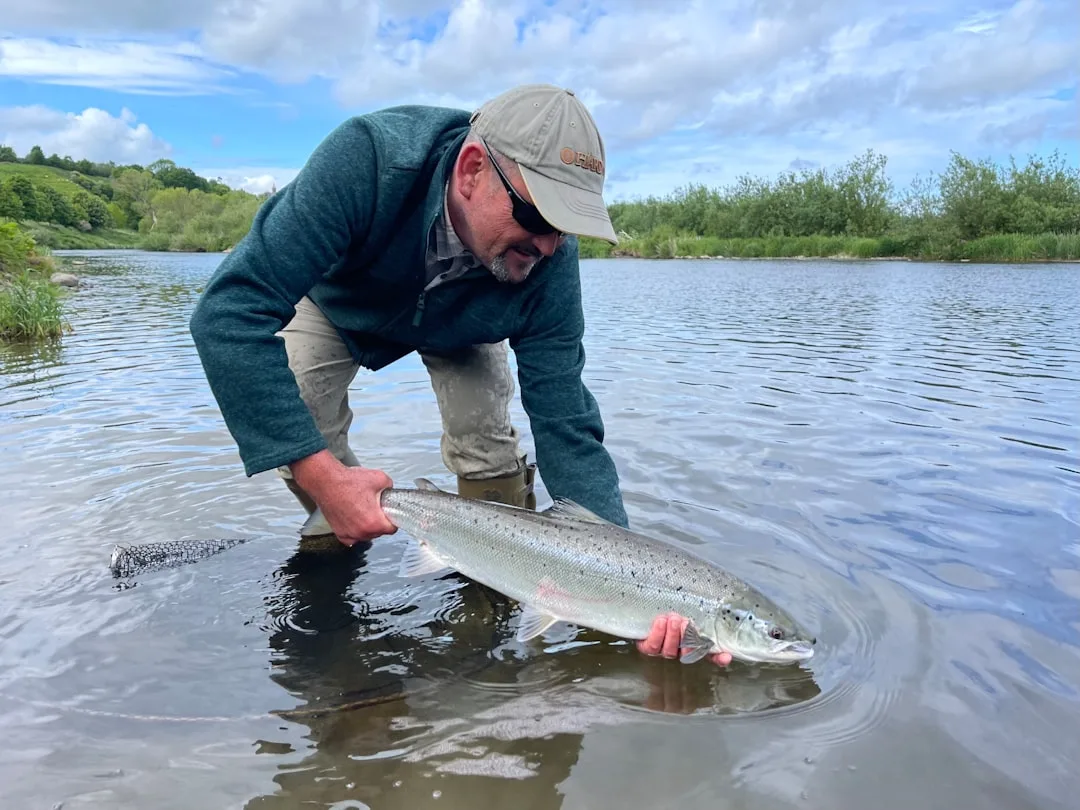
The Atlantic salmon is the fish that refuses to stay in one world.
Born in a gravel bed on a quiet river, it spends its first years drifting between stones and shallow runs, then rebuilds its own body chemistry to step into the North Atlantic, feeds for years in one of the harshest oceans on the planet, and then - guided by magnetic lines most animals cannot sense and by scents its olfactory memory stored when it was smaller than a finger - returns to the exact stream where it hatched to spawn.
No other commercially important fish does all of that, and no other wild fish has been engineered by humans into a global farming industry on the scale that Atlantic salmon has.
This guide covers every major aspect of Atlantic salmon biology and ecology: size and body plan, the anadromous life cycle, magnetic and chemical navigation, spawning behaviour, the dramatic difference between Atlantic and Pacific salmon, farmed versus wild fish, conservation status, and the relationship between Salmo salar and the humans who now produce it in industrial volumes.
It is a reference entry, not a summary - so expect specifics: kilograms, kilometres, temperatures, production tonnes, and verified records.
Etymology and Classification
The scientific name Salmo salar comes from Latin. Salmo is the Roman word for salmon, thought to derive from salire, meaning 'to leap'. Salar is more obscure but has been interpreted as 'salt-water dweller' or 'the leaper'. Either way, the species has carried some version of the same name for two thousand years, which is remarkable for any animal.
Atlantic salmon belong to the class Actinopterygii (ray-finned fishes), the order Salmoniformes, and the family Salmonidae, which also includes trout, char, grayling, and whitefish. Within the genus Salmo, Atlantic salmon are most closely related to brown trout (Salmo trutta), and the two species can hybridise in the wild where their ranges overlap.
The genus Salmo is sharply distinct from the Pacific salmon genus Oncorhynchus, which includes chinook, coho, sockeye, pink, and chum salmon. The two genera diverged roughly 10-15 million years ago, and the differences between them - particularly in reproduction and life history - are larger than most consumers realise. A supermarket rarely flags whether its 'salmon' is Atlantic or Pacific, but biologically these are separate branches of the salmonid family tree with very different ecologies.
Size and Physical Description
Atlantic salmon are medium to large fish with elongated, torpedo-shaped bodies built for sustained swimming in open ocean and bursts of power in river rapids. Size varies enormously depending on how many winters the fish has spent at sea before returning.
Adult salmon returning to spawn:
- Length: 70-150 cm
- Typical weight: 3.6-5.4 kg after one sea winter (grilse)
- Multi-sea-winter weight: 7-15 kg common, up to 20-25 kg for large individuals
- Record wild weight: approximately 46 kg (Norway, Tana River, 1928)
Juvenile stages:
- Alevin (newly hatched): 2-3 cm, yolk sac still attached
- Fry: 3-5 cm
- Parr: 7-20 cm, dark vertical 'parr marks' on the flanks
- Smolt: 12-25 cm, silver, ready for the ocean
Farmed Atlantic salmon are typically harvested at 4-6 kg after roughly two years in sea cages following 10-16 months in freshwater tanks. Farmed fish have been selectively bred for faster growth and now reach market size at around twice the speed of their wild ancestors.
The Atlantic salmon body is a streamlined fusiform shape with a small, adipose second dorsal fin immediately in front of the tail - a family marker shared with all salmonids. The mouth extends back to below the eye, armed with small conical teeth for holding slippery prey. Colour changes dramatically with life stage and environment.
At sea the back is steel blue-green, the flanks are bright silver, and the belly is white. This countershading is excellent camouflage against ocean predators. When the salmon enters freshwater to spawn, its body reorganises under hormonal control: the flanks darken, olive, bronze, or deep red patches appear, and spawning males often develop striking crimson and black markings.
Spawning males grow a distinctive hooked lower jaw called a kype. The kype extends upward and curls into the upper jaw and is used in fights with rival males over spawning access. In extreme cases the kype grows so pronounced that the male cannot fully close his mouth. The kype regresses partially in the rare males that survive spawning and return to sea.
Anadromous Life Cycle
Atlantic salmon are anadromous: they hatch in freshwater, migrate to the ocean to grow, and return to freshwater to spawn. This is one of the most demanding reproductive strategies in vertebrate biology, and the entire life history of the species is shaped by it.
Stage 1: Egg and alevin. Eggs are laid in late autumn or early winter, buried in gravel beds called redds dug by the female. They incubate under ice and cold water for 70-200 days depending on temperature. Alevins hatch with a yolk sac still attached and remain hidden in the gravel for several more weeks, absorbing the yolk before emerging.
Stage 2: Fry and parr. The emerging fry quickly develop into parr - small territorial juveniles with dark vertical bars on their flanks. Parr live in the natal river for one to four years depending on latitude and water temperature, feeding on aquatic insects, small invertebrates, and occasional small fish. Northern populations in Arctic Europe may spend four or even five years as parr; populations in the milder rivers of southern Europe may smolt after one.
Stage 3: Smoltification. When parr reach roughly 12-15 cm and environmental cues align - day length, water temperature, flow - they undergo smoltification. The parr marks disappear, the body turns silver, and the gills, kidneys, and endocrine system rebuild themselves to handle saltwater osmoregulation.
This transformation takes weeks, and during it the fish loses its ability to live in freshwater as surely as it gains the ability to live in the sea. Smolts migrate downstream at night in schools during spring.
Stage 4: Ocean phase. In the North Atlantic, salmon feed for 1-4 years on capelin, sand eels, herring, krill, and squid. Growth rates at sea are explosive: a 15 cm smolt can return as a 70-80 cm grilse in just over a year, or as a 100+ cm multi-sea-winter fish after longer. Atlantic salmon from rivers across Europe, Iceland, Greenland, and North America share feeding grounds off Greenland and the Faroe Islands.
Stage 5: Spawning return. When ready, salmon navigate back to their natal river. They stop feeding the moment they enter freshwater and live off stored fat. They move upstream - over rapids, up waterfalls, through fish ladders - to the specific tributary where they hatched. Females dig redds, males fertilise the eggs, and the exhausted adults then either die (the vast majority) or attempt to return to sea as kelts.
Only about 1% of adult Atlantic salmon successfully complete a second spawning migration. This is the sharpest contrast with Pacific salmon, all of which die after one spawning. Atlantic salmon are technically iteroparous - capable of repeated reproduction - but the physical cost is so high that iteroparity is almost theoretical for most wild fish.
Navigation: The Magnetic Map
The precision of Atlantic salmon homing is one of the most striking navigational feats in the animal kingdom. A fish hatched in a specific tributary of the River Spey in Scotland may feed thousands of kilometres away off Greenland, then return years later to within metres of the gravel bed where it emerged. Salmon accomplish this with a two-stage navigation system.
Stage one: magnetic map. Research by Kenneth Lohmann and colleagues at the University of North Carolina has shown that Atlantic salmon (and several Pacific salmon species) imprint on the geomagnetic signature of their natal river as juveniles. Every location on Earth has a unique combination of magnetic intensity and inclination.
Salmon carry an internal map of the magnetic signature of their home waters, and they use the Earth's field to navigate across the open ocean back to the coast. Experiments that expose salmon to shifted magnetic fields show measurable changes in orientation consistent with map-based navigation rather than simple compass-following.
Stage two: olfactory fine-tuning. Once salmon reach the coast, a second navigation system takes over. Each river carries a distinctive chemical signature shaped by its geology, vegetation, soil chemistry, and microbial communities. Salmon imprint on this scent signature during their final weeks in the river as smolts. When they return, they trace the scent upstream to the specific tributary where they hatched.
The olfactory system is so sensitive that salmon can detect the chemical difference between tributaries that join the same river only a few hundred metres apart.
The combination is remarkable. The magnetic map brings the fish to the coast from thousands of kilometres away. Chemical memory delivers it to the exact metre.
Atlantic vs Pacific Salmon
Atlantic and Pacific salmon look superficially similar and taste similar, but they are biologically distinct in ways that matter for ecology, fisheries, and consumers.
| Feature | Atlantic salmon (Salmo salar) | Pacific salmon (Oncorhynchus spp.) |
|---|---|---|
| Genus | Salmo | Oncorhynchus |
| Number of species | 1 | 6-7 (chinook, coho, sockeye, pink, chum, cherry) |
| Spawning strategy | Iteroparous (can spawn twice) | Semelparous (die after spawning) |
| Post-spawn survival | ~1% of adults | 0% |
| Ocean basin | North Atlantic, Baltic | North Pacific, Arctic |
| Farmed at large scale | Yes (most farmed fish on Earth) | Minor compared to Atlantic |
| Ocean phase duration | 1-4 years | 1-5 years depending on species |
| Closest relative | Brown trout (Salmo trutta) | Rainbow/steelhead trout (O. mykiss) |
The iteroparous-semelparous split is the biggest difference. A Pacific salmon returning to spawn is effectively already dying - its immune system, digestive tract, and connective tissues break down on a schedule. An Atlantic salmon has an escape route, even if almost none take it.
Aquaculture and the Farmed Fish Economy
Atlantic salmon is the most farmed fish on Earth. Global aquaculture production reached roughly 2.5 million tonnes per year in the mid-2020s, with Norway alone producing about half of it. Other major producers include Chile, Scotland, Canada, the Faroe Islands, and Iceland. Selective breeding programmes date back to the 1970s and have produced domesticated lines that grow roughly twice as fast as wild ancestors, mature later, and tolerate farm conditions.
Production stages:
- Eggs and alevins in land-based hatcheries
- Parr and smolt development in freshwater tanks, usually 10-16 months
- On-growing in open sea-cage net pens, usually 14-24 months
- Harvest at 4-6 kg, processed into fillets, portions, and whole fish
Farmed Atlantic salmon is sold globally under countless retail brands. Mass-market sources such as Amazon Fresh, Walmart, Costco, Aldi, and Tesco move enormous volumes of farmed salmon sourced primarily from Norwegian, Scottish, Canadian, and Chilean operations. Restaurant supply chains rely even more heavily on farmed product. Wild Atlantic salmon, by contrast, is almost never seen in mainstream retail in meaningful quantities; most wild-labelled salmon in shops is Pacific.
The environmental footprint of aquaculture is contested. Open net pens release waste, uneaten feed, and pathogens into surrounding waters. Sea lice (Lepeophtheirus salmonis) outbreaks in farms have caused measurable mortality in wild smolts migrating past pens, particularly in Norway, Scotland, and British Columbia.
Farmed salmon escapes are frequent and consequential - hundreds of thousands of fish escape from global farms each year, and escapees can interbreed with wild populations to the genetic detriment of wild stocks.
Industry responses include closed containment systems, land-based recirculating aquaculture systems (RAS), improved feed formulations using algal and plant proteins, and third-party certifications such as ASC (Aquaculture Stewardship Council) and BAP (Best Aquaculture Practices). These measures have reduced some impacts without eliminating the core ecological concerns.
Populations and Range
Atlantic salmon are native to the North Atlantic, with populations on both the European and North American sides. Individual rivers each hold genetically distinctive stocks; scientists often count populations by river system rather than by region.
Range summary:
| Region | Status | Notes |
|---|---|---|
| Norway | Declining, large total runs | Largest remaining wild population |
| Iceland | Relatively stable | Small but healthy stocks |
| Scotland and Ireland | Severely declining | Many rivers at historic lows |
| England and Wales | Endangered in most rivers | Some rivers hold under 5% of 1970s runs |
| France, Spain, Portugal | Critically low | Only a handful of functional rivers |
| Baltic Sea | Mixed | Distinct landlocked and anadromous forms |
| Eastern Canada | Severely declining | Most Maritime rivers at historic lows |
| United States (Maine) | Endangered | Listed under Endangered Species Act |
| Greenland | Feeding area, not spawning | Major mixed-stock feeding grounds |
Wild Atlantic salmon have been extirpated from large sections of their historic range. Major rivers in mainland Europe, New England, and southern Canada that once held enormous runs now hold remnants or none. Baltic populations show mixed trends and include a distinctive non-anadromous form that completes its life cycle entirely in freshwater.
Conservation Status and Threats
The IUCN Red List classifies Atlantic salmon globally as Least Concern because the total number of individuals remains large, thanks primarily to aquaculture and to still-substantial wild runs in Norway and Iceland. However, many individual wild populations and regional stocks are listed as Endangered or Critically Endangered under national laws and European frameworks. Wild Atlantic salmon populations across the species' range have collapsed by more than 70% since the 1980s.
Primary threats:
- Ocean mortality. Marine survival rates of smolts have dropped sharply over recent decades, probably because of warmer sea temperatures, shifts in plankton and forage fish, and changing predator communities.
- Sea lice and disease from aquaculture. Open-pen farms concentrate parasites and pathogens that spill over to wild smolts migrating past farm sites. Sea lice outbreaks are implicated in wild salmon declines in Norway, Scotland, Ireland, and British Columbia.
- Genetic introgression from escaped farmed fish. Escaped farmed salmon interbreed with wild fish. Long-running Norwegian studies show hybrid and introgressed offspring have measurably reduced fitness in the wild, which can erode adaptive genetic diversity over generations.
- River habitat loss. Dams, culverts, water abstraction, sedimentation, riparian deforestation, and acid deposition have degraded spawning and rearing habitat across the species' range.
- Climate change. Rising river temperatures stress eggs, alevins, and parr. Earlier spring melt disrupts migration timing. Ocean warming shifts prey distributions away from traditional feeding grounds.
- Overfishing (historic and ongoing). Commercial netting at sea, particularly the Greenland and Faroese mixed-stock fisheries, reduced spawning adults for decades. Modern quotas are much tighter, but illegal and bycatch mortality continues.
- Pollution. Pesticides, metals, pharmaceuticals, and microplastics accumulate in freshwater and estuarine habitat.
Conservation responses include habitat restoration, dam removal, fish ladder installation, hatchery supplementation, strict catch-and-release regulations on many rivers, tighter aquaculture standards, and international agreements under the North Atlantic Salmon Conservation Organization (NASCO). None of these measures individually is sufficient; recovery depends on addressing multiple threats simultaneously.
Atlantic Salmon and Humans
Atlantic salmon have been central to European and North American cultures for millennia. Mesolithic middens across Scotland, Ireland, and Scandinavia contain salmon bones. Medieval river rights and laws across Europe frequently gave salmon special status, and many surviving royal and ecclesiastical estates date their boundaries to salmon fisheries.
In Celtic mythology the Salmon of Knowledge carries all the wisdom of the world. In Inuit, Sami, and indigenous Atlantic Canadian traditions salmon are a keystone food source and cultural species.
Modern uses are divided sharply between recreational angling, subsistence and indigenous fishing, commercial wild fisheries, and industrial aquaculture. Recreational angling on premier salmon rivers in Scotland, Norway, Iceland, Russia, and eastern Canada supports high-value tourism economies. Commercial wild capture has shrunk dramatically as stocks have declined and quotas have tightened.
Aquaculture has grown to fill the gap and then vastly exceeded it - most salmon eaten anywhere in the world today was raised in a pen, not caught from the wild.
Consumer choices matter. Wild Atlantic salmon is now mostly a protected resource and should generally be left to recover. Certified farmed Atlantic salmon, responsibly caught Pacific salmon, and land-based recirculating aquaculture product are the main sustainable options. Supporting river restoration, dam removal, and tighter aquaculture regulation is probably more effective for wild salmon conservation than any single purchasing decision.
Related Reading
- Great White Shark
- Sailfish: Fastest Fish in the Ocean
- Electric Eel: 600 Volts of Living Battery
- Ocean Sunfish: Heaviest Bony Fish
References
Relevant peer-reviewed and governmental sources consulted for this entry include the IUCN Red List assessment for Salmo salar, North Atlantic Salmon Conservation Organization (NASCO) annual status reports, the International Council for the Exploration of the Sea (ICES) Working Group on North Atlantic Salmon reports, Norwegian Institute for Nature Research (NINA) aquaculture-wild interaction studies, Lohmann laboratory publications on magnetic imprinting in salmonids, and peer-reviewed research published in Proceedings of the National Academy of Sciences, Nature Communications, Journal of Fish Biology, and ICES Journal of Marine Science.
Aquaculture production figures reflect Food and Agriculture Organization (FAO) global statistics from the most recent reporting cycles.
Frequently Asked Questions
How big do Atlantic salmon get?
Adult Atlantic salmon (Salmo salar) returning from the sea typically measure 70-150 cm in length and weigh 3.6-5.4 kg. Larger specimens classified as ‘multi-sea-winter’ salmon, having spent two or more years feeding in the North Atlantic before returning to spawn, can exceed 100 cm and 15 kg. The all-time record wild Atlantic salmon weighed approximately 46 kg and was caught in Norway’s Tana River in 1928.
Farmed Atlantic salmon are usually harvested smaller, at 4-6 kg, after about two years in sea cages. Juveniles called parr spend 1-4 years in freshwater at just 10-20 cm before smolting and migrating to sea.
What is an anadromous fish?
Anadromous fish are species that hatch in freshwater, migrate to the ocean to grow and mature, then return to freshwater to spawn. Atlantic salmon are the textbook example.
A salmon egg deposited in a gravel riverbed in Scotland, Norway, or Maine hatches into an alevin, develops into a fry and then a parr, lives 1-4 years in its natal river, undergoes smoltification to tolerate salt water, migrates thousands of kilometres into the North Atlantic, feeds for 1-4 years on fish and crustaceans, then returns with astonishing precision to the exact river or even tributary where it hatched.
The entire life cycle depends on both healthy rivers and healthy oceans - which makes salmon uniquely vulnerable to environmental change in either habitat.
How do Atlantic salmon find their way home?
Returning Atlantic salmon use a two-stage navigation system. In the open ocean they rely on the Earth’s magnetic field. Research led by Kenneth Lohmann at the University of North Carolina has demonstrated that juvenile salmon imprint on the unique magnetic signature of their natal river before they migrate, and then use that magnetic map to guide them back across thousands of kilometres of featureless ocean.
Once they reach the coast, a second navigation system takes over - olfactory memory. Each river carries a distinctive chemical signature from its geology, soils, and plant life. Salmon recognise this scent and follow it upstream to the specific tributary, sometimes to within metres of their hatching site. This combination of magnetic map and chemical fine-tuning is one of the most precise navigation systems known in vertebrates.
Do Atlantic salmon die after spawning like Pacific salmon?
No, not automatically - but most do. Pacific salmon (genus Oncorhynchus) are semelparous: their bodies begin to deteriorate the moment they enter freshwater and all adults die after a single spawning event. Atlantic salmon (Salmo salar) are iteroparous in principle. They can survive spawning, return to the sea to recover and feed, and spawn again in later years.
In practice only about 1% of wild Atlantic salmon successfully complete a second spawning migration. The journey upstream, the fast during spawning (they eat nothing in freshwater), the physical fights among males, and the hormonal exhaustion of reproduction kill almost all of them before they make it back. The rare survivors, called ‘kelts’, are highly valued by fisheries biologists as genetic contributors across multiple generations.
Are farmed and wild Atlantic salmon the same species?
Taxonomically yes, ecologically and genetically much less so. Farmed Atlantic salmon are all Salmo salar, but they have been selectively bred for roughly fifteen generations since the 1970s for fast growth, late sexual maturity, disease resistance, and efficient feed conversion in net pens. Norwegian farmed salmon now grow about twice as fast as their wild ancestors on the same food.
Genetic studies show farmed salmon differ from wild populations in behaviour, aggression, stress response, and physiology. When farmed salmon escape from net pens - which happens routinely, with hundreds of thousands escaping globally each year - they can interbreed with wild fish.
Hybrid offspring and their descendants are measurably less fit in the wild, according to long-running studies in Norway and Scotland, and escaped farmed salmon are now considered a major threat to wild Atlantic salmon populations in some regions.
Why are wild Atlantic salmon declining?
Wild Atlantic salmon populations across the species’ range have fallen by more than 70% since the 1980s. The causes are interacting and cumulative. River habitat has been lost or degraded by dams, pollution, sedimentation, agricultural runoff, forestry, and water extraction. Oceanic survival has dropped sharply, probably because of warmer sea temperatures, shifts in prey availability, and changing predator communities linked to climate change.
Sea lice outbreaks originating in salmon farms have caused measurable mortality in wild smolts migrating past coastal pens. Escaped farmed salmon dilute wild gene pools. Historic overfishing at sea - particularly the Greenland and Faroese fisheries - reduced spawning adults for decades before quotas were cut.
The IUCN lists the species as Least Concern globally because total numbers remain large, but many individual rivers and regional populations are listed as Endangered or Critically Endangered under national and European frameworks.
How do Atlantic salmon jump waterfalls?
Atlantic salmon are among the most powerful jumping fish in the world. During the upstream migration they routinely clear vertical obstacles over 3 metres high, and they will attempt even higher falls given enough pool depth below for acceleration. The jump begins with a deep, fast swim in the plunge pool at the base of the fall, building momentum against the current.
At the moment of leap the salmon uses rapid tail beats and a powerful body flex to launch into the air, orienting its body almost vertically. The gills seal shut during the leap, and the fish effectively holds its breath. Salmon have been observed making dozens of attempts at the same obstacle before succeeding or giving up.
The iconic images of salmon leaping at Scottish and Norwegian falls are real - and the energetic cost is enormous, contributing to why so few adults survive to spawn twice.
Is farmed salmon safe and sustainable to eat?
Farmed Atlantic salmon is safe to eat by all major food safety standards in the European Union, the United States, Canada, and Japan. Concerns cluster around sustainability rather than direct human health. Open-net-pen aquaculture releases waste, uneaten feed, and parasites into surrounding waters. Sea lice treatments can affect non-target species.
Farmed salmon are fed partly on wild-caught fishmeal and fish oil, which can shift pressure onto other ocean populations, though feed formulations have moved steadily toward plant proteins and algal oils. Land-based recirculating aquaculture systems promise much lower environmental impact but are expensive to scale.
Third-party certifications such as ASC (Aquaculture Stewardship Council) and BAP (Best Aquaculture Practices) attempt to distinguish better-run farms, but standards vary. Consumers looking to minimise impact generally choose certified farmed salmon, responsibly caught wild Pacific salmon, or land-raised Atlantic salmon where available.