
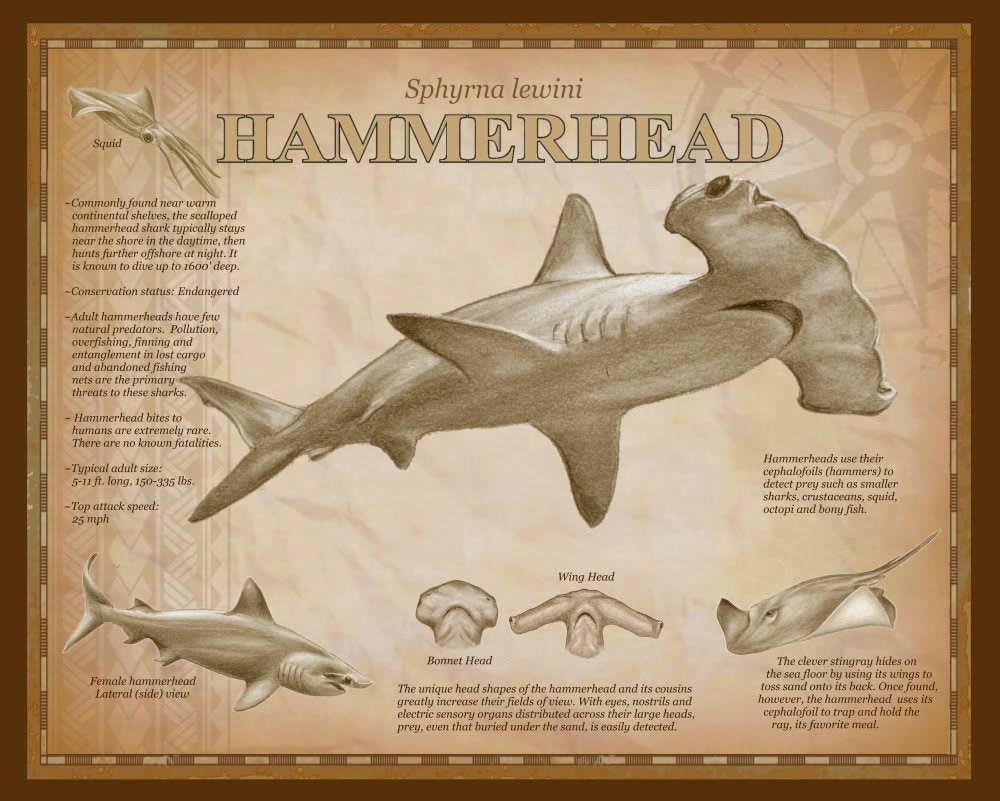
The scalloped hammerhead is the most abundant and most frequently encountered member of the hammerhead family, a lineage of sharks whose flattened, wing-shaped heads make them instantly recognisable and biologically unique among the roughly 500 species of living sharks.
Sphyrna lewini is a circumglobal inhabitant of tropical and warm temperate seas, a deep-diving hunter of fish and rays, and one of the very few sharks that forms large daytime schools. It is also, as of the 2019 IUCN Red List reassessment, Critically Endangered - a status driven almost entirely by the global shark fin trade rather than by any natural frailty of the species itself.
This guide covers every major aspect of scalloped hammerhead biology: the strange anatomy of the cephalofoil and its sensory functions, vision and hearing, diet and hunting behaviour, the unusual mass-schooling behaviour that draws divers from around the world, reproduction via yolk-sac placenta, lifespan and growth, and the conservation crisis that now defines the species' near-term future.
It is written as a reference entry rather than a summary, so specifics matter - metres, kilograms, volts per centimetre, pup counts, population declines - and are included wherever they illuminate the animal.
Etymology and Classification
The genus name Sphyrna comes from the Greek word for hammer, a direct reference to the head shape that makes these animals impossible to confuse with any other shark. The species epithet lewini honours John Lewin, an early nineteenth-century naturalist and illustrator.
The common name "scalloped" refers to the gently notched, wave-like front margin of the cephalofoil in this species, which distinguishes it from the nearly straight front edge of the great hammerhead (Sphyrna mokarran) and the smoothly rounded front edge of the smooth hammerhead (Sphyrna zygaena).
Hammerheads belong to the order Carcharhiniformes, the ground sharks, which also includes tiger sharks, bull sharks, and the various requiem sharks. Within Carcharhiniformes, the family Sphyrnidae contains nine currently recognised hammerhead species distributed across two genera: Sphyrna and the tiny Eusphyra represented by the winghead shark.
Genetic evidence suggests the family diverged from other ground sharks roughly 50 million years ago, and reconstructions of ancestral head shape indicate that the cephalofoil appeared relatively abruptly in evolutionary terms rather than through a long gradual widening.
The nine hammerhead species range from the tiny bonnethead (Sphyrna tiburo), which reaches barely 1.5 metres, to the great hammerhead, which can exceed 6 metres. The scalloped hammerhead sits in the middle of that range and is by far the most commonly encountered species in tropical seas.
Size and Physical Description
Scalloped hammerheads are medium-to-large sharks with an unmistakable silhouette. Females grow larger than males, a reversal of the pattern typical of most shark species, and adults routinely approach or exceed four metres in length.
Adult size:
- Length: 3.0-4.3 metres (females typically larger)
- Weight: up to approximately 150 kilograms
- Record length: 4.3 metres
- Record weight: approximately 152 kilograms
Newborn pups:
- Length: 40-55 centimetres at birth
- Cephalofoil folded backward during birth, unfolds within hours
Body plan highlights:
- Slender, streamlined body in the classic requiem-shark mould
- Long, tall first dorsal fin with a straight or slightly curved trailing edge
- Grey-brown to olive dorsal colouration, shading to pale cream or white ventrally
- Pectoral fin tips often darker, especially on underside
- Cephalofoil width roughly 23-27% of body length in adults
The scalloped hammerhead is slimmer than its close relative the great hammerhead, with a proportionally smaller first dorsal fin and more delicate overall build. In the water it is easy to mistake a scalloped hammerhead for a smooth hammerhead at a distance; the reliable field mark is the scalloped front edge of the head, which bears a central indentation flanked by two shallower notches.
The Cephalofoil: A Head Built for Sensing
No feature of the scalloped hammerhead attracts more scientific attention than the cephalofoil itself. The flattened, wing-shaped head is not a decorative accident or a battering ram. It is a highly specialised sensory platform that performs several functions at once.
Electroreception. All sharks carry ampullae of Lorenzini - tiny jelly-filled pores on the snout that detect the weak electrical fields produced by muscle activity in other animals. In a standard shark these receptors are clustered on a narrow snout. In a hammerhead they are spread across the full width of the cephalofoil, dramatically increasing the area scanned on each pass.
A scalloped hammerhead sweeping the seafloor works like an underwater metal detector, and the system is sensitive enough to register fields as weak as roughly one billionth of a volt per centimetre. That sensitivity lets the shark find stingrays buried under sand using nothing but the electrical pulse of their gill movement.
Vision. The eyes sit at the tips of the cephalofoil, separated by as much as a metre in large adults. This geometry gives the shark full 360-degree vertical vision - it can see directly above and directly below itself simultaneously - and, crucially, binocular overlap in both those zones, producing stereoscopic depth perception.
It does not, contrary to popular belief, have full 360-degree horizontal vision; there is still a blind spot directly ahead of the snout and directly behind the body. The combination of wide visual field and improved vertical depth perception suits an animal that hunts benthic and mid-water prey from above.
Hydrodynamics. The cephalofoil functions as a lifting surface. The flattened head generates hydrodynamic lift as the shark swims, contributing to manoeuvrability and reducing the energetic cost of the characteristic side-to-side roll that hammerheads exhibit.
Biologists increasingly interpret this roll not as inefficient swimming but as a specialised gait that lets the animal glide on its head like an underwater hang-glider and execute extremely tight turns - useful when chasing agile rays across a reef.
Olfaction. The widely separated nostrils, one at each tip of the cephalofoil, give the shark stereoscopic smelling. Just as stereo vision uses two eyes to triangulate distance, paired nostrils set far apart let the animal detect the direction of an odour plume more precisely than a conventional shark.
Schooling Behaviour
The most unusual behavioural feature of the scalloped hammerhead is its tendency to form large daytime schools of 100 or more individuals at specific offshore sites. This is rare among sharks, almost all of which are solitary or only loosely aggregated, and it has made hammerhead schools one of the great wildlife spectacles of the tropical oceans.
Famous aggregation sites:
| Region | Typical school size | Season |
|---|---|---|
| Cocos Island (Costa Rica) | 50-200+ individuals | Year-round |
| Galapagos Islands | 100-500+ individuals | June-November |
| Malpelo Island (Colombia) | Up to 1,000+ (historic) | June-November |
| Gulf of California (Mexico) | 50-200 individuals | Summer-autumn |
| Red Sea, Daedalus Reef | 30-100 individuals | May-July |
| Layang Layang (Malaysia) | 30-100 individuals | March-May |
The schools are predominantly female, size-stratified, and centred on seamounts and offshore pinnacles. Individual sharks peel off at dusk to hunt solo in deeper water and rejoin the school at dawn.
Proposed explanations include mate selection (larger females are preferred and occupy the school centre), navigation using the geomagnetic signatures of seamounts, predator avoidance against larger sharks and orcas, and access to cleaning stations where smaller fish remove parasites.
The exact balance of these drivers remains debated, but the schooling is clearly an ancient and stable behavioural pattern - not a response to modern pressures.
Hunting and Diet
Scalloped hammerheads are active carnivores with a varied diet that shifts across life stages. Juveniles in coastal nursery grounds target smaller prey; adults offshore and at depth take progressively larger items.
Typical diet composition:
- Teleost fish - sardines, mackerel, herring, grouper, lizardfish, snapper
- Cephalopods - squid (often a large fraction), octopus, cuttlefish
- Elasmobranchs - stingrays, eagle rays, smaller sharks, skates
- Crustaceans - crabs and lobsters, especially in juveniles
The specialty diet on stingrays is particularly interesting. Hammerheads regularly carry embedded stingray barbs in their jaws, throats, and mouth linings without apparent distress, and populations that feed heavily on rays appear to develop tolerance - possibly full immunity - to stingray venom.
The hunting sequence is dramatic: the shark detects the ray's electrical signature with the cephalofoil, pins it to the seafloor with the flat underside of the head, then rotates to deliver a powerful bite.
Foraging patterns:
- Daytime schooling near the surface at seamounts with minimal feeding.
- Dusk dispersal to forage in open water and along deep slopes.
- Nighttime solo hunting at depths often exceeding 300 metres, sometimes below 500 metres.
- Dawn return to the aggregation, typically into the surface mixed layer.
This daily vertical migration lets the shark exploit prey populations at depth - midwater squid, deep-reef fish, benthic rays - while returning to warmer, oxygen-rich surface waters to recover between foraging bouts. Satellite-tagged individuals have recorded surface basking behaviour, holding position near the top of the water column in bright sunlight for extended periods, apparently to raise body temperature before the next cold deep dive.
Life Cycle and Reproduction
Scalloped hammerhead reproduction is remarkably advanced for a fish. The species is viviparous - giving birth to live young - and develops a yolk-sac placenta that transfers nutrients, oxygen, and waste between mother and embryo in a fashion functionally similar to a mammalian pregnancy. This is the closest parallel to mammalian viviparity found outside mammals.
Reproductive profile:
- Mating system: polyandrous, with multiple paternity common in single litters
- Gestation: 9-12 months
- Litter size: 15-31 pups (occasionally more)
- Pup length at birth: 40-55 cm
- Sexual maturity: ~9 years in males, ~15 years in females
- Reproductive cycle: typically biennial
Females give birth in shallow coastal nursery areas - bays, estuaries, mangrove systems, inshore reefs - where pups remain for roughly their first one to two years of life. Pups are born with their cephalofoils folded backward like a soft taco shell, which eases birth through the mother's cloaca. The folded shape unfurls within hours of birth and assumes the rigid adult profile as cartilage mineralises.
Juvenile survival in nursery grounds is moderate by shark standards. Major threats to pups include predation by larger sharks (including other hammerheads), bull sharks in estuarine areas, and coastal gillnet fisheries that kill substantial numbers of juveniles before they reach maturity.
The combination of late maturity and slow reproductive cycle means that the species has one of the lowest intrinsic rates of increase of any large shark - recovery from fishing pressure takes decades even when the pressure eases.
Sensory Systems Beyond the Cephalofoil
The cephalofoil dominates any description of scalloped hammerhead biology, but the rest of the sensory toolkit is no less sophisticated.
Lateral line system. A continuous strip of mechanoreceptors along each flank detects water movement - turbulence from nearby fish, the wash of a hunting companion, pressure waves from a struggling prey item at distance. The system is sensitive enough that hammerheads can locate injured fish from tens of metres away.
Olfaction. Scalloped hammerheads can detect blood and other biological odours at parts-per-billion concentrations. The nostrils are set at the extreme tips of the cephalofoil, maximising stereo separation.
Hearing. Low-frequency hearing extends down to roughly 10 hertz, well below human thresholds. Sharks are drawn to the irregular, low-frequency pulses produced by wounded or struggling fish, which carry long distances through water.
Vision. Hammerheads possess a tapetum lucidum - the reflective layer behind the retina that doubles light capture in low-light conditions. Combined with the wide-set eyes, this provides effective vision in dim deep water during nocturnal foraging.
Magnetoreception. The ampullae of Lorenzini detect not only biological electrical fields but also geomagnetic gradients produced by the Earth's magnetic field and by magnetised seafloor features. Evidence suggests that hammerheads use seamount magnetic signatures as navigation landmarks, potentially returning to the same aggregation site year after year by reading the magnetic topography.
Range, Migration, and Populations
Scalloped hammerheads are circumglobal in tropical and warm temperate seas, though their distribution is patchy and concentrated around productive coastal shelves and offshore seamounts.
Regional distribution:
| Ocean basin | Representative range |
|---|---|
| Western Atlantic | New Jersey to southern Brazil, Caribbean, Gulf of Mexico |
| Eastern Atlantic | Mediterranean (rare) to Namibia |
| Indo-West Pacific | Red Sea and East Africa to Japan and Australia |
| Eastern Pacific | Southern California to Peru, Galapagos, Cocos Island |
| Central Pacific | Hawaii, including known pupping grounds in Kaneohe Bay |
Adults undertake long-distance movements tracked by satellite tags across thousands of kilometres, typically along continental shelf edges and between seamounts. Some tagged individuals cross entire ocean basins over the course of years, though site fidelity to specific seamounts is also common. Juveniles remain within relatively small coastal nursery areas for their first one to two years before dispersing offshore.
Global population estimates are uncertain and highly contested. What is well documented is the magnitude of decline: peer-reviewed assessments report regional population losses of 80 to 95 per cent since the 1970s in the northwest Atlantic, eastern Pacific, and parts of the Indo-Pacific. Some formerly massive aggregations - Malpelo Island in the 1980s supported schools of over a thousand individuals - have shrunk to a small fraction of historic sizes.
Conservation Status and Threats
The IUCN uplisted the scalloped hammerhead to Critically Endangered in 2019, the highest category short of Extinct in the Wild. Earlier assessments had ranked the species as Endangered (2007) and Globally Threatened. The uplift reflects the accumulating evidence that population declines have been steeper and more widespread than earlier data suggested.
Primary threats:
- Shark fin trade. Hammerhead fins are among the most valuable on the global shark fin market due to their high fin-to-body ratio and distinctive appearance. A significant fraction of the fin trade is unreported and unregulated. Industrial-scale finning - removing the fins and discarding the body at sea - was widespread throughout the 1990s and 2000s and continues in poorly regulated fisheries.
- Longline and gillnet bycatch. Tuna and swordfish longlines kill substantial numbers of hammerheads as bycatch, often with post-release mortality rates exceeding 90 per cent because of the species' extreme stress sensitivity. Coastal gillnets in nursery areas kill juveniles before they reach reproductive age.
- Slow life history. Late maturity (around 15 years for females), long gestation (9-12 months), and biennial reproductive cycles mean populations rebound extremely slowly. Even full fishing closures would require decades to produce recovery.
- Habitat degradation. Coastal development, mangrove loss, and pollution in juvenile nursery grounds reduce survival of the most vulnerable life stage.
- Climate change. Ocean warming shifts thermal habitat and prey distribution; ocean acidification may eventually affect cephalopod prey abundance. These pressures are less well characterised than direct fishing mortality but may compound it.
Legal protections:
- CITES Appendix II (listed 2013): regulates international trade and requires non-detriment findings for exports.
- Endangered Species Act (United States, 2014): four of the six distinct population segments listed as Threatened or Endangered.
- National prohibitions on targeted catch in several jurisdictions including Costa Rica, Colombia, and parts of the European Union.
- Marine Protected Area coverage at key aggregation sites (Cocos, Galapagos, Malpelo).
Enforcement varies enormously across the species' circumglobal range. The combination of high-value fins, wide distribution, and limited high-seas patrolling makes illegal and unreported fishing a persistent problem. The estimated annual global take of scalloped hammerheads through targeted and bycatch fisheries combined is between 1.3 and 2.7 million individuals, a figure that almost certainly exceeds sustainable levels by an order of magnitude.
Hammerheads and Humans
Scalloped hammerheads are not dangerous to humans in any meaningful sense. The International Shark Attack File records fewer than 20 unprovoked incidents involving any hammerhead species in the modern era, with no confirmed human fatalities attributable to scalloped hammerheads specifically. Bull, tiger, and white sharks account for the overwhelming majority of serious shark-human interactions.
Divers routinely swim with large hammerhead aggregations at destinations like Cocos Island, the Galapagos, Malpelo, and the Red Sea, and the sharks show little aggressive interest in humans. They are typically skittish around bubbles and dive lights, preferring to retreat rather than investigate. The economic value of this shark-diving tourism is substantial and, at well-managed sites, provides strong incentives for local conservation efforts.
The relationship in the opposite direction is catastrophic for the shark. Human fisheries kill hammerheads at rates orders of magnitude higher than the species can sustain. The future of Sphyrna lewini depends almost entirely on reducing fishing mortality - through fin trade controls, bycatch reduction, nursery-area protection, and enforcement of CITES restrictions - rather than on any other conservation measure.
Related Reading
- Great White Shark: The Ocean's Apex Predator
- Tiger Shark: The Striped Hunter of Warm Seas
- Bull Shark: The Freshwater-Tolerant Predator
- Sharks of the World: Biology, Behaviour, and Conservation
References
Relevant peer-reviewed and governmental sources consulted for this entry include the IUCN Red List assessment (Rigby et al., 2019), NOAA Fisheries status reviews for the scalloped hammerhead under the U.S.
Endangered Species Act, CITES Appendix II listing documentation, and published research in Marine Ecology Progress Series, Proceedings of the Royal Society B, Journal of Experimental Biology, and Fish and Fisheries.
Population decline figures reflect regional meta-analyses; cephalofoil sensory function references draw on work by Kajiura and colleagues on electroreception, McComb and colleagues on visual fields, and Payne and colleagues on hydrodynamics.
Frequently Asked Questions
How big are scalloped hammerhead sharks?
Adult scalloped hammerheads (Sphyrna lewini) typically measure 3.0 to 4.3 metres from snout to tail and weigh up to roughly 150 kilograms, with the largest verified individual reaching 4.3 metres and about 152 kilograms. Females grow noticeably larger than males, reversing the pattern seen in most shark species. Newborn pups emerge at 40-55 centimetres, already recognisable by their scalloped head shape.
The great hammerhead (Sphyrna mokarran), a related species often confused with the scalloped, grows larger still - up to 6 metres - but is less abundant and differs in head profile and fin shape. The scalloped hammerhead is the most common and most frequently encountered of the nine hammerhead species.
What does the hammer-shaped head actually do?
The cephalofoil serves at least three functions. First, it spreads the shark’s electroreceptors - the ampullae of Lorenzini - across a much wider sensing surface than a conventional shark snout, allowing detection of the minute electrical fields produced by buried prey such as stingrays. Second, the widely separated eyes provide full 360-degree vertical vision and stereoscopic overlap both above and below the shark, improving depth perception for hunting.
Third, the flattened, wing-shaped head generates hydrodynamic lift that improves manoeuvrability, letting the shark pivot rapidly on its head axis to pin prey. It is not a battering ram, though great hammerheads occasionally use theirs to stun stingrays against the seafloor.
Why do hammerheads form schools?
Scalloped hammerheads gather in daytime schools of 100 or more individuals around seamounts, offshore islands, and current convergences in places like the Galapagos, Cocos Island, and the Gulf of California. The schools are predominantly female, size-stratified, and appear to serve social and reproductive functions rather than cooperative hunting - the sharks disperse at night to hunt solo in deeper water.
Proposed explanations include mate selection, navigation using the geomagnetic signatures of seamounts, protection from predators such as orcas and larger sharks, and access to cleaning stations where smaller fish remove parasites. Schooling at this scale is almost unheard of elsewhere among sharks, which are typically solitary or only loosely aggregated, and makes hammerhead aggregations one of the most dramatic wildlife spectacles in tropical oceans.
Where do hammerhead sharks live?
Scalloped hammerheads are circumglobal in tropical and warm temperate coastal seas, typically above 22 degrees Celsius, in the Atlantic, Pacific, and Indian Oceans. In the western Atlantic they range from New Jersey through the Caribbean to southern Brazil. In the eastern Pacific they extend from southern California to Peru, including the Galapagos and Cocos Island aggregation sites.
In the Indo-Pacific they reach from the Red Sea and East Africa to Japan, Australia, and Hawaii. They prefer continental shelves, island slopes, and seamounts from the surface down to about 275 metres, with recorded dives below 500 metres during nocturnal foraging. Juveniles use coastal bays, estuaries, and mangrove systems as nursery grounds for the first one to two years of life.
What do scalloped hammerheads eat?
Scalloped hammerheads are active carnivores whose diet varies with age and location. Adults eat primarily teleost fish (sardines, mackerel, groupers, lizardfish), cephalopods (squid and octopus), and elasmobranchs including stingrays, eagle rays, and smaller sharks. Crustaceans such as crabs and lobsters appear more often in juvenile stomach contents.
Stingrays are a notable specialty in some populations, which develop tolerance to stingray venom and routinely carry embedded barbs in their jaws without apparent harm. The cephalofoil lets the shark sweep the seafloor like a metal detector, picking up the weak electrical fields of fish hiding beneath sand.
A large prey item - a full stingray or tuna - can sustain an adult for several days, though hammerheads feed opportunistically whenever prey density allows.
How do hammerhead sharks reproduce?
Scalloped hammerheads are viviparous with a yolk-sac placenta - among the most advanced reproductive strategies of any fish. After mating, fertilised eggs initially draw on yolk, then develop a placental connection to the mother’s uterine wall that transfers oxygen, nutrients, and waste in a way functionally similar to mammalian pregnancy. Gestation lasts nine to twelve months.
Females give birth to live litters of 15 to 31 pups, each 40 to 55 centimetres long, in shallow coastal nursery grounds. Pups are born with their cephalofoils folded backward to ease delivery, unfolding within hours. Males reach sexual maturity at around nine years, females at about fifteen, and reproductive cycles are typically biennial. This slow life history makes the species extremely vulnerable to fishing pressure.
Why are hammerhead sharks critically endangered?
The IUCN uplisted scalloped hammerheads to Critically Endangered in 2019 following population declines exceeding 80% in many regions since the 1970s. The primary driver is the global shark fin trade: hammerhead fins are among the most valuable on the market because their high fin-to-body ratio and distinctive shape are prized in shark fin soup.
Bycatch in tuna and swordfish longlines is a secondary but very substantial pressure, and coastal gillnets kill large numbers of juveniles in nursery areas. Their biology works against recovery - late maturity (around 15 years for females), long gestation, and slow reproductive cycles mean populations rebound extremely slowly even when fishing pressure eases.
CITES Appendix II listing since 2013 restricts international trade, and several nations now prohibit targeted catch, but enforcement remains inconsistent across their circumglobal range.
Are hammerhead sharks dangerous to humans?
Hammerhead sharks have an undeserved fearsome reputation. Across all nine species combined, the International Shark Attack File records fewer than 20 unprovoked attacks on humans in the modern era, with no confirmed fatalities attributable to scalloped hammerheads specifically. By comparison, bull, tiger, and white sharks account for the overwhelming majority of serious shark incidents worldwide.
Divers routinely approach schooling hammerheads at sites like Cocos Island, Galapagos, and the Red Sea without aggressive responses from the animals. The sharks are typically skittish around bubbles and dive lights, often retreating rather than investigating.
The much greater danger runs in the opposite direction: humans kill an estimated 1.3 to 2.7 million scalloped hammerheads per year through targeted and bycatch fisheries, threatening the species with extinction.