
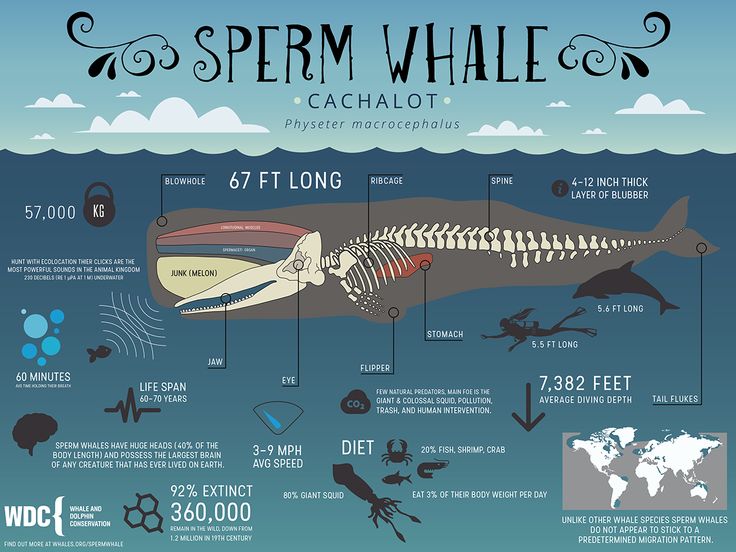
The sperm whale is the largest toothed predator on Earth, the deepest diving mammal ever recorded, and the owner of the largest brain that has ever evolved in any animal. Unlike the filter-feeding baleen whales that share its oceans, Physeter macrocephalus is an active hunter that pursues squid in crushing darkness more than two kilometres beneath the surface.
It produces the loudest biological sound ever measured, communicates in culturally inherited dialects, and lives in matrilineal societies whose structure rivals the complexity of human clans.
This guide is a reference entry on sperm whale biology, ecology, and cultural history: body size, anatomy, deep diving physiology, echolocation, diet, reproduction, social structure, distribution, conservation status, and the long, violent human relationship that gave us spermaceti candles, ambergris perfume, and Moby Dick. It is not a summary - expect specific numbers, verified records, and technical detail.
Etymology and Classification
The scientific name Physeter macrocephalus was formalised by Carl Linnaeus in 1758. Physeter is Greek for 'blower' - a nod to the distinctive single, forward-angled spout visible from kilometres away. Macrocephalus literally means 'big head'. The name fits: the head of an adult bull can stretch more than a third of total body length and weigh ten tonnes on its own.
The common English name is an artefact of a mistake. Early whalers breaking open the heads of harvested bulls in the 1700s found a cavity filled with pale, milky, waxy liquid. They assumed it was seminal fluid and called the substance spermaceti - literally 'sperm of the whale'. The whale itself became the 'sperm whale'. The substance is in fact a mixture of wax esters and triglycerides produced in a specialised organ, but the name stuck for three centuries.
Sperm whales are the sole living members of the family Physeteridae. Their closest surviving relatives are the pygmy sperm whale (Kogia breviceps) and dwarf sperm whale (Kogia sima), small and rarely seen species that form the related family Kogiidae. All three split from the rest of the toothed whales roughly 23 million years ago. Within Cetacea, sperm whales sit within the suborder Odontoceti, the toothed whales, alongside dolphins, porpoises, and beaked whales.
Size and Physical Description
Sperm whales exhibit extreme sexual dimorphism for a cetacean - larger than in almost any other marine mammal. Males are nearly three times the mass of females.
Males (bulls):
- Length: 16-20 metres, historically up to 24 metres
- Weight: 35-45 tonnes, historically up to 57 tonnes
- Head: up to one third of body length, weight over 10 tonnes
- Fluke span: roughly 5 metres across
Females (cows):
- Length: 11-13 metres
- Weight: 15-20 tonnes
- Generally lighter, more streamlined, smaller head in proportion
Calves at birth:
- Length: 3.5-4.5 metres
- Weight: roughly 1,000 kg
The body is dark grey to brownish-black, often showing pale scarring from squid tentacle suckers and intra-species fights. The skin around the mouth can be strikingly white. Unlike baleen whales, sperm whales have a single blowhole placed on the left-front corner of the head, which produces a characteristic forward-angled spout up to five metres high.
This asymmetric skull is one of the animal's most unusual features - the entire front of the head is biologically tuned to focus sound rather than smell or sight.
Teeth are confined to the lower jaw - typically 20-26 on each side - and the upper jaw bears matching sockets rather than functional teeth. Lower teeth are conical, can exceed 28 centimetres in length, and weigh over a kilogram each. They are not used for chewing; squid are swallowed whole. The teeth appear to function primarily in male-on-male aggression during breeding competition.
The Head and the Spermaceti Organ
The sperm whale's head is a specialised acoustic instrument, not a feeding or sensory organ in the usual sense. Inside it sit two major structures unique to the species.
The spermaceti organ is a large, sack-like reservoir filled with up to 1,900 litres of spermaceti oil. Below it, running along the length of the head, lies the junk - a stack of wax-filled lenses that focus sound. Between them, thin muscular structures called 'monkey lips' (phonic lips) clap together to generate the initial click.
Air circulates through two nasal passages and a pair of air sacs that reflect sound backward and forward through the head, turning the whole skull into a biological megaphone.
This structure generates clicks measured at up to 230 decibels underwater at the source. By some reconstructions these are the loudest sounds ever produced by any living animal, past or present. The clicks serve two purposes: echolocation for hunting prey in total darkness at depth, and communication through structured patterns called codas.
A second theory of the spermaceti organ's role concerns buoyancy. Spermaceti wax has an unusual property: it changes density noticeably with temperature. By cooling the wax (drawing cold water into the head), the whale can increase its density and help itself descend. Warming the wax with blood flow during ascent may assist the climb back to the surface. How large a role this plays compared to echolocation is still debated, but most researchers accept that both functions operate simultaneously.
Deep Diving Physiology
Sperm whales are the deepest-diving mammals on Earth. Routine foraging dives reach 400-1,200 metres and last 40-60 minutes. Extreme dives exceed 2,000 metres and can last more than 2 hours. The current deepest verified dive stands at 2,250 metres - deeper than most military submarines operate.
Dive profile:
| Phase | Duration | Depth range | Purpose |
|---|---|---|---|
| Surface rest | 8-10 minutes | 0 m | Oxygen reload, 40+ breaths |
| Descent | 10-15 minutes | 0 to 1,000 m | Travel to hunting depth |
| Hunting | 30-45 minutes | 400 to 1,200 m | Echolocation, prey capture |
| Ascent | 10-15 minutes | 1,000 m to surface | Return |
To withstand pressures of more than 220 atmospheres, sperm whale physiology makes dramatic adjustments. The rib cage is flexible and collapses with depth, pushing residual air into non-absorbing spaces to avoid nitrogen absorption and decompression injury. The lungs essentially empty during long dives, and oxygen is stored in myoglobin - an oxygen-binding protein in muscle.
Sperm whale myoglobin is so densely concentrated it turns their flesh almost black and gives the muscle a bitter, metallic taste. Blood flow is shunted away from muscle and skin to preserve oxygen for the brain and heart. Heart rate drops to a handful of beats per minute - a dive bradycardia shared with seals and other extreme divers.
Repeated deep dives are extremely demanding. Evidence from stranded whales and modern tag data suggests that the spine and skeleton of aged sperm whales bear cumulative osteonecrosis injuries that resemble decompression damage in human divers - the price of a lifetime of extreme diving.
Hunting and Diet
Sperm whales are specialist predators of deep-sea cephalopods. Their diet is overwhelmingly squid, supplemented with deep-water fish and occasionally bottom-dwelling species.
Primary prey:
- Medium-sized squid (Histioteuthidae, Octopoteuthidae, Onychoteuthidae)
- Giant squid (Architeuthis dux) - up to 13 metres
- Colossal squid (Mesonychoteuthis hamiltoni) - up to 14 metres, heaviest invertebrate known
Secondary prey:
- Deep-water fish: lanternfish, ragfish, hakes
- Sharks and skates, occasionally
- Octopus, on rare occasions
- Bottom-dwelling species during floor-scraping dives
A large bull consumes 700-1,000 kg of food per day. Stomach contents from whaling records contained up to 14,000 squid beaks at a time, and single stomachs have held squid carcasses weighing more than 200 kg.
The relationship between sperm whales and giant squid is the source of some of the most striking physical evidence in biology: mature sperm whales carry round scars across their heads and backs, the ring-shaped trace of giant squid sucker hooks. These scars are direct proof of deep-sea battles that have never been witnessed by humans.
Hunting proceeds by echolocation. Click trains sweep the water ahead of the descending whale. When a target is located, click rates accelerate into a rapid 'buzz' as the whale closes the distance - similar to the terminal buzz of a hunting bat. There is evidence that the intensity of sperm whale clicks is sufficient to disorient or momentarily stun soft-bodied prey, though this remains debated.
Life Cycle and Reproduction
Sperm whale reproduction is slow and heavily invested. Females reach sexual maturity around age 9-10 and give birth to a single calf every 4-6 years. Males mature more slowly and do not compete for mates until their late 20s, when they have attained full size.
Reproductive cycle:
- Gestation: 14-16 months
- Calves per birth: 1 (twins are exceptionally rare)
- Nursing period: 2 years minimum, often extending 4-10 years
- Birth weight: ~1,000 kg
- Birth length: 3.5-4.5 m
- Milk fat content: ~35 per cent
Calves are born in warm tropical and subtropical waters and remain in the protective matrilineal unit throughout childhood. While the mother dives for food, nearby adult females stand watch at the surface with the calf - a cooperative behaviour called calf-sitting or babysitting. A single calf can nurse from multiple females in the group, and lactation can continue for over a decade in some observed cases.
Adult males leave their natal group at 10-15 years old, join loose bachelor pods in cooler waters, and eventually become solitary as they mature. Mature bulls migrate enormous distances to breeding grounds and compete for access to females through size displays and occasional physical fights - the function of their outsized lower teeth. Breeding is polygynous, with a small number of dominant bulls siring most calves in a season.
Female sperm whales can continue reproducing into their 40s and may live productively as post-reproductive 'grandmothers' assisting younger relatives, a pattern otherwise seen only in orcas and humans.
Social Structure and Culture
Sperm whale societies are among the most complex known outside humans and certain other great apes.
Matrilineal units - groups of 10-20 closely related females and their young - form the basic social building block. These units remain stable for decades, with members traveling, feeding, and nursing together.
Vocal clans are larger groupings of thousands of individuals that share a common acoustic dialect. Clans ignore each other even when their ranges overlap. Several clans may share the same patch of ocean without mixing, because they produce distinct patterns of clicks called codas.
Codas are stereotyped sequences of 3-40 clicks lasting a few seconds. Different clans in the Pacific, Atlantic, and Indian oceans use different coda repertoires. Crucially, coda dialect is not genetic - a calf learns its clan's codas from its mother and other female relatives. This is cultural transmission in the strict sense biologists use the term, and sperm whales are one of only a handful of non-human species in which it has been clearly documented.
Current research in the Caribbean, the Azores, Sri Lanka, and the Gulf of California is actively decoding coda structure. Some codas appear to identify clan membership; others may identify individuals, coordinate group movement, or mediate reunion after a dive. The full meaning of the acoustic repertoire is still being worked out.
Distribution and Movement
Sperm whales are among the most widely distributed mammals on Earth. They are found in all deep oceans from the equator to the edge of polar pack ice - everywhere except very shallow coastal shelves and permanent Arctic and Antarctic ice fields.
Sex-segregated distribution:
| Group | Typical range | Water temperature |
|---|---|---|
| Females + calves | Tropics to temperate (40N to 40S) | 15-28 degrees Celsius |
| Juvenile males | Temperate to subpolar | 5-20 degrees Celsius |
| Mature bulls | Polar feeding grounds | Near freezing |
Adult males undertake seasonal migrations between high-latitude feeding grounds - off Iceland, Norway, Alaska, New Zealand, and the Southern Ocean - and tropical breeding areas where female pods reside. Key observation hotspots include the Azores, Dominica, Sri Lanka, the Gulf of California, Kaikoura in New Zealand, and the deep-water trenches off southern Greece.
All of these are places where deep water comes close to shore, providing accessible foraging for the whales and easy observation for researchers and whale-watchers.
Sperm whales prefer waters deeper than 1,000 metres where their squid prey concentrates. Unlike several baleen whale species, their seasonal movements are more about temperature and breeding than coordinated long-distance migration.
Sleep - Vertical Naps
Sperm whales have one of the strangest sleep patterns in the animal kingdom. Using suction-cup tags and drifting observations, researchers have documented groups of sperm whales sleeping in near-perfect vertical formation, head up, hanging in the water column like floating pencils. These naps are short - 10 to 15 minutes at a time - but come in tight clusters, and during them the whales appear unresponsive to much of their surroundings.
Because they are conscious breathers (every breath is voluntary), cetaceans cannot sleep with both brain hemispheres at once the way land mammals do. Most species use unihemispheric slow-wave sleep, with one hemisphere resting while the other remains alert. Sperm whales appear to occasionally enter bilateral sleep - shutting down both hemispheres briefly - during these vertical drift naps. It is one of the clearest cases of true mammalian sleep in the open ocean.
Conservation Status and Threats
The IUCN Red List classifies sperm whales as Vulnerable with a recovering population trend. Global estimates place the current population at 300,000 to 450,000 individuals, likely about one third of pre-whaling abundance.
Historical threats:
- Commercial whaling, 1712 to 1986. Approximately 770,000 sperm whales were killed during three centuries of industrial hunting. Peak slaughter between 1950 and 1980 took more than 25,000 animals per year. The species was hunted primarily for spermaceti (lamp oil, candles, industrial lubricant), sperm oil (blubber-derived), and ambergris.
Modern threats:
- Ship strikes. Sperm whales rest at the surface between dives and are struck by tankers, container ships, and cruise vessels in busy shipping lanes.
- Fishing gear entanglement. Long-line gear and drift nets entangle sperm whales, particularly males that depredate long-line catches in Alaskan and southern waters.
- Noise pollution. Naval sonar, seismic airguns used in oil exploration, and shipping noise interfere with echolocation and communication. Documented strandings have followed naval sonar exercises.
- Plastic and debris. Ingested plastics have been found in sperm whale stomachs in increasing quantities. A bull stranded in Scotland in 2019 held 100 kg of plastic debris.
- Chemical contamination. Persistent organic pollutants (PCBs, DDT), heavy metals (mercury), and PFAS concentrate in blubber and transfer to calves through milk.
- Climate change. Changes in ocean temperature and circulation may shift the distribution and abundance of deep-sea squid prey.
Protection came with the 1986 International Whaling Commission moratorium on commercial whaling. The species is also listed on CITES Appendix I, prohibiting commercial international trade, and is covered by regional protections under the Convention on Migratory Species. Populations are slowly recovering in some areas but remain below pre-whaling baselines and face sustained pressure from modern industrial activity.
Sperm Whales and Humans
The human relationship with sperm whales is long and largely extractive. From the early 1700s until the mid-20th century the species was central to the global whaling industry. Nantucket, New Bedford, and later Dundee, Hobart, and Yokohama were built on sperm whale oil. Three products drove the hunt.
Spermaceti was the most valuable. It burned brighter and cleaner than any other lamp fuel available before electrification - 'sperm candles' set the industrial standard for measuring light output for more than a century. It was also used in precision watch mechanisms, high-altitude and automatic transmission lubricants, cosmetics, pharmaceuticals, and military applications.
Sperm oil, rendered from blubber, was used as a general-purpose industrial lubricant and lamp fuel.
Ambergris is a waxy substance produced in the intestines of about 1 per cent of sperm whales, apparently as a pathological response to squid beaks irritating the gut lining. Aged by seawater and sunlight, ambergris becomes a grey, pleasant-smelling wax used as a fixative in high-end perfumery. Prices have reached over 40,000 US dollars per kilogram.
Herman Melville's 1851 novel Moby-Dick was set inside this industry and remains the most famous portrait of the sperm whale in Western culture. Melville drew on real events - the sinking of the whaleship Essex by a sperm whale in 1820 in the South Pacific, and accounts of a white bull called Mocha Dick hunted off the coast of Chile - to construct his allegorical white whale.
The book helped cement the sperm whale's cultural stature even as the industry that inspired it drove the species toward collapse.
Modern human engagement is largely non-lethal. Research stations in the Azores, Dominica, New Zealand, and Sri Lanka track individual whales acoustically and through photo-identification over decades. Whale-watching tourism provides economic incentives for protection in several countries. Deep-ocean acoustic monitoring by automated buoys now detects sperm whales across entire ocean basins without ever seeing them.
Related Reading
- Sperm Whale: The Deepest Diving Mammal
- Blue Whale: The Largest Animal Ever
- Humpback Whale Songs
- Orca: Killer Whale Intelligence
- Whales and Dolphins: The Singing Giants of the Deep
References
Relevant peer-reviewed and governmental sources consulted for this entry include IUCN Cetacean Specialist Group status reports (2023, 2024), International Whaling Commission historical catch records, and published research in Marine Mammal Science, Journal of Experimental Biology, Behavioral Ecology and Sociobiology, Animal Behaviour, and Proceedings of the Royal Society B.
Coda dialect and cultural transmission research draws on long-term studies led by teams at Dalhousie University, the Dominica Sperm Whale Project, and Project CETI. Deep dive physiology figures reflect tag data from Woods Hole Oceanographic Institution and the Kaikoura Sperm Whale Research Program.
See also: Sperm Whale vs Colossal Squid
Frequently Asked Questions
How big are sperm whales?
Adult male sperm whales (Physeter macrocephalus) reach 16-20 metres in length and weigh 35-45 tonnes, making them the largest toothed predators on the planet. Females are considerably smaller at 11-13 metres and 15-20 tonnes - an extreme example of sexual dimorphism among cetaceans. The head alone accounts for roughly one third of total body length and can weigh over 10 tonnes in a large bull.
Calves are born at about 4 metres and 1 tonne, and grow quickly on extremely fat-rich milk. The largest sperm whale ever reliably measured was a 24 metre bull killed in the 1950s, though most modern animals rarely exceed 18 metres because whaling removed many of the oldest, largest males.
What do sperm whales eat?
Sperm whales are specialist deep-sea predators whose diet is dominated by cephalopods, especially medium-sized squid, giant squid (Architeuthis dux), and colossal squid (Mesonychoteuthis hamiltoni). A large bull can consume 700-1,000 kg of food per day. They also take deep-water fish such as lanternfish, ragfish, sharks, skates, and occasionally octopus.
Prey is typically hunted between 400 and 1,200 metres deep, though dives exceeding 2,000 metres have been documented during extreme foraging. Stomach contents from whaling records have contained more than 14,000 squid beaks at a time, along with bottom-dwelling species that suggest the whales sometimes forage along the sea floor. Their powerful echolocation - the loudest biological sound on Earth - lets them detect prey in total darkness.
How deep can sperm whales dive?
Sperm whales are the deepest diving mammals on record. Routine foraging dives reach 400-1,200 metres and last 40-60 minutes. Exceptional dives have been documented to 2,250 metres and durations of more than 2 hours. To withstand these pressures, their rib cages collapse, their lungs empty, and blood flow is redirected to the brain and heart. Oxygen is stored mainly in muscle myoglobin, which is so concentrated it turns their flesh nearly black.
Between dives they rest at the surface for 8-10 minutes, breathing once every 10-15 seconds to recharge. The spermaceti organ in the head is thought to play a role in buoyancy control: cooling the wax into a denser solid helps the whale descend, warming it back into a liquid assists the ascent.
Where do sperm whales live?
Sperm whales are among the most widely distributed mammals on Earth, present in all deep oceans from the equator to the edges of polar pack ice. They avoid only shallow continental shelves and permanent ice.
Males and females separate ecologically: adult females and juveniles stay in tropical and temperate waters between roughly 40 degrees north and 40 degrees south, while mature males migrate alone to high-latitude feeding grounds off Iceland, Norway, Alaska, the Southern Ocean, and New Zealand. Hotspots include the Azores, Dominica, Sri Lanka, the Gulf of California, Kaikoura in New Zealand, and deep canyons off the coast of Greece.
They favour waters over 1,000 metres deep, where their preferred squid prey concentrates.
How loud are sperm whale clicks?
Sperm whale clicks have been measured at 230 decibels underwater at the source - the loudest sound produced by any living animal. For comparison, a jet engine at take-off reaches about 150 dB in air, and a rifle shot around 165 dB. Underwater sound is measured on a different reference than air sound, so the figures are not directly comparable, but even after adjustment the sperm whale remains the loudest known animal on Earth.
The clicks are produced in a specialised nasal structure called the ‘monkey lips’ or phonic lips, reflected off the front air sac, and focused forward through the spermaceti organ like a biological megaphone. These clicks serve two purposes: long-range echolocation for finding prey at depth, and social communication through structured patterns called codas.
Are sperm whales social?
Yes. Sperm whales live in some of the most complex societies in the animal kingdom. Core units are matrilineal - groups of roughly 10-20 related females and their young - that travel and hunt together for decades. These units combine into larger ‘vocal clans’ of thousands of individuals that share a common coda dialect. Coda dialects are culturally transmitted, not genetic: a calf learns the pattern of clicks used by its mother’s clan.
Two clans sharing the same ocean can have entirely different coda repertoires and rarely mix. Calves are protected cooperatively, with ‘babysitter’ females standing guard at the surface while the mother dives for food. Males leave the natal group around age 10-15, form loose ‘bachelor pods’, and eventually become solitary as they mature.
Why are sperm whales called sperm whales?
The name comes from spermaceti, a waxy liquid that fills the enormous organ in the whale’s head. Early whalers in the 1700s assumed the substance was the animal’s seminal fluid because of its milky appearance - a mistake now embedded in the species’ common name. Spermaceti is in fact a mixture of wax esters and triglycerides that sperm whales use for echolocation focusing and possibly buoyancy control.
In Nantucket and New Bedford during the 18th and 19th centuries, spermaceti was prized above almost every other whale product: it produced the brightest, cleanest candles ever burned and was used in precision machinery, cosmetics, ointments, and later in automatic transmissions and high-altitude lubricants. Herman Melville’s novel Moby Dick (1851) is set in this industry and features a fictional white bull sperm whale as its antagonist.
Are sperm whales endangered?
The IUCN currently lists sperm whales as Vulnerable. Global population estimates range from 300,000 to 450,000 individuals - perhaps one third of pre-whaling numbers. Commercial whaling removed an estimated 770,000 sperm whales during the 19th and 20th centuries, with peak slaughter occurring between 1950 and 1980 when factory fleets took more than 25,000 animals per year.
International protection arrived with the 1986 International Whaling Commission moratorium, and populations have been recovering slowly since. Modern threats include ship strikes (sperm whales rest at the surface and are struck by tankers), entanglement in fishing gear, ingestion of plastic debris, underwater noise pollution that interferes with echolocation, and chemical contaminants that concentrate in blubber.
Climate change may also shift the distribution of deep-sea squid prey.