
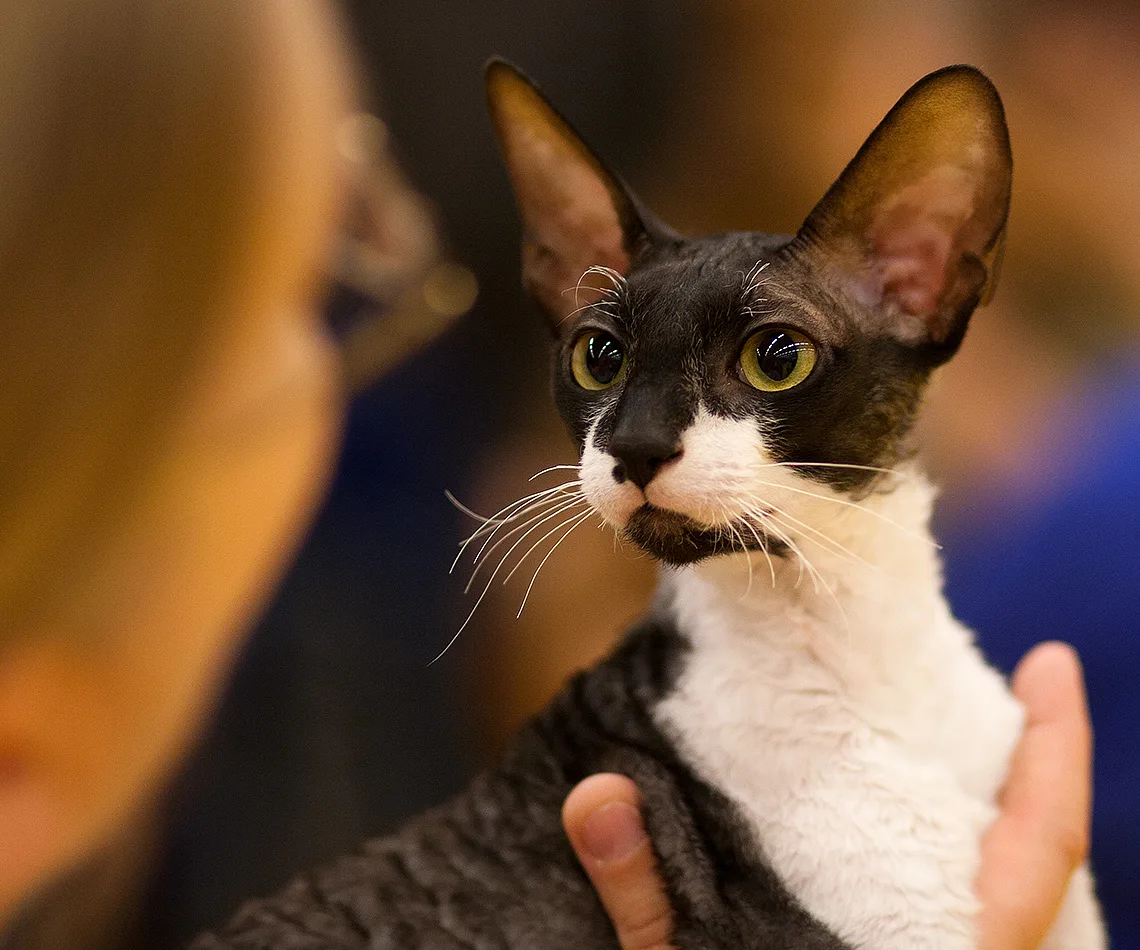
The Cornish Rex is the original rex cat, the breed that established the principle of selectively breeding from a spontaneous curly-coat mutation to create a new pedigree type. It originated in Cornwall, England, in 1950 when a curly-coated kitten named Kallibunker was born in a litter of otherwise straight-haired farm cats owned by Nina Ennismore.
What distinguished Kallibunker was not just the wavy coat but the entire silhouette, long legs, arched body, egg-shaped head, enormous ears, a type quite different from the typical British domestic cat and one that breeders recognized as the foundation of something new.
The Cornish Rex is built for speed and athleticism. The arched backbone, long hind legs, and deep chest give it a running style more reminiscent of a greyhound than a typical cat, and the breed matches this form with exceptional energy, curiosity, and a playfulness that persists throughout adult life in a way that is unusual in the domestic cat world.
These are cats that will play fetch, scale cat trees at full speed, and engage with interactive toys with genuine athletic intensity well into their second decade.
Origin and the Kallibunker Discovery
Nina Ennismore's farm near Bodmin, Cornwall, became the birthplace of an entire cat type on July 21, 1950, when one kitten in a litter fathered by a straight-haired barn cat showed a distinctly wavy coat covering a strikingly different body type from its littermates. Ennismore recognized the unusual kitten and sought advice from a geneticist, A.C. Jude, who suggested the curl might be similar to the rex mutation known in laboratory rabbits.
Kallibunker was bred back to his mother to explore the inheritance of the curl. Two curly-coated kittens resulted from this mating, confirming that the mutation was heritable. One of these, a male named Poldhu, was exported to the United States, where the breed was developed separately.
The American Cornish Rex program encountered initial difficulties. The narrow founding population led to genetic bottlenecks, and breeders were forced to introduce outcrosses with domestic shorthairs, Siamese, and other breeds to maintain genetic diversity while preserving the rex coat.
This is why American Cornish Rex cats look somewhat different from the British type, the Siamese and oriental breed influences gave the American type a more extreme, elongated conformation than the original British cats.
The breed was recognized by the GCCF in 1967 and by CFA in 1962.
The Rex Coat: Structure and Genetics
The Cornish Rex coat is anatomically unique in the domestic cat world. Cats normally have three hair types: the coarse outer guard hairs, the intermediate awn hairs, and the fine inner down hairs. The Cornish Rex lacks guard hairs entirely, its coat consists only of down hairs (and some awn hairs in some lines) arranged in tight waves.
The absence of guard hairs has several consequences. The coat is extraordinarily fine and soft, softer than the Devon Rex's suede-like coat, closer to silk. It lies close to the body in waves that ripple across the flanks and back. The coat provides significantly less insulation than a normal cat coat, making Cornish Rex cats consistently seek warm environments.
The genetic mechanism is an autosomal recessive mutation at the LVRN locus. Two copies of the mutation are required to produce the curly coat, and the mutation is different from the Devon Rex's KRT71 mutation, the two cannot complement each other to produce curly coats in crosses between the breeds.
| Characteristic | Details |
|---|---|
| Weight | 2.7-4.5 kg |
| Build | Long, lean, arched, greyhound-like |
| Head | Egg-shaped, long, narrow muzzle |
| Ears | Very large, wide-set, high on head |
| Eyes | Oval, proportionally large |
| Coat | Down and awn only; no guard hairs; wavy |
| Body temperature feel | Warmer than coated cats |
| Lifespan | 11-15 years |
| CFA recognition | 1962 |
The Arched Body Type
The Cornish Rex's body type is among the most distinctive in domestic cats. The spine has an exaggerated arch that makes the back form a continuous curve from shoulder to rump, with the highest point over the hips. The hind legs are long and powerful, designed to generate the tremendous push that makes the breed such an explosive leaper and sprinter. The chest is deep relative to body width, providing substantial lung volume.
"The Cornish Rex's skeletal structure, particularly the pronounced spinal arch and elongated hind limbs, gives the breed a biomechanical profile closer to high-speed running mammals than to the typical domestic cat. In functional terms, this translates to exceptional athleticism." Bradshaw, J., Cat Sense, 2013
This body type was not deliberately engineered; it came bundled with Kallibunker's rex mutation or was independently present in the founding population. Breeders retained and refined it because it complemented the unusual coat to create a completely novel physical type.
Temperament and Activity Level
The Cornish Rex's personality matches its physical athleticism. These are exceptionally active, playful, and curious cats that maintain the engagement level of kittens throughout adult life. The combination of high intelligence, athletic ability, and social orientation makes them demanding in the best possible sense; they need interaction, play, and mental stimulation, and they repay this investment with performances of extraordinary enthusiasm and affection.
The breed is notably vocal, though less relentlessly so than the Siamese. Communication tends to be purposeful, requests for food, attention, and play, rather than continuous commentary. The voice is varied and expressive.
Cornish Rex cats are particularly noted for their food enthusiasm. The combination of high activity level and fast metabolism creates a genuine appetite, and many Cornish Rex cats become skilled at begging, counter-surfing, and general food-related opportunism. Measured feeding rather than free-feeding is important for weight management despite the breed's naturally lean build.
The breed does well with other cats and with dogs, largely because its high energy level benefits from a companion that can match it in play. A single Cornish Rex in a low-stimulation environment may redirect its energy into behaviors that owners find destructive.
Health Profile
The Cornish Rex shares several health concerns with the Devon Rex and with cats generally.
| Health Concern | Details | Management |
|---|---|---|
| Hypertrophic cardiomyopathy (HCM) | Reported in breed | Echocardiogram screening |
| Blood type B | Elevated prevalence vs. general population | Blood type before transfusion |
| Patellar luxation | Kneecap displacement | Orthopedic assessment |
| Progressive retinal atrophy (PRA) | Reported in some lines | DNA testing where available |
| Sunburn risk | Sparse coat provides minimal UV protection | Indoor management |
Blood type B is more prevalent in Cornish Rex cats than in most mixed-breed cat populations. As with Devon Rex cats, this creates a transfusion incompatibility risk that can be life-threatening if type A blood is given to a type B cat. Any Cornish Rex undergoing procedures where blood transfusion might be needed should be blood-typed.
"Progressive retinal atrophy in Cornish Rex cats represents a distinct form from the rdAc-PRA found in Abyssinians and Persians. The specific genetic mechanism in the Cornish Rex has been partially characterized but breed-specific DNA tests are not yet widely commercially available." Petersen-Jones, S.M., Journal of Veterinary Ophthalmology, 2005
The sparse coat creates a practical health consideration: Cornish Rex cats can sunburn on exposed skin areas, particularly the ears and the thinly coated areas of the abdomen. Indoor management is strongly recommended, and cats with access to windows with direct sun exposure should have that limited to avoid prolonged UV exposure.
For grooming guidance see How to Groom a Cat at Home. For allergy considerations see Best Cats for Allergy Sufferers. For health detail see Cornish Rex Health Problems.
Grooming
The Cornish Rex coat requires minimal grooming. The absence of guard hairs and the fine texture mean there is very little shedding relative to coated breeds, and the coat does not mat. A weekly wipe with a soft cloth or a chamois is usually sufficient.
When a Cornish Rex is bathed, which may be necessary because the sebaceous glands produce oils that can accumulate on the skin without guard hairs to distribute them, the coat dries quickly and lies back in its wavy pattern without specific intervention.
For comparison with the Devon Rex see Devon Rex and Sphynx Cat.
References
- Bradshaw, J. Cat Sense: How the New Feline Science Can Make You a Better Friend to Your Pet. Basic Books, 2013. ISBN 978-0465031016.
- Petersen-Jones, S.M. "Advances in the molecular understanding of canine and feline retinal disease." Journal of Small Animal Practice, 2005. https://doi.org/10.1111/j.1748-5827.2005.tb00317.x
- Lyons, L.A., et al. "Whole genome sequencing in cats, for variant discovery, and Mendelian trait analysis." Scientific Data, 2016. https://doi.org/10.1038/sdata.2016.113
- Cat Fanciers' Association. "Cornish Rex Breed Standard." CFA.org, 2023. https://cfa.org/cornish-rex/
- Robinson, R. "Expressivity of the Manx gene in cats." Journal of Heredity, 1993. https://doi.org/10.1093/jhered/esq063
Frequently Asked Questions
What makes the Cornish Rex coat different from other cats?
The Cornish Rex lacks guard hairs entirely, the outermost, coarsest coat layer present in virtually all other cats. Its coat consists only of down hairs and some awn hairs arranged in tight waves. This gives the coat an extraordinarily fine, soft texture that has been compared to silk or velvet, and means the cat sheds very little compared to normal-coated breeds.
The absence of guard hairs also means significantly reduced insulation, which is why Cornish Rex cats consistently seek warm places.
Is the Cornish Rex the same as the Devon Rex?
No. Despite both having curly or wavy coats and both originating in England, the two breeds carry different mutations at different gene loci. When Cornish Rex and Devon Rex cats are crossed, all kittens have straight coats. The Cornish Rex’s wavy coat is caused by a mutation at the LVRN locus; the Devon Rex’s curl is caused by a KRT71 mutation. The two breeds also differ significantly in head shape, ear placement, coat texture, and health profile.
Are Cornish Rex cats good for allergy sufferers?
Cornish Rex cats produce less airborne hair than most breeds because of the minimal shedding from their guard-hair-free coat. However, the primary cat allergen (Fel d 1) is a protein produced in skin and saliva, not fur, and Cornish Rex cats produce it at similar levels to other breeds. Reduced shedding may help some allergy sufferers but is not a reliable solution for significant cat allergies.
Individual tolerance testing before acquiring any cat is essential for allergy sufferers.
How playful are Cornish Rex cats?
Extremely playful throughout their lives. Cornish Rex cats maintain a kitten-like enthusiasm for play well into adulthood and old age. The breed’s athletic build, arched spine, long powerful hind legs, gives it physical capabilities matched by genuine behavioral drive. Fetch, climbing, speed runs, and interactive toy play are engaged with intensity.
This is among the most persistently active adult cat breeds and needs owners who can meet that energy with play and enrichment.
What health problems do Cornish Rex cats have?
The main concerns are hypertrophic cardiomyopathy (HCM), blood type B compatibility issues, patellar luxation, progressive retinal atrophy in some lines, and sunburn risk from the sparse coat. Blood type B is more common in Cornish Rex than in most cat populations, creating a risk of severe transfusion reactions if type A blood is administered. Any Cornish Rex requiring surgical or emergency care should be blood-typed in advance.
Do Cornish Rex cats need grooming?
Minimal grooming is needed. The absence of guard hairs means little shedding and no matting. A weekly wipe with a soft cloth is usually sufficient. Bathing is occasionally necessary because sebaceous glands can accumulate oils on the skin without guard hairs to distribute them, a problem that does not occur with normal-coated cats. The coat dries quickly after bathing and returns to its wavy pattern without special treatment.