
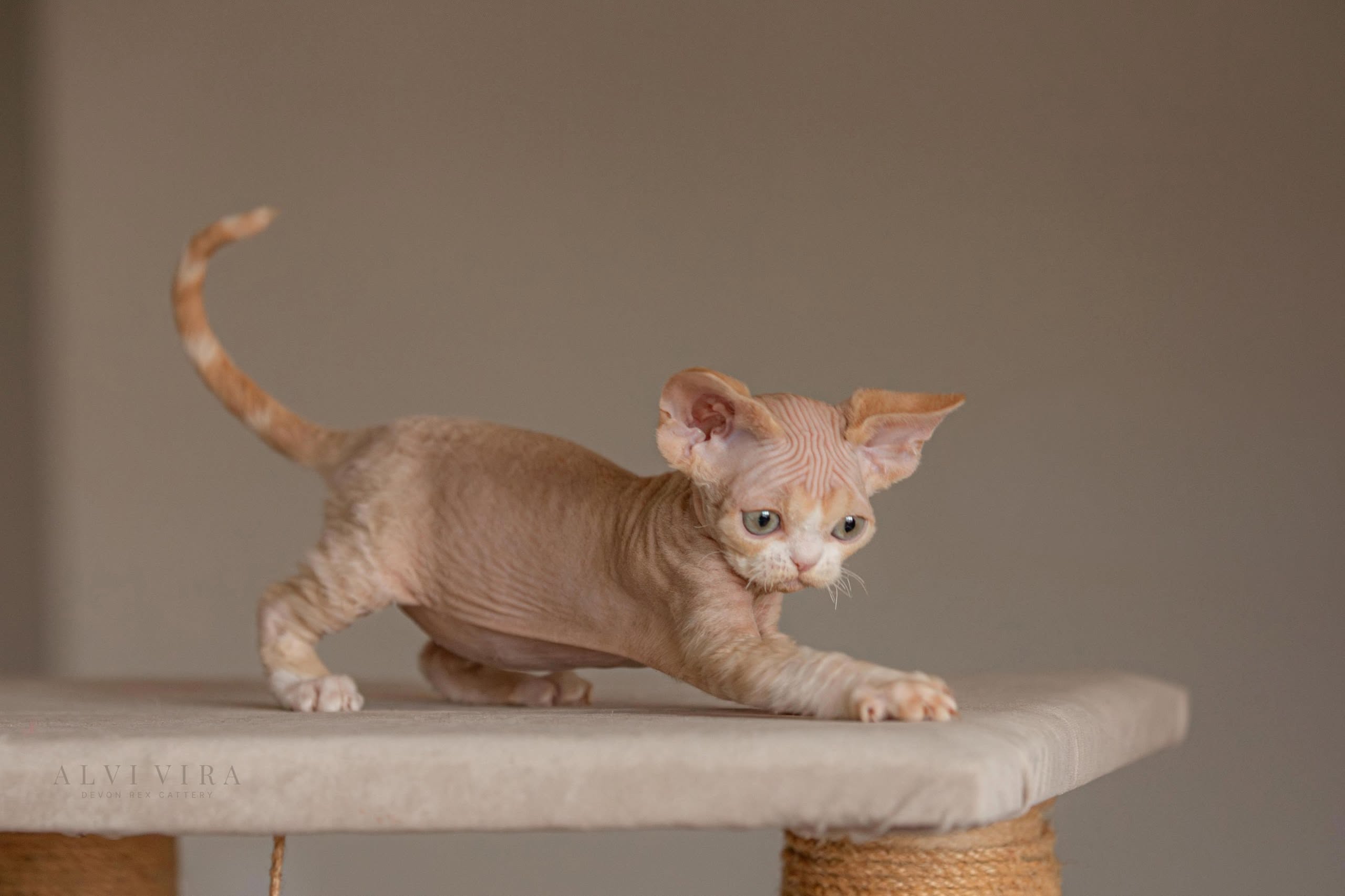
The Devon Rex is one of the most visually distinctive domestic cat breeds in existence, a small cat with enormous ears, huge luminous eyes, a triangular pixie face, and a coat of soft, wavy curls that feels like warm suede against the skin.
It was developed in Devon, England, in 1960 from a curly-haired stray tomcat named Kirlee discovered near an abandoned tin mine, and despite superficial similarities to the Cornish Rex, which also originated in England and also has a curly coat, the Devon Rex is genetically distinct. The two breeds cannot be interbred to produce curly-coated offspring.
The Devon Rex is sometimes called the "alien cat" or "pixie cat" by breeders, and the names fit. The combination of a very short, upturned nose, enormous radar-dish ears set low on the sides of the head, and a small, impish face gives the breed a science-fiction quality that is polarizing, some potential owners find it irresistible, others find it unsettling.
Those who fall for the look almost invariably fall for the personality: the Devon Rex is among the most people-oriented, interactive, and amusing cats in the pedigree world.
Origin and Discovery
The Devon Rex was discovered, not bred; it arose from a spontaneous mutation in the general cat population of Devon, England. In 1960, a woman named Beryl Cox observed a curly-haired tom living in an abandoned tin mine near Buckfastleigh. This male sired a litter with one of Cox's tortoiseshell-and-white females, and one kitten in the litter, a curly-haired male named Kirlee, had the same unusual coat as his feral father.
Beryl Cox initially believed Kirlee was related to the Cornish Rex, which had been discovered approximately ten years earlier and was already being developed as a breed. She contacted cat fancier Brian Stirling-Webb, who had been involved with Cornish Rex breeding, to discuss the possibility of incorporating Kirlee into the Cornish Rex breeding program.
What followed was a crucial discovery in cat genetics: when Kirlee was mated with Cornish Rex females, all resulting kittens had straight coats. The two curl genes were different, and they failed to complement each other.
This incompatibility proved that the Devon and Cornish Rex curls are caused by different mutations at different gene loci. The Devon Rex curl is caused by a mutation in the KRT71 gene (also called the rex-2 gene), which produces a defective keratin protein that changes the structure of the hair shaft, resulting in the characteristic soft wavy curl. The Cornish Rex curl is caused by a different mutation affecting a different gene.
Kirlee was retained as the sole foundation male for a new Devon Rex breed program, and the breed was recognized by the GCCF in 1967 and by CFA in 1979.
Physical Characteristics
The Devon Rex's appearance is striking by any measure. Every feature seems exaggerated in a direction different from every other breed: the ears are enormous, the eyes are very large, the nose is short and upturned, the head is small and triangular, and the body is slender and elf-like. Together these features create a look of perpetual alertness and impishness.
| Characteristic | Details |
|---|---|
| Weight | 2.7-4.5 kg |
| Build | Slender, long-legged, lightweight |
| Head | Small, triangular |
| Ears | Very large, wide-set, low on head |
| Eyes | Very large, oval, all colors |
| Nose | Short, upturned |
| Coat | Short, wavy, very soft, feels like suede |
| Coat layers | Down and awn hair; guard hairs sparse or absent |
| Lifespan | 9-15 years |
| CFA recognition | 1979 |
The coat is the breed's most unusual physical feature. Unlike the Cornish Rex, which has only down hairs (the softest, finest hair layer), the Devon Rex has a combination of down and awn hairs in a wavy arrangement. Guard hairs, the coarse outer coat present in most cats, are either absent or present in very reduced numbers. The result is a coat that is extraordinarily soft, that waves or curls in fine ripples across the body, and that provides less insulation than a normal cat coat.
The reduced insulation means Devon Rex cats tend to seek warmth more actively than most cats. They are famous for burrowing under bedcovers, draping themselves across warm laps and shoulders, and positioning themselves near heat sources. This thermal seeking behavior is a breed characteristic rather than illness.
The Rex Gene and Coat Structure
The KRT71 mutation that causes the Devon Rex curl affects the production of a structural protein in the hair shaft. In the normal hair shaft, multiple keratin proteins interlock to create a straight, smooth cylinder. When the KRT71 protein is defective, the hair shaft develops an irregular structure that curls as it grows, producing the characteristic Devon Rex wave.
The gene is autosomal recessive, two copies are required to produce a curly-coated cat. Cats carrying one copy of the Devon Rex gene and one copy of a normal gene will have straight coats but can produce curly-coated offspring when bred to another carrier or another Devon Rex.
Because the Devon and Cornish Rex curls are caused by different recessive genes, a cross between the two breeds produces straight-coated kittens carrying one copy of each different rex gene. These F1 crosses look like ordinary shorthaired cats. Breeding two of these straight-coated F1 hybrids together would theoretically produce some kittens with two Devon Rex genes (curly Devon coat) and some with two Cornish Rex genes (wavy Cornish coat) along with straight-coated individuals.
Temperament and Personality
The Devon Rex is widely described as the most dog-like of cat breeds, an assessment that reflects the breed's orientation toward human company, its tendency to follow owners from room to room, its habit of greeting visitors enthusiastically, and its willingness to be trained with food rewards to perform simple behaviors.
Devon Rex cats are intensely interactive. They want to be involved in whatever their owner is doing. They will sit on keyboards, drape themselves across books and magazines, position themselves between the owner and the television, and insert themselves into any activity that excludes them. This is not aggression; it is social need expressed as physical presence.
"Devon Rex cats show a consistently high degree of affiliative behavior toward their owners, including proximity seeking, following, and active solicitation of interaction. These behaviors exceed what is typically observed in other domestic shorthaired breeds and are a reliable breed characteristic." Dr. Kristyn Vitale, Oregon State University, Human-Animal Interaction Laboratory, 2019
The breed is playful throughout life. Adult Devon Rex cats maintain a kitten-like enthusiasm for interactive play well into old age, and many Devon Rex owners report that their cats retain a kitten-like quality at ten or twelve years of age that is unusual in domestic cats. The intelligence supports complex play: puzzle feeders, fetch games (yes, Devon Rex cats often retrieve), and training sessions are enjoyed rather than merely tolerated.
The breed is remarkably tolerant of handling and of novel situations. Devon Rex cats generally adapt well to travel, to veterinary visits, and to changes in household composition, because their security is grounded in human presence rather than in territorial stability.
For Devon Rex health detail see Devon Rex Health Problems. For care guidance see Devon Rex Care Guide.
Health Profile
The Devon Rex has several hereditary health concerns that prospective owners should understand thoroughly.
Devon Rex myopathy (hereditary myopathy of Devon Rex cats, also called spasticity) is a serious muscle condition in which affected cats develop progressive muscle weakness, typically appearing in kittenhood or early adulthood.
The weakness first appears in the neck and shoulder muscles, causing the head to be held in a lowered, bobbing position, progressing to generalized muscle weakness, difficulty eating, and exercise intolerance. The condition is caused by an autosomal recessive mutation and is potentially fatal in severely affected individuals. DNA testing for this mutation is available in some countries.
| Health Concern | Details | Testing |
|---|---|---|
| Devon Rex myopathy | Hereditary muscle weakness; autosomal recessive | DNA test available |
| Hypertrophic cardiomyopathy (HCM) | Reported in breed | Echocardiogram screening |
| Patellar luxation | Kneecap displacement; may need surgery | Orthopedic assessment |
| Blood type B | High prevalence in breed | Blood type before transfusion |
| Dental disease | Progressive with age | Regular dental care |
Blood type B is significantly more common in Devon Rex cats than in most other breeds. This matters clinically because cats with type B blood that receive type A blood transfusions (the most common blood type) can have life-threatening transfusion reactions. Any Devon Rex requiring a blood transfusion should be blood-typed first.
"Devon Rex myopathy is caused by a homozygous mutation in the COLQ gene affecting neuromuscular junction acetylcholinesterase anchoring. DNA testing for the causative mutation allows identification of carriers before breeding and prevention of the condition in subsequent generations." Mauler, D.A., et al., Neuromuscular Disorders, 2014. https://doi.org/10.1016/j.nmd.2014.05.011
For allergy considerations see Best Cats for Allergy Sufferers. For comparison with similar breeds see Cornish Rex and Sphynx Cat.
Grooming
The Devon Rex coat requires a different approach than most cat coats. It is fine and fragile, vigorous brushing can break the delicate wavy hair shafts, resulting in bare patches. The recommended approach is gentle, infrequent handling: a soft cloth or chamois wiped over the coat to remove loose hairs and distribute skin oils, done no more than once or twice a week.
Devon Rex cats occasionally develop bare or thinly coated areas on the belly, inner legs, and behind the ears; this is normal for the breed and reflects the reduced density of the coat in these regions. Full coats that remain dense and consistently wavy are show quality; many Devon Rex pets have thinner areas that are cosmetically unremarkable.
The large ears accumulate wax and debris more readily than smaller-eared breeds. Weekly ear inspection and gentle cleaning with a cotton ball is advisable. The absence of heavy guard hairs means less ear protection from airborne particles.
References
- Mauler, D.A., Gandolfi, B., Reinero, C.R., et al. "Precision medicine in cats: Novel Niemann-Pick type C1 identified in the Siamese cat breed." PLoS ONE, 2017. https://doi.org/10.1371/journal.pone.0172483
- Mauler, D.A., et al. "Devon Rex muscular dystrophy caused by a COLQ mutation." Neuromuscular Disorders, 2014. https://doi.org/10.1016/j.nmd.2014.05.011
- Gandolfi, B., et al. "A novel mutation in KRT71 causes Devon Rex coat in cat." PLoS ONE, 2010. https://doi.org/10.1371/journal.pone.0013143
- Cat Fanciers' Association. "Devon Rex Breed Standard." CFA.org, 2023. https://cfa.org/devon-rex/
- Lyons, L.A. "Feline genetics: Clinical applications and genetic testing." Topics in Companion Animal Medicine, 2010. https://doi.org/10.1053/j.tcam.2010.09.002
Frequently Asked Questions
Are Devon Rex and Cornish Rex the same breed?
No. Despite both originating in England and both having curly coats, the Devon Rex and Cornish Rex carry different curl mutations at different gene loci. When the two breeds are crossed, all kittens have straight coats because neither different recessive gene complements the other. The Devon curl is caused by a KRT71 mutation; the Cornish curl is caused by a separate, different mutation.
The two breeds also differ in head shape, coat texture, and health profile.
What is Devon Rex myopathy?
Devon Rex myopathy (hereditary myopathy) is a serious inherited muscle condition caused by an autosomal recessive mutation. Affected kittens develop progressive muscle weakness starting in the neck and shoulder muscles, causing a characteristic head-bobbing posture, difficulty eating, and generalized weakness. The condition is potentially fatal in severely affected individuals.
DNA testing for the causative mutation is available and responsible breeders test breeding animals to avoid producing affected kittens.
Are Devon Rex cats hypoallergenic?
Devon Rex cats are sometimes marketed as hypoallergenic, but this claim requires qualification. The breed does shed less than most cats because of the reduced coat volume, and the absence of heavy guard hairs means less airborne hair. However, the primary cat allergen (Fel d 1) is produced in the skin and saliva, not the fur, and Devon Rex cats produce Fel d 1 at similar levels to other breeds.
Some allergy sufferers tolerate Devon Rex better than heavily-shedding cats; others do not. Individual testing before acquisition is strongly recommended.
Why do Devon Rex cats feel so warm?
Devon Rex cats feel warm to the touch because their reduced coat provides less insulation, allowing body heat to radiate more directly through the skin. Their actual body temperature is normal for a cat (approximately 38.5 degrees Celsius), but the thin, fine coat means this warmth is more directly perceptible when handling.
This warmth, combined with the soft suede-like coat texture, is often described by Devon Rex owners as one of the breed’s most appealing physical qualities.
Why are Devon Rex cats called pixie cats or alien cats?
The nicknames refer to the breed’s distinctive facial features: enormous, wide-set ears placed low on the head, very large oval eyes, a short upturned nose, and a small triangular head. The combination creates an appearance quite unlike any other domestic cat breed, simultaneously impish, alert, and other-worldly. The breed’s enthusiasts find this appearance irresistible; others find it unusual.
The personality matches the eccentric appearance: Devon Rex cats are highly interactive and behaviorally distinctive.
How do you groom a Devon Rex?
Very gently and infrequently. The fine, wavy coat is fragile and can break with vigorous brushing, leading to bare patches. A soft cloth or chamois wiped over the coat once or twice a week to remove loose hair and distribute oils is the recommended approach. The large ears need weekly inspection and gentle cleaning. Bathing is occasionally necessary but should be done with a gentle, pH-appropriate shampoo and the coat handled carefully.