
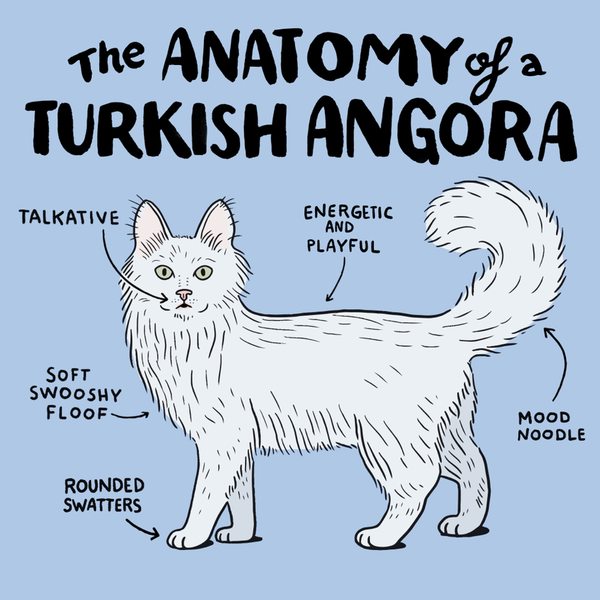
The Turkish Angora is one of the oldest naturally occurring cat breeds in documented history, originating in the Ankara region of Turkey, known in earlier centuries as Angora, from which both the cat breed and the angora fiber (from Angora rabbits and goats from the same region) take their names.
Long-haired, silky-coated cats from this region are recorded in European literature from the sixteenth century, making the Turkish Angora one of the earliest pedigree cat types to reach the Western world.
The breed's place in cat history is ironic and cautionary in equal measure. Turkish Angoras were imported to Europe in large numbers from the sixteenth century onward, where their long, silky coats were enormously admired. When Persian cats began to be developed in the nineteenth century, breeders used Turkish Angoras as foundation stock to improve the Persian's coat quality.
Over decades of Persian development, the Turkish Angora as a distinct type effectively disappeared from Western breeding, absorbed into the Persian.
The breed was rescued through the intervention of the Ankara Zoo, which began a structured conservation program in 1917, maintaining a breeding colony specifically to preserve the white Turkish Angora. This program continues today, and Turkish Angoras from the Ankara Zoo remain among the most documented representatives of the original breed type.
History and Near-Extinction
The Turkish Angora's near-extinction in the West was a direct consequence of its own success. The cat's silky coat made it the most sought-after longhaired cat in Europe through the seventeenth and eighteenth centuries, leading to extensive importation. When Persian breeding began in earnest in the nineteenth century, Turkish Angoras were regularly crossed with Persians to improve Persian coat quality, a practice that eventually diluted the distinct Turkish Angora type into the Persian.
By the early twentieth century, the Turkish Angora had largely vanished as a recognized type in Western cat breeding. Its survival as a distinct breed is attributed almost entirely to the Ankara Zoo's conservation program, which maintained a closed breeding colony of Turkish Angoras, prioritizing the classic white coat and odd-eyed (one blue, one amber) variety, from 1917 onwards.
American servicemen stationed in Turkey after World War II encountered the cats and arranged to import breeding pairs. The first pair to arrive in the United States, in 1954, came from the Ankara Zoo. CFA began registering Turkish Angoras in 1968 and granted Championship status in 1972. A stipulation existed for decades that all CFA-registered Turkish Angoras must have documented Turkish ancestry, a requirement intended to maintain the genetic integrity of the breed.
Physical Characteristics
The Turkish Angora is a medium-sized cat with a long, elegant body, a fine-boned structure, and a distinctive silky coat that flows with movement. The overall impression is of lightness and athletic grace, quite different from the heavy-boned Persians and British Shorthairs with which it is sometimes grouped due to its long coat.
| Characteristic | Details |
|---|---|
| Weight | 2.3-5 kg |
| Build | Long, lean, fine-boned, graceful |
| Head | Medium-sized wedge, tapering muzzle |
| Ears | Large, pointed, set high |
| Eyes | Almond-shaped; can be blue, amber, green, or odd-eyed |
| Coat | Semi-long, silky, single layer (no dense undercoat) |
| Classic color | White |
| Lifespan | 12-18 years |
| CFA recognition | 1968 (championship 1972) |
The coat is one of the Turkish Angora's most distinctive features. It is semi-long, fine, and silky, and crucially, unlike the Persian and most other longhaired breeds, it lacks a dense woolly undercoat. This single-layer structure means the coat does not mat readily, does not tangle as severely as a Persian coat, and requires significantly less intensive grooming. The coat flows and ripples with the cat's movement, giving it a liquid quality in action.
White is the classic and most celebrated Turkish Angora color, but the breed is recognized in a wide range of colors and patterns including tabby, tortoiseshell, bicolor, and solid non-white colors.
The White Coat, Blue Eyes, and Deafness
The white Turkish Angora, particularly the odd-eyed variety (one blue eye, one amber), is the breed's iconic image and also illustrates one of its most important health considerations. In cats, the dominant white gene (W) that causes a fully white coat is associated with a developmental abnormality in the inner ear that causes deafness, particularly in white cats with blue eyes.
The mechanism involves the same pigment cells (melanocytes) that produce iris coloration and inner ear structural development. When the W gene suppresses pigment development, it can also suppress the stria vascularis, a pigment-cell-rich structure in the cochlea that is essential for hearing. White cats with two blue eyes have approximately a 65 to 85% rate of deafness.
White cats with one blue eye are deaf on the blue-eyed side in a significant percentage of cases. White cats with amber or green eyes have lower deafness rates.
"The association between white coat coloration, blue eye color, and hereditary deafness in cats is one of the most well-documented gene-phenotype relationships in domestic animals. The mechanism involves failure of melanocyte migration to the stria vascularis during cochlear development." Strain, G.M., Veterinary Medicine, 2011. https://doi.org/10.1111/j.1740-8261.2011.01820.x
Deaf Turkish Angoras can live full, happy lives as indoor-only cats. Deafness in cats does not cause distress in the way it might be imagined, cats rely heavily on other senses and adapt readily. However, deaf cats are more vulnerable to outdoor hazards and should not be allowed unsupervised outdoor access.
Temperament
The Turkish Angora is an agile, playful, intelligent, and affectionate cat with a personality that is both more active and more interactive than the Persian, despite the superficial similarity in coat type. The breed is described as dog-like in its engagement, following its owners through the house, investigating every activity, and participating in household life with genuine interest.
Vocalization is moderate, the Turkish Angora communicates but is not as relentlessly vocal as the Siamese or Oriental. The breed is confident in social situations and typically greets visitors rather than hiding. Adaptability is good: Turkish Angoras adjust to new environments and changes in household routine more readily than many more territorial breeds.
Athleticism is a notable characteristic. Turkish Angoras jump well, climb readily, and enjoy high vantage points. Tall cat trees and high shelves that cats can reach are appreciated and used actively.
The breed gets along well with other cats and, with proper introduction, with dogs. It is patient with children and tends to match the household's energy level, active in active households, calmer in quieter ones.
Health Profile
| Health Concern | Details | Management |
|---|---|---|
| Hereditary deafness | Linked to white coat and blue eyes | Evaluate at 6 weeks; BAER test |
| Hypertrophic cardiomyopathy (HCM) | Reported in breed | Echocardiogram screening |
| Ataxia | Autosomal recessive condition; some lines | DNA test available in some countries |
| General robustness | Good constitution overall | Standard veterinary care |
Ataxia, a progressive neurological condition causing coordination failure, is reported in some Turkish Angora lines, primarily in Turkey. An autosomal recessive mutation is involved, and DNA testing is available in some European countries. This condition is distinct from the deafness and is not specifically linked to coat color.
For lifespan context see How Long Do Cats Live. For health detail see Turkish Angora Health Problems. For a related breed see Turkish Van and Persian Cat.
Grooming
The Turkish Angora's single-layer silky coat is among the most manageable of all semi-longhaired breeds. Without a dense undercoat, the coat resists matting and does not develop the felted tangles that are the primary challenge of Persian grooming. Twice-weekly combing with a stainless steel comb is usually sufficient for an indoor Turkish Angora. Seasonal shedding occurs, particularly in spring, and slightly more frequent grooming during this period prevents hair accumulation.
The coat's silky texture shows well when regularly maintained and can look magnificent on a well-groomed white individual. Regular brushing is also an opportunity for bonding and for inspecting the skin and coat condition.
For allergy considerations see Best Cats for Allergy Sufferers.
References
- Strain, G.M. "Deafness prevalence and pigmentation and gender associations in dog breeds at risk." The Veterinary Journal, 2004. https://doi.org/10.1016/j.tvjl.2003.09.004
- Strain, G.M. "Hereditary deafness in dogs and cats: Causes, prevalence, and current research." Proceedings of the 26th Annual Waltham/OSU Symposium, 2011.
- Drögemüller, C., et al. "A mutation in the Swedish Lapphund gene associated with canine progressive retinal atrophy." Genomics, 2010.
- Cat Fanciers' Association. "Turkish Angora Breed Standard." CFA.org, 2023. https://cfa.org/turkish-angora/
- Ogan, M. and Biricik, A. "Genetic diversity in the Turkish Angora breed." Turkish Journal of Veterinary and Animal Sciences, 2016. https://doi.org/10.3906/vet-1507-56
Frequently Asked Questions
Why are white Turkish Angora cats often deaf?
The dominant white gene (W) that creates a fully white coat in cats also suppresses the development of melanocytes, pigment cells, in the cochlea during fetal development. The stria vascularis, a pigment-cell-rich structure essential for hearing, fails to develop properly when these cells are absent. White cats with blue eyes have a 65-85% rate of deafness. Cats with one blue eye are typically deaf only on the blue-eyed side.
White cats with amber or green eyes have lower deafness rates because slightly different genetic mechanisms are involved.
Is the Turkish Angora the same as a regular long-haired cat?
No. The Turkish Angora is a distinct pedigree breed with documented Turkish ancestry, a specific silky single-layer coat (no dense undercoat), and a breed standard maintained by CFA, TICA, and other registries. It is one of the oldest naturally occurring cat breeds, predating the development of the Persian.
A random-bred longhaired cat, while superficially similar in appearance, lacks the documented lineage, predictable conformation, and breed-specific health screening associated with the Turkish Angora.
How is the Turkish Angora coat different from the Persian?
The Turkish Angora has a single-layer silky coat without the dense, woolly undercoat that characterizes the Persian. This structural difference means the Turkish Angora coat is much easier to maintain; it resists matting and requires only twice-weekly combing rather than daily grooming. The Persian’s double coat mats severely if not maintained daily. Both coats are long and beautiful, but the maintenance commitment is very different.
Why was the Turkish Angora almost lost as a breed?
The Turkish Angora was nearly absorbed into the Persian breed during the nineteenth century. Persian breeders imported Turkish Angoras and crossed them with Persians to improve the Persian coat quality. Over decades of these crossings, the distinct Turkish Angora type disappeared from Western breeding.
The breed survived only because the Ankara Zoo in Turkey maintained a closed conservation breeding colony from 1917 onwards, which provided the genetic material for the breed’s revival in the West from the 1950s onward.
What is Turkish Angora ataxia?
Turkish Angora ataxia is a hereditary neurological condition reported in some Turkish Angora lines, causing progressive coordination problems and balance failure. It is caused by an autosomal recessive mutation separate from the deafness gene. DNA testing is available in some European countries. The condition is rare in Western breeding populations but is mentioned in the context of thorough breed health disclosure.
Are Turkish Angoras good with other pets?
Generally yes. Turkish Angoras are social and confident, and with proper introduction they typically coexist well with other cats and with dogs. They are active and playful and benefit from feline companionship, particularly in households where owners are absent for extended periods. The breed adapts readily to multi-pet households and is patient with children.