
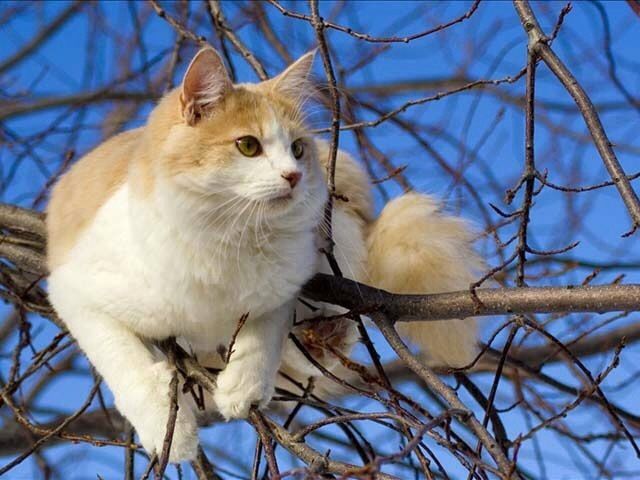
The Turkish Van is an ancient breed from one of the world's oldest continuously inhabited regions, the Van Lake area of eastern Turkey, and it carries one of the most immediately distinctive descriptions in all of domestic cat breeding: the Swimming Cat.
Unlike virtually all other domestic cat breeds, which treat water with varying degrees of reluctance, Turkish Vans have a documented and frequently observed predilection for water. They paddle in streams, wade into ponds, and will reportedly swim in Lake Van itself, behavior that has been recorded by multiple independent observers over centuries and is so consistent that it is now considered a breed characteristic.
The Van is also visually distinctive, one of the few breeds to have a specific coat pattern named after it. The "Van pattern" describes a white body with colored markings restricted to the head and tail, and this pattern, in the semi-long cashmere-like coat specific to the breed, is immediately identifiable.
In temperament, the Turkish Van is the opposite of its compatriot the Turkish Angora in one critical respect: where the Angora is graceful and moderate, the Van is athletic, boisterous, and independent. These are large, powerful cats with strong opinions and a physical presence that commands attention.
Origin and History
The Turkish Van originates in the ancient highlands of eastern Turkey, in the mountainous region surrounding Lake Van, one of the largest soda lakes in the world, a high-altitude body of water in the mountains of eastern Anatolia. Cats matching the Van description have been present in this region for so long that the precise origin of the domestication event is lost to history, and the modern breed represents a direct descendant of the cats that have lived in this region for millennia.
The Turkish Van came to Western attention primarily through the work of British photographers Laura Lushington and Sonia Halliday, who visited Turkey in 1955 and encountered the distinctively patterned white cats with colored head and tail markings. They imported two of these cats to Britain and began a breeding program. Lushington documented the cats' affinity for water, describing their willingness to swim in streams and water features, an observation confirmed by subsequent observers.
The breed was recognized by the GCCF in 1969, by CFA in 1994 (as the Turkish Van), and by TICA. The Ankara Zoo maintains a Turkish Van preservation program parallel to its Turkish Angora program, treating both breeds as national heritage animals.
The Van Pattern
The Van pattern, white body with colored markings only on the head and tail, is the breed's defining coat characteristic and the origin of the pattern's name in cat genetics broadly. When breeders refer to a "Van pattern" in any breed, they are using terminology derived from the Turkish Van.
| Pattern Region | Coloring |
|---|---|
| Body | White |
| Tail | Colored (rings or solid) |
| Head | Colored patches, typically symmetrical |
| Eyes | Amber, blue, or odd-eyed |
The colored areas on the head should be symmetrical, separated by white, and typically cover the area from the ears down to but not below the eye level. The tail coloring ranges from full rings to a solid colored tail with a white base. A white blaze on the forehead, running between the colored head markings, is characteristic of the breed.
The genetics of the Van pattern involve the piebald gene (S) in a specific expression state that produces very extensive white spotting, leaving color only at the extremities. The Van pattern is at the high end of the S gene expression range. The same gene at lower expression levels produces the tuxedo pattern; at the highest levels, it produces fully white cats.
Physical Characteristics
The Turkish Van is a large, muscular cat, one of the larger domestic breeds. Males commonly reach 7 to 9 kg, and some individuals exceed this. The breed matures slowly, not reaching full adult size and muscular development until three to five years of age.
| Characteristic | Details |
|---|---|
| Weight (male) | 5-9 kg |
| Weight (female) | 4.5-6 kg |
| Build | Large, muscular, broad chest |
| Head | Broad, wedge-shaped |
| Eyes | Amber, blue, or odd-eyed |
| Coat | Semi-long, cashmere-like; minimal undercoat |
| Pattern | Van pattern (white body, colored head and tail) |
| Lifespan | 12-17 years |
| CFA recognition | 1994 |
The coat is semi-long with a cashmere-like texture, silky, fine, and without the dense undercoat that characterizes the Persian. The coat is water-resistant to a degree, which may contribute to the breed's willingness to enter water. It dries relatively quickly after swimming or bathing, which is not insignificant if the breed's water behavior is genuine and frequent.
The Swimming Cat
The Turkish Van's affinity for water is the breed's most famous characteristic and one of the most frequently cited examples of breed-specific behavioral variation in domestic cats. Multiple independent observers, from the British journalists who introduced the breed to the West in the 1950s, to subsequent breeders, to owners today, have documented the same behavior.
"We can confirm that the cats we brought from Turkey genuinely preferred water play and would voluntarily enter a shallow stream near where they were kept. This behavior was not induced or trained but appeared spontaneously and consistently." Laura Lushington, quoted in GCCF Turkish Van breed history records
The swimming behavior appears to be a genuine breed characteristic rather than individual variation. This distinguishes it from the rare instances of water-interested individuals in other breeds, and suggests that the trait was either adaptive in the Lake Van environment (the lake supports fish populations that cats might have hunted) or was preserved by geographic isolation that reduced outcrossing.
Turkish Van owners today report cats that play in water bowls, follow owners into the shower, dip toys into water before playing with them, and in some cases actually swim when given access to safe swimming areas. The behavior is not universal but is common enough to be reliably predicted in the breed.
For water-related cat behavior context see Why Do Cats Hate Water.
Temperament
The Turkish Van has a forceful, independent, and highly active personality. It is athletic, curious, and opinionated in ways that owners either find enormously entertaining or find challenging; there is little middle ground. The breed plays vigorously, climbs energetically, and will investigate every corner of its environment with thoroughness and determination.
The Van is affectionate but on its own terms. It typically bonds strongly with its family but may not be a lap cat in the conventional sense; it prefers being near its people and engaging in activity rather than sitting still for extended petting. When it wants affection, it seeks it directly; when it does not, it makes this clear.
Vocalization is moderate, more expressive than the Persian but less relentless than the Siamese. The breed communicates clearly and will not be ignored when it has something to communicate.
The large, powerful body and independent personality make early socialization and consistent handling important. Turkish Vans that are handled regularly and exposed to a variety of people and situations from kittenhood are generally excellent companions. Those that are left largely unsocialized may be difficult to manage.
For outdoor considerations see Indoor vs Outdoor Cats Which Is Better. For Turkish Van care see Turkish Van Care Guide.
Health Profile
The Turkish Van is generally a robust, healthy breed with few documented hereditary conditions relative to many other pedigree breeds.
| Health Concern | Details | Management |
|---|---|---|
| Hypertrophic cardiomyopathy (HCM) | Reported in some individuals | Echocardiogram screening |
| Hereditary deafness | Risk in predominantly white individuals | BAER test at 6 weeks |
| Obesity | Risk in less active indoor individuals | Measured meals |
| General robustness | Good; long-lived | Standard veterinary care |
The deafness risk associated with the white gene and blue eyes applies to the Turkish Van as to the Turkish Angora, since both breeds have the dominant white gene in the white portions of their coats. White cats with blue eyes in both breeds should be BAER-tested for hearing at an early age.
For comparison with a related Turkish breed see Turkish Angora. For a large breed comparison see Maine Coon.
Grooming
The Turkish Van's semi-long, cashmere-like coat is easier to maintain than many longhaired breeds because it lacks the dense undercoat that causes severe matting in Persians and similar breeds. The coat self-maintains to a reasonable degree and sheds the winter coat in spring with a notable increase in loose hair.
Weekly combing with a wide-toothed comb keeps the coat in good condition during normal periods. More frequent combing during seasonal shedding prevents excessive hair accumulation. The tail, with its full plume, benefits from particular attention during shedding season.
References
- Lushington, L. "The Turkish Van Cat: Notes from the original import program." GCCF Turkish Van Breed History, 1969.
- Strain, G.M. "Deafness prevalence and pigmentation and gender associations in dog breeds at risk." The Veterinary Journal, 2004. https://doi.org/10.1016/j.tvjl.2003.09.004
- Driscoll, C.A., et al. "The Near Eastern origin of cat domestication." Science, 2007. https://doi.org/10.1126/science.1139518
- Cat Fanciers' Association. "Turkish Van Breed Standard." CFA.org, 2023. https://cfa.org/turkish-van/
- Ottoni, C., et al. "The palaeogenetics of cat dispersal in the ancient world." Nature Ecology and Evolution, 2017. https://doi.org/10.1038/s41559-017-0139
Frequently Asked Questions
Do Turkish Van cats really swim?
Yes, with notable frequency. Multiple independent observers, from the British journalists who introduced the breed to the West in the 1955 to contemporary owners worldwide, have documented Turkish Vans voluntarily entering water, swimming in shallow streams and pools, and playing actively in water.
The behavior is a recognized breed characteristic rather than individual quirk, and is consistent enough that the Turkish Van is known internationally as the Swimming Cat. Not every individual will swim, but water interest of some kind is common across the breed.
What is the Van pattern in cat coat colors?
The Van pattern describes a coat with an entirely white body and colored markings restricted only to the head and the tail. The pattern is named after the Turkish Van breed and the term has been adopted broadly in cat genetics to describe any breed that shows this specific distribution. The pattern results from the piebald (S) gene at very high expression, leaving pigment only at the extremities while white spotting covers the body.
The Van’s own coat shows this pattern in a cashmere-like semi-long coat.
How large do Turkish Van cats get?
Turkish Vans are among the larger domestic cat breeds. Males commonly reach 5 to 9 kg and some individuals exceed this. The breed matures slowly, full adult size and muscular development is not reached until 3 to 5 years of age. Female Turkish Vans are noticeably smaller than males, typically ranging from 4.5 to 6 kg.
The combination of large size, athletic build, and energetic personality means the Turkish Van has a physical presence that is difficult to ignore.
Are Turkish Van cats good pets?
For the right owner, absolutely. Turkish Vans are engaging, intelligent, active, and strongly bonded to their families. They are not low-maintenance cats, their size, energy level, and independence require owners who can provide physical space, interactive play, and consistent early socialization. They are best for experienced cat owners who appreciate an assertive, active companion rather than those seeking a calm, placid lap cat.
How do you groom a Turkish Van?
Weekly combing with a wide-toothed comb is sufficient for most of the year. The semi-long, cashmere-like coat lacks the dense undercoat that causes rapid matting in Persians, so it self-maintains to a reasonable degree. During the spring shedding season, more frequent combing prevents significant hair accumulation. The full tail plume needs particular attention during shedding.
Is the Turkish Van related to the Turkish Angora?
Both are ancient Turkish breeds preserved in part through the Ankara Zoo’s conservation programs, and both have semi-long, silky coats with minimal undercoats. However, they are distinct breeds with different body types, different patterns (the Van pattern is exclusive to the Turkish Van), and different personalities. The Turkish Van is significantly larger and more boisterous; the Turkish Angora is more moderate in size and temperament.
They should not be confused or treated as variants of the same breed.