
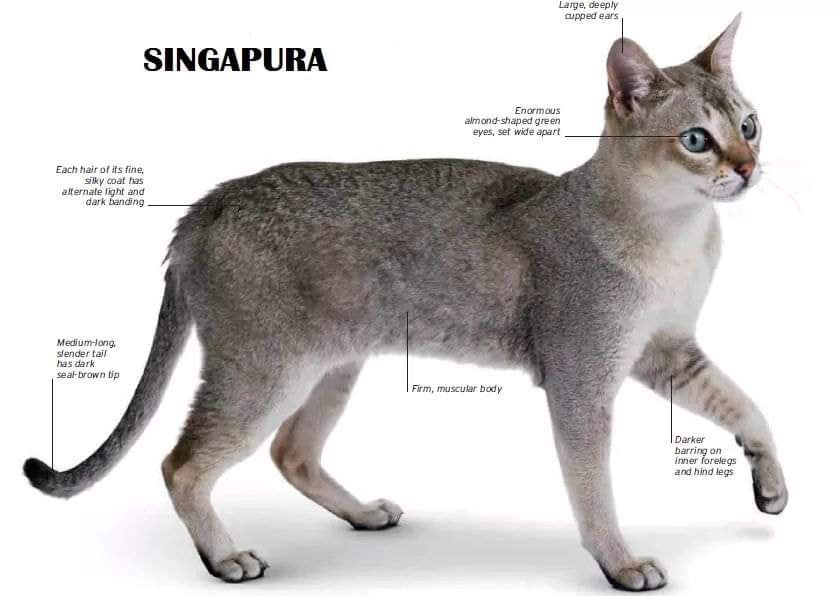
The Singapura is the smallest pedigree cat breed in the world. Adults typically weigh between 1.8 and 3.6 kilograms, less than some of the largest domestic rabbit breeds. In an era when cat breeding frequently emphasises size, the Singapura is distinguished precisely by its miniature proportions, combined with a sepia-toned ticked coat, enormous eyes relative to its head size, and a personality of irrepressible curiosity and affection.
The breed's origins are intertwined with controversy, questions about whether the Singapura was truly developed from Singapore street cats or whether it has a more complex history involving other breeds remain unresolved to this day.
Origins: Singapore and the Street Cat Controversy
The Singapura's official origin story begins in Singapore. Hal and Tommy Meadow, American cat breeders working in Singapore, claimed to have discovered the small ticked cats living as semi-feral street cats in the drain culverts and back streets of Singapore in the early 1970s. They imported several of these cats to the United States in 1975, registered them with TICA and then CFA, and developed the breed.
The Singapore Tourist Board later adopted the Singapura as a national mascot, naming the local version the "Kucinta" (love cat), a marketing decision that lent the breed significant international profile.
The controversy arose in the 1990s when CFA records appeared to show that cats matching the Singapura description had been imported to Singapore from the United States before the Meadows' "discovery," suggesting that the cats they found may have been partially or wholly American-developed cats rather than an ancient local natural breed.
The Meadows maintained their account, and no definitive resolution has been reached. DNA studies have found that the Singapura is closely related to Burmese cats, which has been interpreted as supporting either natural evolutionary convergence (Southeast Asian street cats and Burmese cats sharing a common ancestral pool) or deliberate crossing.
The controversy does not affect the breed's recognised status or its distinctive characteristics today. It is an interesting chapter in cat fancy history rather than an ongoing management concern.
Physical Characteristics
The Singapura's defining characteristic is its size, and the optical illusion that size creates. The cat appears to have enormous eyes, ears, and head because the proportions of the face are normal while the overall frame is dramatically smaller than other breeds.
Weight. Adult females typically weigh 1.8-2.7 kg. Adult males typically weigh 2.5-3.6 kg. These are not malnourished cats; they are genuinely small in skeletal structure, representing the breed's natural size.
Coat. The coat is short, fine, and silky, lying close to the body. The colour is sepia agouti, a warm beige to brownish ground colour with each hair banded in varying shades of ivory and brown/dark brown. The result is a ticked appearance similar to the Abyssinian, but in warm earth tones rather than the Abyssinian's cooler gold-brown. The underparts, chest, muzzle, and chin are lighter (unbarred ivory).
Face. Large, wide-set, hazel or green or gold eyes dominate the small, rounded wedge-shaped head. Large, slightly pointed ears contribute to the wide-eyed, alert expression that makes Singapuras recognisable.
Physical Characteristics at a Glance
| Feature | Detail |
|---|---|
| Body type | Small, muscular, rounded |
| Male weight | 2.5-3.6 kg |
| Female weight | 1.8-2.7 kg |
| Coat | Short, fine, silky; sepia agouti only |
| Eye colour | Hazel, green, or gold |
| Coat pattern | Ticked tabby only (sepia agouti) |
| Lifespan | 11-15 years |
Colour: Sepia Agouti Only
The Singapura is one of very few cat breeds that exists in a single colour only. The CFA and TICA both recognise only sepia agouti, the characteristic warm brown ticked pattern. No other colour or pattern is accepted for registration or show competition.
This uniformity is part of what makes the Singapura's look so distinctive. Prospective owners cannot choose coat colour, every Singapura has essentially the same coat.
Temperament
The Singapura's personality is as distinctive as its appearance. The breed is known for being:
Extraordinarily curious. Singapuras investigate everything in their environment with focused intensity. They perch in high places to observe activity below, insert themselves into whatever their owners are doing, and engage with objects in ways that often appear more deliberate than typical cat exploration.
Affectionate and people-oriented. Despite (or perhaps because of) their small size, Singapuras are confident and attached to their families. They tend to follow owners from room to room and seek physical contact.
Playful throughout life. The breed retains kitten-like energy well into adulthood. Interactive toys, puzzle feeders, and games of fetch (yes, many Singapuras retrieve) are well-received.
Not particularly vocal. The Singapura is generally a quiet cat, communicating with soft, small vocalisations rather than persistent calling.
Gentle and non-confrontational. The breed's small size may contribute to its gentle temperament, Singapuras are not typically aggressive with other cats or people and tend to resolve conflicts by retreating rather than fighting.
Pyruvate Kinase Deficiency
The primary documented health concern in the Singapura is pyruvate kinase deficiency (PK deficiency). This is a hereditary haemolytic anaemia caused by deficient activity of the enzyme pyruvate kinase in red blood cells.
Pyruvate kinase is essential for energy production in red blood cells. When the enzyme is deficient, red blood cells have reduced survival, leading to anaemia. Severity varies, mildly affected cats may compensate well and show minimal clinical signs; severely affected cats develop significant anaemia, weakness, and poor quality of life.
PK deficiency in cats is caused by a recessive gene mutation. A cat must inherit two copies of the defective gene (one from each parent) to be affected. Carriers (one normal and one defective gene) are clinically normal but can pass the defective gene to offspring.
DNA testing for PK deficiency is available and should be performed on all breeding cats. Reputable breeders test all individuals before breeding to avoid producing affected offspring. Prospective buyers should ask about PK deficiency test results for both the kitten and its parents.
Health Summary
| Condition | Status |
|---|---|
| Pyruvate kinase deficiency | Documented in breed; DNA test available |
| Uterine inertia (queens) | Some reports of difficulty whelping due to small size |
| General health | Generally good; no other breed-specific conditions at high frequency |
| Lifespan | 11-15 years |
Cross-Links and Related Articles
- Abyssinian
- Burmese Cat
- Kitten Feeding Schedule by Age
- Senior Cat Nutrition Guide
- How Long Do Cats Live
References
Grahn RA, et al. "Erythrocyte pyruvate kinase deficiencies of domestic cats identified by optimised enzymatic spectrophotometric assay." Veterinary Clinical Pathology. 2012;41(4):519-527. doi:10.1111/j.1939-165X.2012.00467.x
Lyons LA, et al. "Feline genetics: clinical applications and genetic diversity of cats." Veterinary Clinics of North America: Small Animal Practice. 2012;42(5):1111-1127. doi:10.1016/j.cvsm.2012.08.001
Cat Fanciers' Association. "Singapura Breed Profile." CFA Official Publication, 2023. cfainc.org
Fogle B. The Encyclopedia of the Cat. New York: DK Publishing; 1997.
International Cat Association (TICA). "Singapura Breed Standard." TICA Official Publication, 2023. tica.org
Lipinski MJ, et al. "The ascent of cat breeds: genetic evaluations of breeds and worldwide random-bred populations." Genomics. 2008;91(1):12-21. doi:10.1016/j.ygeno.2007.10.009
Frequently Asked Questions
Is the Singapura the world's smallest cat?
The Singapura is the world’s smallest recognised pedigree cat breed by typical adult weight. Adult females typically weigh 1.8-2.7 kg; adult males 2.5-3.6 kg. These are genetically small cats with a compact skeletal structure, not malnourished or unhealthy animals. Other small breeds like the Devon Rex or Cornish Rex may reach similar small sizes but are not specifically bred for minimal size.
What is the Singapura origin controversy?
Hal and Tommy Meadow claimed to have discovered the Singapura as a natural street cat in Singapore in the early 1970s. However, CFA records later suggested that cats matching the Singapura description had been imported to Singapore from the US before their ‘discovery.’ DNA studies show the Singapura is closely related to Burmese cats, which some interpret as evidence of crossbreeding. The controversy remains unresolved.
The breed’s recognised status and distinctive characteristics are unaffected.
What is pyruvate kinase deficiency in Singapuras?
Pyruvate kinase (PK) deficiency is a hereditary haemolytic anaemia caused by a recessive gene mutation that reduces the activity of an enzyme essential for red blood cell energy production. Affected cats (with two copies of the defective gene) develop anaemia of varying severity. DNA testing is available and should be performed on all Singapura breeding cats. Ask breeders for PK deficiency test results for both parents and the kitten.
What colour is a Singapura?
All Singapuras are sepia agouti, a warm brown ticked coat in which each hair is banded with ivory and warm brown. The underparts, chest, muzzle, and chin are lighter unbarred ivory. No other colour or pattern is accepted by CFA or TICA for this breed. Every Singapura has essentially the same coat appearance.
What is the Singapura's temperament?
The Singapura is curious, affectionate, and very people-oriented. Despite its small size it is confident and assertive. The breed tends to follow owners around, seek contact, and insert itself into whatever is happening. It is generally non-vocal, gentle, and non-confrontational. Many Singapuras play fetch. The breed does not do well with prolonged isolation.
How long do Singapuras live?
Well-cared-for Singapuras typically live 11-15 years. Individual lifespan depends on genetics, diet, healthcare, and environment. The breed’s main hereditary health concern is pyruvate kinase deficiency. Regular veterinary care, annual examinations, and attention to dental health support longevity.