
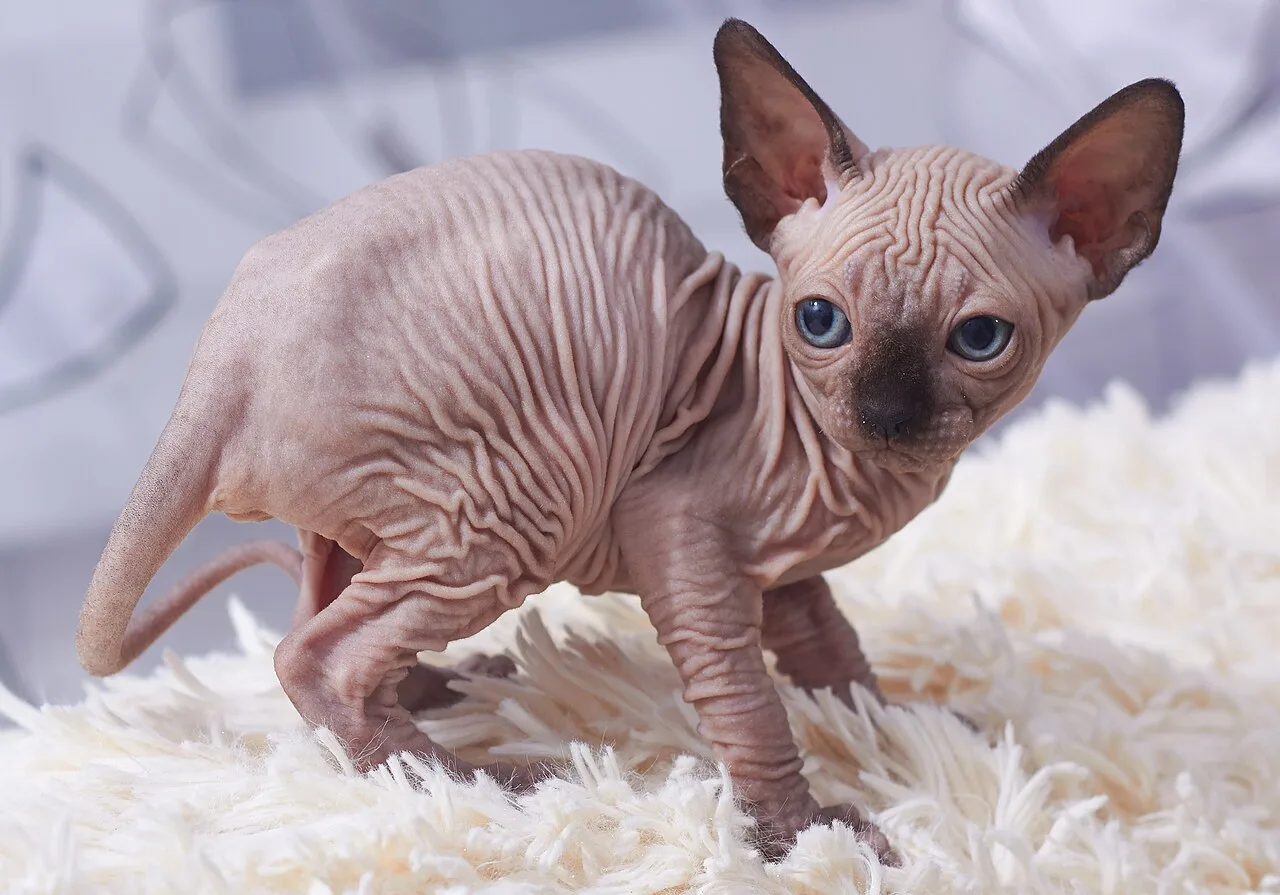
The Sphynx is the world's most recognisable hairless cat breed, and one of the most polarising in appearance of any domestic cat. Its wrinkled skin, oversized ears, prominent cheekbones, and absence of a conventional coat produce a visual profile that provokes strong reactions: the people who find Sphynx cats beautiful tend to find them extraordinarily beautiful; those who find them unsettling are rarely converted.
In temperament, however, the Sphynx is nearly universally appealing to anyone who actually spends time with one: it is among the warmest-bodied, most socially intense, and most persistently affectionate of all cat breeds.
Understanding the Sphynx requires knowing what it is and what it is not. It is not truly hairless, the breed is covered in a fine down that is perceptible to touch. It is not ancient despite its vaguely pharaonic appearance, the modern Sphynx descends from a single hairless kitten born in Toronto in 1966.
It is not low-maintenance simply because it lacks a coat, the absence of fur creates specific care obligations that require more active management than most coated breeds. And it is not cold or aloof in temperament: the Sphynx is among the most gregarious cats in existence.
This guide covers the Sphynx's genuine genetic origin, the biology of its hairlessness and what that means for its skin and thermoregulation, the specific grooming and care requirements that replace conventional coat maintenance, the breed's health profile dominated by cardiac concerns, its cold sensitivity and housing requirements, and the experience of sharing a home with a cat that will claim any warm surface available including you.
Origins: Prune and the Toronto Hairless Mutation
The modern Sphynx breed does not descend from ancient Egyptian cats, despite the Egyptian connotations of its name. The breed traces its origin to a specific genetic event: a hairless kitten born on 31 January 1966 in Toronto, Ontario, Canada, to a domestic shorthair cat owned by Elizabeth Borden. This kitten was named Prune and was the first individual carrying the mutation that would eventually be developed into the Sphynx breed.
Hairless cats had been recorded occasionally throughout history in various parts of the world, and the mutation is known to recur spontaneously in domestic cat populations. However, these earlier occurrences did not produce established breeding programs. The Toronto hairless mutation, which proved to be a recessive autosomal mutation affecting the hair follicle's ability to produce a normal hair shaft, was the starting point for the modern breed.
The development of the Sphynx was not straightforward. Breeders initially worked with Prune's descendants but faced population bottleneck challenges inherent in developing a breed from a single founding individual with a recessive mutation. In the 1970s, further hairless kittens appeared in Minnesota and were incorporated into breeding programs.
Canadian breeders Shirley Smith of Toronto discovered more hairless kittens, named Bambi, Paloma, and Starla, in the late 1970s, and these cats became important contributors to the breed's genetic foundation.
The gene responsible for Sphynx hairlessness is a recessive mutation in the KRT71 gene (keratin 71), which encodes a structural protein essential to hair shaft formation. Cats homozygous for the hr (hairless) allele lack functional hair shafts. Because the allele is recessive, a cat must carry two copies to be hairless; carriers with one copy appear normally coated.
The name "Sphynx" was given by breeders as a reference to the Great Sphinx of Giza, acknowledging the breed's Egyptian aesthetic associations even though the genetic connection to ancient Egypt is absent. CFA granted the Sphynx championship status in 2002. TICA recognised the breed earlier, in 1979.
Not Truly Hairless: The Biology of Sphynx Skin
The Sphynx's skin is not bare in the way that a shaved cat's skin would be bare. The mutation prevents the formation of normal hair shafts but does not eliminate hair follicles entirely, and the follicles produce a fine, sparse down that is microscopically short and barely visible in most individuals. The texture of Sphynx skin is commonly described as similar to warm chamois leather or peach fuzz, perceptibly soft when touched but visually hairless.
This residual fine down is variable between individuals. Some Sphynx cats are more densely covered in down than others, and some have slightly more visible hair on particular areas, the bridge of the nose, the outer edge of the ears, and the tip of the tail sometimes show more obvious hair presence. Show standards generally prefer a nearly complete absence of visible hair, with any remaining down being uniformly fine and short.
The skin itself is heavily wrinkled, particularly on the face, around the neck and shoulders, and across the belly. The wrinkling is not a separate genetic feature; it is the inherent structure of the skin that would normally be smoothed and supported by hair. In coated cats, the fur obscures the natural texture of the skin; in the Sphynx, that texture is fully exposed.
One of the most physically distinctive features of the Sphynx is its surface temperature. The absence of a coat means that the body's heat is radiated directly from the skin rather than being retained by fur. Sphynx cats feel distinctly warm to the touch, many owners describe them as feeling like a hot water bottle.
Core body temperature in Sphynx cats is within the normal feline range (38-39.2 degrees Celsius), but the lack of insulation means this warmth is immediately perceptible on the skin surface. This warmth-seeking and warmth-radiating quality is central to the Sphynx's appeal as a physical companion.
Cold Sensitivity and Housing Requirements
The biological consequence of hairlessness is a substantially reduced capacity to retain body heat in cold environments. Coated cats use their fur as a thermal buffer, reducing heat loss to the environment and maintaining body temperature across a range of ambient conditions. The Sphynx has no such buffer.
Sphynx cats are highly sensitive to cold. In ambient temperatures below approximately 20 degrees Celsius, they will actively seek warm locations: radiators, heating vents, patches of direct sunlight, and most consistently the bodies of other animals or humans in the household. Their thermoregulation demands constant access to warmth, and indoor temperatures must be maintained at comfortable levels year-round.
In winter climates or air-conditioned environments, many Sphynx owners provide additional warmth through cat beds with heating elements, blankets accessible to the cat, or simply by allowing the cat to sleep under bedcovers, a behaviour Sphynx cats adopt enthusiastically and independently. A Sphynx left in a cold room will be uncomfortable in a way that a coated cat would not be.
Sun exposure poses the opposite risk. Without fur to filter ultraviolet radiation, a Sphynx cat's skin can sunburn in prolonged direct sunlight. The degree of sun sensitivity varies with the individual cat's skin pigmentation, cats with dark skin pigmentation have more melanin protection than those with pale skin, but all Sphynx cats should avoid extended direct sun exposure on warm days, particularly through windows that concentrate heat and UV.
Skin Care: The Primary Grooming Requirement
The paradox of Sphynx grooming is that a "hairless" cat requires more skin care than most coated cats require coat care. The explanation is straightforward: in coated cats, the coat absorbs the skin's sebaceous secretions (body oils), distributing them along the hair shaft and preventing accumulation on the skin surface. The Sphynx's skin secretes the same oils but has no coat to absorb them.
Over time, the oils accumulate on the skin surface, creating a dark, greasy film that is visible in skin folds and on paler-coloured cats.
If this accumulation is not addressed, it can lead to skin infections, particularly in the skin folds of the face and body. Regular bathing, typically once per week for most Sphynx cats, is the standard management approach. A mild, cat-formulated shampoo removes excess oil effectively. Many Sphynx owners use a gentle routine of wiping the cat's skin between baths with pet-safe moistened wipes to prevent between-bath accumulation.
The ears require equally consistent attention. The absence of ear hair means that ear wax accumulates faster in Sphynx cats than in coated breeds, and weekly ear cleaning with a veterinarian-approved ear cleaner is standard practice. Neglected Sphynx ears accumulate a dark, waxy buildup that provides ideal conditions for yeast and bacterial infections.
Nail care is comparable to other breeds, trimming every two to three weeks, but requires specific attention to the paw webbing, where oil and debris can accumulate in the absence of fur. Regular inspection and gentle cleaning of the paw webbing prevents buildup.
For detailed grooming instructions including bathing technique and product recommendations, see How to Groom a Cat at Home.
Temperament: Extreme Sociability and Heat-Seeking
The Sphynx temperament is characterised by one overriding quality: an exceptional need for social contact. The breed seeks warmth, and warmth means other bodies, human or animal. A Sphynx that can access its owner will do so: it will drape itself across your shoulders, press against your side, sleep in contact with you, and follow you from room to room with a persistence that goes beyond what most cat breeds demonstrate.
This quality is partly thermoregulatory, the Sphynx genuinely needs warmth and exploits proximity to warm bodies for this purpose, and partly temperamental. The breed is highly social in its own right, apart from the warmth motive. It is curious, highly alert to its environment, and playful throughout its life in a manner similar to the Bengal, though channelled through social engagement rather than athletic activity.
"The Sphynx's behavioural profile is consistent with a breed that has been selected strongly for human-oriented traits. Its heat-seeking behaviour reinforces physical proximity, which in turn reinforces the social bond. The result is a cat that experiences human presence as both socially rewarding and physically beneficial, a powerful combination of motivations that produces extremely intense owner attachment." Turner, D.C., & Bateson, P. (Eds.). (2000). The Domestic Cat: The Biology of Its Behaviour, Cambridge University Press
The Sphynx is highly playful and retains kitten-like energy and curiosity into adulthood. It is an enthusiastic investigator of new objects and situations, climbing into bags, investigating open drawers, and inserting itself into whatever activity is occurring. It is a poor candidate for isolated, owner-absent environments: the breed does not tolerate extended solitude well and benefits from a feline companion if human presence is intermittent.
Compatibility with other cats and dogs is generally high. The Sphynx's need for body contact means it often actively seeks closeness with other pets and initiates physical contact with them. A Sphynx cat curled against a dog is a commonly reported household arrangement.
Health Conditions: HCM as the Primary Concern
The Sphynx has significant health concerns, the most serious of which is hypertrophic cardiomyopathy. The breed is one of the most severely affected by HCM among all domestic cat breeds, and this health risk is the primary factor responsible for the breed's shorter-than-average lifespan relative to other pedigree cats.
Hypertrophic Cardiomyopathy (HCM) in Sphynx cats is caused by multiple possible mutations, only some of which have been identified and are testable. The MYBPC3 mutation implicated in Maine Coons and Ragdolls is not the primary HCM variant in Sphynx; at least one Sphynx-specific variant has been identified, but HCM in this breed arises from multiple genetic causes that are not fully characterised.
The practical implication is significant: a Sphynx cat that tests negative for all currently identified HCM mutations can still develop the condition.
Annual echocardiography performed by a board-certified veterinary cardiologist is the most important health monitoring tool for the breed. Responsible breeders screen all breeding animals annually and provide cardiac screening documentation at the time of sale. Cats diagnosed with HCM should not be used in breeding.
"Sphynx cats are overrepresented in feline HCM at referral cardiology centres relative to their prevalence in the general cat population. The complexity of HCM genetics in this breed, with multiple causative variants and likely additional unidentified mutations, means that DNA testing alone is insufficient for health assurance. Annual echocardiography remains the primary screening recommendation." Borgeat, K., et al. (2014), Journal of Veterinary Internal Medicine, on HCM in Sphynx cats
Hereditary Myopathy resembling muscular dystrophy has been documented in some Sphynx lines. Affected cats show progressive muscle weakness, abnormal posture, dysphagia (difficulty swallowing), and exercise intolerance. The condition is severe in affected individuals and has no curative treatment. Awareness of this condition in any Sphynx line's breeding history is important, and any kitten showing signs of muscle weakness should receive prompt veterinary evaluation.
Skin conditions are an inherent risk given the breed's exposed skin. Bacterial skin infections, fungal infections (particularly Malassezia dermatitis in skin folds), and contact dermatitis from household products are more common in Sphynx cats than in coated breeds. Regular bathing and consistent skin inspection allow early identification and treatment of developing problems.
| Health Condition | Type | Test | Recommendation |
|---|---|---|---|
| Hypertrophic Cardiomyopathy | Cardiac | DNA (partial) + echocardiogram | Annual echo from age 1; DNA test available variants |
| Hereditary Myopathy | Neuromuscular | No DNA test | Pedigree review; watch for early signs in kittens |
| Skin infections | Dermatological | Clinical examination | Weekly bathing; regular skin fold inspection |
| Sun sensitivity | Environmental | Not applicable | Limit direct sun exposure; monitor for redness |
For comprehensive Sphynx health condition coverage, see Sphynx Cat Health Problems.
Lifespan
The Sphynx lifespan ranges from approximately 8 to 14 years, which is shorter than most established pedigree cat breeds. The reduced lifespan is significantly influenced by HCM prevalence in the breed: cats that develop and are diagnosed with HCM may have substantially shorter lives than unaffected individuals, and the high prevalence of HCM in Sphynx cats pulls the average lifespan downward.
Sphynx cats from cardiac-screened lines, maintained with consistent veterinary monitoring, regular skin care, and appropriate indoor temperature management, can reach the upper end of the 8-14 year range or beyond. The two primary investments that support longevity are annual cardiac screening and consistent skin hygiene.
Diet and Metabolic Considerations
The Sphynx's thermoregulatory demands have a nutritional dimension. Without a coat for insulation, Sphynx cats expend more metabolic energy maintaining body temperature than coated cats of comparable size. This elevated metabolic rate translates to a higher caloric requirement per unit of body weight than most other breeds. Sphynx cats typically require more food relative to their size than their coated counterparts, and their bodies should be lightly muscled and lean but not thin.
High-protein, meat-based diets support the breed's elevated metabolic demands. Taurine-enriched foods or supplementation are advisable given the breed's cardiac risk, as taurine is essential for cardiac muscle function. Regular body condition scoring by a veterinarian helps calibrate feeding amounts to the individual cat's needs, which will vary by activity level, age, and health status.
Comparing the Sphynx to Similar Breeds
The Ragdoll shares the Sphynx's intense desire for human contact and physical warmth-seeking but expresses it through passive proximity rather than the Sphynx's active climbing and draping. The Ragdoll is much lower-maintenance in skin care and has a substantially different health profile.
The Maine Coon is sometimes cited as a comparison for dog-like following behaviour, which the Sphynx shares. The Maine Coon is vastly different in coat care requirements, has a longer lifespan, and is more physically independent than the Sphynx.
The Devon Rex and Cornish Rex are partial-coat breeds produced by different mutations from the Sphynx hairlessness gene. Rex cats have curly, reduced coats rather than true hairlessness and have somewhat overlapping skin care considerations (oilier than average skin) with somewhat less intensive maintenance requirements. Both share the Sphynx's high-energy, social temperament profile.
Living with a Sphynx
The Sphynx experience is not for every household, but owners who suit the breed describe an unusual depth of companionship that is difficult to find in other breeds. The cat's constant physical presence, its warmth, its playful energy, and its apparent requirement of your company at all times produce an animal that occupies your home more completely than a more reserved cat.
The practical obligations are real: weekly bathing and ear cleaning are non-negotiable; annual cardiac echocardiograms are a health necessity rather than a luxury; consistent indoor warmth must be provided; sun exposure must be managed. The breed is not inexpensive to maintain responsibly.
For a detailed care guide addressing the weekly bathing routine, ear care, temperature management, and enrichment planning, see Sphynx Cat Care Guide. For an understanding of common feline health conditions in the context of Sphynx vulnerabilities, see Common Cat Illnesses Explained.
References
Borgeat, K., Casamian-Sorrosal, D., Sherwood, K., & Fuentes, V.L. (2014). "Association of the myosin binding protein C3 mutation (MYBPC3, p.A31P) with hypertrophic cardiomyopathy in a cohort of Sphynx cats." Journal of Veterinary Internal Medicine, 28(3), 923-929. https://doi.org/10.1111/jvim.12333
Meurs, K.M., et al. (2007). "A cardiac myosin binding protein C mutation in the Maine Coon cat with familial hypertrophic cardiomyopathy." Human Molecular Genetics, 16(7), 764-773. https://doi.org/10.1093/hmg/ddm024
Turner, D.C., & Bateson, P. (Eds.). (2000). The Domestic Cat: The Biology of Its Behaviour (2nd ed.). Cambridge University Press. ISBN 978-0521636483.
Abitbol, M., et al. (2015). "A recessive mutation in KRT71 causes hairlessness in the Sphynx cat." Mammalian Genome, 26(7-8), 467-479. https://doi.org/10.1007/s00335-015-9578-3
The International Cat Association (TICA). (2023). Sphynx Breed Standard. Retrieved from https://tica.org/breeds/browse-all-breeds
Cat Fanciers' Association (CFA). (2023). Sphynx Breed Standard and Profile. Retrieved from https://cfa.org/sphynx/
Helps, C.R., et al. (2010). "Factors associated with upper respiratory tract disease caused by feline herpesvirus, feline calicivirus, Chlamydophila felis and Bordetella bronchiseptica in cats." Veterinary Record, 166(21), 649-654. https://doi.org/10.1136/vr.b4857
Frequently Asked Questions
Are Sphynx cats actually hairless?
Sphynx cats are not completely hairless. The KRT71 gene mutation prevents normal hair shaft formation but does not eliminate hair follicles. The follicles produce a very fine, sparse down that is barely visible but perceptible to touch, commonly described as feeling like warm chamois leather or peach fuzz. Some individuals have slightly more visible fine hair on particular areas such as the nose bridge and ear edges.
Show standards prefer minimal visible hair, but no Sphynx cat is as bare as shaved skin.
Why do Sphynx cats need baths?
All cats produce sebaceous skin oils. In coated cats, the coat absorbs these oils and distributes them along the hair shaft, preventing surface accumulation. Sphynx cats produce the same oils but have no coat to absorb them, so the oils accumulate on the skin surface and in skin folds.
Without regular bathing, typically once per week, the oil buildup becomes visible as a dark, greasy residue and creates conditions favourable for bacterial and yeast skin infections. Weekly bathing with a mild cat-formulated shampoo keeps the skin clean and healthy.
Do Sphynx cats get cold?
Yes. Without a coat to insulate against heat loss, Sphynx cats are significantly more sensitive to cold than coated breeds. They become uncomfortable in ambient temperatures below approximately 20 degrees Celsius and actively seek warm locations, radiators, sunny spots, under blankets, and on human bodies.
Indoor temperatures should be maintained at comfortable levels year-round, and supplemental warmth through heated cat beds or blankets should be provided in cold rooms. The breed is strictly indoor-only for this reason among others.
What are the most common Sphynx cat health problems?
Hypertrophic cardiomyopathy (HCM) is the most serious and most common health concern in Sphynx cats. The breed is one of the most severely affected by HCM of any domestic cat breed, and HCM arises from multiple genetic causes in Sphynx that are not fully characterised by current DNA testing. Annual cardiac echocardiograms are the primary screening tool. Hereditary myopathy (a muscular dystrophy-like condition) occurs in some lines.
Skin infections are an ongoing management consideration due to the breed’s exposed skin.
Are Sphynx cats good with other pets?
Sphynx cats are generally excellent with other cats and tolerant of dogs. Their strong motivation for physical warmth and body contact means they often actively seek closeness with other animals. They are poor candidates for being the sole pet in a household where people are away for extended periods, as they do not tolerate solitude well. A feline companion is strongly recommended for Sphynx cats in households with significant owner absence.
Most Sphynx cats integrate naturally into multi-pet households when introductions are managed thoughtfully.